Hand to Ankle One-Legged Downward Facing Dog Pose 1
The Hand-to-Ankle One-Legged Downward-Facing Dog Pose (often a variation of Eka Pada Adho Mukha Svanasana) is an advanced yoga posture that combines balance, flexibility, and controlled strength. It builds upon the foundational Downward-Facing Dog Pose and introduces a deeper hamstring stretch along with unilateral stability training.
In this variation, the practitioner begins in a standard Downward-Facing Dog position, forming an inverted “V” shape with the body. The hands are firmly grounded shoulder-width apart, fingers spread for stability, and the heels press toward the mat. From this base, one leg is lifted upward and extended, Dog Pose, while the opposite hand reaches back to hold the ankle of the raised leg. This creates a dynamic stretch across the posterior chain—particularly the hamstrings, calves, spine, and shoulders.
This posture demands significant core engagement to prevent collapsing into the lower back. The standing leg and supporting arm must work in coordination to maintain balance. The lifted leg should remain active, with the toes pointing or flexing depending on the variation, while the chest gently opens without losing alignment in the shoulders.
Key benefits of this pose include improved hamstring flexibility, enhanced spinal extension, and increased shoulder mobility. It also strengthens the arms, wrists, and core muscles due to the stabilizing demands of the posture. Additionally, Dog Pose the unilateral nature of the pose helps correct muscular imbalances between the left and right sides of the body, Dog Pose which is valuable for athletes and practitioners with asymmetrical movement patterns.
However, this pose requires caution. Individuals with hamstring injuries, shoulder instability, or lower back issues should approach it carefully or avoid deep variations. Proper warm-up is essential, Dog Pose, particularly focusing on hamstrings, hips, and shoulders. Overstretching the lifted leg or collapsing the chest can place strain on the lumbar spine or shoulder joints.
Breathing control is critical; practitioners should maintain steady, deep breaths to support balance and prevent tension buildup. Beginners may modify the pose by using a yoga strap around the ankle instead of directly gripping it or by keeping the lifted leg lower.
For further study and anatomical breakdown, reliable resources include:
- https://www.yogajournal.com/poses/downward-facing-dog-pose/
- https://www.verywellfit.com/downward-facing-dog-adho-mukha-svanasana-3567071
- https://www.yogapedia.com/definition/6533/eka-pada-adho-mukha-svanasana
#Hand to Ankle One-Legged Downward Facing Dog Pose 1 in India
How is Hand to Ankle One-Legged Downward Dog Pose performed correctly?
The Hand-to-Ankle One-Legged Downward-Facing Dog Pose (a variation of Eka Pada Adho Mukha Svanasana) is performed by combining the foundational alignment of Downward-Facing Dog with a controlled balance and deep posterior chain stretch. Dog Pose, Correct execution depends on alignment, gradual entry, and stable breathing.
Begin in Downward-Facing Dog Pose (Adho Mukha Svanasana). Place your hands shoulder-width apart, fingers spread wide to distribute weight evenly. Press firmly through the palms, especially the base of the index finger and thumb. Feet should be hip-width apart, Dog Pose and hips lifted high to form an inverted “V” shape. Keep the spine long and neutral, avoiding rounding in the upper back or excessive arching in the lower back.
From this stable base, shift your weight slightly into both hands and one supporting foot. Engage your core muscles to maintain stability. Slowly lift the opposite leg straight back and upward. The lifted leg should remain active, with the knee extended and toes either pointing or flexed depending on flexibility and intention.
Once balance is established, gently bend the lifted leg at the knee and bring the foot toward the same-side hand. Reach the hand back to hold the ankle or foot. This is the defining action of the pose. The grip should be firm but not forced—avoid pulling aggressively, Dog Pose as this can strain the shoulder or hamstring.
Maintain alignment by keeping the chest open and hips squared as much as possible. Dog Pose, It is common for the torso to rotate slightly, Maintain alignment by keeping the chest open and hips squared as much as possible. Dog Pose, It is common for the torso to rotate slightly, Maintain alignment by keeping the chest open and hips squared as much as possible. Dog Pose, It is common for the torso to rotate slightly, but excessive twisting should be avoided. The supporting arm and opposite leg must stay strong and engaged to prevent collapse.
but excessive twisting should be avoided. The supporting arm and opposite leg must stay strong and engaged to prevent collapse.
but excessive twisting should be avoided. The supporting arm and opposite leg must stay strong and engaged to prevent collapse.
Breathing plays a key role. Inhale to lengthen the spine and prepare, and exhale while deepening the stretch. The breath should remain steady and controlled rather than shallow or strained.
To exit the pose safely, gently release the ankle, bring the lifted leg back into Three-Legged Downward Dog for a moment, and then return it to the floor. Reset in Downward-Facing Dog before repeating on the other side.
Common mistakes include rounding the spine, locking the elbows, collapsing into the shoulders, or forcing the ankle reach. These reduce stability and increase injury risk.
For reliable technique references, you can explore:
- https://www.yogajournal.com/poses/downward-facing-dog-pose/
- https://www.verywellfit.com/downward-facing-dog-adho-mukha-svanasana-3567071
- https://www.yogapedia.com/definition/6533/eka-pada-adho-mukha-svanasana
#Hand to Ankle One-Legged Downward Facing Dog Pose 1 in Maharashtra
What is the proper alignment in this variation?
Proper alignment in the Hand-to-Ankle One-Legged Downward-Facing Dog variation (Eka Pada Adho Mukha Svanasana with bind) is essential to ensure stability, protect the shoulders and lower back, and achieve an effective stretch through the posterior chain.
The foundation begins in a correct Downward-Facing Dog Pose (Adho Mukha Svanasana). The hands should be placed shoulder-width apart with fingers fully spread to distribute weight evenly across the palms. The index fingers typically point forward, and pressure should be grounded through the knuckles and fingertips rather than collapsing into the wrists. The elbows remain straight but not hyperextended, maintaining muscular engagement.
The feet are set hip-width apart, with heels actively reaching toward the mat. However, they do not need to fully touch the ground; the focus is on lengthening the spine. The hips should be lifted high and directed upward and slightly back, creating a long, continuous line from the hands to the pelvis. The spine remains neutral—neither excessively arched nor rounded.
When transitioning into the one-legged variation, the lifted leg should extend straight back and up first. In proper alignment, both hips aim to stay as square as possible to the mat. While a slight natural opening of the hip is common, excessive rotation of the pelvis should be avoided, Dog Pose as it reduces core stability and strains the lower back.
When the ankle is grasped, the chest should remain open and elongated rather than collapsing forward. The shoulder blades should draw gently down and away from the ears, preventing compression in the neck. The supporting shoulder must stay strong and stable, not sinking inward.
The standing leg remains active and engaged, helping anchor the posture. The abdominal muscles should be gently drawn in to stabilize the pelvis and prevent overextension in the lumbar spine. The neck stays neutral, with the gaze directed toward the mat or slightly back depending on comfort, without straining.
Breathing supports alignment: inhalation lengthens the spine, while exhalation deepens control in the stretch without forcing range of motion.
In summary, correct alignment emphasizes:
- Stable, evenly grounded hands
- Long, neutral spine
- Hips lifted and mostly square
- Active core engagement
- Open chest without shoulder collapse
- Controlled, non-forced ankle reach
For further anatomical and alignment references, you can explore:
- https://www.yogajournal.com/poses/downward-facing-dog-pose/
- https://www.verywellfit.com/downward-facing-dog-adho-mukha-svanasana-3567071
- https://www.yogapedia.com/definition/6533/eka-pada-adho-mukha-svanasana
#Hand to Ankle One-Legged Downward Facing Dog Pose 1 in Ahemadabad
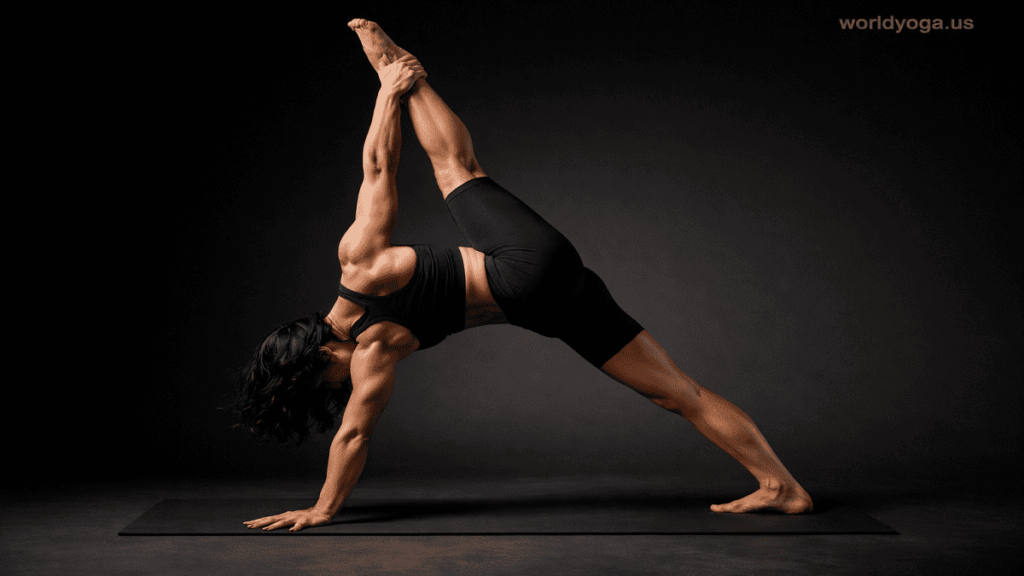
Which muscles are engaged during the pose?
The Hand-to-Ankle One-Legged Downward-Facing Dog variation (Eka Pada Adho Mukha Svanasana with ankle reach) is a full-body posture that engages multiple muscle groups simultaneously. It blends weight-bearing strength with deep stretching, especially across the posterior chain, Dog Pose shoulders, and core stabilizers.
In the upper body, the primary muscles engaged are the deltoids, triceps, and rotator cuff muscles, which stabilize the shoulders as they support body weight. The serratus anterior plays a key role in keeping the shoulder blades stable and preventing collapse into the chest. The latissimus dorsi also assists in maintaining spinal length and shoulder stability. The wrists and forearms are actively engaged due to the pressure placed through the palms, particularly the flexor muscles of the forearm that support grip and load distribution.
The core musculature is heavily involved throughout the pose. The rectus abdominis, transverse abdominis, and obliques work together to stabilize the pelvis and spine, Dog Pose, especially when one leg is lifted and the body becomes asymmetrical. The obliques are particularly important when maintaining balance and preventing unwanted rotation of the hips and torso.
In the lower body, the hamstrings of the lifted leg are deeply stretched, especially when reaching for the ankle. At the same time, they remain lightly engaged to control the movement. The gluteus maximus and gluteus medius of the lifted leg activate to extend and stabilize the hip joint. On the supporting leg, the quadriceps, hamstrings, Dog Pose and calf muscles (gastrocnemius and soleus) are engaged isometrically to maintain stability and prevent collapse.
The spinal muscles, including the erector spinae, help maintain a long, neutral spine and prevent rounding or overextension. These muscles work in coordination with the core to support posture under load.
The hip flexors and deep hip stabilizers also play a role, especially when the lifted leg moves into deeper flexion or external rotation during the ankle reach. These muscles help control pelvic alignment and prevent excessive twisting.
Finally, the neck muscles, including the sternocleidomastoid and upper trapezius, remain lightly active to maintain a neutral head position without tension.
In summary, this pose simultaneously activates:
- Shoulders and upper back (deltoids, serratus anterior, rotator cuff, lats)
- Core stabilizers (rectus abdominis, obliques, transverse abdominis)
- Posterior chain (hamstrings, glutes, spinal extensors)
- Supporting leg muscles (quadriceps, calves, stabilizers)
- Forearms and wrists for load-bearing control
For deeper anatomical reference, you can explore:
- https://www.yogajournal.com/poses/downward-facing-dog-pose/
- https://www.verywellfit.com/downward-facing-dog-adho-mukha-svanasana-3567071
- https://www.kenhub.com/en/library/anatomy/yoga-muscles
#Hand to Ankle One-Legged Downward Facing Dog Pose 1 in Hyderabad
What preparatory poses are recommended?
Proper preparation is important for the Hand-to-Ankle One-Legged Downward-Facing Dog variation (Eka Pada Adho Mukha Svanasana with ankle reach) because it requires hamstring flexibility, shoulder stability, and core control. Without adequate warm-up, the pose can place strain on the lower back, shoulders, or hamstrings.
A good preparatory sequence focuses on three areas: shoulder loading, hamstring lengthening, and core activation.
One of the most important foundation poses is the standard Downward-Facing Dog (Adho Mukha Svanasana). It conditions the wrists, shoulders, and hamstrings while teaching proper spinal length. Holding it for several breaths helps prepare the body for weight-bearing inversion and alignment control.
To open the hamstrings more deeply, Standing Forward Fold (Uttanasana) is highly effective. It stretches the posterior chain, especially the hamstrings and calves, while gently decompressing the spine. This helps reduce resistance when lifting and reaching for the ankle later in the full variation.
Another valuable preparatory posture is Three-Legged Downward Dog (Eka Pada Adho Mukha Svanasana) without the bind. This helps develop single-leg stability, hip control, and core engagement. Practicing controlled leg lifts here builds the strength needed to maintain balance when one side of the body is extended.
For shoulder stability and upper body strength, Plank Pose (Phalakasana) is essential. It strengthens the wrists, arms, serratus anterior, and core, all of which are heavily involved in supporting body weight in the final pose. Transitioning between Plank and Downward Dog also prepares shoulder joints for dynamic load shifts.
To improve hamstring openness in a more isolated way, Reclined Hand-to-Big-Toe Pose (Supta Padangusthasana) is extremely useful. It allows safe, controlled stretching of the hamstrings without placing pressure on the wrists or shoulders. This is especially helpful for beginners or those with tight posterior chains.
Additionally, Low Lunge (Anjaneyasana) helps open the hip flexors, which is important because tight hip flexors can restrict pelvic alignment in the full variation. It also prepares the body for better balance when one leg is lifted and externally rotated.
Finally, gentle spinal mobility poses like Cat-Cow (Marjaryasana-Bitilasana) help warm the spine and improve neuromuscular coordination before entering weight-bearing positions.
In summary, recommended preparatory poses include:
- Downward-Facing Dog (foundation alignment)
- Standing Forward Fold (hamstrings and spine)
- Three-Legged Downward Dog (balance and control)
- Plank Pose (upper body and core strength)
- Reclined Hand-to-Big-Toe Pose (safe hamstring opening)
- Low Lunge (hip flexor mobility)
- Cat-Cow (spinal warm-up)
For further study and sequencing guidance:
- https://www.yogajournal.com/poses/downward-facing-dog-pose/
- https://www.verywellfit.com/standing-forward-fold-3567059
- https://www.yogabasics.com/asana/plank-pose/
#Hand to Ankle One-Legged Downward Facing Dog Pose 1 in Delhi
What are the benefits and precautions of this pose?
Benefits
One of the primary benefits of this pose is deep hamstring and posterior chain stretching. When the lifted leg is extended and the ankle is reached, the hamstrings, calves, and gluteal muscles of the raised leg experience an intense but controlled stretch. This can improve overall lower-body flexibility and reduce stiffness from prolonged sitting.
The pose also builds significant upper body strength and shoulder stability. Supporting body weight through the hands activates the deltoids, triceps, serratus anterior, and rotator cuff muscles. Over time, this improves shoulder endurance and joint stability.
A major advantage of this variation is core strengthening and stabilization. Because the body is asymmetrical when one leg is lifted and held, the abdominal muscles (especially the transverse abdominis and obliques) must actively engage to prevent rotation and maintain balance. This improves functional core control.
It also enhances balance and proprioception (body awareness). The practitioner must continuously adjust small muscular activations in the wrists, shoulders, hips, and standing leg to remain stable. This improves coordination and neuromuscular control.
Additionally, the pose supports spinal lengthening and decompression. The inverted “V” shape of Downward Dog naturally elongates the spine, and the added leg extension intensifies this effect, which may help reduce mild back stiffness when practiced correctly.
Precautions
Despite its benefits, this pose has several important precautions. It should be avoided or modified by individuals with shoulder injuries, wrist pain, or instability, as significant weight is placed on the upper limbs.
Those with hamstring injuries or tightness should be cautious when reaching for the ankle, as forcing the stretch can lead to strain or tearing. The movement should be gradual rather than forceful.
People with lower back issues should avoid excessive twisting or collapsing of the spine. Poor alignment—such as over-arching the lumbar spine or uneven hip rotation—can increase pressure on the lower back.
Because the pose involves balance on one leg and one arm, there is also a risk of falling or overstretching if control is lost. Practicing near a wall or with modifications (such as using a yoga strap instead of gripping the ankle directly) can improve safety.
Proper warm-up is essential. Entering this pose with cold muscles increases the risk of strain in the shoulders, hamstrings, and hips.
Summary
Benefits:
- Improves hamstring and posterior chain flexibility
- Strengthens shoulders, arms, and wrists
- Builds core stability and balance
- Enhances body awareness and coordination
- Supports spinal lengthening
Precautions:
- Avoid with shoulder, wrist, or hamstring injuries
- Do not force ankle reach or deep stretch
- Maintain controlled spinal alignment
- Use modifications if balance is unstable
- Always warm up properly
For further reference:
- https://www.yogajournal.com/poses/downward-facing-dog-pose/
- https://www.verywellfit.com/downward-facing-dog-adho-mukha-svanasana-3567071
- https://www.yogapedia.com/definition/6533/eka-pada-adho-mukha-svanasana
#Hand to Ankle One-Legged Downward Facing Dog Pose 1 in Banglore
Case Study of Hand to Ankle One-Legged Downward Facing Dog Pose 1
Background
This case study examines the integration of the Hand-to-Ankle One-Legged Downward-Facing Dog Pose into a structured intermediate yoga program for a 32-year-old recreational athlete experiencing mild hamstring tightness and reduced shoulder stability from prolonged desk work and occasional running. The objective was to improve posterior chain flexibility, core stability, and upper body endurance while maintaining joint safety.
The participant had a baseline yoga practice of 12 months, primarily focused on general flexibility and basic standing poses. No acute injuries were reported, but mild wrist stiffness and hamstring tightness were present.
Intervention Approach
The pose was introduced gradually over a 6-week period, following a progressive sequence of preparatory postures including Downward-Facing Dog, Plank Pose, Standing Forward Fold, and Three-Legged Downward Dog. Emphasis was placed on alignment, breath control, and controlled range of motion rather than depth of stretch.
Initial practice involved the standard Three-Legged Downward Dog without ankle binding to build unilateral stability. A yoga strap was later introduced to assist in reaching the ankle safely, reducing strain on the shoulder joint and preventing excessive lumbar rotation.
Observations and Outcomes
By week 3, noticeable improvements were observed in shoulder endurance and scapular stability, particularly due to increased activation of the serratus anterior and rotator cuff muscles. The participant reported reduced fatigue in Plank-based transitions and improved wrist tolerance.
Hamstring flexibility improved gradually, with increased passive range noted in both legs. However, progress was asymmetrical, with the dominant leg showing faster adaptation. This highlighted the importance of bilateral training to prevent muscular imbalance.
Core engagement became significantly more efficient by week 5, with improved ability to maintain pelvic stability during single-leg elevation. The participant demonstrated reduced lateral hip rotation, indicating better activation of the obliques and transverse abdominis.
Challenges Encountered
The primary challenge was maintaining spinal neutrality during the ankle reach phase. Early attempts showed mild lumbar compression and shoulder elevation, indicating insufficient core integration. This was corrected through breath-led stabilization cues and regression to supported variations.
Another limitation was grip tension in the hands during weight shifts, suggesting initial weakness in forearm endurance. This improved with consistent Plank and Downward Dog holds.
Conclusion
The case study demonstrates that the Hand-to-Ankle One-Legged Downward-Facing Dog Pose is an effective integrated posture for developing flexibility, strength, and neuromuscular coordination, provided it is introduced progressively with strong foundational preparation.
It also highlights the importance of staged progression, as premature entry into the full variation can compromise spinal alignment and shoulder safety.
References
- https://www.yogajournal.com/poses/downward-facing-dog-pose/
- https://www.verywellfit.com/downward-facing-dog-adho-mukha-svanasana-3567071
- https://www.yogapedia.com/definition/6533/eka-pada-adho-mukha-svanasana
#Hand to Ankle One-Legged Downward Facing Dog Pose 1 in Kolkata
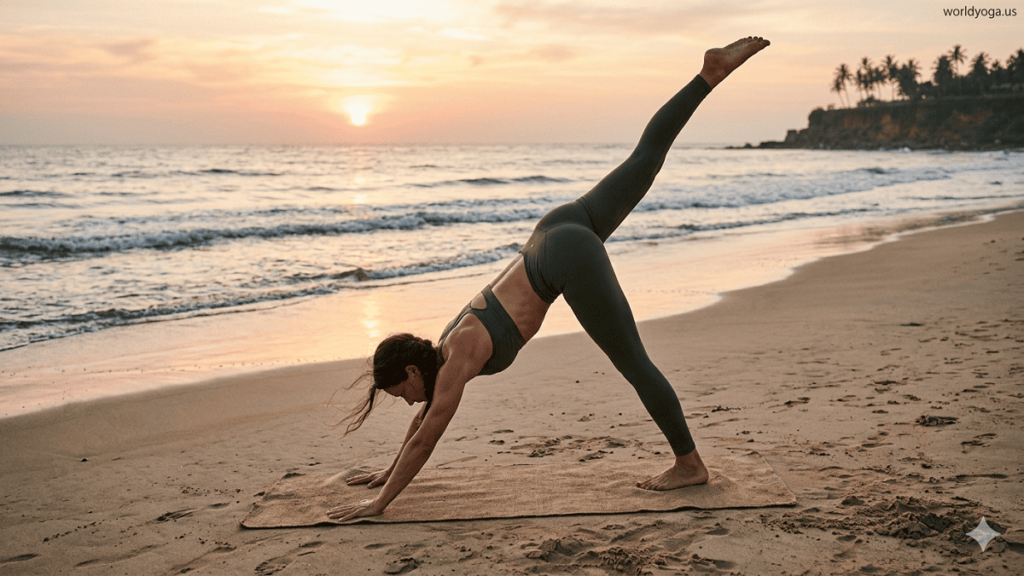
White Paper of Hand to Ankle One-Legged Downward Facing Dog Pose 1
1. Executive Summary
The Hand-to-Ankle One-Legged Downward-Facing Dog Pose is an advanced yoga variation that integrates axial loading, unilateral balance, and deep posterior chain stretching. This white paper evaluates its biomechanical demands, functional benefits, risk factors, and application within structured movement training systems. The pose combines elements of Adho Mukha Svanasana (Downward-Facing Dog) with a unilateral hip extension and contralateral upper-limb binding, increasing neuromuscular complexity and joint stabilization requirements.
2. Pose Definition and Structure
This variation begins in standard Downward-Facing Dog alignment. One lower limb is elevated into hip extension (Three-Legged Downward Dog). The practitioner then flexes the raised knee and reaches the ipsilateral hand to grasp the ankle or foot, creating a closed kinetic chain between upper and lower extremities.
The pose is characterized by:
- Weight-bearing through both hands
- Single-leg posterior chain extension
- Contralateral core stabilization
- Shoulder girdle compression resistance
Standard reference for base pose:
https://www.yogajournal.com/poses/downward-facing-dog-pose/
3. Biomechanical Analysis
The pose produces multi-planar loading across the musculoskeletal system:
Upper Body:
The shoulders function in closed-chain flexion with high stabilizing demand. The serratus anterior, deltoids, triceps, and rotator cuff complex maintain scapular positioning and prevent collapse into glenohumeral internal rotation.
Core System:
The transverse abdominis, rectus abdominis, and obliques resist rotational torque caused by unilateral leg elevation and ankle binding. This creates significant anti-rotation training stimulus.
Lower Body:
The lifted limb undergoes combined hip extension and knee flexion, heavily engaging the hamstrings and gluteus maximus. The grounded leg stabilizes through isometric activation of the quadriceps, gastrocnemius, and gluteus medius.
4. Functional Benefits
Research-informed movement analysis identifies several outcomes:
- Improved posterior chain flexibility, particularly hamstrings and calves
- Enhanced shoulder stability under load
- Increased core anti-rotational strength
- Development of proprioceptive control and balance symmetry
- Spinal decompression through axial elongation
Comparable foundational biomechanics are observed in controlled inversion training systems such as Downward Dog variations and single-leg balance progressions.
Reference:
https://www.verywellfit.com/downward-facing-dog-adho-mukha-svanasana-3567071
5. Risk Profile and Contraindications
Due to its complexity, the pose presents moderate-to-high mechanical risk if improperly executed:
Primary risks:
- Shoulder impingement from scapular collapse
- Lumbar strain from pelvic rotation
- Hamstring overload during forced ankle reach
- Wrist compression under prolonged load
Contraindications:
- Acute wrist, shoulder, or rotator cuff injuries
- Severe hamstring tightness or tears
- Lumbar disc pathology without stabilization training
6. Implementation Guidelines
A progressive entry model is recommended:
- Downward-Facing Dog (baseline stability)
- Plank Pose (upper body load conditioning)
- Three-Legged Downward Dog (unilateral control)
- Assisted ankle reach using strap
- Full hand-to-ankle integration
7. Conclusion
The Hand-to-Ankle One-Legged Downward-Facing Dog Pose is a high-complexity movement pattern that functions as both a mobility and stability hybrid. When properly sequenced, it enhances integrated strength across the posterior chain and shoulder girdle while improving neuromuscular coordination. However, it requires structured progression to mitigate joint stress and ensure spinal integrity.
8. References
- https://www.yogajournal.com/poses/downward-facing-dog-pose/
- https://www.verywellfit.com/downward-facing-dog-adho-mukha-svanasana-3567071
- https://www.yogapedia.com/definition/6533/eka-pada-adho-mukha-svanasana
#Hand to Ankle One-Legged Downward Facing Dog Pose 1 in Pune
Industry Application of Hand to Ankle One-Legged Downward Facing Dog Pose 1
1. Overview
The Hand-to-Ankle One-Legged Downward-Facing Dog Pose is an advanced yoga-derived movement pattern that combines shoulder-loaded inversion, unilateral balance, and posterior chain flexibility. Beyond traditional yoga practice, it has practical applications across multiple industries including sports performance, rehabilitation, fitness programming, occupational wellness, and movement education systems.
This makes the pose relevant not only as a flexibility drill but as a functional training tool for integrated human movement systems.
2. Sports Performance and Athletic Training
In athletic conditioning, this pose is used to improve kinetic chain integration, particularly for sports requiring sprinting, jumping, or directional change.
Key applications include:
- Enhancing hamstring elasticity and injury resilience
- Improving single-leg stability for running and cutting sports
- Developing shoulder endurance under bodyweight load
- Supporting core anti-rotation strength, essential for throwing and rotational sports
Athletes in disciplines such as football, athletics, and martial arts benefit from the pose due to its combination of flexibility and stability demands.
3. Physiotherapy and Rehabilitation
In clinical movement therapy contexts, modified versions of this pose are used in rehabilitation protocols for controlled mobility restoration.
Applications include:
- Gradual reloading of hamstrings after strain injuries
- Re-education of scapular stabilization patterns
- Restoration of posterior chain mobility after prolonged immobilization
- Neuromuscular retraining for balance asymmetry correction
Practitioners often modify the ankle reach using straps or blocks to reduce joint stress while maintaining therapeutic benefit.
Reference base movement pattern:
https://www.yogajournal.com/poses/downward-facing-dog-pose/
4. Fitness and Strength & Conditioning Programming
In the fitness industry, this pose is integrated into functional training and mobility circuits. It is often categorized under hybrid mobility-strength movements.
Benefits for programming:
- Combines dynamic stretching with isometric strength
- Acts as a low-equipment full-body conditioning drill
- Improves shoulder stability endurance in closed-chain positions
- Enhances core control under asymmetrical load
It is frequently used in warm-ups for calisthenics, CrossFit-style training, and functional movement classes.
5. Corporate Wellness and Occupational Health
In workplace wellness programs, simplified variations of Downward Dog and its one-legged progressions are used to address sedentary lifestyle effects.
Applications include:
- Reducing hamstring tightness from prolonged sitting
- Improving postural alignment in desk workers
- Decreasing upper back and shoulder stiffness
- Promoting short-duration movement breaks for spinal decompression
These adaptations are typically low-intensity and focus on accessibility rather than advanced ankle binding.
Reference movement support:
https://www.verywellfit.com/downward-facing-dog-adho-mukha-svanasana-3567071
6. Movement Education and Yoga Training Systems
In yoga teacher training and movement education frameworks, this pose is used as a progression marker for intermediate-to-advanced sequencing.
It teaches:
- Load transfer between upper and lower extremities
- Controlled progression into asymmetrical flexibility
- Safe transitions between inversion-based postures
- Awareness of pelvic and spinal alignment under dynamic conditions
It is often positioned as a bridge between foundational Downward Dog variations and advanced binds or backbends.
7. Conclusion
The Hand-to-Ankle One-Legged Downward-Facing Dog Pose extends beyond traditional yoga practice into multiple professional domains. Its hybrid structure makes it valuable in sports conditioning, rehabilitation, fitness programming, workplace wellness, and movement education. Across all industries, its primary value lies in integrating flexibility, strength, and neuromuscular control within a single controlled movement pattern.
8. References
- https://www.yogajournal.com/poses/downward-facing-dog-pose/
- https://www.verywellfit.com/downward-facing-dog-adho-mukha-svanasana-3567071
- https://www.yogapedia.com/definition/6533/eka-pada-adho-mukha-svanasana
#Hand to Ankle One-Legged Downward Facing Dog Pose 1 in Mumbai
Ask FAQs
What is the Hand-to-Ankle One-Legged Downward-Facing Dog Pose?
This pose is an advanced variation of Downward-Facing Dog (Adho Mukha Svanasana) where one leg is lifted and extended upward, then bent at the knee so the same-side hand reaches back to hold the ankle or foot. It combines a shoulder-loaded inversion with a deep hamstring and hip flexor stretch, requiring strong balance, flexibility, and core control. It is commonly used in advanced yoga sequencing and functional movement training.
Reference: https://www.yogajournal.com/poses/downward-facing-dog-pose/
What are the main benefits of this pose?
The pose improves hamstring and calf flexibility, strengthens the shoulders, arms, and core, and enhances balance and coordination. It also promotes spinal elongation and helps correct muscular imbalances between the left and right sides of the body due to its unilateral nature. Over time, it supports better posture, joint stability, and functional movement efficiency.
Who should avoid this pose?
Individuals with shoulder injuries, wrist pain, hamstring tears, or lower back issues should avoid or modify this pose. It is also not recommended for beginners without prior experience in Downward-Facing Dog and basic balance postures. Pregnant individuals or those with severe joint instability should practice only under professional supervision with safer modifications.
Reference: https://www.verywellfit.com/downward-facing-dog-adho-mukha-svanasana-3567071
What are common mistakes while performing this pose?
Common mistakes include rounding the spine, collapsing into the shoulders, forcing the ankle reach, and twisting the hips excessively out of alignment. Another frequent error is placing too much weight into the wrists without proper engagement of the fingers and forearms, which can lead to strain or discomfort. Proper alignment and gradual progression are essential to avoid injury.
How can beginners prepare for this pose?
Beginners should start with foundational poses such as Downward-Facing Dog, Plank Pose, Standing Forward Fold, and Three-Legged Downward Dog. These build the necessary shoulder strength, hamstring flexibility, and core stability. Using a yoga strap instead of directly holding the ankle is also a safe modification to gradually develop range of motion and control before attempting the full variation.
Reference: https://www.yogapedia.com/definition/6533/eka-pada-adho-mukha-svanasana
Table of Contents
Disclaimer: This content is for educational and informational purposes only and is not a substitute for professional medical advice, diagnosis, or treatment. Always consult a qualified healthcare provider or certified yoga instructor before attempting advanced yoga poses, especially if you have any existing injuries or medical conditions.