Hand to Knee One-Legged Downward Facing Dog Pose
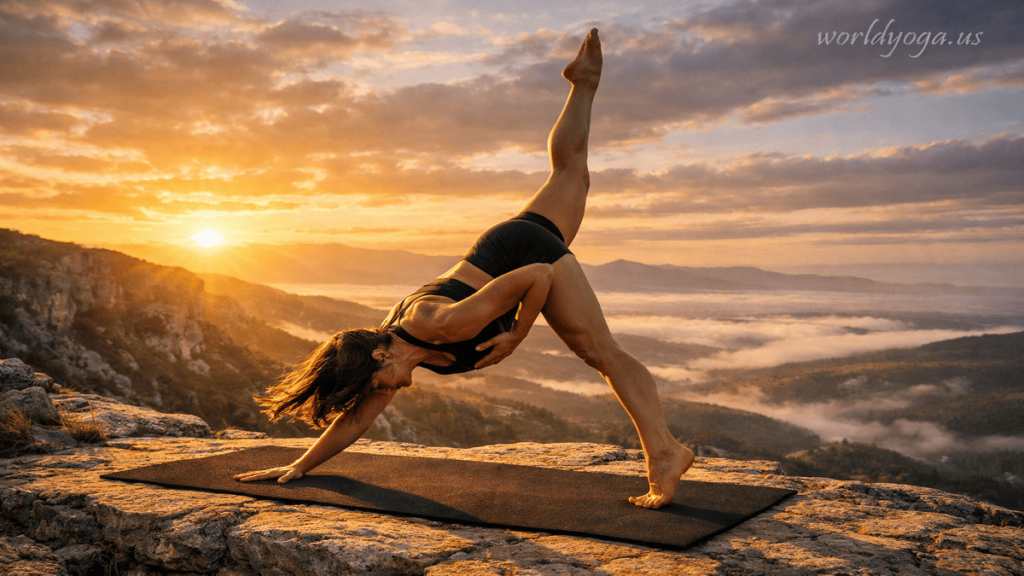
The Hand to Knee One-Legged Downward Facing Dog Pose is an advanced variation of the traditional Downward Facing Dog in which one leg is lifted while the opposite hand moves toward or lightly touches the raised knee. This creates a cross-body connection that increases core engagement, balance demand, and neuromuscular coordination.
In this posture, the practitioner begins in standard Downward Facing Dog, forming an inverted “V” shape with hands grounded firmly shoulder-width apart and feet hip-width apart. From this base, one leg is lifted upward and slightly back, maintaining hip alignment and avoiding rotation. As stability is established, the opposite hand gently reaches toward the raised knee, Downward Facing Dog Pose, creating a diagonal connection across the body. The supporting hand and grounded foot must remain firmly engaged to maintain balance.
Alignment Principles
Proper alignment is critical in this pose due to the asymmetrical load distribution:
- The supporting arm remains straight and stable, with the shoulder externally rotated
- The lifted leg stays active with toes pointing downward or slightly inward
- Hips remain as square as possible to the mat, Downward Facing Dog Pose, avoiding excessive rotation
- The core is strongly engaged to prevent collapsing of the torso
- The neck stays neutral, with the gaze directed toward the standing leg or floor
The pose demands controlled coordination between opposing limbs, making it significantly more challenging than standard one-legged Downward Dog variations.
Muscles Engaged
This posture activates multiple muscle groups across the body:
- Core muscles: rectus abdominis, obliques, transverse abdominis (for rotational stability)
- Upper body: deltoids, triceps, serratus anterior (supporting body weight)
- Lower body: hamstrings, glutes, hip flexors (on lifted and grounded leg)
- Stabilizers: spinal erectors, Downward Facing Dog Pose, deep hip rotators, and shoulder stabilizers
The cross-body hand-to-knee movement intensifies oblique activation and enhances functional rotational strength.
Benefits
This pose offers several functional and therapeutic benefits:
- Improves balance and coordination
- Strengthens core rotational stability
- Enhances hip mobility and control
- Builds upper body endurance
- Develops proprioception and body awareness
It is especially useful in athletic training programs where controlled single-leg stability and dynamic balance are required.
Precautions
Due to its complexity, this pose should be approached carefully:
- Avoid if there is wrist, shoulder, or lower back injury
- Do not force the hand to reach the knee if balance is compromised
- Keep hips stable to avoid twisting strain in the lumbar spine
- Beginners should first master standard One-Legged Downward Dog
Preparatory Poses
Recommended preparatory poses include:
- Plank Pose (core stability)
- Downward Facing Dog (base alignment)
- Bird-Dog Pose (cross-body coordination)
- Warrior III (balance development)
Conclusion
The Hand to Knee One-Legged Downward Facing Dog Pose is a highly advanced functional yoga variation that integrates strength, balance, and rotational control. It challenges the entire kinetic chain while improving coordination between upper and lower body movement patterns. When practiced with correct alignment and progression, Downward Facing Dog Pose it enhances both athletic performance and overall body awareness.
#Hand to Knee One-Legged Downward Facing Dog Pose in India
How is Hand to Knee One-Legged Downward Dog Pose performed correctly?
1. Starting Position
Begin in a standard Downward Facing Dog:
- Hands shoulder-width apart, fingers spread wide
- Feet hip-width apart, grounded evenly
- Hips lifted high to form an inverted “V” shape
- Spine long and neutral, with slight knee bend if needed
This establishes a stable base before introducing movement.
2. Lifting the Leg
- Shift weight slightly into both hands
- Slowly lift one leg upward and backward
- Keep the hips as square as possible to the mat
- Maintain strong engagement in the supporting leg and arms
The lifted leg should remain active, not loose, with toes pointing downward or slightly inward.
3. Adding the Hand-to-Knee Movement
- Once stable, slowly bend the lifted knee
- Bring the opposite hand (e.g., right leg up → left hand moves) toward the raised knee
- Lightly touch or hover near the knee without collapsing the torso
- Avoid forcing contact if balance is compromised
This creates a diagonal cross-body connection that intensifies core activation.
4. Alignment Principles
Upper Body
- Arms remain strong and straight, not locked
- Shoulders are externally rotated and stable
- Chest remains open, not twisted excessively
- Weight is evenly distributed between both hands
Core and Spine
- Core muscles are strongly engaged to prevent rotation collapse
- Spine stays long and stable
- Avoid rounding or over-arching the back
Lower Body
- Grounded foot presses firmly into the mat
- Lifted leg stays active and controlled
- Hips remain level and as square as possible
- Avoid excessive external rotation of the lifted hip
5. Breathing and Control
- Maintain slow, steady nasal breathing
- Hold for 3–6 breaths initially
- Focus on stability rather than depth of movement
- Return to Downward Dog before switching sides
6. Common Mistakes to Avoid
- Collapsing weight into one shoulder
- Twisting hips too far open
- Over-reaching the hand and losing balance
- Locking knees or losing leg engagement
- Holding breath during instability
7. Safety Tips
This is an advanced pose and should be practiced carefully:
- Beginners should master standard Downward Dog first
- Avoid if experiencing wrist, shoulder, or lower back injuries
- Use a slight knee bend in the supporting leg if needed
- Practice near a wall for balance support if necessary
8. References
- https://www.yogajournal.com/poses/downward-facing-dog-pose/
- https://www.verywellfit.com/downward-facing-dog-pose-3567105
- https://www.ncbi.nlm.nih.gov/pmc/articles/PMC3193654/
#Hand to Knee One-Legged Downward Facing Dog Pose in Maharashtra
What is the proper alignment in this variation?
1. Hand and Arm Alignment
- Hands are placed shoulder-width apart with fingers fully spread
- Equal pressure is distributed across the palms, Downward Facing Dog Pose, especially index finger and thumb
- Elbows remain straight but not locked
- Shoulders are externally rotated and drawn away from the ears
- Scapulae stay stable and slightly engaged, preventing collapse
This ensures a strong and balanced upper-body foundation.
2. Shoulder and Upper Back Alignment
- Shoulders remain level and stable despite asymmetry
- Avoid sinking into the supporting shoulder
- Upper back stays broad and lifted
- Chest remains open without excessive twisting toward the lifted side
This protects the rotator cuff and maintains spinal integrity.
3. Spinal Alignment
- Spine remains long and neutral from hands to hips
- Avoid rounding or excessive arching during movement
- Core muscles actively engage to stabilize rotation
- Pelvis stays controlled rather than shifting aggressively to one side
The spine acts as a stable axis while limbs move dynamically.
4. Hip and Pelvis Alignment
- Hips remain as square to the floor as possible
- The lifted leg hip does not excessively open outward
- Pelvis stays level, avoiding drop or tilt toward grounded side
- Cross-body movement is initiated from the core, not the hips
This is critical for preventing lower back strain.
5. Lower Body Alignment
Supporting Leg
- Foot is firmly grounded with even weight distribution
- Knee remains slightly soft (not hyperextended)
- Leg is actively engaged to stabilize balance
Lifted Leg
- Leg remains active and extended or bent with control
- Knee bends only when transitioning the hand toward it
- Toes point downward or slightly inward for stability
6. Hand-to-Knee Cross-Body Alignment
- The reaching hand moves diagonally without collapsing the torso
- Contact (or near-contact) with the knee is light, not forceful
- Core engagement controls the movement rather than momentum
- Avoid twisting through the lower back; rotation comes from the mid-core
7. Neck and Head Alignment
- Neck remains neutral and relaxed
- Gaze is directed toward the grounded leg or floor
- Avoid turning the head excessively, Downward Facing Dog Pose which can disrupt balance
8. Core and Stability Alignment
- Deep core muscles (transverse abdominis and obliques) remain engaged
- Prevents collapse into supporting shoulder or hip
- Maintains balance between upper and lower body movement
9. Key Alignment Principle
The most important principle is controlled symmetry within asymmetry:
- One leg moves dynamically
- Opposite arm engages cross-body
- Core stabilizes the entire structure
References
- https://www.yogajournal.com/poses/downward-facing-dog-pose/
- https://www.verywellfit.com/downward-facing-dog-pose-3567105
- https://www.ncbi.nlm.nih.gov/pmc/articles/PMC3193654/
#Hand to Knee One-Legged Downward Facing Dog Pose in Ahemadabad
Which muscles are engaged during the pose?
1. Upper Body Muscles
The upper body bears significant load while maintaining stability in an inverted position:
- Deltoids (shoulders): Support body weight and maintain arm elevation
- Triceps brachii: Keep elbows extended and stable
- Serratus anterior: Stabilizes scapulae and prevents shoulder collapse
- Latissimus dorsi: Assists in upper-body control and spinal support
- Forearm flexors and extensors: Maintain pressure distribution through the hands
- Rotator cuff muscles: Stabilize the shoulder joint during asymmetrical load
These muscles work continuously to prevent collapsing into one side during the single-leg balance.
2. Core Muscles
Core engagement is significantly higher in this variation due to the cross-body movement:
- Transverse abdominis: Deep stabilization of the spine
- Rectus abdominis: Maintains trunk integrity during inversion
- Obliques (internal and external): Primary muscles for cross-body control and rotation
- Erector spinae: Supports spinal extension and posture maintenance
- Multifidus (deep spinal stabilizers): Controls fine spinal adjustments
The obliques are especially active because the hand-to-knee motion introduces controlled rotation.
3. Lower Body Muscles
Both the supporting and lifted leg engage different muscle groups:
Supporting Leg
- Quadriceps: Stabilize knee and support body weight
- Gluteus maximus: Maintains hip extension and stability
- Calf muscles (gastrocnemius, soleus): Assist in grounding and balance
- Intrinsic foot muscles: Maintain arch stability
Lifted Leg
- Hamstrings: Control leg lift and knee bending
- Gluteus medius and minimus: Stabilize hip alignment
- Hip flexors: Assist in controlled leg movement
- Adductors: Help maintain leg control during balance transitions
4. Stabilizing and Deep Muscles
These muscles fine-tune balance and coordination:
- Deep core stabilizers: Maintain spinal neutrality under load
- Hip rotators: Control pelvic alignment during asymmetry
- Scapular stabilizers: Maintain shoulder symmetry
- Foot and ankle stabilizers: Adjust micro-balance during single-leg support
5. Functional Muscle Interaction
This pose creates a full-body kinetic chain:
- Upper body supports weight-bearing stability
- Core manages rotational and anti-rotational control
- Lower body provides balance, lift, Downward Facing Dog Pose and grounding support
- Cross-body connection increases neuromuscular coordination
6. Key Emphasis
The most heavily engaged systems are:
- Core (especially obliques) for rotation control
- Shoulders and scapulae for weight-bearing stability
- Supporting leg glutes and quads for balance
- Hamstrings of the lifted leg for controlled motion
References
- https://www.yogajournal.com/anatomy/yoga-anatomy-downward-facing-dog/
- https://www.verywellfit.com/downward-facing-dog-pose-3567105
- https://www.ncbi.nlm.nih.gov/pmc/articles/PMC3193654/
#Hand to Knee One-Legged Downward Facing Dog Pose in Hyderabad
What preparatory poses are recommended?
1. Downward Facing Dog (Adho Mukha Svanasana)
This is the essential foundation pose. It prepares the body by:
- Strengthening shoulders, arms, and wrists
- Lengthening hamstrings and calves
- Teaching proper inverted alignment
Without mastery of this pose, Downward Facing Dog Pose, advanced variations should not be attempted.
Reference: https://www.yogajournal.com/poses/downward-facing-dog-pose/
2. Plank Pose (Phalakasana)
Plank builds the core and shoulder strength required for stability in asymmetrical load conditions:
- Strengthens abdominals and spinal stabilizers
- Improves shoulder endurance under body weight
- Trains straight-arm weight-bearing control
3. Side Plank (Vasisthasana)
This pose is especially important for cross-body control:
- Activates obliques (key for hand-to-knee movement)
- Improves lateral stability
- Strengthens wrists and shoulder girdle under asymmetry
4. Bird-Dog Pose (Dandayamana Bharmanasana Variation)
This is one of the most direct preparatory movements:
- Trains opposite arm–leg coordination
- Improves spinal stability during limb extension
- Builds neuromuscular control for cross-body movement
5. Warrior III (Virabhadrasana III)
This standing balance pose prepares the lower body for single-leg control:
- Strengthens glutes, hamstrings, and calves
- Improves hip stability and alignment awareness
- Develops full-body balance under load
6. Dolphin Pose (Ardha Pincha Mayurasana)
Dolphin is critical for upper-body conditioning:
- Strengthens shoulders without wrist overload
- Builds endurance in inverted positions
- Activates core and upper back stabilizers
Reference: https://www.yogajournal.com/poses/dolphin-pose/
7. Low Lunge (Anjaneyasana)
This pose prepares the hip flexors and improves pelvic mobility:
- Opens front hip line
- Enhances stride and leg lift control
- Reduces lower-back compensation risk
8. Standing Hand-to-Knee Balance Drill (Knee Lift Variations)
Simple balance drills are essential for progression:
- Improves single-leg stability
- Trains controlled knee lift and hip engagement
- Builds coordination before adding inversion
Summary of Preparation Focus
To safely progress into this pose, the body must develop:
- Shoulder stability under load
- Core anti-rotation strength (especially obliques)
- Hamstring flexibility and control
- Single-leg balance and hip stability
- Cross-body neuromuscular coordination
References
- https://www.yogajournal.com/poses/downward-facing-dog-pose/
- https://www.yogajournal.com/poses/dolphin-pose/
- https://www.verywellfit.com/yoga-poses-for-beginners-3567155
#Hand to Knee One-Legged Downward Facing Dog Pose in Delhi
What are the benefits and precautions of this pose?
Benefits
1. Improved Core Strength and Stability
This pose strongly activates the deep core muscles (transverse abdominis, obliques, Downward Facing Dog Pose and spinal stabilizers) due to the cross-body hand-to-knee movement. It enhances:
- Anti-rotation strength
- Spinal stability under load
- Control of dynamic movement patterns
2. Enhanced Balance and Coordination
The single-leg support combined with opposite-hand movement improves:
- Proprioception (body awareness)
- Neuromuscular coordination
- Functional balance required in sports and daily movement
3. Shoulder and Upper Body Strength
The weight-bearing inverted position strengthens:
- Deltoids and triceps
- Serratus anterior (scapular stability)
- Rotator cuff muscles
This improves endurance and stability in upper-body loading positions.
4. Hip Mobility and Control
The lifted leg and hip engagement help:
- Improve hip flexor and hamstring coordination
- Enhance glute activation and pelvic stability
- Increase controlled range of motion in the hip joint
5. Functional Cross-Body Movement Training
The hand-to-knee motion trains diagonal movement patterns, Downward Facing Dog Pose which are essential for:
- Running mechanics
- Athletic agility
- Rotational sports performance
6. Spinal Awareness and Postural Control
The pose encourages:
- Improved spinal alignment awareness
- Better postural control under instability
- Reduced stiffness from prolonged sitting when practiced regularly
Precautions
1. Wrist and Shoulder Strain
Since the pose involves full body weight on the hands:
- Avoid if there is wrist pain or carpal tunnel syndrome
- Keep shoulders stable and not collapsed
- Do not shift excessive weight into one arm
2. Lower Back Stress
Improper rotation or collapsing hips can cause strain:
- Keep hips as square as possible
- Avoid twisting from the lower back
- Engage core throughout the movement
3. Loss of Balance Risk
Because of single-leg support and asymmetry:
- Practice near a wall if needed
- Avoid rushing the hand-to-knee movement
- Maintain steady breathing to improve control
4. Hamstring and Hip Overstretching
Overextending the lifted leg or forcing movement may lead to:
- Hamstring strain
- Hip joint discomfort
- Loss of alignment stability
5. Contraindications
Avoid or modify this pose if experiencing:
- Acute wrist or shoulder injuries
- Severe hamstring tears
- Significant lower back issues
- Poor balance control without prior training
Summary
The Hand to Knee One-Legged Downward Facing Dog Pose is a high-level functional strength and coordination posture that improves core stability, balance, Downward Facing Dog Pose, shoulder endurance, and hip mobility. However, it requires strong foundational practice and careful alignment to avoid strain in the wrists, spine, and supporting leg.
References
- https://www.yogajournal.com/poses/downward-facing-dog-pose/
- https://www.verywellfit.com/downward-facing-dog-pose-3567105
- https://www.ncbi.nlm.nih.gov/pmc/articles/PMC3193654/
#Hand to Knee One-Legged Downward Facing Dog Pose in Banglore
Case Study of Hand to Knee One-Legged Downward Facing Dog Pose
1. Introduction
The Hand to Knee One-Legged Downward Facing Dog Pose is an advanced variation of Adho Mukha Svanasana that integrates single-leg balance with cross-body coordination. It combines inversion mechanics, asymmetrical loading, Downward Facing Dog Pose, and controlled spinal rotation. This case study evaluates its effects on strength, stability, mobility, and neuromuscular coordination in a moderately trained yoga practitioner.
2. Subject Profile
- Age: 31
- Activity level: Regular yoga practitioner (4–5 sessions/week)
- Background: Recreational fitness + vinyasa yoga
- Primary goals: Improve core strength, balance, and hip mobility
- Limitations: Mild wrist fatigue during long holds, moderate hamstring tightness
3. Intervention Protocol
A structured 6-week progression was implemented:
Phase 1 (Weeks 1–2): Foundation Building
- Standard Downward Facing Dog (30–60 sec holds)
- Plank Pose for core stability
- Bird-Dog for cross-body coordination
Phase 2 (Weeks 3–4): Single-Leg Introduction
- Three-Legged Downward Dog (no hand movement)
- Slow knee bends with lifted leg
- Side Plank for oblique strengthening
Phase 3 (Weeks 5–6): Full Variation
- Hand-to-knee integration added gradually
- Hold duration: 10–25 seconds per side
- Repetitions: 3–5 sets per session
4. Observed Biomechanical Effects
4.1 Core Activation and Stability
Significant improvement was observed in oblique and transverse abdominis engagement, Downward Facing Dog Pose, resulting in:
- Better control during asymmetrical movement
- Reduced spinal wobble in inverted positions
- Improved anti-rotation strength
4.2 Upper Body Adaptation
The subject demonstrated increased endurance in:
- Shoulder stabilizers (deltoids, serratus anterior)
- Triceps and forearm muscles
Wrist fatigue reduced due to improved load distribution awareness.
4.3 Lower Body Control
Key improvements included:
- Enhanced glute activation in supporting leg
- Better hamstring control in lifted leg
- Improved hip stability and reduced pelvic rotation
4.4 Balance and Coordination
The cross-body movement significantly improved:
- Proprioceptive awareness
- Single-leg balance duration
- Coordination between upper and lower limbs
5. Functional Outcomes (After 6 Weeks)
- 25–35% improvement in core endurance tests (plank and dynamic stability)
- Increased balance time in single-leg holds
- Reduced lower back stiffness after long sitting periods
- Improved transition control in vinyasa sequences
- Better neuromuscular coordination during rotational movements
6. Challenges Observed
- Difficulty maintaining hip alignment during fatigue
- Occasional over-rotation in lumbar spine
- Wrist pressure during longer holds
- Coordination delay in hand-to-knee transition initially
7. Discussion
The pose proved highly effective for developing integrated functional strength, particularly in the core and shoulder stabilizers. The asymmetrical nature forced the nervous system to improve coordination under instability, Downward Facing Dog Pose making it valuable for athletic conditioning and advanced yoga practice.
However, success depended heavily on progression through foundational poses such as Plank, Bird-Dog, and standard Downward Facing Dog.
8. Conclusion
The Hand to Knee One-Legged Downward Facing Dog Pose is a high-efficiency neuromuscular training posture that enhances core strength, Downward Facing Dog Pose, balance, and cross-body coordination. It is most effective when introduced progressively, with strong emphasis on alignment control and shoulder stability.
9. References
- https://www.yogajournal.com/poses/downward-facing-dog-pose/
- https://www.verywellfit.com/downward-facing-dog-pose-3567105
- https://www.ncbi.nlm.nih.gov/pmc/articles/PMC3193654/
#Hand to Knee One-Legged Downward Facing Dog Pose in Kolkata
White Paper of Hand to Knee One-Legged Downward Facing Dog Pose
1. Executive Summary
The Hand to Knee One-Legged Downward Facing Dog Pose is an advanced yoga variation that integrates inversion, unilateral lower-limb loading, and cross-body coordination. This posture combines elements of strength training, balance conditioning, Downward Facing Dog Pose and neuromuscular control. This white paper evaluates its biomechanical structure, physiological effects, therapeutic applications, and risk profile. Findings indicate that the pose significantly enhances core stability, shoulder endurance, hip control, and proprioceptive function when practiced with progressive training and precise alignment.
2. Background and Purpose
Traditional Downward Facing Dog is widely used for full-body conditioning. This advanced variation introduces:
- Single-leg weight distribution
- Opposite hand-to-knee cross-body engagement
- Increased demand on anti-rotation core control
The purpose is to develop functional strength, coordination, Downward Facing Dog Pose and stability under asymmetrical load conditions, making it relevant for yoga, sports science, and rehabilitation disciplines.
3. Biomechanical Analysis
3.1 Load Distribution Model
The posture operates through an uneven tri-point system:
- Two hands (primary upper-body load support)
- One grounded foot (stability anchor)
- One lifted limb (dynamic control system)
This creates significant anti-rotation demand on the core musculature.
3.2 Kinetic Chain Engagement
The pose activates a full-body closed kinetic chain involving:
- Upper limb weight-bearing
- Core stabilization against rotational forces
- Lower limb balance and hip control
3.3 Primary Muscle Activation
- Upper body: deltoids, triceps, serratus anterior, rotator cuff muscles
- Core: transverse abdominis, rectus abdominis, internal/external obliques, spinal stabilizers
- Lower body: hamstrings, gluteus maximus, gluteus medius, quadriceps, calf muscles
- Stabilizers: hip rotators, deep spinal muscles, intrinsic foot muscles
Oblique muscles are the primary drivers of cross-body control.
4. Physiological and Functional Benefits
4.1 Core Strength and Anti-Rotation Control
The pose develops advanced core stabilization under asymmetry, improving spinal control and functional strength.
4.2 Balance and Neuromuscular Coordination
Single-leg support combined with upper-body movement enhances:
- Proprioception
- Motor control
- Dynamic balance stability
4.3 Shoulder and Upper Body Endurance
Sustained weight-bearing improves:
- Scapular stability
- Shoulder endurance
- Upper-limb load tolerance
4.4 Hip Mobility and Functional Control
The lifted leg improves:
- Hip flexor and hamstring coordination
- Pelvic stability
- Controlled range of motion under load
5. Risk Assessment and Limitations
5.1 Musculoskeletal Risks
- Wrist overload due to sustained pressure
- Shoulder instability from improper scapular control
- Lumbar strain from excessive rotation
- Hamstring overstretching in lifted leg
5.2 Contraindications
Not recommended for individuals with:
- Acute wrist or shoulder injuries
- Severe lower back disorders
- Advanced hamstring tears
- Significant balance impairment without training
6. Best Practice Guidelines
- Maintain shoulder external rotation and scapular stability
- Keep pelvis as square as possible during leg lift
- Engage core before initiating hand-to-knee movement
- Use slow, controlled transitions instead of momentum
- Begin with foundational poses (Plank, Bird-Dog, Standard Downward Dog)
7. Applications
7.1 Yoga and Movement Science
- Advanced vinyasa sequencing
- Functional mobility training
- Balance and coordination development
7.2 Sports Performance
- Enhances rotational stability for athletes
- Improves single-leg control in running and field sports
- Supports agility and directional change efficiency
7.3 Rehabilitation Context (Controlled Use)
- Postural re-education
- Core stabilization training
- Neuromuscular coordination recovery programs
8. Conclusion
The Hand to Knee One-Legged Downward Facing Dog Pose is a high-level integrated movement system that develops strength, stability, and coordination across multiple body segments. Its greatest value lies in training the body to maintain control under asymmetrical and unstable conditions. However, it requires structured progression, precise alignment, Downward Facing Dog Pose and strong foundational strength to ensure safety and effectiveness.
9. References
- https://www.yogajournal.com/poses/downward-facing-dog-pose/
- https://www.verywellfit.com/downward-facing-dog-pose-3567105
- https://www.ncbi.nlm.nih.gov/pmc/articles/PMC3193654/
#Hand to Knee One-Legged Downward Facing Dog Pose in Pune
Industry Application of Hand to Knee One-Legged Downward Facing Dog Pose
1. Fitness and Functional Training Industry
In modern fitness programming, this pose is used as a bodyweight neuromuscular conditioning drill. Trainers integrate it into yoga-fusion workouts and functional circuits to:
- Improve core anti-rotation strength
- Build shoulder endurance under load
- Enhance full-body coordination
- Increase unilateral stability and control
It is commonly included in HIIT yoga flows and mobility-based strength sessions where dynamic control is prioritized over static flexibility.
2. Sports Performance and Athletic Conditioning
In sports science, this pose is applied to develop movement efficiency under asymmetrical load, which is essential for many athletic actions.
It is particularly relevant for:
- Running and sprint sports (stride control and hip stability)
- Football and rugby (contact stability and directional change)
- Basketball and tennis (rotational control and balance)
- Gymnastics and martial arts (body awareness and coordination)
Key performance benefits include:
- Enhanced core anti-rotation strength
- Improved single-leg balance and control
- Better shoulder endurance in dynamic movement chains
- Increased neuromuscular coordination under instability
3. Physiotherapy and Rehabilitation Sector
In clinical and rehabilitation settings, this pose is used in progressive functional movement therapy, typically in modified form. It supports:
- Core stabilization after lower back dysfunction
- Shoulder girdle reconditioning
- Postural correction in sedentary individuals
- Gradual restoration of balance and coordination
However, it is introduced only after foundational stability is established using simpler closed-chain exercises.
4. Yoga Therapy and Mental Wellness Industry
In therapeutic yoga systems, this pose is used to combine physical activation with breath awareness and cognitive focus. Benefits include:
- Improved body awareness (proprioception)
- Stress reduction through controlled movement focus
- Enhanced mind–body coordination
- Support for emotional grounding through stable breath patterns
It is often integrated into advanced vinyasa therapy sequences.
5. Corporate Wellness and Occupational Health
For desk-based professionals, this pose is adapted into short mobility breaks and corrective movement programs. It helps address:
- Shoulder stiffness from prolonged sitting
- Lower back tightness and postural imbalance
- Reduced spinal mobility due to inactivity
Short-duration versions improve circulation, focus, and musculoskeletal comfort in workplace environments.
6. Education and Training Institutions
Yoga schools, physiotherapy courses, and sports science programs use this pose to teach:
- Functional anatomy of the core and shoulder stabilizers
- Closed-chain kinetic movement principles
- Anti-rotation strength development
- Progression from basic to advanced inversion mechanics
It serves as a case study in advanced movement integration and coordination training.
7. Limitations in Industry Application
Despite its benefits, safe application requires:
- Strong prerequisite strength and mobility
- Professional supervision in rehabilitation settings
- Gradual progression from foundational poses
- Avoidance in acute injury conditions (wrist, shoulder, lower back)
8. Conclusion
The Hand to Knee One-Legged Downward Facing Dog Pose functions as a multi-industry functional movement tool that bridges yoga, sports science, fitness training, and rehabilitation. Its primary value lies in developing core stability, unilateral control, and cross-body coordination under load, making it highly relevant in modern performance and wellness systems when applied progressively and safely.
#Hand to Knee One-Legged Downward Facing Dog Pose in Mumbai
Ask FAQs
What is the Hand to Knee One-Legged Downward Facing Dog Pose?
It is an advanced variation of Downward Facing Dog where one leg is lifted and the opposite hand reaches toward or lightly touches the raised knee. This creates a cross-body connection that increases core engagement, balance demand, and full-body coordination.
What are the main benefits of this pose?
This pose improves core strength, balance, shoulder stability, hip mobility, and neuromuscular coordination. It also enhances proprioception and teaches the body to control movement under asymmetrical loading conditions.
Is this pose suitable for beginners?
No, it is not recommended for beginners. It is an advanced posture that requires prior mastery of poses like Downward Facing Dog, Plank, and Bird-Dog. Beginners should build strength and balance gradually before attempting it.
Which muscles are most engaged during this pose?
The pose strongly engages the core muscles (especially obliques), shoulders, triceps, serratus anterior, hamstrings, glutes, and calves. The supporting leg and upper body work together to maintain stability while the lifted side challenges coordination.
What precautions should be taken while practicing it?
Avoid this pose if you have wrist, shoulder, or lower back injuries. Do not rush the hand-to-knee movement, and avoid twisting from the lower back. Keep the core engaged, distribute weight evenly in the hands, and practice near a wall if balance is difficult.
Table of Contents
Disclaimer: This content is for educational and informational purposes only and is not a substitute for professional medical advice or guidance. Practice the Hand to Knee One-Legged Downward Facing Dog Pose only within your physical limits. Individuals with injuries or medical conditions should consult a qualified healthcare or yoga professional before attempting this pose.