Backends On The Knees And Head: Little Thunderbolt Pose
Little Thunderbolt Pose, known in Sanskrit as Laghu Vajrasana, is an advanced kneeling backbend in yoga that demands significant flexibility, strength, and body awareness. It is traditionally practiced within Ashtanga and Hatha yoga systems as a deeper progression from Camel Pose (Ustrasana) and is often considered a preparatory step toward more intense backbending postures like Full Wheel (Urdhva Dhanurasana). The name “Thunderbolt” (Vajra) reflects both the intensity and energetic activation associated with the pose.
In this asana, the practitioner begins in a kneeling position with the thighs perpendicular to the ground. From here, the spine is gradually arched backward while the hands often reach toward the heels for support. In the full expression of Laghu Vajrasana, the crown of the head may gently move toward or touch the floor, creating a deep arc through the entire spine. The chest lifts upward and outward, while the hips remain grounded on the heels or slightly lifted depending on flexibility and variation.
Physiologically, Little Thunderbolt Pose opens the chest, shoulders, hip flexors, and abdominal region. It strengthens the thighs, glutes, and spinal muscles while significantly improving spinal mobility. The pose also stimulates the cardiovascular system due to the deep expansion of the chest and the inversion-like position of the head relative to the heart.
However, this posture is not recommended for beginners. It places considerable pressure on the lower back, neck, and knees. Individuals with spinal injuries, hypertension, vertigo, or knee issues should avoid or modify this pose. Proper warm-up is essential, Thunderbolt Pose, especially through preparatory poses like Cobra (Bhujangasana), Camel (Ustrasana), and Bridge Pose (Setu Bandhasana).
From an energetic perspective in yogic philosophy, Laghu Vajrasana is believed to activate the heart chakra (Anahata) and throat chakra (Vishuddha), promoting emotional openness, courage, and expression. Practitioners often report a sense of exhilaration and emotional release after safely completing the pose.
Breath control is critical. Inhale deeply to lengthen the spine and expand the chest, and exhale slowly while deepening the backbend. The movement should always be controlled and never forced, as the spine is vulnerable in extreme extension.
For further reading and reliable references on this pose and its variations, you may explore:
- https://www.yogajournal.com/poses/little-thunderbolt-pose/
- https://www.verywellfit.com/how-to-do-the-thunderbolt-pose-3567091
- https://www.artofliving.org/yoga/yoga-poses/laghu-vajrasana
#Backends On The Knees And Head: Little Thunderbolt Pose in India
What is Little Thunderbolt Pose and its significance?
Little Thunderbolt Pose, or Laghu Vajrasana in Sanskrit, is an advanced yoga backbend performed from a kneeling position. It is considered one of the more intense spinal extension postures in traditional Hatha and Ashtanga yoga systems. The name combines “Laghu” (meaning “small” or “light”) and “Vajra” (meaning “thunderbolt” or “diamond-like strength”), symbolizing both its lighter variation of the powerful Full Thunderbolt Pose (Vajrasana variation in deep backbend forms) and the strong energetic impact it creates in the body and mind.
In the full expression of the pose, the practitioner begins kneeling with the thighs grounded and knees hip-width apart. The spine is gradually arched backward while maintaining stability through the legs and core. In deeper variations, Thunderbolt Pose, the hands may reach the ankles or heels for support, and the crown of the head may gently approach or rest on the ground. The chest lifts upward and opens dramatically, creating a deep arc through the entire spine. This posture requires a combination of flexibility, balance, and controlled strength.
Physical Significance
Laghu Vajrasana is primarily known for its powerful effect on the spine and chest. It increases spinal flexibility, strengthens the back muscles, and opens the hip flexors, abdominal region, and shoulders. The pose also stimulates the respiratory system by expanding the rib cage, which can improve lung capacity and breathing efficiency over time. Additionally, it enhances blood circulation to the head and upper body due to the deep backward extension.
However, because of its intensity, the pose places significant stress on the lower back, neck, and knees. It should be approached gradually, ideally under the supervision of an experienced instructor. Preparatory poses such as Cobra (Bhujangasana), Camel (Ustrasana), and Bridge Pose (Setu Bandhasana) are strongly recommended.
Energetic and Mental Significance
From a yogic and energetic perspective, Little Thunderbolt Pose is believed to activate the heart chakra (Anahata) and throat chakra (Vishuddha). This activation is associated with emotional openness, Thunderbolt Pose, courage, self-expression, and release of stored tension. Practitioners often describe feelings of emotional liberation and heightened awareness after safely practicing this posture.
Mentally, the pose cultivates focus, fearlessness, and trust in one’s body. Because it requires surrender into a deep backbend, it can also challenge psychological resistance and build resilience.
Importance in Yoga Practice
Laghu Vajrasana is not just a physical exercise but a transformative posture that integrates body, breath, and awareness. It serves as a bridge between foundational backbends and advanced asanas, making it an important milestone in progressive yoga practice.
For further reading, you may refer to:
- https://www.yogajournal.com/poses/little-thunderbolt-pose/
- https://www.artofliving.org/yoga/yoga-poses/laghu-vajrasana
- https://www.verywellfit.com/how-to-do-the-thunderbolt-pose-3567091
#Backends On The Knees And Head: Little Thunderbolt Pose in Maharashtra
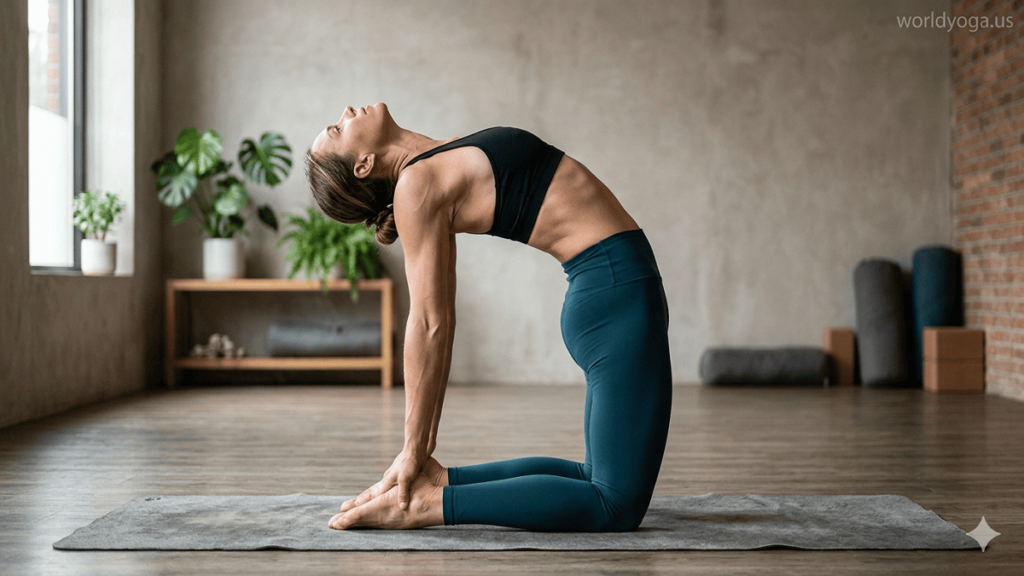
How is this backbend performed step by step?
Little Thunderbolt Pose is an advanced kneeling backbend that requires careful preparation, controlled movement, and awareness of spinal alignment. It should ideally be practiced only after sufficient flexibility has been developed in foundational backbends like Camel Pose (Ustrasana) and Bridge Pose (Setu Bandhasana).
1. Starting Position (Vajrasana Setup)
Begin by kneeling on a yoga mat in Vajrasana (Thunderbolt Pose). Sit back on your heels with your knees together or hip-width apart depending on comfort. Keep the spine upright, Thunderbolt Pose, shoulders relaxed, and hands resting on the thighs. This position establishes grounding and stability before entering the backbend.
2. Preparing the Breath and Core Engagement
Take several slow, deep breaths. Inhale to lengthen the spine upward, and gently engage the abdominal muscles to support the lower back. This core engagement is essential to protect the spine during the backward movement.
3. Transition into a Backbend
On an inhale, begin to lean backward gradually. The movement should originate from the upper back rather than collapsing into the lower spine. Keep the chest lifting upward and open as you arc the spine.
4. Reaching for Support
As the backbend deepens, bring the hands toward the heels or ankles. This helps stabilize the posture and control the descent. The thighs may remain grounded or slightly lifted depending on flexibility level.
5. Deepening the Pose
Continue lowering the torso backward with control. The chest expands fully, and the shoulders draw back. In advanced variation, the crown of the head may gently approach or touch the floor behind you. The neck remains relaxed—never forcefully compressed.
6. Holding the Pose
Once in position, maintain steady breathing. The chest should remain open, and the hips engaged. Hold for a few seconds to several breaths depending on comfort and experience. The focus should be on expansion, not strain.
7. Exiting Safely
To release, engage the core muscles and slowly lift the torso back up using the strength of the thighs and abdomen. Avoid jerky movements. Return to Vajrasana and rest for a few breaths before continuing practice.
Key Safety Notes
- Avoid forcing the backbend; progression must be gradual
- Do not attempt without proper warm-up
- Individuals with spinal, neck, knee, or blood pressure issues should avoid this pose
- Practicing under guidance is strongly recommended
Significance in Execution
The controlled step-by-step approach reflects yoga’s principle of “sthira sukham asanam”—steady and comfortable posture. The pose is not about maximum depth but about balanced openness and stability throughout the spine.
For further reference:
- https://www.yogajournal.com/poses/little-thunderbolt-pose/
- https://www.verywellfit.com/how-to-do-the-thunderbolt-pose-3567091
- https://www.artofliving.org/yoga/yoga-poses/laghu-vajrasana
#Backends On The Knees And Head: Little Thunderbolt Pose in Kolkata
What strength, flexibility, and control are required?
Little Thunderbolt Pose (Laghu Vajrasana) is considered an advanced spinal extension that demands a balanced combination of strength, Thunderbolt Pose, flexibility, and neuromuscular control. Unlike simpler backbends, this posture requires the practitioner to support the body through a deep arc while maintaining joint safety and breath stability.
1. Strength Requirements
The most important strength component in this pose is posterior chain strength, particularly in the glutes, hamstrings, and spinal erectors. These muscle groups stabilize the pelvis and protect the lower back from excessive compression during deep extension.
- Lower back (erector spinae): Supports spinal arching without collapsing into the lumbar region.
- Glutes and thighs (quadriceps and hamstrings): Maintain grounding in the kneeling position and assist in controlling descent and ascent.
- Core muscles (rectus abdominis and obliques): Provide essential stabilization to prevent over-compression of the spine and help control the backbend rather than falling into it.
- Shoulders and arms: Assist in supporting body weight if hands reach the heels or floor.
Without adequate strength, practitioners risk placing excessive stress on the lumbar spine and knees.
2. Flexibility Requirements
Flexibility in Laghu Vajrasana is not isolated to one region; it is a full-body extension requirement, especially in:
- Spinal flexibility: The thoracic and lumbar spine must extend smoothly without sharp bending at a single point.
- Hip flexors (iliopsoas): Must lengthen significantly to allow the pelvis to tilt backward safely.
- Quadriceps (front of thighs): Must stretch deeply as the knees remain bent.
- Shoulders and chest: Require openness to allow full chest expansion and backward reach of the arms.
- Abdominals: Must be supple enough to lengthen without restricting breath.
Limited flexibility in any of these areas often causes compensation in the lower back, increasing injury risk.
3. Control and Coordination
Control is what differentiates a safe practice from a forced one. Laghu Vajrasana requires:
- Breath control (pranayama awareness): Smooth inhalation supports spinal extension; exhalation helps deepen the posture safely.
- Segmental spinal control: The backbend should originate from the upper spine and gradually move downward, not collapse all at once.
- Balance between effort and release: Over-tensing muscles restricts movement, while complete relaxation leads to instability.
- Proprioception (body awareness): The practitioner must constantly sense alignment in knees, hips, spine, and neck.
Control also involves knowing when to stop depth progression to avoid overstretching ligaments.
Overall Integration
Laghu Vajrasana is not simply about bending backward; it is about integrating strength to support, flexibility to allow movement, and control to guide it safely. When these three elements are balanced, the pose becomes a powerful expression of spinal openness rather than strain.
References for Further Study
- https://www.yogajournal.com/poses/little-thunderbolt-pose/
- https://www.verywellfit.com/how-to-do-the-thunderbolt-pose-3567091
- https://www.artofliving.org/yoga/yoga-poses/laghu-vajrasana
#Backends On The Knees And Head: Little Thunderbolt Pose in Ahemadabad
What are the benefits of this pose?
Little Thunderbolt Pose (Laghu Vajrasana) is an advanced backbend in yoga that offers a wide range of physical, physiological, and energetic benefits when practiced safely and with proper preparation. Because it involves a deep spinal extension from a kneeling position, its effects are both powerful and far-reaching across multiple body systems.
1. Improves Spinal Flexibility and Strength
One of the primary benefits of this pose is the enhancement of spinal mobility. The deep backbend helps increase flexibility in the thoracic and lumbar spine while simultaneously strengthening the muscles that support the vertebral column, including the erector spinae. Over time, this can contribute to better posture and reduced stiffness in the upper and lower back, especially for individuals who spend long hours sitting.
2. Opens the Chest, Shoulders, and Hip Flexors
Laghu Vajrasana creates a strong expansion in the chest (thoracic region), which helps open the rib cage and shoulders. This can counteract rounded shoulders and forward head posture commonly caused by modern sedentary lifestyles. Additionally, it deeply stretches the hip flexors and quadriceps, improving mobility in the front of the body and reducing tightness from prolonged sitting.
3. Supports Respiratory Function
Because the chest is lifted and expanded in this pose, it can encourage deeper breathing capacity. The diaphragm is given more space to move freely, which may improve breath awareness and efficiency. This is why backbends are often associated with increased vitality and energy levels in yoga practice.
4. Strengthens Lower Body and Core Stability
Although it appears as a flexibility pose, Laghu Vajrasana also requires significant lower body and core engagement. The thighs, glutes, and abdominal muscles work to stabilize the body and control the backbend. This combination of strength and flexibility helps build functional stability in the knees, hips, and spine.
5. Stimulates Energy Flow and Emotional Release
From a yogic perspective, this posture is believed to activate the heart chakra (Anahata) and throat chakra (Vishuddha). This is associated with emotional openness, improved self-expression, and the release of stored tension in the chest and shoulders. Many practitioners report feelings of emotional lightness and mental clarity after practicing deep backbends.
6. Enhances Mental Focus and Confidence
Because the pose requires courage, control, and trust in the body, it helps develop mental resilience and focus. Practitioners often overcome fear of backward movement, which can translate into greater confidence both on and off the mat.
Safety Note
Despite its benefits, this pose is not suitable for beginners and should be approached gradually. Improper practice can strain the lower back, neck, or knees.
References for Further Reading
- https://www.yogajournal.com/poses/little-thunderbolt-pose/
- https://www.verywellfit.com/how-to-do-the-thunderbolt-pose-3567091
- https://www.artofliving.org/yoga/yoga-poses/laghu-vajrasana
Conclusion
Little Thunderbolt Pose offers a powerful combination of physical strengthening, deep flexibility, improved breathing capacity, and emotional release. When practiced with proper preparation and awareness, it becomes a transformative posture that enhances both body function and inner awareness.
#Backends On The Knees And Head: Little Thunderbolt Pose in Hyderabad
What common mistakes or safety risks should be avoided?
Little Thunderbolt Pose (Laghu Vajrasana) is an advanced backbend, and most of its risks come from pushing too quickly into depth without adequate preparation. Because the pose combines spinal extension, knee flexion, and shoulder opening, even small alignment errors can lead to strain in sensitive joints.
1. Forcing the Backbend Too Quickly
One of the most common mistakes is dropping into the pose instead of gradually entering it. When the movement is rushed, the lumbar spine (lower back) often absorbs too much of the bend, which increases the risk of compression or muscle strain.
Risk: Lower back injury, muscle spasms
Prevention: Enter slowly, initiating the movement from the upper spine and maintaining core engagement.
2. Over-Reliance on the Lower Back
Many practitioners mistakenly allow the lumbar spine to do all the work, instead of distributing the backbend through the thoracic spine (upper/mid-back).
Risk: Lumbar compression and long-term discomfort
Prevention: Focus on opening the chest and upper back first, keeping the core lightly engaged to support the spine.
3. Collapsing the Neck
Dropping the head back too aggressively is another frequent error. The neck is highly sensitive and should never be forced into extreme extension.
Risk: Cervical strain, nerve irritation
Prevention: Keep the neck long and relaxed; the head should move naturally with the spine, not independently forced backward.
4. Knee and Hip Misalignment
Since the pose begins in a kneeling position, poor alignment can place excessive stress on the knees or hips.
Risk: Knee pain, joint instability
Prevention: Keep knees hip-width apart (or as advised), distribute weight evenly, and avoid twisting the legs outward or inward.
5. Holding Breath or Straining
Breath control is essential. A common mistake is holding the breath during the deepest part of the pose, which increases tension and reduces body awareness.
Risk: Dizziness, loss of control
Prevention: Maintain steady inhalation and exhalation; use the breath to guide movement rather than resist it.
6. Skipping Preparation Poses
Attempting Laghu Vajrasana without warming up the spine and hip flexors is a major safety risk.
Risk: Muscle strain or joint injury
Prevention: Always prepare with poses like Camel Pose (Ustrasana), Cobra (Bhujangasana), and Bridge Pose (Setu Bandhasana).
7. Ignoring Pain Signals
Pain is often mistaken for “deep stretching” in advanced yoga, which can lead to overextension.
Risk: Chronic injury to spine, shoulders, or knees
Prevention: Differentiate between stretch sensation and pain; never push through sharp or pinching discomfort.
Key Safety Principle
The guiding principle in this pose is control over depth. A smaller, well-aligned backbend is far safer and more beneficial than a deep but uncontrolled one.
Reliable References
- https://www.yogajournal.com/poses/little-thunderbolt-pose/
- https://www.verywellfit.com/how-to-do-the-thunderbolt-pose-3567091
- https://www.artofliving.org/yoga/yoga-poses/laghu-vajrasana
#Backends On The Knees And Head: Little Thunderbolt Pose in Delhi
Case Study of Backends On The Knees And Head: Little Thunderbolt Pose
1. Background and Context
Little Thunderbolt Pose (Laghu Vajrasana) is an advanced kneeling backbend commonly practiced in traditional yoga systems such as Hatha and Ashtanga yoga. It is considered a high-intensity spinal extension posture that requires a strong foundation in preparatory backbends like Camel Pose (Ustrasana) and Bridge Pose (Setu Bandhasana).
This case study examines how the pose is applied in structured yoga practice, its physiological impact, adaptations used by practitioners, and safety considerations observed in real training environments.
2. Case Profile (Typical Practitioner Scenario)
- Practitioner level: Intermediate to advanced yoga student
- Training background: 2–5 years consistent yoga practice
- Primary goal: Improve spinal flexibility, deepen backbend practice, enhance emotional release and breath capacity
- Limitations observed: Mild hip tightness, moderate thoracic stiffness, occasional lower back sensitivity
3. Method of Practice
Phase 1: Preparation
The practitioner begins with a structured warm-up:
- Cat–Cow movements for spinal articulation
- Camel Pose to open hip flexors and chest
- Cobra Pose for controlled spinal extension
- Core activation exercises for lumbar protection
This phase ensures the spine is mobile and the surrounding muscle groups are engaged.
Phase 2: Entry into Pose
The practitioner starts in Vajrasana (kneeling position). With controlled inhalation:
- The spine is gradually extended backward
- Hands reach toward the heels for stability
- Chest is lifted upward to initiate thoracic opening
The movement is segmented rather than a single drop backward, ensuring spinal safety.
Phase 3: Peak Expression
In the deeper stage:
- The thighs remain grounded or slightly lifted depending on flexibility
- The chest forms a strong arch
- In advanced cases, the crown of the head gently approaches the floor
- Breath remains steady and controlled
At this stage, emphasis is placed on distribution of extension across the entire spine, not just the lower back.
Phase 4: Exit Strategy
The practitioner:
- Engages abdominal muscles first
- Slowly lifts the torso using thigh and core strength
- Returns to Vajrasana
- Rest phase follows to normalize breathing
4. Observed Benefits in Case Practice
- Noticeable improvement in thoracic spine mobility
- Increased chest expansion and breathing depth
- Reduced stiffness in hip flexors over time
- Enhanced body awareness and emotional release patterns
- Improved confidence in advanced backbend progression
5. Risks and Challenges Noted
- Lumbar compression when core engagement is weak
- Neck strain if head is dropped prematurely
- Knee discomfort if alignment is unstable
- Breath holding during peak intensity leading to tension buildup
6. Corrective Strategies Applied
- Use of props (bolsters or blocks under hips in early stages)
- Emphasis on thoracic extension drills
- Breath pacing techniques (slow inhale–exhale cycles)
- Reduced depth focus, prioritizing alignment over range
7. Conclusion
This case study shows that Little Thunderbolt Pose is not merely a flexibility posture but a structured neuromuscular coordination challenge. Safe practice depends on progressive training, spinal awareness, and controlled breathing rather than depth of the backbend.
When properly integrated into a yoga sequence, Laghu Vajrasana supports spinal health, respiratory expansion, and psychological resilience. However, without preparation and control, it can place excessive stress on the lumbar spine and knees.
References
- https://www.yogajournal.com/poses/little-thunderbolt-pose/
- https://www.verywellfit.com/how-to-do-the-thunderbolt-pose-3567091
- https://www.artofliving.org/yoga/yoga-poses/laghu-vajrasana
#Backends On The Knees And Head: Little Thunderbolt Pose in Banglore
White Paper of Backends On The Knees And Head: Little Thunderbolt Pose
1. Executive Summary
Little Thunderbolt Pose (Laghu Vajrasana) is an advanced yoga backbend performed from a kneeling base that places the spine into deep extension while maintaining lower-body grounding. This posture integrates spinal flexibility, hip extension, and thoracic opening with significant neuromuscular control demands. While it offers measurable benefits in mobility, respiratory expansion, and postural correction, it also carries elevated risk for lumbar compression, cervical strain, and knee stress if improperly executed.
2. Introduction
Laghu Vajrasana is derived from traditional Hatha yoga systems and is often categorized as a progression beyond Camel Pose (Ustrasana). The posture involves controlled backward spinal extension from a kneeling position, sometimes culminating in the crown of the head approaching or touching the ground.
Its classification as an advanced asana is based on the combined requirement of:
- Spinal extension capacity
- Hip flexor lengthening
- Quadriceps flexibility
- Core stabilization strength
3. Biomechanical Analysis
3.1 Primary Joint Actions
- Spine: Global extension (cervical, thoracic, lumbar)
- Hips: Extension with anterior pelvic tilt control
- Knees: Deep flexion under load
- Shoulders: Extension and retraction (in deeper variations)
3.2 Load Distribution
- Thoracic spine: primary mobility driver in safe execution
- Lumbar spine: high-risk zone if overused
- Knees: static load-bearing joint under compression
- Neck: vulnerable during head descent phase
4. Physiological Effects
4.1 Musculoskeletal
- Increases spinal extensibility
- Strengthens posterior chain muscles (erector spinae, glutes)
- Lengthens hip flexors and abdominal fascia
- Enhances shoulder girdle mobility
4.2 Respiratory
- Expands thoracic cavity
- Improves diaphragmatic excursion
- Encourages deeper inhalation capacity
4.3 Neurological
- Requires high proprioceptive control
- Enhances interoceptive awareness (body sensing)
- Activates parasympathetic regulation through controlled breathing
5. Benefits Summary
- Improved posture and spinal alignment
- Increased chest and lung capacity
- Enhanced flexibility in anterior body chain
- Strengthened core-spine coordination
- Emotional release through chest opening (associated with heart chakra activation in yogic frameworks)
6. Risk Assessment
6.1 High-Risk Zones
- Lumbar spine (hyperextension compression)
- Cervical spine (forced neck extension)
- Knees (compression and ligament stress)
6.2 Common Failure Modes
- Over-reliance on lumbar spine instead of thoracic extension
- Loss of core engagement during descent
- Breath retention under strain
- Premature head drop without shoulder/chest preparation
7. Safety and Mitigation Protocols
- Progressive training from Camel and Bridge Pose
- Core activation prior to backbend entry
- Thoracic mobility drills as prerequisite conditioning
- Use of props (bolsters, blocks) for early-stage practice
- Controlled breathing cycles (no breath holding under strain)
- Exit strategy emphasizing abdominal engagement
8. Training Framework (Recommended Progression)
- Spinal mobility drills (Cat–Cow, gentle extensions)
- Foundational backbends (Bhujangasana, Setu Bandhasana)
- Intermediate backbends (Ustrasana)
- Assisted Laghu Vajrasana
- Full expression with supervision
9. Conclusion
Little Thunderbolt Pose is a high-complexity biomechanical posture that integrates flexibility, strength, and neuromuscular control. Its benefits are significant when practiced progressively, particularly for spinal health, respiratory expansion, and postural correction. However, due to its deep extension demands, it must be approached with structured progression and strict alignment awareness to mitigate injury risk.
References
- https://www.yogajournal.com/poses/little-thunderbolt-pose/
- https://www.verywellfit.com/how-to-do-the-thunderbolt-pose-3567091
- https://www.artofliving.org/yoga/yoga-poses/laghu-vajrasana
#Backends On The Knees And Head: Little Thunderbolt Pose in Pune
Industry Application of Backends On The Knees And Head: Little Thunderbolt Pose
1. Overview
Little Thunderbolt Pose (Laghu Vajrasana) is an advanced kneeling backbend from yoga that combines deep spinal extension, thoracic opening, hip flexor lengthening, and strong neuromuscular control. While traditionally rooted in yogic practice, its biomechanical and physiological principles have found relevance in several modern industries, particularly those focused on movement science, rehabilitation, fitness, mental health, and performance training.
2. Healthcare and Physiotherapy Applications
In physiotherapy and rehabilitative medicine, Laghu Vajrasana is not typically used in its full expression but its movement principles are adapted.
- Spinal mobility rehabilitation: The controlled extension pattern is used in modified form to restore thoracic and lumbar mobility in patients with stiffness or postural dysfunction.
- Postural correction therapy: Helps counteract kyphosis (rounded upper back) and forward-head posture common in desk workers.
- Breathing rehabilitation: Chest-opening mechanics support respiratory retraining in patients with reduced lung capacity or shallow breathing patterns.
Clinicians usually use safer variations like supported backbends before progressing toward advanced extensions.
3. Sports Science and Athletic Training
In sports performance contexts, the pose contributes to mobility and recovery protocols.
- Flexibility training for athletes: Gymnasts, dancers, martial artists, and swimmers benefit from improved spinal extension and hip flexor length.
- Injury prevention: Balanced posterior chain development reduces risk of lower back injuries caused by tight hip flexors or weak spinal extensors.
- Recovery routines: Gentle backbend variations help relieve muscular tension after high-intensity training.
Sports trainers often emphasize thoracic mobility derived from this posture rather than full execution.
4. Fitness and Movement Training Industry
In yoga studios, functional fitness programs, and mobility training systems, Laghu Vajrasana is used as:
- Advanced progression marker: Indicates readiness for deep backbending programs.
- Flexibility benchmarking pose: Helps assess spinal extension capacity and hip flexor openness.
- Core control development tool: Reinforces integration of abdominal stability with spinal movement.
It is often included in advanced yoga teacher training modules as a peak posture.
5. Mental Health and Wellness Industry
Within yoga therapy and mindfulness-based wellness programs, the pose is used indirectly through its principles.
- Stress release techniques: Deep chest opening is associated with emotional release and reduced muscular tension linked to stress.
- Trauma-informed movement therapy: Modified backbends help gently reintroduce openness in individuals with guarded posture due to stress or trauma.
- Breathwork integration: The expanded thoracic capacity supports pranayama practices used in anxiety management programs.
6. Performing Arts and Dance Industry
Dancers and performance artists use movement patterns inspired by Laghu Vajrasana for:
- Stage flexibility and expression: Deep backbends enhance aesthetic movement lines.
- Spinal articulation training: Improves fluidity in choreography requiring extreme extension.
- Body awareness development: Enhances control during dynamic movement transitions.
7. Limitations and Risk Considerations in Industry Use
Despite its applications, the pose carries significant limitations:
- High risk of lumbar and cervical strain if improperly trained
- Not suitable for untrained populations in full expression
- Requires progressive conditioning and supervision
Therefore, industries primarily use modified or preparatory forms rather than full execution.
8. Conclusion
Little Thunderbolt Pose serves as a valuable reference model in multiple industries rather than a universally applied exercise. Its biomechanics influence rehabilitation protocols, athletic flexibility training, performance arts conditioning, and wellness-based therapies. However, due to its intensity, its safest and most effective industry application lies in adapted variations and progressive training frameworks, rather than direct replication of the full posture.
References
- https://www.yogajournal.com/poses/little-thunderbolt-pose/
- https://www.verywellfit.com/how-to-do-the-thunderbolt-pose-3567091
- https://www.artofliving.org/yoga/yoga-poses/laghu-vajrasana
#Backends On The Knees And Head: Little Thunderbolt Pose in Mumbai
Ask FAQs
What is Little Thunderbolt Pose?
Little Thunderbolt Pose (Laghu Vajrasana) is an advanced yoga backbend performed from a kneeling position. It involves deep spinal extension, chest opening, and controlled backward movement, sometimes ending with the crown of the head approaching the ground.
Is Little Thunderbolt Pose suitable for beginners?
No. This pose is considered advanced and is not recommended for beginners. It requires strong spinal flexibility, core strength, and experience with foundational backbends like Camel Pose (Ustrasana) and Bridge Pose (Setu Bandhasana). Beginners should focus on preparatory poses first.
What are the main benefits of this pose?
Little Thunderbolt Pose helps improve spinal flexibility, opens the chest and shoulders, strengthens the back and core muscles, and supports better breathing capacity. It is also believed to enhance emotional release and improve posture when practiced correctly.
What are the common risks of practicing this pose?
The main risks include lower back strain, neck compression, and knee stress. These usually occur when practitioners force the depth of the backbend, skip warm-ups, or rely too much on the lumbar spine instead of distributing the movement evenly through the thoracic spine.
How can I safely prepare for Little Thunderbolt Pose?
Safe preparation includes regular practice of preparatory poses such as Cobra Pose (Bhujangasana), Bridge Pose (Setu Bandhasana), and Camel Pose (Ustrasana). Strengthening the core, improving hip flexor flexibility, and practicing controlled breathing are also essential before attempting the full posture.
Table of Contents
Disclaimer:
Little Thunderbolt Pose (Laghu Vajrasana) is an advanced yoga posture and should be practiced only under the guidance of a qualified instructor. Attempting it without proper preparation, alignment knowledge, or physical readiness may lead to injury, especially in the spine, neck, or knees. The information provided is for educational purposes only and is not a substitute for professional medical or yoga instruction.