Lotus Pose in Peacock Pose
“Lotus Pose in Peacock Pose” refers to an advanced arm balance variation that combines Padmasana with Mayurasana. In traditional yoga terminology, this variation is commonly known as Padma Mayurasana.
Meaning of the Combination
This posture merges two distinct elements:
- Lotus Pose (Padmasana): A seated posture where the legs are crossed and locked on the thighs, requiring deep hip external rotation and knee flexibility.
- Peacock Pose (Mayurasana): A powerful arm balance where the body is lifted horizontally using the forearms, with elbows pressing into the abdomen for support.
When combined, the legs remain in Lotus while the body is lifted in Peacock Pose, increasing both balance difficulty and core compression demands.
How the Pose Works
In this variation:
- The practitioner first enters a stable Lotus Pose.
- Hands are placed on the floor with fingers pointing backward or in a supported variation.
- Elbows press into the abdominal region to create a leverage point.
- The body weight shifts forward gradually onto the forearms.
- The legs remain locked in Lotus while the body lifts into a horizontal alignment.
The result is a suspended, straight-body arm balance with crossed legs held above the ground.
Key Benefits
This hybrid posture develops:
- Upper-body strength in wrists, forearms, and shoulders
- Deep core activation and abdominal compression strength
- Enhanced balance and proprioception
- Improved hip flexibility from Lotus positioning
The combination increases intensity compared to standard Mayurasana.
Difficulty Level
This is an expert-level yoga posture. It requires:
- Strong arm balance foundation
- Safe and pain-free Lotus Pose ability
- Excellent core control and shoulder stability
It is not recommended for beginners due to high wrist and knee stress.
Safety Notes
Common risks include wrist strain, knee pressure, and loss of balance if Lotus is forced. Proper warm-up and progressive training are essential before attempting this pose.
Summary
“Lotus Pose in Peacock Pose” is a demanding arm balance that combines structural strength and flexibility into a single advanced yoga expression, blending the stability of Lotus Pose with the lifting power of Peacock Pose.
#Lotus Pose in Peacock Pose in India
What is Lotus Pose in Peacock Pose?
“Lotus Pose in Peacock Pose” is a modern descriptive term for an advanced yoga arm balance that combines Padmasana with Mayurasana. In traditional yoga terminology, this posture is most commonly referred to as Padma Mayurasana.
Meaning of the Pose
This variation involves performing Peacock Pose while keeping the legs locked in Lotus Pose. Instead of extending the legs straight back (as in standard Mayurasana), the practitioner maintains the crossed-leg position of Lotus while lifting the entire body off the ground using forearm strength and core engagement.
How It Works Biomechanically
In this posture:
- The forearms and wrists support nearly the full body weight.
- The elbows press into the abdomen to create a leverage point.
- The core muscles generate lift and maintain horizontal alignment.
- The legs remain fixed in Lotus, increasing rotational load and instability.
Compared to standard Mayurasana, the lotus variation shifts the center of gravity forward, making balance significantly more challenging.
Key Characteristics
- Body is lifted horizontally above the floor
- Legs remain in full Lotus configuration
- Elbows act as a fulcrum against the abdomen
- Requires strong coordination between core and upper body
Benefits
This advanced posture develops:
- Exceptional wrist, forearm, and shoulder strength
- Deep core activation and abdominal control
- Improved balance and proprioception
- Increased hip flexibility due to Lotus requirement
It is often used as a progression milestone in advanced arm balance training.
Difficulty Level
This is an expert-level arm balance and is not suitable for beginners. It requires:
- Mastery of basic arm balances
- Safe and comfortable Lotus Pose ability
- Strong core and shoulder stability
Safety Considerations
Common risks include wrist strain, knee stress from improper Lotus positioning, and loss of balance due to insufficient core control. Proper progression and guidance from an experienced instructor are strongly recommended.
Summary
“Lotus Pose in Peacock Pose” is a high-level hybrid arm balance that combines the flexibility of Lotus Pose with the strength demands of Peacock Pose, resulting in a powerful test of core stability, upper-body strength, and balance control.
#Lotus Pose in Peacock Pose in Maharashtra
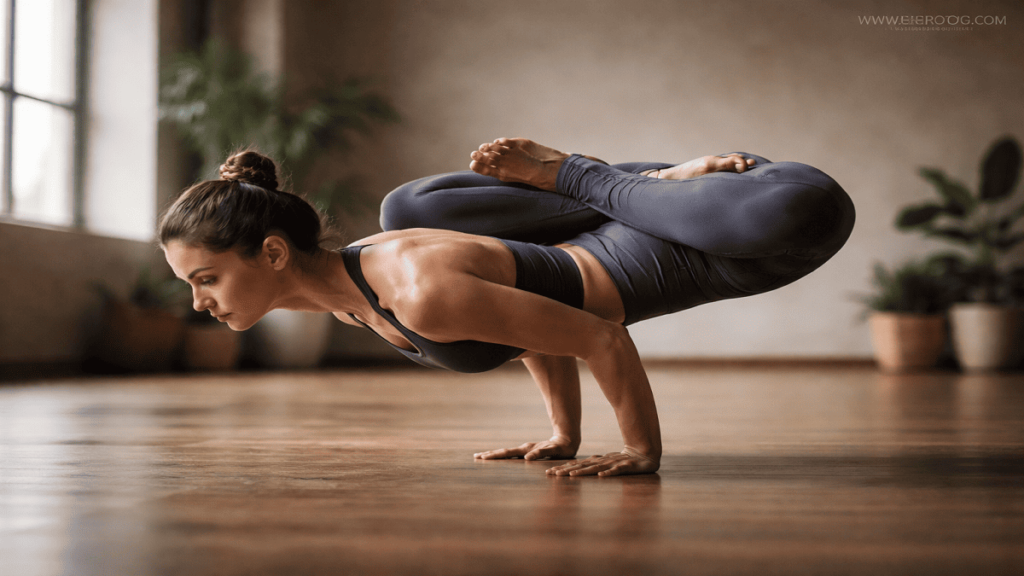
How is this variation performed step by step?
Step-by-step Performance
1. Warm-up and preparation
Begin with wrist, shoulder, and hip mobility exercises. Prepare the body with plank holds, dolphin pose, and gentle hip openers. This is essential to protect the wrists and knees.
2. Enter Lotus Pose
Sit on the floor and carefully place each foot onto the opposite thigh to form a stable Padmasana. Keep the spine upright and chest open. Ensure there is no knee pain or strain before proceeding.
3. Hand placement
Place both hands on the floor beside the hips, then gradually bring them inward under the abdomen. Fingers are typically pointed backward toward the feet. In some modern variations, a “fist-style” engagement may be used for additional wrist stability.
4. Elbow positioning
Bend the elbows and press them firmly into the lower abdomen just above the navel. This creates the main leverage point used in Mayurasana.
5. Forward weight shift
Slowly lean the torso forward while keeping the elbows anchored. Engage the core strongly to control the shift of the center of gravity. The movement must be gradual and controlled.
6. Lift-off phase
Once balance is achieved on the forearms, begin lifting the feet off the ground while maintaining the Lotus position. The body should gradually become horizontal.
7. Full balance hold
Hold the position with steady breathing. The elbows remain pressed into the abdomen, the core stays fully engaged, and the body remains parallel to the floor. Small adjustments are made through forearm pressure and core control.
8. Controlled exit
Slowly lower the feet back to the ground while maintaining control. Release the hands first, then gently unlock the Lotus position one leg at a time.
Safety Note
This is an expert-level posture. It should only be attempted after mastering basic arm balances and achieving pain-free Lotus Pose. Avoid forcing the knees or collapsing into the wrists.
Summary
The variation is performed through a controlled sequence of Lotus entry, precise hand and elbow placement, gradual forward shifting, and slow lift into a horizontal forearm-supported balance, requiring strength, flexibility, and advanced body awareness.
#Lotus Pose in Peacock Pose in Pune
What strength and flexibility are required?
1. Upper-body strength requirements
This posture places almost the entire body weight on the forearms and wrists.
- Wrist strength and stability: Must tolerate strong compression and extension without collapsing.
- Forearm strength: Essential for maintaining balance and micro-adjustments.
- Shoulder stability: Strong deltoids and rotator cuff muscles are needed to prevent sinking or shaking.
- Elbow control: In Mayurasana, elbows act as a structural lever and must remain firmly engaged.
Without strong upper-body conditioning, lift-off is not possible.
2. Core strength requirements
The core is the primary driver of lift and balance.
- Rectus abdominis: Supports forward lean and body elevation.
- Obliques: Maintain lateral stability and prevent twisting.
- Deep core (transverse abdominis): Provides internal pressure and structural support.
Strong core engagement is critical because the elbows press into the abdomen, requiring both resistance and lift simultaneously.
3. Hip and lower-body flexibility
The lotus component depends on deep flexibility:
- Hip external rotation: Required to safely form Padmasana
- Knee flexion tolerance: Must be achieved without strain or force
- Ankle mobility: Supports comfortable and stable foot placement
If flexibility is insufficient, the knees may be forced, increasing injury risk.
4. Spinal and postural control
- Spinal stability: Needed to maintain alignment during forward shift
- Postural awareness: Prevents collapse or over-arching
- Controlled flexion: Allows smooth transition into horizontal balance
5. Balance and neuromuscular coordination
This is one of the most demanding aspects:
- Center-of-mass control: Must shift forward precisely for lift-off
- Proprioception: Fine awareness of body position in space
- Micro-adjustments: Continuous corrections through forearms and core
- Stillness under load: Maintaining calm stability while fully suspended
Compared to standard Mayurasana, the lotus variation significantly increases instability.
Summary
This pose requires:
- Very strong wrists, forearms, shoulders, and core
- Deep hip flexibility for Lotus Pose
- Excellent spinal control and balance awareness
It is considered an expert-level posture because it combines maximum strength demand with advanced flexibility and balance control simultaneously.
#Lotus Pose in Peacock Pose in Delhi
What are the benefits of this arm balance?
1. Exceptional upper-body strength development
This posture places the entire body weight on the forearms and wrists.
- Strengthens wrists, forearms, and grip endurance
- Builds shoulder stability through sustained isometric load
- Enhances triceps and deltoid control
- Improves joint resilience under compression
Compared to standard Mayurasana, the lotus variation increases instability, requiring greater muscular control.
2. Deep core activation and abdominal control
The elbows press into the abdominal region, creating intense core engagement.
- Strengthens rectus abdominis and obliques
- Activates deep stabilizing muscles (transverse abdominis)
- Improves abdominal compression strength
- Enhances ability to control internal pressure under load
This makes it one of the most intense static core engagement poses in advanced yoga practice.
3. Improved balance and body awareness
The pose significantly enhances neuromuscular coordination.
- Develops fine proprioception (body position awareness)
- Trains micro-adjustment control through forearms and core
- Improves ability to stabilize in unstable conditions
- Enhances focus and concentration under physical stress
4. Hip flexibility enhancement
Because the legs remain in Padmasana:
- Deepens hip external rotation flexibility
- Encourages controlled joint mobility
- Improves long-term comfort in seated meditation postures
5. Digestive and internal organ stimulation (traditional perspective)
In classical yoga interpretation:
- Abdominal compression is believed to stimulate digestive organs
- May enhance circulation in the abdominal region
- Creates internal massage effect on visceral structures
This is a traditional yogic concept rather than a medically proven effect.
6. Mental discipline and stress control
The pose requires high concentration and calm execution.
- Improves focus under physical strain
- Develops breath control during effort
- Builds patience and fear management in advanced movement practice
7. Progression benefit for advanced arm balances
This posture acts as a milestone for:
- Advanced arm balance mastery
- Transition into more complex inversion and suspension skills
- Strength benchmarking for elite yoga practitioners
Summary
This advanced arm balance builds upper-body strength, core stability, hip flexibility, and intense mental focus. It is most beneficial for experienced practitioners who already have a strong foundation in arm balances and can safely perform both Mayurasana and Lotus-based postures.
#Lotus Pose in Peacock Pose in Ahemadabad
What common mistakes should be avoided?
1. Forcing the Lotus position
One of the most dangerous mistakes is forcing the legs into Padmasana.
- Pushing the knees instead of opening the hips
- Ignoring pain in the knee joint
- Using momentum instead of flexibility
This can lead to serious knee ligament strain. Lotus must come from deep hip rotation, not force.
2. Incorrect elbow placement
In Mayurasana, elbow placement is critical.
Common errors:
- Elbows placed too wide apart (loss of stability)
- Elbows too high or too low on the abdomen
- Weak contact with the core
Incorrect placement reduces leverage and increases collapse risk.
3. Overloading the wrists
Many practitioners place excessive strain on the wrists.
- Collapsing into wrist joints instead of engaging forearms
- Poor hand alignment on the floor
- Lack of wrist conditioning before practice
This can lead to chronic wrist pain or strain injuries.
4. Weak core engagement
A major mistake is relying only on arm strength.
- Insufficient abdominal activation
- Failure to stabilize the spine during lift-off
- Allowing hips to drop during balance
Without strong core engagement, lift is impossible and balance is unstable.
5. Rushing the lift-off
Attempting to lift too quickly causes instability.
- Sudden weight shift leads to loss of control
- Jerky movement increases strain on shoulders and wrists
- Poor alignment during transition
The lift must be slow, controlled, and progressive.
6. Poor shoulder stability
Shoulder engagement is often overlooked.
- Sinking between shoulders
- Lack of scapular activation
- Rounded upper back during balance
This weakens structural support and increases collapse risk.
7. Holding the breath
Breath is often neglected during effort.
- Breath holding increases tension and instability
- Reduces endurance and focus
- Causes early fatigue and loss of balance
Steady breathing is essential for control.
8. Skipping preparation work
Attempting the pose without progression is a major mistake.
- No prior arm balance training
- Weak wrist conditioning
- Inadequate hip flexibility
Foundational strength must be built before attempting this variation.
Summary
The most critical mistakes include forcing Lotus, poor elbow alignment, weak core engagement, and overloading the wrists. Safe practice requires gradual progression, correct technique, and mastery of foundational arm balances such as Mayurasana before attempting this advanced variation.
#Lotus Pose in Peacock Pose in Hyderabad

Case Study of Lotus Pose in Peacock Pose
1. Introduction
“Lotus Pose in Peacock Pose” is an advanced hybrid yoga arm balance combining Padmasana with Mayurasana. In traditional yoga terminology, this variation is commonly referred to as Padma Mayurasana. It is used in advanced practice contexts to explore the limits of strength, balance, and neuromuscular control.
2. Objective of the Case Study
The objective is to analyze:
- Biomechanical demands
- Strength and flexibility requirements
- Balance and control mechanisms
- Risk factors and adaptation outcomes
This case study reflects a composite of advanced practitioners rather than a single individual.
3. Subject Profile (Composite Practitioner)
- Experience: 6–10 years of consistent yoga practice
- Skill level: Advanced arm balance practitioner
- Mobility: Full or near-full Lotus capability
- Strength: High core and upper-body conditioning
- Limitations: Moderate wrist sensitivity under prolonged load
4. Execution Methodology
Phase 1: Foundation Setup
The practitioner begins in a stable Padmasana with upright spinal alignment and relaxed breath control.
Phase 2: Hand and Elbow Positioning
Hands are placed under the abdomen with fingers pointing backward. Elbows are carefully positioned into the lower abdominal region to create a stable lever system.
Phase 3: Weight Transfer
The practitioner gradually shifts the center of gravity forward, engaging core muscles to control momentum and prevent collapse.
Phase 4: Lift-Off and Suspension
Once balance is achieved, the feet lift off the ground while maintaining Lotus configuration. The body transitions into a horizontal suspended position supported entirely by forearms in the structure of Mayurasana.
Phase 5: Stabilization
Micro-adjustments are made through forearm pressure, shoulder engagement, and abdominal bracing. Breathing remains steady to maintain neuromuscular control.
5. Biomechanical Observations
Load Distribution
- Forearms and wrists: primary load-bearing structures
- Elbows: act as a fixed fulcrum against the abdomen
- Core: provides dynamic stabilization and lift generation
Center of Gravity Shift
The Lotus position shifts mass forward, increasing torque and requiring greater core compensation than standard Mayurasana.
Stability Challenge
Rotational instability increases due to crossed-leg configuration, requiring refined proprioception.
6. Outcomes and Adaptations
Positive Adaptations
- Improved static core endurance
- Enhanced shoulder and wrist stability
- Increased hip flexibility control
- Better balance under compression-based load
Observed Limitations
- Wrist fatigue during early attempts
- Loss of balance due to premature lift-off
- Knee sensitivity if Lotus is forced
- Core collapse under fatigue
7. Risk Analysis
The pose carries elevated risk due to:
- High wrist compression load
- Knee strain risk from improper Lotus alignment
- Shoulder instability under fatigue
- Lack of progression training
Proper preparatory conditioning is essential.
8. Conclusion
“Lotus Pose in Peacock Pose” is a highly advanced arm balance that integrates the structural leverage of Mayurasana with the flexibility demands of Padmasana. It functions as a performance benchmark for elite yoga practitioners, emphasizing strength, balance, and controlled neuromuscular coordination.
#Lotus Pose in Peacock Pose in Banglore
White Paper of Lotus Pose in Peacock Pose
Abstract
“Lotus Pose in Peacock Pose” is an advanced hybrid yoga arm balance combining Padmasana with Mayurasana. In classical yoga, it is commonly referred to as Padma Mayurasana. This white paper outlines its biomechanics, physiological demands, execution framework, safety considerations, and its role in advanced movement training systems.
1. Introduction
The posture represents a high-complexity variation of Mayurasana in which the practitioner maintains a Lotus configuration while lifting the body horizontally on the forearms. This integration significantly increases instability, load demand, and neuromuscular coordination requirements compared to standard Peacock Pose.
It is primarily practiced in advanced yoga systems, strength-based yoga fusion training, and elite mobility disciplines.
2. Biomechanical Framework
2.1 Load Distribution
The body weight is distributed across:
- Forearms (primary support structure)
- Wrists (load transmission points)
- Elbows (fulcrum against abdomen)
- Core musculature (dynamic stabilizer)
2.2 Center of Gravity Shift
The Lotus position alters mass distribution by:
- Increasing forward torque
- Raising rotational instability
- Demanding higher core compensation
2.3 Structural Mechanics
In Mayurasana, the elbows act as a lever against the abdominal wall. The Lotus configuration increases resistance to stabilization, requiring precise neuromuscular control.
3. Method of Execution
Step 1: Base Position
Begin in Padmasana with upright spine alignment and controlled breathing.
Step 2: Upper Limb Placement
Place hands beneath the abdomen with fingers directed backward. Elbows are drawn inward to contact the lower abdomen.
Step 3: Forward Shift
Gradually shift body weight forward while engaging deep core muscles.
Step 4: Lift Phase
Lift the lower body off the ground while maintaining Lotus alignment.
Step 5: Stabilization
Maintain horizontal suspension through forearm pressure, core bracing, and scapular stability.
4. Physiological Demands
Muscular Requirements
- High isometric core activation (rectus abdominis, obliques, transverse abdominis)
- Forearm and wrist endurance
- Shoulder stabilization (rotator cuff engagement)
Neuromuscular Control
- High proprioceptive accuracy
- Fine motor corrections in forearms and core
- Breath-regulated stability under load
Flexibility Requirements
- Deep hip external rotation for Lotus
- Controlled knee flexion tolerance
- Ankle mobility for safe alignment
5. Functional Benefits
- Increased upper-body strength endurance
- Enhanced core compression strength
- Improved balance and proprioception
- Advanced hip mobility development
- Mental focus and stress regulation under load
6. Safety and Risk Profile
Primary Risks
- Wrist overload and repetitive strain
- Knee stress if Lotus is forced
- Shoulder instability under fatigue
- Core collapse due to insufficient progression
Risk Mitigation
- Progressive strength training (plank, crow pose)
- Gradual Lotus preparation
- Wrist conditioning and mobility work
- Supervised instruction for advanced practice
7. Training Applications
- Advanced yoga teacher training modules
- Elite strength and mobility conditioning
- Movement science and biomechanics analysis
- Athletic cross-training for balance and control sports
8. Limitations
- Not suitable for beginners
- High injury risk without preparation
- Requires long-term flexibility and strength development
- Not standardized across all yoga traditions
9. Conclusion
“Lotus Pose in Peacock Pose” is an advanced performance-based yoga variation that integrates the structural compression mechanics of Mayurasana with the flexibility demands of Padmasana. It functions primarily as an elite training benchmark for strength, balance, and neuromuscular control rather than a general practice posture.
References
https://www.yogajournal.com/poses/peacock-pose/
https://www.yogajournal.com/poses/lotus-pose/
https://www.verywellfit.com/how-to-do-peacock-pose-mayurasana-3567042
#Lotus Pose in Peacock Pose in Chennai
Industry Application of Lotus Pose in Peacock Pose
1. Advanced Yoga Training Industry
In yoga education systems, this posture is used as a peak-performance milestone.
Applications:
- Advanced yoga teacher training (RYT-500 and specialty modules)
- Arm balance progression benchmarking
- Technique refinement for elite practitioners
- Demonstration of leverage and compression mechanics
It is primarily used for experienced practitioners rather than general classes.
2. Strength and Functional Fitness Industry
In hybrid fitness systems (yoga + calisthenics), the pose is used to develop extreme static strength.
Applications:
- Core compression strength training
- Wrist and forearm endurance conditioning
- Shoulder stability programming
- Isometric full-body control exercises
The integration of Lotus increases instability, making it useful for advanced progression training beyond standard bodyweight movements.
3. Sports Performance and Athletic Conditioning
Athletic disciplines use modified progressions for neuromuscular development.
Applications:
- Gymnastics-style balance training
- Martial arts core stability conditioning
- Climbing-specific grip and shoulder endurance
- Dance and acrobatics body control enhancement
The pose itself is rarely performed fully in sport but inspires training variations.
4. Physiotherapy-Informed Movement Systems
While not a clinical exercise, scaled versions are used in rehabilitation-adjacent training.
Applications:
- Wrist strengthening and load adaptation drills
- Controlled core activation exercises
- Hip mobility progression based on Padmasana
- Postural stability reconditioning
Full expression is avoided in clinical settings due to high load intensity.
5. Movement Science and Biomechanics Research
The pose is valuable for studying extreme body mechanics.
Applications:
- Center-of-mass shift analysis under closed-chain load
- Forearm weight-bearing biomechanics
- Core compression under lever-based stress
- Stability thresholds in suspended positions
Researchers use it as a model for understanding human balance limits.
6. Wellness, Yoga Tourism, and Digital Media
The pose also has strong visual and branding value.
Applications:
- Advanced yoga demonstration content
- Wellness retreat showcases
- Social media fitness challenges
- Instructor branding and portfolio development
Its complexity and aesthetic appeal make it popular in digital fitness storytelling.
7. Limitations in Industry Use
Despite its applications, the pose has constraints:
- High injury risk for untrained individuals
- Not standardized across yoga systems
- Requires extensive preparation and supervision
- Limited direct therapeutic use
Conclusion
“Lotus Pose in Peacock Pose” functions as a specialized advanced movement skill with applications primarily in elite yoga training, functional strength conditioning, sports performance development, and biomechanics research. Built on Mayurasana and Padmasana, it serves more as a high-level training and demonstration tool than a general fitness exercise.
#Lotus Pose in Peacock Pose in Mumbai
Ask FAQs
What is Lotus Pose in Peacock Pose?
It is an advanced yoga arm balance that combines Padmasana with Mayurasana. The practitioner balances the body on the forearms while keeping the legs locked in Lotus Pose, creating a highly challenging strength and balance posture.
Is this pose suitable for beginners?
No. This is an expert-level posture. Beginners should first build strength through basic poses like plank, crow pose, and standard Peacock Pose. It also requires safe, pain-free ability to perform Lotus Pose before attempting any variation.
What are the main benefits of this pose?
It strengthens the wrists, forearms, shoulders, and core muscles. It also improves balance, body awareness, hip flexibility, and mental focus. The combination increases intensity compared to standard Mayurasana.
What are the risks involved?
Common risks include wrist strain, shoulder overload, and knee injury if Lotus is forced incorrectly. Loss of balance can also cause falls or muscle strain. Proper progression and warm-up are essential to reduce injury risk.
How should someone safely progress toward this pose?
A safe progression includes building wrist and core strength, practicing plank variations, mastering crow pose, and gradually working toward Mayurasana. Flexibility training for Padmasana is also essential before attempting the full variation.
Table of Contents
Disclaimer
“Lotus Pose in Peacock Pose” is an advanced yoga variation and should only be attempted by experienced practitioners under the guidance of a qualified instructor. It requires significant strength and flexibility, and improper practice may lead to injury, especially to the wrists, knees, and shoulders. Always ensure proper preparation and consult a professional before attempting advanced arm balances.