Malasana Namaskar
Malasana (also known as Garland Pose) combined with Namaskar (a traditional gesture of greeting and respect) is often interpreted in modern yoga practice as a deep squat posture performed with hands joined at the chest in prayer position. This combination is commonly used in yoga flows, meditation practices, and mobility training to enhance lower-body flexibility, grounding awareness, and postural alignment.
Overview and Meaning
“Malasana” comes from Sanskrit, where mala means garland and asana means posture. It symbolically represents grounding and humility, as the body folds close to the earth in a squatting position. “Namaskar” refers to the gesture of Anjali Mudra—palms pressed together at the heart center—representing respect, balance, and mindfulness. When combined, Malasana Namaskar reflects both physical grounding and mental centering.
How to Perform
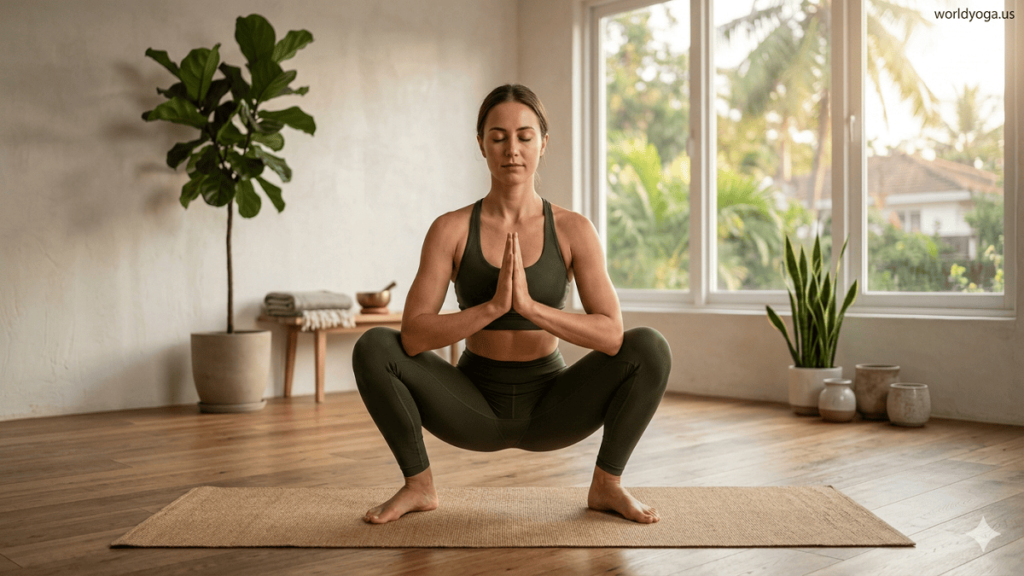
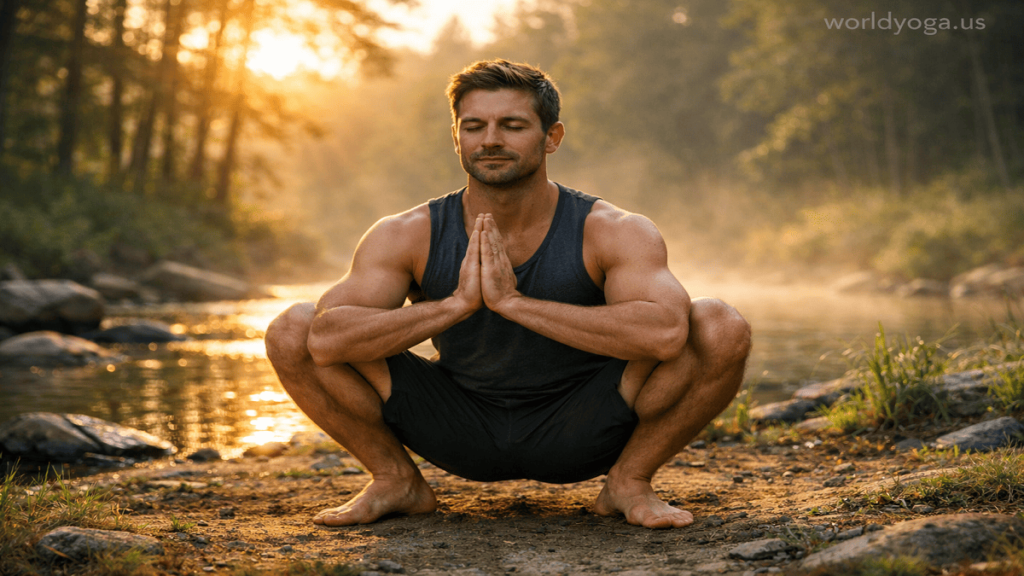
Begin standing with feet slightly wider than hip-width apart. Slowly lower the hips into a deep squat while keeping the heels grounded (or supported if needed). The toes may turn slightly outward. Bring the palms together at the chest in Namaskar position. Elbows press gently against the inner knees, helping to open the hips further. The spine remains elongated, and the chest stays lifted rather than collapsing forward. Breathing should be slow and steady, focusing on stability and awareness.
Benefits
Malasana Namaskar is highly beneficial for hip opening, ankle flexibility, and strengthening the lower back and core muscles. It improves digestion by gently compressing the abdominal region and stimulating internal organs. The posture also enhances balance, body awareness, and grounding energy, making it useful for stress reduction and mindfulness practice. Regular practice can improve mobility in the hips and knees, especially for individuals who spend long hours sitting.
Precautions
People with knee injuries, severe ankle pain, or lower back issues should approach this posture carefully. Using a yoga block or rolled blanket under the heels can provide support. It is also advisable to avoid forcing the squat depth; instead, mobility should improve gradually over time. Consulting a qualified yoga instructor is recommended for beginners.
Variations and Practice Tips
Beginners may practice holding onto a wall for balance or placing a block under the hips for support. Advanced practitioners may deepen the squat or incorporate forward folds. Slow breathing and maintaining spinal alignment are more important than depth.
External References
- https://www.yogajournal.com/poses/garland-pose/
- https://www.verywellfit.com/how-to-do-garland-pose-malasana-3567046
- https://www.artofliving.org/yoga/yoga-poses/malasana-garland-pose
#Malasana Namaskar in India
How is Malasana Namaskar performed correctly?
Malasana performed with Namaskar (hands in prayer position at the heart) is a grounding yoga posture that requires careful alignment of the hips, spine, and knees to ensure both safety and effectiveness. Correct execution is essential because it is a deep squat that places significant demand on lower-body mobility.
Starting Position
Begin in a standing position with feet slightly wider than hip-width apart. The toes should point slightly outward, but not excessively, to avoid strain on the knees. The spine remains tall, shoulders relaxed, and gaze forward. Before descending, engage the core muscles lightly to support the lower back.
Lowering into the Squat
Slowly bend the knees and lower the hips toward the floor. The movement should be controlled rather than abrupt. As you descend, ensure the heels stay grounded. If the heels lift due to tight calves or ankles, place a folded yoga mat or block underneath for support. The hips move straight down rather than shifting backward like a chair pose.
Hand Position (Namaskar)
Once in the squat, bring the palms together in front of the chest in Namaskar (Anjali Mudra). The elbows gently press against the inner thighs. This action helps open the hips further while maintaining balance and stability. The chest should remain lifted, avoiding rounding of the upper back.
Spinal Alignment and Breathing
The spine must stay elongated throughout the posture. Avoid collapsing the chest forward or rounding the lower back. The head remains in a neutral position, aligned with the spine. Breathing should be slow, deep, and steady through the nose. Each inhale creates length in the spine, while each exhale allows deeper relaxation into the hips.
Key Alignment Points
- Knees track in the same direction as the toes
- Heels stay grounded or supported
- Spine remains upright, not slouched
- Core remains lightly engaged for stability
- Elbows gently press inner thighs outward
Common Mistakes to Avoid
One of the most common errors is allowing the heels to lift excessively, which reduces stability and increases knee strain. Another mistake is rounding the lower back, which can place pressure on the spine. Forcing the squat depth too quickly is also unsafe and should be avoided.
Exit from the Pose
To come out, slowly release the hands, press through the feet, and straighten the legs gradually. Maintain balance by engaging the core during the ascent.
Benefits of Correct Practice
When performed correctly, Malasana Namaskar improves hip flexibility, strengthens the ankles and lower back, and supports digestive health by gently compressing the abdomen. It also enhances mindfulness and grounding awareness.
References
- https://www.yogajournal.com/poses/garland-pose/
- https://www.verywellfit.com/how-to-do-garland-pose-malasana-3567046
- https://www.artofliving.org/yoga/yoga-poses/malasana-garland-pose
#Malasana Namaskar in Maharashtra
What is the proper alignment in this squat variation?
Foot and Lower Limb Alignment
The foundation begins with the feet. They should be placed slightly wider than hip-width, with toes turned outward at a mild angle (typically 15–45 degrees depending on individual hip structure). The key principle is that the knees must track in the same direction as the toes during the descent and hold. This prevents rotational stress on the knee joint.
The heels ideally remain grounded throughout the posture. If mobility in the ankles or calves limits this, a support such as a folded mat or wedge under the heels can be used. Weight should be distributed evenly across the entire foot—avoid shifting excessively toward the toes or heels.
Knee and Hip Alignment
As you lower into the squat, the hips move straight down rather than shifting backward. The knees bend deeply and open outward, guided gently by the inner pressure of the elbows. This outward resistance helps maintain hip external rotation without collapsing the knees inward.
The thighs should move toward parallel alignment with the feet, depending on flexibility. However, forcing depth is unnecessary; proper alignment is more important than how low the hips go.
Spine and Torso Position
The spine must remain long and neutral. A common error is rounding the lower back, which places stress on the lumbar region. Instead, the pelvis should remain in a neutral tilt while the chest stays lifted. The sternum gently rises forward and upward without over-arching the lower back.
The head remains aligned with the spine, and the gaze is forward or slightly downward to maintain balance.
Arm and Namaskar Position
In this variation, the hands are brought together in Namaskar (Anjali Mudra) at the center of the chest. The elbows press lightly against the inner thighs. This is not forceful but supportive, encouraging hip opening while maintaining stability. The shoulders remain relaxed and away from the ears.
Core Engagement and Stability
A subtle engagement of the abdominal muscles is important. This stabilizes the pelvis and prevents excessive forward collapse. However, the engagement should not restrict breathing; the breath remains slow and natural.
Breathing and Balance
Steady nasal breathing helps maintain equilibrium in the posture. Inhale to lengthen the spine, exhale to settle deeper into the squat without losing alignment.
Key Alignment Summary
- Knees aligned with toes
- Heels grounded or supported
- Spine neutral and elongated
- Chest open, not collapsed
- Elbows gently guiding knees outward
- Weight evenly distributed through feet
References
- https://www.yogajournal.com/poses/garland-pose/
- https://www.verywellfit.com/how-to-do-garland-pose-malasana-3567046
- https://www.artofliving.org/yoga/yoga-poses/malasana-garland-pose
#Malasana Namaskar in Ahemadabad
Which muscles are engaged during the pose?
During Malasana performed with Namaskar (hands in prayer position at the chest), multiple muscle groups are engaged simultaneously to support stability, mobility, and postural control. This makes it a compound, full-body functional posture rather than an isolated stretch.
Primary Muscle Groups Engaged
1. Quadriceps (front thigh muscles)
The quadriceps are heavily engaged as they control knee flexion during the deep squat and help stabilize the knee joint. They work eccentrically while lowering into the pose and isometrically while holding the position.
2. Gluteal muscles (gluteus maximus, medius, and minimus)
The glutes are active to support hip flexion and external rotation. They help stabilize the pelvis and prevent collapse inward. In deeper variations, the gluteus maximus assists in controlling descent and maintaining balance.
3. Adductor group (inner thighs)
The adductors play a key role in this posture. Although they are stretched due to the wide squat, they are also engaged isometrically to stabilize the legs. This dual action—stretching and activation—improves hip mobility over time.
Secondary Muscle Engagement
4. Calf muscles (gastrocnemius and soleus)
These muscles are engaged to maintain ankle stability and assist in keeping the heels grounded. Limited ankle flexibility increases their activation significantly.
5. Core muscles (rectus abdominis, obliques, transverse abdominis)
The core stabilizers are essential for maintaining spinal alignment. The transverse abdominis acts like a natural brace, preventing excessive forward collapse. The obliques assist in maintaining balance, especially if weight shifts unevenly.
6. Erector spinae (lower back muscles)
These muscles support spinal extension and prevent rounding of the back. They work isometrically to keep the torso upright throughout the hold.
Supporting Upper Body Muscles
7. Deltoids and scapular stabilizers
While less dominant, the shoulder muscles stabilize the arms in Namaskar position. The rhomboids and trapezius help maintain an open chest and proper shoulder alignment.
8. Forearm and hand muscles
Light activation occurs to maintain the Namaskar position without tension in the wrists or fingers.
Functional Muscle Interaction
The uniqueness of Malasana lies in the simultaneous engagement of strength and flexibility. While the lower body muscles (quadriceps, glutes, adductors) provide structural support, the hip and groin muscles undergo deep stretching. This dual demand improves neuromuscular coordination and joint mobility.
The posture also enhances proprioception—your body’s awareness in space—because stabilizing in a deep squat requires continuous micro-adjustments from multiple muscle groups.
Benefits of Muscle Engagement
- Improves lower-body strength and endurance
- Enhances hip mobility and flexibility
- Strengthens core stabilizers for better posture
- Supports functional movement patterns like squatting and lifting
- Reduces stiffness from prolonged sitting
References
- https://www.yogajournal.com/poses/garland-pose/
- https://www.verywellfit.com/how-to-do-garland-pose-malasana-3567046
- https://www.acefitness.org/resources/everyone/exercise-library/
#Malasana Namaskar in Hyderabad
What preparatory poses are recommended?
1. Hip-Opening Preparations
Baddha Konasana (Butterfly Pose)
This pose gently stretches the inner thighs and groin. Sitting upright with the soles of the feet together and allowing the knees to drop outward helps prepare the adductor muscles for the external rotation required in Malasana.
Anjaneyasana (Low Lunge)
This posture opens the hip flexors and improves range of motion in the pelvis. It is especially useful for people who sit for long periods, as tight hip flexors often restrict squat depth.
2. Ankle and Calf Mobility Work
Adho Mukha Svanasana (Downward-Facing Dog)
This foundational pose stretches the calves, Achilles tendon, and hamstrings. Improved ankle dorsiflexion is crucial for keeping heels grounded in Malasana.
Heel Raises and Controlled Squats
Simple dynamic movements like lifting and lowering the heels while standing help increase ankle flexibility and prepare the joints for deep flexion.
3. Squat-Specific Preparation
Supported Squat (Malasana Prep Hold)
Practicing a shallow squat while holding onto a wall or using a block under the hips helps condition the knees and ankles gradually. This bridges the gap between standing and full Malasana.
Utkatasana (Chair Pose)
This strengthens the quadriceps, glutes, and core while simulating squat mechanics. It builds endurance and control needed for holding Malasana safely.
4. Spine and Core Activation
Marjaryasana (Cat-Cow Pose)
This dynamic movement improves spinal mobility and warms up the erector spinae muscles. A flexible spine is essential for maintaining upright posture in Malasana.
Gentle Core Engagement Exercises
Simple breath-linked core activation (such as drawing the navel toward the spine on exhale) helps stabilize the pelvis and prevent collapse during the squat.
5. Groin and Inner Thigh Stretching
Wide-Leg Forward Fold (Prasarita-like preparation)
Although not listed as a separate yoga pose here, a wide stance forward fold gently stretches the inner thighs and prepares the hips for deep external rotation.
Why Preparation Matters
Without proper warm-up, practitioners may experience heel lifting, knee strain, or lower back rounding in Malasana. Preparatory poses gradually increase mobility in the exact muscle groups required: adductors, calves, hip flexors, and spinal stabilizers.
Recommended Sequence (Simple Flow)
- Cat-Cow for spine mobility
- Downward Dog for calves and hamstrings
- Low Lunge for hip flexors
- Butterfly Pose for inner thighs
- Chair Pose for strength
- Supported Squat hold → transition to Malasana
References
- https://www.yogajournal.com/poses/garland-pose/
- https://www.verywellfit.com/how-to-do-garland-pose-malasana-3567046
- https://www.artofliving.org/yoga/yoga-poses/malasana-garland-pose
#Malasana Namaskar in Delhi
What are the benefits and precautions of Malasana Namaskar?
Benefits of Malasana Namaskar
1. Improves hip and groin flexibility
The deep squat position strongly engages and stretches the adductor muscles (inner thighs), hip joints, and glutes. Over time, this improves range of motion in the hips, making everyday movements like squatting and bending easier.
2. Strengthens lower body muscles
The quadriceps, glutes, hamstrings, and calves work isometrically to maintain balance in the squat. This builds endurance and functional strength in the legs, especially useful for stability and mobility.
3. Enhances ankle mobility and balance
Keeping the heels grounded requires good ankle dorsiflexion. Regular practice improves ankle flexibility and strengthens stabilizing muscles, which supports better balance and posture.
4. Supports digestion and abdominal function
The compressed position of the abdomen gently stimulates digestive organs. This can support improved digestion and may help relieve mild constipation or sluggish bowel movement.
5. Promotes spinal awareness and posture control
The upright spine in Malasana Namaskar activates the erector spinae and core muscles. This encourages better postural awareness and reduces habitual slouching.
6. Encourages mindfulness and grounding
The Namaskar (Anjali Mudra) position at the heart center adds a meditative quality. It promotes calmness, focus, and a sense of stability, making it beneficial for stress reduction.
Precautions and Contraindications
1. Knee sensitivity or injury
People with knee pain, ligament injuries, or meniscus issues should avoid forcing the depth of the squat. Excess pressure in deep flexion can worsen discomfort.
2. Ankle stiffness or instability
Tight calves or limited ankle mobility may cause the heels to lift excessively, shifting pressure into the knees and lower back. Support (such as a folded mat under the heels) is recommended.
3. Lower back problems
If the spine rounds excessively in the squat, it can strain the lumbar region. Maintaining a neutral, elongated spine is essential. Individuals with disc issues should proceed cautiously.
4. Pregnancy considerations
In later stages of pregnancy, deep squats may not be suitable due to balance changes and abdominal compression. Medical guidance is recommended.
5. Avoid forcing depth
One of the most common mistakes is trying to achieve full squat depth too quickly. Flexibility develops gradually, and forcing the posture can lead to joint strain.
Safe Practice Tips
- Warm up hips, ankles, and spine before entering the pose
- Keep knees aligned with toes throughout
- Use props (block or rolled towel) under heels if needed
- Engage the core lightly for spinal support
- Focus on breath rather than depth
References
- https://www.yogajournal.com/poses/garland-pose/
- https://www.verywellfit.com/how-to-do-garland-pose-malasana-3567046
- https://www.artofliving.org/yoga/yoga-poses/malasana-garland-pose
#Malasana Namaskar in Pune
Case Study of Malasana Namaskar
Background
A 38-year-old office-based professional presented with reduced hip mobility, intermittent lower back stiffness, and difficulty performing full-range squats during daily activities such as bending and lifting. The individual reported prolonged sitting (8–10 hours/day), minimal structured exercise, and occasional knee discomfort during deep flexion movements. The goal of intervention was to improve functional lower-body mobility, reduce stiffness, and enhance postural control through a progressive yoga-based protocol centered on Malasana Namaskar.
Intervention Design
A 6-week structured program was developed incorporating mobility, strength, and neuromuscular control exercises. The core posture used for progression was Malasana with Namaskar (hands in Anjali Mudra at chest level). The program was introduced only after preparatory mobility work, including hip openers, ankle dorsiflexion drills, and spinal mobility sequences.
The progression included:
- Week 1–2: Supported squat holds using a yoga block under the hips
- Week 3–4: Unassisted partial-depth Malasana with Namaskar
- Week 5–6: Full-depth Malasana hold with controlled breathing cycles (30–60 seconds)
Observations
By week 2, the participant demonstrated improved tolerance in hip flexion and reduced compensatory forward trunk lean. Ankle stiffness initially limited heel grounding, but gradual improvement was observed with consistent calf mobility drills.
By week 4, the participant was able to maintain alignment with knees tracking over toes and spine in neutral position. Engagement of the core muscles improved postural stability, reducing reliance on upper-body support.
By week 6, full Malasana Namaskar was achieved without heel lift. The participant reported reduced lower back stiffness and improved ease in daily squatting movements such as picking objects from the floor.
Outcomes
Key measurable improvements included:
- Increased hip external rotation range
- Improved ankle dorsiflexion flexibility
- Enhanced lower-body muscular endurance
- Reduction in reported lower back discomfort
- Improved postural awareness during functional movements
The Namaskar hand position contributed to improved proprioceptive focus and breathing control, helping the participant maintain balance during deeper squat holds.
Discussion
This case highlights the effectiveness of Malasana Namaskar as a functional mobility tool when introduced progressively. The posture simultaneously challenges flexibility (adductors, hips, ankles) and stability (core, spinal extensors), making it highly suitable for sedentary individuals.
However, the case also emphasizes the importance of preparatory work. Without adequate ankle and hip mobility preparation, compensatory patterns such as heel lifting or lumbar rounding can occur, increasing injury risk.
Conclusion
Malasana Namaskar, when integrated into a structured mobility program, can significantly improve lower-body function, postural stability, and movement efficiency. Its dual emphasis on strength and flexibility makes it valuable in both yoga therapy and functional rehabilitation contexts.
References
- https://www.yogajournal.com/poses/garland-pose/
- https://www.verywellfit.com/how-to-do-garland-pose-malasana-3567046
- https://www.artofliving.org/yoga/yoga-poses/malasana-garland-pose
#Malasana Namaskar in Banglore
White Paper of Malasana Namaskar
1. Abstract
Malasana Namaskar, a deep squatting posture performed with hands in Anjali Mudra (Namaskar), is a traditional yoga asana increasingly studied in modern movement science for its effects on lower-limb mobility, postural stability, and neuromuscular control. This white paper evaluates its biomechanical structure, physiological impact, therapeutic applications, limitations, and implementation considerations in mobility training and yoga therapy frameworks.
2. Introduction
Malasana is a foundational yoga squat posture characterized by deep hip flexion, knee flexion, and ankle dorsiflexion. The Namaskar variation introduces upper-body alignment and cognitive focus through hand placement at the heart center. Together, they form a posture that integrates flexibility, strength, balance, and breath awareness.
In sedentary populations, reduced squatting capacity is associated with hip stiffness, ankle restriction, and weakened posterior chain activation. Malasana Namaskar is increasingly used as a corrective and preventive movement strategy.
3. Biomechanical Analysis
The posture involves simultaneous multi-joint engagement:
- Hips: Deep flexion and external rotation
- Knees: High flexion under controlled alignment
- Ankles: Dorsiflexion requiring calf flexibility
- Spine: Axial extension with neutral lumbar positioning
Primary muscular involvement includes quadriceps, gluteals, adductors, and calf musculature, while the core stabilizers (transverse abdominis, obliques, and erector spinae) maintain postural integrity. The Namaskar position enhances scapular stability and encourages thoracic openness.
4. Physiological and Functional Benefits
4.1 Musculoskeletal Adaptation
Regular practice improves:
- Hip external rotation and flexion range
- Ankle dorsiflexion mobility
- Lower-limb strength endurance
- Functional squatting mechanics
4.2 Neuromuscular Coordination
The posture requires continuous balance adjustments, improving proprioception and motor control. This is especially relevant for fall prevention and athletic conditioning.
4.3 Digestive and Circulatory Effects
Abdominal compression may stimulate gastrointestinal activity and improve circulation in the pelvic region.
4.4 Psychophysiological Impact
The Namaskar gesture introduces a meditative component, supporting parasympathetic activation, stress reduction, and breath regulation.
5. Therapeutic Applications
Malasana Namaskar is applied in:
- Yoga therapy for sedentary lifestyle correction
- Physical rehabilitation for hip and ankle mobility deficits
- Functional movement training in sports conditioning
- Postural re-education programs
It is particularly useful in restoring natural squatting patterns, which are often lost due to prolonged sitting behavior.
6. Limitations and Risks
Despite its benefits, the posture has constraints:
- Knee pathology may limit deep flexion tolerance
- Restricted ankle mobility can cause compensatory lumbar strain
- Forcing depth increases risk of ligament stress
- Not universally appropriate in late-stage pregnancy
Proper progression is essential to prevent joint overload.
7. Implementation Guidelines
A structured approach is recommended:
- Mobility preparation (hips, calves, spine)
- Supported squat progression
- Gradual depth increase with alignment focus
- Breath-integrated static holds
- Transition to full Malasana Namaskar practice
Emphasis must remain on alignment over depth.
8. Conclusion
Malasana Namaskar is a high-value functional posture that bridges traditional yoga and modern movement science. It provides integrated benefits in mobility, stability, and neuromuscular coordination. When applied progressively and with biomechanical awareness, it serves as an effective tool for restoring natural squatting capacity and improving lower-body function.
References
- https://www.yogajournal.com/poses/garland-pose/
- https://www.verywellfit.com/how-to-do-garland-pose-malasana-3567046
- https://www.artofliving.org/yoga/yoga-poses/malasana-garland-pose
#Malasana Namaskar in Kolkata
Industry Application of Malasana Namaskar
Malasana combined with Namaskar (Anjali Mudra at the chest) has moved beyond traditional yoga settings and is now being applied in multiple industries focused on movement efficiency, injury prevention, rehabilitation, and human performance optimization. Its relevance comes from its ability to integrate deep hip mobility, ankle flexibility, core stability, and postural control in a single functional position.
1. Fitness and Functional Training Industry
In modern fitness programming, Malasana Namaskar is widely used as a foundational mobility and strength tool.
- Movement screening: Trainers use it to assess squat depth, hip external rotation, and ankle dorsiflexion.
- Warm-up protocols: It prepares joints for compound lifts like deadlifts and squats.
- Functional strength training: The posture builds endurance in quadriceps, glutes, and adductors, supporting athletic performance.
It is especially valuable in corrective exercise programs for individuals with sedentary lifestyles.
2. Physiotherapy and Rehabilitation
In rehabilitation settings, Malasana Namaskar is used as a progressive mobility and re-education tool.
- Post-injury recovery: Helps restore natural squatting mechanics after knee or hip rehabilitation.
- Joint mobility restoration: Improves restricted hip and ankle range of motion.
- Motor control training: Enhances neuromuscular coordination and balance after immobilization or injury.
Therapists often introduce it in supported form before progressing to full-depth squats.
3. Sports Performance and Athletics
Athletic training programs use Malasana Namaskar to improve movement efficiency.
- Lower-body power development: Strengthens muscles involved in jumping, sprinting, and change of direction.
- Injury prevention: Improves joint stability in knees and ankles.
- Mobility for performance: Enhances deep squat mechanics required in sports like wrestling, martial arts, and weightlifting.
The Namaskar hand position also helps athletes maintain focus and breathing control during static holds.
4. Corporate Wellness and Occupational Health
In desk-bound work environments, Malasana Namaskar is used as a corrective movement break.
- Posture correction: Counteracts effects of prolonged sitting such as tight hips and weak glutes.
- Stress reduction: The Namaskar position encourages mindfulness and nervous system regulation.
- Micro-break activity: Used in 5–10 minute wellness routines to reduce musculoskeletal strain.
Organizations integrate it into yoga-at-work programs and ergonomic wellness initiatives.
5. Yoga Therapy and Mental Health Applications
In therapeutic yoga, Malasana Namaskar is applied for both physical and psychological benefits.
- Anxiety reduction: Grounding posture helps activate parasympathetic response.
- Body awareness training: Improves interoception and emotional regulation.
- Trauma-informed movement: Slow, supported squatting helps rebuild safe body awareness.
It is often paired with breathwork practices for calming the nervous system.
6. Education and Developmental Movement Training
Schools and developmental programs use deep squat patterns to improve natural movement skills.
- Enhances gross motor development in children
- Supports healthy joint development
- Encourages natural movement patterns lost due to sedentary behavior
Conclusion
Malasana Namaskar is a multi-industry functional movement tool that bridges traditional yoga and modern applied biomechanics. Its ability to simultaneously improve mobility, strength, posture, and mindfulness makes it valuable in fitness, rehabilitation, sports science, corporate wellness, and therapeutic settings.
References
- https://www.yogajournal.com/poses/garland-pose/
- https://www.verywellfit.com/how-to-do-garland-pose-malasana-3567046
- https://www.artofliving.org/yoga/yoga-poses/malasana-garland-pose
#Malasana Namaskar in Mumbai
Ask FAQs
What is Malasana Namaskar?
Malasana Namaskar is a deep squatting yoga posture where the hips are lowered close to the ground while the feet remain flat (or supported if needed), and the hands are joined together at the chest in Namaskar (Anjali Mudra). It combines hip-opening mobility with balance, core engagement, and mindful breathing.
What are the main benefits of practicing Malasana Namaskar regularly?
Regular practice improves hip flexibility, strengthens the thighs, glutes, and core muscles, and enhances ankle mobility. It also supports better digestion due to gentle abdominal compression and promotes relaxation by encouraging mindful breathing and grounding awareness.
Who should avoid or modify Malasana Namaskar?
Individuals with knee injuries, severe ankle stiffness, or lower back issues should practice cautiously or use modifications such as heel support or a yoga block. Pregnant individuals or those recovering from joint surgery should consult a healthcare professional before attempting the full pose.
What are common mistakes in Malasana Namaskar?
Common mistakes include lifting the heels excessively, rounding the lower back, collapsing the chest, and allowing the knees to cave inward. These errors can reduce effectiveness and increase strain on the knees and spine. Proper alignment and gradual progression are essential.
How can beginners safely start practicing Malasana Namaskar?
Beginners should first warm up with hip openers, ankle mobility exercises, and gentle squats. Starting with a supported squat using a block or cushion under the heels or hips is recommended. Over time, they can progress to a full squat while maintaining controlled breathing and correct alignment.
Table of Contents
Disclaimer:
The information provided about Malasana is for general educational and informational purposes only. It is not a substitute for professional medical advice, diagnosis, or treatment. Individuals with existing medical conditions, injuries, or physical limitations should consult a qualified healthcare professional or certified yoga instructor before attempting this posture. Practice should always be done within personal comfort limits and with proper attention to alignment and safety.