
Garland Pose
Overview
Garland Pose, commonly known as Malasana, is a deep squatting yoga posture that focuses on hip opening, ankle mobility, and lower-body strength. It is widely practiced in yoga, functional movement training, and mobility conditioning because it reflects a natural human resting squat position. The pose involves lowering the hips toward the ground while keeping the spine elongated and hands either in prayer position or placed together at the chest for balance and alignment.
For foundational reference: Yoga Journal – Garland Pose Guide
How It Is Performed
To enter Garland Pose, begin standing with feet slightly wider than hip-width apart. Slowly bend the knees and lower the hips toward the floor into a deep squat. The toes may turn slightly outward depending on hip comfort. The heels can remain grounded or supported if flexibility is limited. The hands are brought together in a prayer position at the chest, while the elbows gently press against the inner thighs to encourage hip opening. The spine should remain long, and the chest lifted rather than collapsed forward.
Proper Alignment
Correct alignment is essential for safety and effectiveness. The knees should track in the same direction as the toes, avoiding inward collapse. The spine must stay neutral and extended, with the chest open and shoulders relaxed. Weight should be evenly distributed across both feet. The pelvis should lower naturally without forcing depth, and the heels may be supported if they lift off the ground.
Muscles Engaged
Garland Pose activates multiple muscle groups:
- Quadriceps and glutes for squat stability
- Adductors (inner thighs) for hip opening and control
- Calves and ankles for balance and grounding
- Core muscles for spinal stability and posture support
- Lower back muscles for maintaining upright alignment
Benefits
- Improves hip flexibility and external rotation
- Strengthens legs, knees, and core stability
- Enhances ankle mobility and balance
- Supports digestion and pelvic mobility through gentle compression
- Encourages better posture and functional squatting ability
Precautions
Individuals with knee injuries, hip impingement, or lower back issues should practice cautiously or use support such as blocks or cushions. Avoid forcing squat depth or allowing knees to collapse inward. Heels can be elevated for additional support if needed.
Reference on anatomical structure: Malasana Overview
Conclusion
Garland Pose is a foundational yoga posture that builds strength, mobility, and stability across the lower body and core. When practiced with correct alignment and appropriate modifications, it serves as both a therapeutic and functional movement pattern that supports everyday mobility and long-term joint health.
#Garland Pose in India
How is Garland Pose performed correctly?
Garland Pose, also known as Malasana, is performed as a deep, grounded squat that emphasizes hip opening, spinal alignment, and controlled balance. Correct execution depends on gradual descent, stable footing, and maintaining an elongated spine throughout the movement.
To begin, stand with your feet slightly wider than hip-width apart. The toes should turn slightly outward, but not excessively, to match natural hip rotation. Slowly bend the knees and lower your hips toward the ground in a controlled manner. The movement should feel smooth rather than forced.
As you descend, aim to keep your heels grounded on the floor. If the heels lift due to limited ankle flexibility, place a folded mat, block, or towel underneath for support. This helps maintain balance and reduces strain on the ankles and knees.
Once in the squat position, bring your palms together at the center of the chest in a prayer position. Gently press the elbows against the inner thighs. This action helps open the hips while encouraging proper knee alignment. The knees should always track in line with the toes and should not collapse inward.
The spine must remain long and upright. Avoid rounding the lower back or collapsing the chest forward. Instead, lift through the sternum and extend the crown of the head upward. The shoulders should stay relaxed and away from the ears.
Weight should be evenly distributed across both feet—heel, big toe mound, and little toe mound—to ensure stability. The pelvis lowers naturally without forcing depth. The goal is comfort and control, not maximum range.
Breathing is an essential part of correct performance. Inhale to lengthen the spine and create space in the torso. Exhale slowly as you settle deeper into the squat without losing alignment. The breath should remain steady and calm throughout the posture.
Common mistakes include letting the knees collapse inward, rounding the spine, lifting the heels excessively without support, or forcing the squat deeper than mobility allows. These errors can increase strain on the joints and reduce the benefits of the pose.
For reference on foundational alignment and structure, you can review detailed guidance on Malasana at Yoga Journal – Garland Pose Guide and anatomical background at Malasana Overview.
In summary, Garland Pose is performed correctly when the practitioner maintains a stable squat, aligned knees, grounded feet, and an upright spine while using breath and controlled movement to support depth and balance.
#Garland Pose in Maharashtra
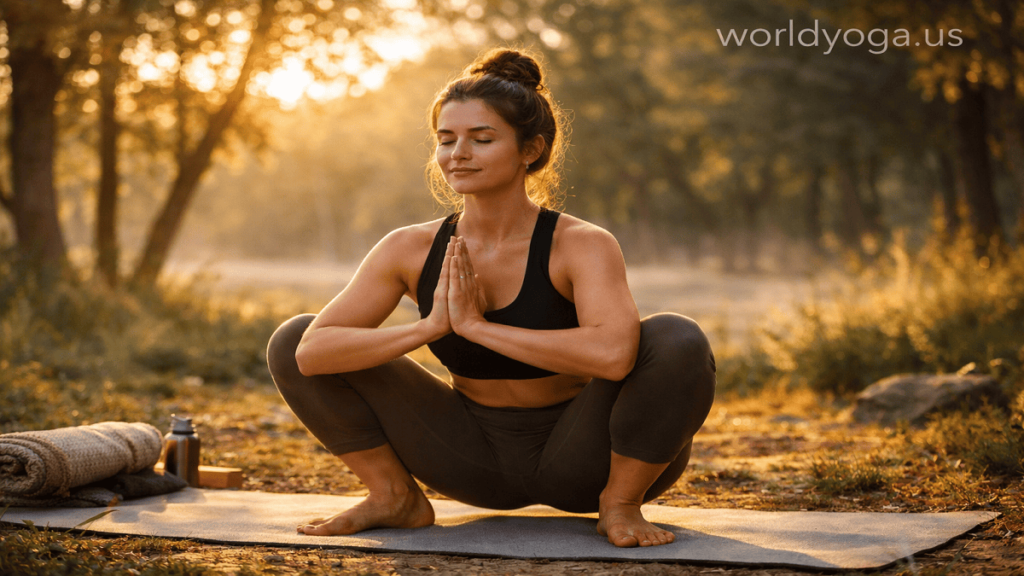
What is the proper alignment in Malasana?
Proper alignment in Malasana focuses on creating a stable, joint-safe deep squat while maintaining an upright, lengthened spine and balanced lower-body engagement. Because it is a weight-bearing posture, alignment is essential for protecting the knees, hips, ankles, and lower back.
1. Foot alignment
The feet are placed slightly wider than hip-width apart. The toes turn slightly outward, but not excessively, to match natural hip rotation. The heels ideally stay grounded. If heel lift occurs due to limited ankle mobility, a folded blanket or block can be placed underneath for support and stability.
2. Knee alignment
The knees should track directly in line with the toes throughout the movement. A key principle is to avoid inward collapse of the knees, which can place stress on the joint. Gentle engagement of the outer hips helps maintain proper tracking and stability.
3. Hip and pelvis alignment
The hips lower toward the floor in a controlled descent without forcing depth. The pelvis should remain neutral rather than excessively tucked under. The goal is a natural squat position that allows comfort while maintaining control and balance.
4. Spine alignment
The spine should stay long, upright, and neutral. The chest remains open, and the sternum lifts slightly upward. Rounding of the lower back or collapsing the torso forward should be avoided, as it reduces spinal integrity and can strain the lumbar region.
For foundational reference: Yoga Journal – Garland Pose Guide
5. Shoulder and upper body alignment
The shoulders stay relaxed and away from the ears. Hands are typically brought into prayer position at the chest, with elbows gently pressing against the inner thighs. This action supports hip opening while maintaining upper-body stability.
6. Weight distribution
Weight should be evenly distributed across the entire foot—heel, big toe mound, and little toe mound. This creates balance and prevents excessive pressure on any single joint or area of the foot.
7. Head and neck alignment
The neck remains in line with the spine, with a natural forward gaze. The head should not drop excessively forward or tilt backward.
8. Core engagement and breath
The core muscles should be gently engaged to support the spine and maintain balance. Inhale to lengthen the torso, and exhale to settle deeper into the squat without losing alignment or control.
Reference for anatomical context: Malasana Overview
Summary
Proper Malasana alignment is achieved when the practitioner maintains:
- Stable, grounded feet
- Knees tracking over toes
- Neutral pelvis and upright spine
- Relaxed shoulders and open chest
- Even weight distribution
- Controlled, breath-supported depth
This alignment ensures the pose is both safe and effective for improving hip mobility, lower-body strength, and postural awareness.
#Garland Pose in Ahemadabad
Which muscles are engaged during the pose?
Malasana is a deep squatting posture that recruits multiple muscle groups across the lower body, core, and postural stabilizers. Because it is a closed-chain position (feet fixed on the ground), many muscles work isometrically to maintain stability, alignment, and balance.
1. Lower body muscles
Quadriceps
The quadriceps are heavily engaged to control knee flexion as you lower into and hold the squat. They provide the primary support for maintaining the bent-knee position.
Gluteus maximus and medius
The glutes stabilize the hips and support pelvic alignment. The gluteus medius is especially important for preventing the knees from collapsing inward.
Hamstrings
The hamstrings assist in controlling the descent into the squat and help stabilize the back of the thigh during the hold.
Adductor muscles (inner thighs)
The adductors are strongly engaged in Malasana. They help maintain balance and prevent the knees from falling outward or inward excessively. They also assist in hip opening when the elbows gently press against the inner thighs.
Calf muscles (gastrocnemius and soleus)
These muscles stabilize the ankles and help maintain grounding through the feet, especially when holding a deep squat position.
2. Core and spinal stabilizers
Rectus abdominis
Helps maintain trunk stability and prevents excessive forward collapse of the torso.
Transverse abdominis
Acts as a deep stabilizer, supporting intra-abdominal pressure and spinal control.
Obliques
Assist in subtle postural adjustments and help stabilize the torso during micro-movements in the squat.
Erector spinae
Keeps the spine extended and upright, preventing rounding in the lower back.
3. Hip stabilizers
- Deep hip rotators (piriformis and surrounding muscles) support external rotation
- Hip flexors (iliopsoas) assist in maintaining squat depth control
- These muscles work together to stabilize pelvic positioning in a deep range
4. Foot and ankle muscles
- Intrinsic foot muscles maintain arch stability
- Tibialis anterior and posterior support ankle balance and dorsiflexion control
- These muscles ensure even weight distribution across the foot
Functional summary
Malasana engages a coordinated system of:
- Lower-body strength muscles (quads, glutes, adductors)
- Core stabilizers (abdominals and spinal muscles)
- Hip and ankle stabilizers for balance and control
This combination makes it a highly functional posture that improves mobility, strength, and postural endurance simultaneously.
For anatomical reference on the posture structure, see Yoga Journal – Garland Pose Guide and general description at Malasana Overview.
#Garland Pose in Hyderabad
What preparatory poses help achieve Garland Pose?
Garland Pose (Malasana) requires a combination of hip opening, ankle mobility, and core stability to safely achieve a deep squat with proper alignment. Preparatory poses are designed to gradually open the lower body, strengthen stabilizers, and improve balance so the posture can be performed comfortably and without strain.
1. Hip-opening preparatory poses
Bound Angle Pose (Baddha Konasana)
This pose opens the inner thighs and groin, directly improving the adductor flexibility needed for a stable squat position in Malasana.
Low Lunge (Anjaneyasana)
Low Lunge stretches the hip flexors and prepares the pelvis for controlled lowering into a squat. It also improves hip mobility and reduces tightness from prolonged sitting.
Frog Pose (Mandukasana – gentle variation)
This pose deeply targets the inner thighs and hips, helping develop external rotation and squat readiness.
2. Ankle mobility preparatory poses
Downward-Facing Dog (Adho Mukha Svanasana)
Stretches the calves and Achilles tendon, improving ankle dorsiflexion needed to keep heels grounded in Malasana.
Heel lifts and squats with support
Simple controlled heel raises and supported squats help strengthen ankle stability and improve balance in deep squat positions.
3. Core strengthening preparatory poses
Plank Pose (Phalakasana)
Builds core stability and teaches the body how to maintain spinal alignment under load.
Boat Pose (Navasana)
Strengthens abdominal muscles, which support balance and upright posture in Malasana.
Bridge Pose (Setu Bandhasana)
Activates posterior chain muscles and improves pelvic control for better squat stability.
4. Spinal mobility preparatory poses
Cat-Cow Pose (Marjaryasana–Bitilasana)
Improves spinal articulation and awareness, helping maintain a neutral spine in the squat.
Seated Forward Fold (Paschimottanasana)
Gently stretches the posterior chain and improves hamstring flexibility, supporting smoother squat mechanics.
5. Squat adaptation drills
Supported squat holds
Using a block or wall for support helps the body adapt to the deep squat position gradually without strain.
Wall-assisted squats
These help build confidence, balance, and correct alignment before attempting full Malasana.
Conclusion
A well-structured preparation for Garland Pose focuses on:
- Hip opening (Baddha Konasana, Low Lunge)
- Ankle flexibility (Downward Dog, heel work)
- Core strength (Plank, Boat Pose)
- Spinal mobility (Cat-Cow, forward folds)
- Gradual squat training (supported squats)
For foundational alignment reference, see Yoga Journal – Garland Pose Guide and anatomical overview at Malasana Overview.
In summary, these preparatory poses progressively build the mobility, strength, and stability required to safely and effectively achieve Malasana.
#Garland Pose in Delhi
What are the benefits and precautions of practicing Malasana?
Malasana, or Garland Pose, is a foundational deep squatting posture that supports hip mobility, lower-body strength, and postural awareness. While it offers significant functional and therapeutic benefits, it also requires attention to alignment and joint sensitivity to ensure safe practice.
Benefits of Malasana
1. Improved hip mobility and flexibility
Malasana deeply opens the hips, groin, and inner thighs (adductors). Regular practice increases external hip rotation and helps restore natural squatting ability, which is often reduced due to prolonged sitting.
2. Strengthening of lower body muscles
The posture actively engages the quadriceps, glutes, hamstrings, and calves, building endurance and functional strength needed for daily movements such as bending, lifting, and squatting.
3. Enhanced core stability and posture
The abdominal muscles and spinal stabilizers are engaged to maintain an upright spine. This improves postural alignment and reduces slouching tendencies.
4. Improved ankle mobility and balance
Holding a deep squat improves ankle dorsiflexion and foot stability, which supports better balance and coordination in functional movement.
5. Digestive and circulatory support
Traditionally, Malasana is believed to support digestion by gently compressing the abdominal region and stimulating internal organs through controlled breathing and posture.
Reference for anatomical and structural overview: Yoga Journal – Garland Pose Guide
Precautions of Malasana
1. Knee sensitivity or injury
Individuals with knee pain, ligament injuries, or meniscus issues should avoid forcing depth. Misalignment or excessive pressure can worsen discomfort.
2. Ankle limitations
Limited ankle flexibility may cause heel lift, which can strain balance. Using a folded blanket or block under the heels is recommended for support.
3. Lower back strain
Rounding the lower back or collapsing the torso forward can place stress on the lumbar spine. Maintaining a long, upright spine is essential.
4. Hip impingement or stiffness
People with hip joint issues should avoid pushing into deep squats and instead use modified versions with support.
5. Balance instability
Beginners may struggle with balance in deep squat positions. Wall support or props can help ensure safety during practice.
Reference on posture structure: Malasana Overview
Safe practice guidelines
- Do not force squat depth beyond comfort
- Keep knees aligned with toes
- Maintain an upright spine
- Use props when needed (blocks, blankets, wall support)
- Move slowly with controlled breathing
Conclusion
Malasana is a powerful functional posture that improves lower-body strength, hip flexibility, and core stability while supporting overall mobility and posture. However, safe practice depends on respecting individual limitations, maintaining correct alignment, and using modifications when necessary.
#Garland Pose in Banglore
Case Study of Garland Pose
1. Background
This case study examines the application of Garland Pose (Malasana) within a structured mobility improvement program. The subject is a 36-year-old office worker with chronic hip stiffness, reduced ankle mobility, and difficulty performing a natural deep squat due to prolonged sedentary lifestyle (8–10 hours sitting daily). The primary goal was to restore functional squatting ability, improve hip flexibility, and enhance postural stability over an 8-week period.
Reference for foundational posture mechanics: Yoga Journal – Garland Pose Guide
2. Initial Assessment
At baseline, the subject demonstrated:
- Limited hip external rotation
- Restricted ankle dorsiflexion causing heel lift in squats
- Weak core engagement during bending movements
- Forward trunk collapse during squat attempts
- Discomfort in knees during deep flexion
The subject was unable to maintain a stable, unsupported Malasana position.
3. Intervention Protocol
A progressive 8-week program was designed:
Weeks 1–2: Mobility Foundation
- Supported squats using a chair
- Cat-Cow for spinal mobility
- Bound Angle Pose (Baddha Konasana) for hip opening
Weeks 3–5: Strength and Adaptation
- Wall-assisted squats
- Low Lunge (Anjaneyasana) for hip flexor release
- Plank Pose for core stability
Weeks 6–8: Full Malasana Integration
- Deep squat practice with controlled descent
- Hands in prayer position with elbows pressing inner thighs
- Focus on breath control and spinal alignment
Reference for anatomical structure and posture classification: Malasana Overview
4. Observations and Outcomes
After 8 weeks, the following improvements were recorded:
- Hip mobility significantly improved, allowing deeper squat depth without pain
- Ankle flexibility increased, reducing heel lift and improving stability
- Core strength improved, supporting upright posture during squatting
- Knee discomfort reduced, due to improved alignment and muscle balance
- Functional movement confidence increased, especially in bending and lifting tasks
The subject reported that Malasana became more comfortable and sustainable for daily mobility practice.
5. Discussion
This case demonstrates that Malasana is highly effective as a functional movement training tool when introduced progressively. The structured approach—starting with supported variations and gradually increasing load—was essential in preventing strain and ensuring neuromuscular adaptation.
The posture not only improved flexibility but also retrained natural squat mechanics often lost due to sedentary behavior.
6. Conclusion
Garland Pose (Malasana) is a highly effective foundational posture for improving hip mobility, ankle flexibility, core stability, and functional movement efficiency. When integrated progressively with proper alignment and preparatory poses, it serves as both a corrective and strengthening movement pattern suitable for general population fitness and mobility restoration programs.
#Garland Pose in Kolkata
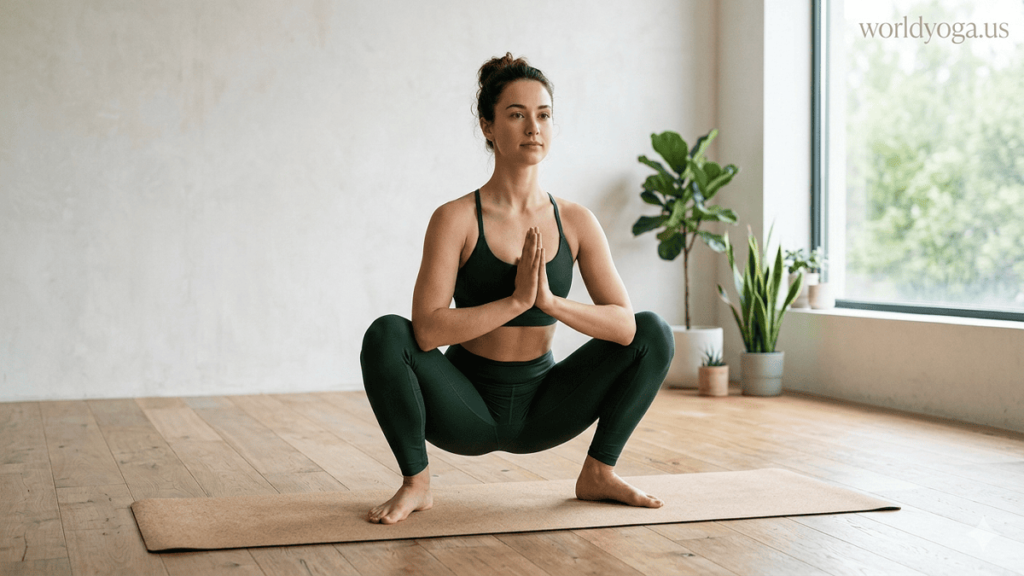
White Paper of Garland Pose
1. Executive Summary
Garland Pose, or Malasana, is a foundational deep squatting posture widely used in yoga, mobility training, and functional movement systems. It emphasizes hip opening, lower-body strength, ankle mobility, and spinal alignment. This white paper outlines its biomechanics, physiological effects, applications across industries, and safety considerations for structured practice.
2. Background and Context
Malasana reflects a natural human squatting position that is often reduced in modern sedentary lifestyles. In traditional yoga systems, it is used to improve grounding, flexibility, and postural awareness. Contemporary movement science recognizes it as a key functional pattern for restoring squat mechanics and joint mobility.
For foundational reference: Yoga Journal – Garland Pose Guide
For anatomical classification: Malasana Overview
3. Biomechanical Analysis
Malasana involves coordinated multi-joint engagement:
- Lower body: Quadriceps control knee flexion; gluteus maximus stabilizes hip extension; adductors regulate leg alignment; calves support ankle stability.
- Core system: Rectus abdominis and transverse abdominis maintain trunk stability; obliques assist in postural balance.
- Spinal structure: Erector spinae maintains upright alignment and prevents lumbar collapse.
- Feet and ankles: Intrinsic foot muscles provide grounding and balance control.
The posture functions as a closed-chain deep squat, requiring isometric endurance across multiple muscle groups.
4. Functional Benefits
4.1 Mobility Enhancement
Improves hip external rotation, ankle dorsiflexion, and lower-back flexibility.
4.2 Strength Development
Builds endurance in quadriceps, glutes, hamstrings, and core stabilizers.
4.3 Postural Improvement
Encourages upright spinal alignment and reduces effects of prolonged sitting posture.
4.4 Functional Movement Transfer
Enhances real-world movements such as bending, lifting, and squatting.
4.5 Circulatory and Digestive Support
Promotes mild abdominal compression and improved circulation through controlled breathing and posture.
5. Industry Applications
- Fitness training: Used in mobility circuits and squat pattern development
- Physiotherapy: Applied in hip and ankle rehabilitation programs
- Sports performance: Supports agility, rotational stability, and injury prevention
- Corporate wellness: Reduces stiffness from prolonged sitting
- Yoga systems: Foundational posture for beginners and progression sequences
6. Risk Factors and Precautions
Despite its benefits, Malasana requires careful execution:
- Avoid forcing depth in individuals with knee or hip injuries
- Use support (blocks or blankets) for limited ankle mobility
- Maintain neutral spine to prevent lumbar strain
- Ensure knees track over toes to avoid joint stress
- Avoid prolonged holds without preparation in beginners
7. Methodological Progression
Recommended progression model:
- Supine and seated mobility drills
- Hip-opening preparatory poses
- Supported squat practice
- Partial Malasana holds
- Full Malasana integration
This ensures safe neuromuscular adaptation and joint conditioning.
8. Conclusion
Garland Pose (Malasana) is a highly effective functional movement pattern that improves lower-body mobility, core stability, and postural alignment. When practiced with proper progression and alignment, it serves as a foundational tool for rehabilitation, fitness development, and long-term movement efficiency.
#Garland Pose in Pune
Industry Application of Garland Pose
Garland Pose, or Malasana, is a deep squatting posture widely applied across multiple industries focused on movement efficiency, rehabilitation, performance optimization, and workplace wellness. Its relevance comes from its ability to restore a fundamental human movement pattern: the natural deep squat.
1. Fitness and Functional Training Industry
In fitness systems, Malasana is used as a foundational mobility and strength-building exercise.
- Improves squat mechanics and lower-body movement quality
- Develops hip mobility, ankle flexibility, and core endurance
- Used in warm-ups, mobility flows, and corrective exercise programs
- Helps retrain natural squatting patterns often lost due to sedentary habits
Fitness professionals often include it in movement preparation routines before strength training or athletic conditioning sessions.
Reference for posture mechanics: Yoga Journal – Garland Pose Guide
2. Physiotherapy and Rehabilitation
In clinical and rehabilitation settings, Malasana is used as a functional recovery movement.
- Assists in restoring hip and ankle range of motion
- Helps improve knee stability through controlled loading
- Used in postural re-education for sedentary or injured patients
- Supports gradual reintroduction of weight-bearing squat patterns
Therapists often modify the pose using props such as blocks or support surfaces to ensure safety and controlled progression.
3. Sports Performance and Athletic Training
Athletes use Malasana to enhance mobility, stability, and injury prevention.
- Improves explosive lower-body mechanics (jumping, sprinting)
- Enhances hip external rotation for agility and directional changes
- Builds core stability for rotational sports
- Reduces stiffness from repetitive training loads
It is especially useful in sports requiring deep hip engagement and quick directional movement.
4. Corporate Wellness and Occupational Health
In workplace wellness programs, Malasana is used to counteract sedentary lifestyle effects.
- Reduces hip and lower-back stiffness from prolonged sitting
- Improves posture awareness and spinal alignment
- Can be performed as a short mobility break exercise
- Supports stress reduction through controlled breathing and grounding
This aligns with ergonomic strategies aimed at reducing musculoskeletal strain in office environments.
5. Yoga and Mind-Body Industry
Within yoga systems, Malasana is a foundational posture for beginners and sequencing.
- Prepares practitioners for advanced hip-opening poses
- Enhances grounding and body awareness
- Improves squat-based movement transitions in flows
- Builds foundational flexibility and balance
It remains a core posture in traditional and modern yoga practices Malasana Overview
Conclusion
Garland Pose has strong cross-industry relevance due to its functional, adaptable, and low-equipment nature. It is widely used in fitness, rehabilitation, sports performance, corporate wellness, and yoga training systems. Its ability to improve hip mobility, ankle flexibility, core strength, and postural control makes it a valuable movement tool for enhancing human biomechanics and long-term physical health across populations.
#Garland Pose in Mumbai
Ask FAQs
What is Garland Pose (Malasana)?
Garland Pose, or Malasana, is a deep squatting yoga posture that opens the hips, strengthens the lower body, and improves spinal alignment. It reflects a natural resting squat position and is commonly used in yoga and mobility training for flexibility and functional movement development.
Who can practice Malasana?
Malasana is suitable for beginners to advanced practitioners, provided it is modified according to mobility levels. People with good hip and ankle flexibility can perform it directly, while beginners or those with stiffness may use props like blocks or folded blankets for support. Individuals with knee or hip injuries should consult a professional before practicing.
What are the main benefits of Garland Pose?
Malasana improves hip flexibility, strengthens the legs and core, enhances ankle mobility, and supports better posture. It also helps develop functional squat strength and can reduce stiffness caused by prolonged sitting. Additionally, it promotes body awareness and balance.
What are common mistakes in this pose?
Common mistakes include letting the knees collapse inward, rounding the lower back, lifting the heels excessively without support, and forcing the squat deeper than comfortable. These errors can reduce effectiveness and increase strain on the joints.
How can beginners make Malasana easier?
Beginners can place a block or cushion under the hips or heels for support. Keeping the hands at the chest in a prayer position helps maintain balance. Practicing hip-opening poses like Bound Angle Pose and Low Lunge can also help prepare the body for deeper squatting.
Table of Contents
Disclaimer: This content is for educational and informational purposes only and is not intended as medical advice. Practice Garland Pose (Malasana) within your own comfort and mobility limits. Consult a qualified healthcare professional or certified yoga instructor before beginning, especially if you have any existing injuries or medical conditions.