Downward Dog: One-Armed
The One-Armed Downward Dog is an advanced variation of Downward-Facing Dog that challenges unilateral strength, balance, and core stability. By removing one hand from the ground, the pose introduces asymmetrical loading, requiring the body to resist rotation while maintaining proper alignment through the shoulders, spine, and hips.
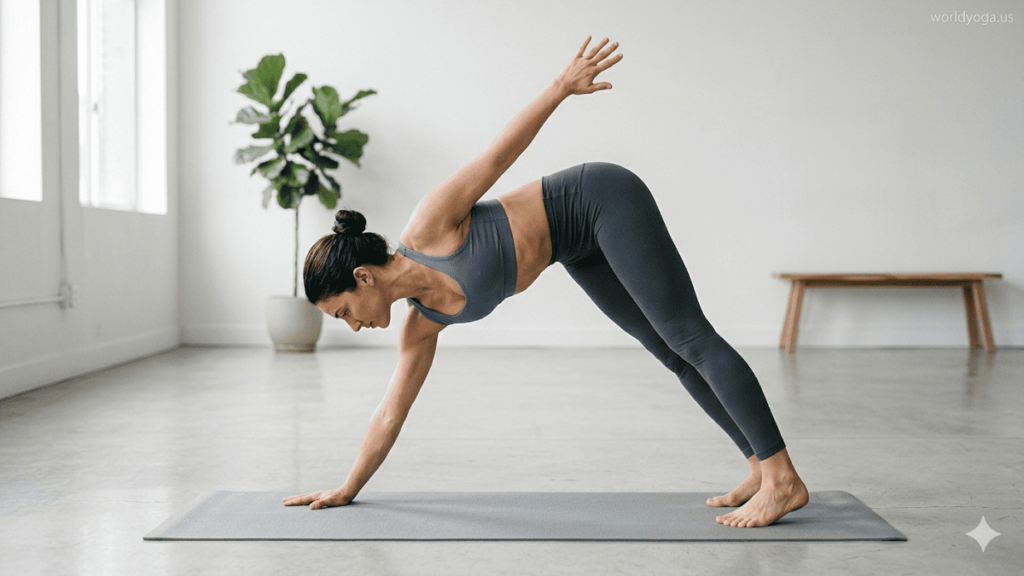
In the traditional Downward-Facing Dog, weight is evenly distributed between both hands and feet, forming a stable inverted “V” shape. In the one-armed variation, one hand remains grounded while the other is lifted—either resting lightly on the thigh, extended forward, or placed behind the back. This shift significantly increases demand on the supporting arm, particularly the deltoids, triceps, and stabilizing muscles of the shoulder girdle, including the rotator cuff and serratus anterior.
To perform the pose correctly, begin in a well-aligned Downward-Facing Dog. Ensure your hands are shoulder-width apart, fingers spread, and hips lifted with a long, neutral spine. From this stable base, engage your core to prevent the torso from twisting. Slowly shift more weight into one hand and both feet. Once balanced, gently lift the opposite hand off the mat. Keep the hips as level as possible and avoid collapsing into the supporting shoulder by actively pressing the floor away.
The key to this variation is maintaining control rather than simply lifting the hand. The pelvis should remain relatively square, and the spine should not rotate excessively. The standing arm must stay strong and stable, with a slight external rotation to protect the shoulder joint. Holding the pose for 2–4 breaths per side is sufficient for most practitioners.
Benefits of the One-Armed Downward Dog include enhanced shoulder stability, improved core strength (especially anti-rotational control), and greater proprioception. It also builds confidence and coordination, making it a useful preparatory pose for more advanced arm balances.
Precautions are important due to the increased load on a single shoulder and wrist. Individuals with wrist pain, shoulder instability, or recent injuries should approach this variation carefully or avoid it altogether. Common mistakes include letting the torso twist excessively, collapsing into the supporting shoulder, or shifting too much weight forward.
For additional guidance and technique refinement, resources such as Yoga Journal (https://www.yogajournal.com/poses/downward-facing-dog/) and DoYogaWithMe (https://www.doyogawithme.com/content/three-legged-dog-pose-variation) provide foundational insights into alignment and safe progression.
Overall, the One-Armed Downward Dog is a strength-focused progression that prioritizes stability, control, and mindful movement, making it a valuable addition to advanced yoga practice.
#Downward Dog: One-Armed in India
How is One-Armed Downward Dog performed safely?
1. Start with a stable foundation
Begin in a well-aligned Downward-Facing Dog. Hands should be shoulder-width apart, fingers spread wide, and pressing evenly into the mat. Feet are hip-width apart, hips lifted, and spine long. Before lifting one hand, ensure both shoulders feel equally engaged and not collapsing inward.
A strong base in poses like Plank Pose is highly recommended beforehand, as it builds the shoulder and core strength needed for safe asymmetrical loading.
2. Engage core to prevent twisting
Safety in this pose depends heavily on anti-rotational core strength. Activate the transverse abdominis and obliques by gently drawing the navel inward. This prevents the torso from rotating when one hand is lifted. Without this engagement, the lower back and shoulders compensate, increasing injury risk.
3. Shift weight gradually
Slowly transfer more weight into one hand and both feet before lifting the opposite hand. Avoid sudden movement. The supporting arm should remain strong but not locked, with a slight micro-bend to protect the elbow joint.
4. Maintain shoulder stability
The supporting shoulder is the most vulnerable area. Actively press the floor away to engage the serratus anterior and prevent sinking into the joint. Keep the shoulder externally rotated slightly to maintain space in the socket. This reduces strain and improves control.
5. Keep hips as level as possible
A key safety principle is minimizing pelvic rotation. The hips should remain squared toward the floor rather than opening to one side. Excessive twisting shifts pressure into the lower back and compromises spinal alignment.
6. Control the lifted hand
When lifting one hand, avoid swinging or using momentum. The hand can rest lightly on the thigh, extend forward, or hover near the body—but the movement should always be slow and intentional.
7. Hold briefly and exit carefully
Hold the pose for 2–4 steady breaths per side. Exit slowly by returning the hand to the mat with control before resetting your base.
Common safety precautions
- Avoid if you have wrist, elbow, or shoulder injuries
- Do not over-shift weight onto the supporting arm
- Avoid collapsing into the chest or rounding the spine
- Do not force balance if core engagement is weak
Practicing preparatory poses such as Dolphin Pose and Bird Dog Pose can significantly improve safety by strengthening stabilizers.
For alignment references, Yoga Journal (https://www.yogajournal.com/poses/downward-facing-dog/) and DoYogaWithMe (https://www.doyogawithme.com/content/three-legged-dog-pose-variation) offer helpful foundational guidance.
In summary, safe execution of the One-Armed Downward Dog depends on controlled weight transfer, strong core engagement, and strict shoulder stability rather than depth or duration.
#Downward Dog: One-Armed in Maharashtra
What is the correct alignment in this variation?
1. Hand and shoulder alignment
Start with the grounded hand placed directly under the shoulder, not forward or behind it. The fingers should be spread wide, with pressure distributed evenly—especially through the index finger and thumb. The supporting arm must remain straight but not locked. A slight micro-bend protects the elbow joint.
The shoulder should stay active and stable. Avoid sinking into the joint. Instead, press the floor away to engage the serratus anterior and keep space in the shoulder socket. The upper back should remain broad, not collapsed.
2. Spine and torso alignment
The spine should stay long and neutral, maintaining the same integrity as in a standard Downward Dog. A common error is twisting the torso toward the grounded hand side. Instead, the chest should face the mat, with minimal rotation.
Core engagement is essential here. The transverse abdominis and obliques work to prevent the spine from rotating under asymmetrical load. Think of the ribs gently drawing inward to stabilize the midsection.
3. Hip alignment
The pelvis should remain as level as possible. One of the most important alignment goals is resisting the tendency for the hips to open or shift toward the lifted side. Uneven hips can place stress on the lower back and reduce stability.
A helpful cue is to imagine both hip points facing the floor evenly, similar to the alignment focus in Three-Legged Dog, but without the external rotation of the lifted side.
4. Leg and foot alignment
Both legs remain active and engaged. The feet stay hip-width apart, pressing evenly into the mat. Heels move toward the floor, but do not need to fully touch it. The legs should act as stabilizing pillars rather than passive supports.
5. Head and neck alignment
The neck should remain neutral, in line with the spine. The gaze can be toward the feet or the mat, avoiding excessive lifting or dropping of the head.
6. Weight distribution
Although one hand is lifted, weight should still be distributed between the grounded hand and both feet. The goal is not to overload the supporting arm but to create balanced integration across the entire body.
Summary of key alignment principles
- Grounded hand under shoulder
- Strong, active supporting shoulder
- Long, neutral spine with minimal rotation
- Level pelvis, no hip collapse or opening
- Engaged core to resist twisting
- Even weight distribution through base points
For foundational alignment guidance, Yoga Journal (https://www.yogajournal.com/poses/downward-facing-dog/) and DoYogaWithMe (https://www.doyogawithme.com/content/three-legged-dog-pose-variation) provide useful references that apply directly to this progression.
In essence, correct alignment in the One-Armed Downward Dog is defined by stability under asymmetry—keeping the body unified, controlled, and non-rotational despite the reduced base of support.
#Downward Dog: One-Armed in Ahemadabad
Which muscles are engaged during the pose?
1. Core muscles (primary stabilizers)
The core is highly engaged to prevent the torso from rotating or collapsing.
- Transverse abdominis: Acts as a deep stabilizing corset, maintaining spinal neutrality under asymmetrical load.
- Internal and external obliques: Resist rotation and keep the ribcage aligned with the pelvis.
- Rectus abdominis: Assists in maintaining overall trunk stability and preventing excessive lumbar extension.
This anti-rotation demand is significantly higher than in standard Downward Dog or even Three-Legged Dog.
2. Shoulder complex (supporting arm)
The supporting arm bears most of the upper-body load and must remain highly stable:
- Deltoids (especially anterior fibers): Maintain shoulder positioning under load.
- Rotator cuff muscles: Stabilize the shoulder joint and prevent collapse or excessive internal rotation.
- Serratus anterior: Keeps the scapula engaged against the ribcage, preventing winging.
- Trapezius (lower and middle fibers): Support scapular alignment and postural control.
- Triceps brachii: Maintain elbow extension and structural support.
3. Back muscles
- Latissimus dorsi: Helps control the torso’s relationship to the hips and supports spinal length.
- Erector spinae: Maintain a neutral spine and prevent rounding or overextension.
- Rhomboids: Assist in scapular retraction and upper-back stability.
4. Lower body (legs and hips)
- Gluteus maximus: Supports hip extension and stabilizes pelvis alignment.
- Gluteus medius and minimus: Crucial for pelvic stability and preventing lateral shift or collapse.
- Hamstrings: Assist in maintaining hip hinge and posterior chain engagement.
- Quadriceps: Stabilize the knees and support lower-body structure.
- Calf muscles (gastrocnemius and soleus): Contribute to ankle stability and balance.
5. Forearms and hands
- Forearm flexors and extensors: Control wrist stability and distribute pressure through the grounded hand.
- Intrinsic hand muscles: Maintain grip and balance through finger engagement.
Key insight
The One-Armed Downward Dog is fundamentally an anti-rotation and unilateral strength exercise disguised as a yoga pose. The most important muscular work happens not in movement, but in stabilization—especially through the core and supporting shoulder.
For reference on foundational biomechanics, see Yoga Journal (https://www.yogajournal.com/poses/downward-facing-dog/) and DoYogaWithMe (https://www.doyogawithme.com/content/three-legged-dog-pose-variation).
#Downward Dog: One-Armed in Hyderabad
What preparatory poses build strength for this variation?
1. Foundational weight-bearing poses
These establish the base strength needed for any arm-supported variation:
Plank Pose
Plank is essential for building shoulder endurance and core engagement. It teaches the body how to maintain a straight line under load, which directly translates to stability in the one-armed variation. Focus on pressing the floor away and keeping the ribs controlled.
Side Plank
Side Plank is particularly important because it trains anti-rotational strength and unilateral shoulder loading. This directly mirrors the imbalance created when one hand is lifted in the target pose.
2. Shoulder stability and endurance work
Dolphin Pose
Dolphin Pose strengthens the shoulders and upper back in a Downward Dog-like position, but with reduced wrist load. It builds endurance in the deltoids, serratus anterior, and rotator cuff—critical for safe one-arm support.
3. Core anti-rotation training
Bird Dog Pose
Bird Dog teaches controlled movement between opposite arm and leg while keeping the torso stable. This directly trains the body to resist twisting when one hand is lifted in the final variation.
Boat Pose
Boat Pose strengthens deep core muscles, especially the transverse abdominis, which is essential for keeping the spine stable under asymmetrical load.
4. Progressive Downward Dog variations
Three-Legged Dog
This is a key transitional pose. It teaches weight shift into one arm while lifting one leg, helping the practitioner understand balance and load distribution before removing a hand.
Standard Downward-Facing Dog
Repeated practice of the base pose is necessary to ensure proper shoulder alignment, hamstring length, and spinal control before advancing.
5. Wrist and shoulder conditioning
- Wrist rock-backs (to build joint tolerance)
- Shoulder taps in plank (to simulate weight shift)
- Scapular push-ups (to strengthen serratus anterior control)
Summary
To safely prepare for the One-Armed Downward Dog, training should prioritize:
- Shoulder endurance (Plank, Dolphin)
- Core anti-rotation strength (Side Plank, Bird Dog)
- Controlled asymmetry (Three-Legged Dog)
- Foundational alignment (Downward-Facing Dog)
For additional anatomical and alignment guidance, Yoga Journal (https://www.yogajournal.com/poses/downward-facing-dog/) and DoYogaWithMe (https://www.doyogawithme.com/content/three-legged-dog-pose-variation) provide reliable foundational references.
#Downward Dog: One-Armed in Pune
What are the benefits and precautions of this pose?
Benefits
1. Advanced shoulder strength and stability
This pose strongly activates the stabilizing structures of the shoulder complex, including the rotator cuff, deltoids, and serratus anterior. The supporting arm must control the entire upper-body load, improving joint integrity and endurance.
2. Core anti-rotation strength
Because the body naturally wants to twist when one hand is lifted, the deep core muscles—especially the transverse abdominis and obliques—must engage intensely. This builds functional strength that improves posture and movement control in other activities.
3. Improved balance and proprioception
The reduction in base support enhances body awareness. Practitioners develop a refined sense of alignment and weight distribution, which improves coordination and stability in both yoga and daily movement.
4. Enhanced upper-back engagement
Muscles of the upper back, including the trapezius and rhomboids, work to maintain scapular stability. This helps counteract rounded-shoulder posture commonly seen in sedentary lifestyles.
5. Preparation for advanced arm balances
This pose acts as a stepping stone toward more complex asymmetrical postures by teaching controlled weight shifting and one-sided load management.
Precautions
1. Wrist and shoulder strain risk
Because all upper-body weight shifts onto a single arm, individuals with wrist pain, shoulder instability, or prior injuries should approach this pose cautiously or avoid it. Overloading the supporting arm can lead to joint irritation.
2. Avoid spinal twisting or collapse
A common mistake is rotating the torso toward the grounded hand or letting the chest collapse. This reduces core engagement and increases stress on the lower back and shoulder.
3. Do not sacrifice alignment for balance
Lifting the hand should not come at the expense of form. If stability is lost, it is safer to return the hand to the mat rather than hold a compromised position.
4. Overloading the supporting shoulder
Collapsing into the shoulder joint can lead to compression injuries. The practitioner should actively push the floor away to keep the shoulder engaged and stable.
5. Not recommended for beginners
Without sufficient preparatory strength from poses like Plank Pose and Dolphin Pose, this variation may place excessive stress on stabilizing muscles.
Summary
The One-Armed Downward Dog offers significant benefits in shoulder strength, core stability, and balance development. However, it is only safe when performed with strict alignment, controlled movement, and adequate preparatory conditioning.
For foundational alignment principles, Yoga Journal (https://www.yogajournal.com/poses/downward-facing-dog/) and DoYogaWithMe (https://www.doyogawithme.com/content/three-legged-dog-pose-variation) provide useful reference material.
#Downward Dog: One-Armed in Banglore
Case Study of Downward Dog: One-Armed
1. Case Background
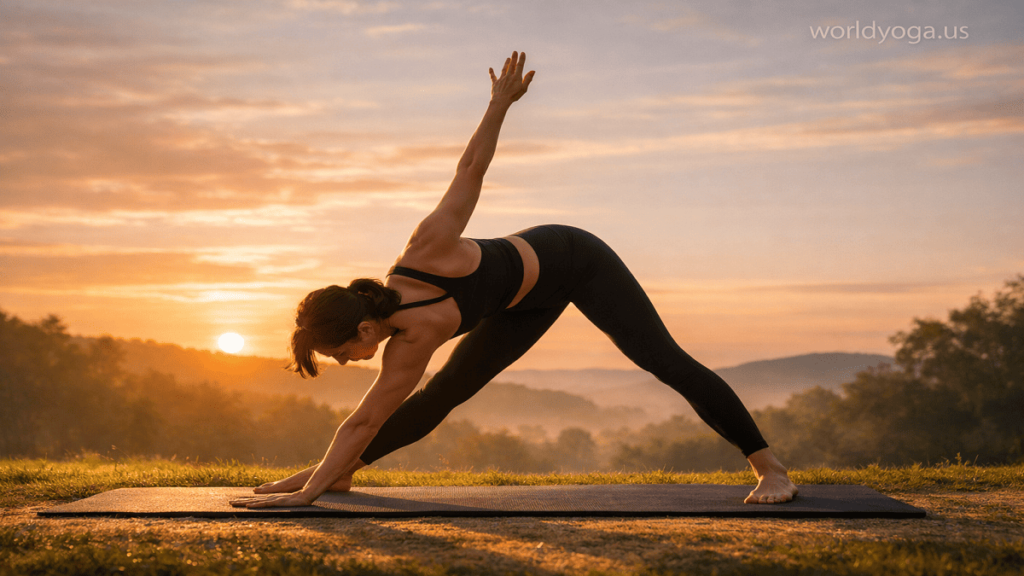
A 29-year-old recreational yoga practitioner with 3 years of consistent practice reported difficulty progressing into arm balances and frequent right shoulder fatigue during weight-bearing transitions. The practitioner was comfortable in standard Downward-Facing Dog and Three-Legged Dog but demonstrated early trunk rotation and instability when shifting weight unevenly.
The objective of the intervention was to:
- Improve shoulder stability under unilateral load
- Strengthen core anti-rotation capacity
- Enhance proprioceptive control during asymmetrical poses
2. Methodology
A structured 8-week progression protocol was introduced, incorporating:
- Foundational strengthening (Plank Pose, Dolphin Pose)
- Core stabilization training (Bird Dog Pose, Side Plank)
- Controlled asymmetry practice (Three-Legged Dog transitions)
- Gradual introduction of One-Armed Downward Dog holds
Sessions were performed 4 times per week, with emphasis on slow transitions, breath control, and alignment integrity rather than duration.
3. Observations
Weeks 1–2:
The practitioner exhibited noticeable torso rotation when lifting one hand. The supporting shoulder showed signs of collapse due to insufficient serratus anterior engagement. Core activation was inconsistent, leading to instability.
Weeks 3–5:
Improved scapular control was observed. The practitioner demonstrated better ability to maintain a neutral spine during partial weight shifts. Core engagement increased, reducing excessive twisting.
Weeks 6–8:
The practitioner achieved controlled holds of 3–4 breaths per side in One-Armed Downward Dog. Shoulder stability improved significantly, with reduced fatigue and better alignment retention. Pelvic rotation decreased, indicating improved anti-rotational core strength.
4. Outcomes
- Increased unilateral shoulder endurance
- Improved core stability and anti-rotation control
- Enhanced proprioception and body awareness
- Reduced compensatory spinal twisting
- Improved transition control into dynamic arm-bearing poses
5. Discussion
The results highlight that the One-Armed Downward Dog functions not only as a strength-building posture but also as a diagnostic tool for identifying asymmetries in shoulder and core control. Compared to symmetrical loading in standard Downward Dog, this variation exposes weaknesses in stabilizer muscles more rapidly, making it valuable in both yoga progression and corrective training contexts.
6. Safety Considerations
Throughout the study, strict alignment cues were enforced:
- Grounded hand aligned under shoulder
- Core engaged to prevent rotation
- Hips kept as level as possible
- No collapse into supporting shoulder
These precautions minimized risk to the wrist and shoulder joint while ensuring progressive adaptation.
7. Conclusion
This case demonstrates that the One-Armed Downward Dog is an effective advanced training tool for improving unilateral stability, core control, and postural awareness. When introduced progressively with proper preparatory work, it enhances functional strength and prepares practitioners for higher-level arm balance practices.
#Downward Dog: One-Armed in Kolkata
White Paper of Downward Dog: One-Armed
Abstract
The One-Armed Downward Dog is an advanced progression of Downward-Facing Dog designed to develop unilateral shoulder strength, core anti-rotation control, and global postural stability. By removing one point of upper-limb support, the posture significantly increases neuromuscular demand across the shoulder girdle and trunk. This paper outlines its biomechanics, physiological effects, applications, and safety considerations within modern movement and yoga-based training systems.
1. Introduction
Traditional Downward-Facing Dog is a symmetrical closed-chain posture that distributes load evenly across both upper limbs and lower limbs. The one-armed variation introduces controlled asymmetry, forcing the neuromuscular system to stabilize against rotational collapse. Compared with Three-Legged Dog, which primarily challenges hip mobility and balance, this variation shifts emphasis toward upper-body load management and spinal integrity under unilateral stress.
2. Biomechanical Analysis
2.1 Upper Limb Loading
With one hand removed, approximately 60–70% of upper-body load transfers to a single shoulder complex. This requires:
- Increased activation of the serratus anterior for scapular stabilization
- High engagement of rotator cuff muscles for glenohumeral joint control
- Sustained contraction of deltoids and triceps for structural support
2.2 Core Anti-Rotation Mechanics
The absence of bilateral support introduces rotational torque. Stability depends on:
- Transverse abdominis (deep core bracing)
- Internal/external obliques (resisting spinal rotation)
- Multifidus and spinal stabilizers (segmental control of the vertebrae)
2.3 Posterior Chain Integration
- Latissimus dorsi maintains upper-lower body linkage
- Gluteus medius and maximus stabilize pelvic alignment
- Hamstrings assist in maintaining hip hinge structure
3. Physiological Benefits
3.1 Shoulder Strength and Resilience
Improves load tolerance in the shoulder joint, enhancing injury resistance in dynamic movement patterns.
3.2 Core Stability Enhancement
Develops functional anti-rotation strength essential for posture, locomotion, and athletic performance.
3.3 Neuromuscular Coordination
Improves proprioception by challenging balance under asymmetric conditions.
3.4 Postural Correction Support
Strengthens scapular stabilizers, helping reduce forward-shoulder posture patterns.
4. Applications
- Yoga progression training: Bridges foundational poses to arm balances
- Rehabilitation contexts: Assists controlled reconditioning of shoulder stability
- Athletic conditioning: Enhances unilateral force control and core integration
- Movement education: Improves awareness of load transfer mechanics
5. Risk Factors and Precautions
- Shoulder overload risk due to unilateral load concentration
- Wrist strain potential if alignment is not directly under shoulder
- Spinal rotation compensation if core engagement is insufficient
- Exclusion criteria: individuals with acute shoulder instability or wrist injuries
Proper progression through preparatory poses such as Plank Pose and Dolphin Pose is strongly recommended.
6. Safety Guidelines
- Maintain strict shoulder alignment over wrist
- Engage core before lifting the hand
- Avoid thoracic or lumbar rotation
- Distribute weight evenly across grounded hand and feet
- Use short holds (2–4 breaths) during early training phases
7. Conclusion
The One-Armed Downward Dog is a high-demand stability posture that transforms a foundational yoga shape into a unilateral strength and neuromuscular control exercise. Its primary value lies not in flexibility or range of motion, but in resistance to collapse under asymmetrical load. When integrated progressively, it enhances shoulder resilience, core integrity, and full-body coordination.
References
- Yoga Journal: https://www.yogajournal.com/poses/downward-facing-dog/
- DoYogaWithMe: https://www.doyogawithme.com/content/three-legged-dog-pose-variation
#Downward Dog: One-Armed in Delhi
Industry Application of Downward Dog: One-Armed
1. Fitness and Strength & Conditioning Industry
In modern strength and conditioning programs, this variation is used as a bodyweight training tool to improve unilateral upper-body strength and core integration. Unlike machine-based training, it challenges stabilizer muscles in real-time.
Applications include:
- Progression training for advanced calisthenics and arm balances
- Shoulder stability conditioning for athletes
- Core anti-rotation drills integrated into functional fitness circuits
It is often paired with foundational movements like Plank Pose and dynamic variations of Downward Dog to build progressive load tolerance.
2. Physiotherapy and Rehabilitation
In clinical movement therapy, the One-Armed Downward Dog is used as a controlled loading exercise for shoulder and scapular rehabilitation.
Key applications:
- Rebuilding serratus anterior activation after shoulder injury
- Restoring scapular control in postural dysfunction cases
- Gradual reintroduction of weight-bearing in upper-limb recovery
Because it can be scaled (using partial weight shift or elevated surfaces), it is adaptable for rehabilitation protocols when supervised.
3. Sports Performance and Athletic Training
Athletes in sports requiring unilateral strength—such as tennis, swimming, climbing, and combat sports—benefit from the pose’s ability to improve asymmetrical force control.
Benefits in this context:
- Enhanced shoulder endurance under uneven load
- Improved trunk stability during rotational sports movements
- Better injury resistance in high-impact or overhead activities
Compared to symmetrical training, this variation better replicates real-world athletic demands.
4. Corporate Wellness and Ergonomics
In workplace wellness programs, the pose is adapted into short movement breaks to counteract prolonged sitting.
Applications:
- Reducing scapular stiffness from desk posture
- Improving postural awareness and spinal alignment
- Activating core stabilizers during sedentary work routines
Even simplified versions (such as weight shifts in Downward Dog) can reduce musculoskeletal strain associated with office ergonomics.
5. Yoga Education and Teacher Training
In advanced yoga curricula, this pose is used as a progression marker for stability and control mastery.
It helps instructors assess:
- Core engagement quality
- Shoulder stability under asymmetrical load
- Readiness for arm balances and transitions
It is often introduced only after mastery of standard Downward Dog and preparatory poses such as Dolphin Pose and Side Plank.
Conclusion
The One-Armed Downward Dog functions as a cross-disciplinary movement tool that bridges yoga, rehabilitation science, and athletic conditioning. Its emphasis on anti-rotation strength and unilateral stability makes it valuable for both performance enhancement and injury prevention strategies.
For foundational reference on alignment principles, Yoga Journal (https://www.yogajournal.com/poses/downward-facing-dog/) and DoYogaWithMe (https://www.doyogawithme.com/content/three-legged-dog-pose-variation) provide useful supporting material.
#Downward Dog: One-Armed in Mumbai
Ask FAQs
What is the main purpose of the One-Armed Downward Dog?
The primary purpose is to develop unilateral shoulder strength, core anti-rotation stability, and full-body coordination. By removing one point of support, the body must work harder to maintain alignment and prevent twisting, making it a highly effective advanced stability exercise.
Is the One-Armed Downward Dog suitable for beginners?
No, it is generally considered an advanced variation. Beginners should first master foundational poses such as standard Downward-Facing Dog, Plank Pose, and Dolphin Pose before attempting this progression. Lack of preparation can lead to shoulder or wrist strain.
What are the most important alignment cues?
Key alignment principles include keeping the grounded hand directly under the shoulder, maintaining a long neutral spine, engaging the core to prevent rotation, and keeping the hips as level as possible. The supporting shoulder must stay active to avoid collapsing into the joint.
What muscles does this pose strengthen the most?
It strongly engages the core (especially the transverse abdominis and obliques), the shoulder stabilizers (rotator cuff and serratus anterior), and the upper back muscles. The legs and glutes also work to maintain balance and pelvic alignment under asymmetrical load.
What precautions should be taken before practicing this pose?
Practitioners should avoid this pose if they have wrist, elbow, or shoulder injuries. It is important not to rush into lifting the hand without proper core engagement, as this can cause spinal rotation or joint overload. Preparatory poses like Dolphin Pose and Side Plank are recommended for safe progression.
Table of Contents
Disclaimer:
This content is for informational and educational purposes only and is not a substitute for professional medical, fitness, or physiotherapy advice. Consult a qualified healthcare provider or certified yoga instructor before attempting advanced poses, especially if you have existing injuries or health conditions.