Downward Dog: One-Legged—Knees Together
The Downward Dog: One-Legged—Knees Together variation builds on the foundational yoga posture Downward-Facing Dog (Adho Mukha Svanasana) by introducing asymmetrical load, enhanced core engagement, and refined hip control. This variation is particularly effective for practitioners seeking to improve balance, stability, and alignment awareness without over-relying on flexibility alone.
In the standard Downward-Facing Dog, the body forms an inverted “V” shape, with hands and feet grounded, hips lifted, and spine elongated. In the one-legged variation, often called Three-Legged Dog, one leg lifts toward the ceiling. However, the “knees together” modification changes the dynamic: instead of opening the hip and allowing the lifted leg to externally rotate, the practitioner keeps both knees aligned and close together. This maintains a squared pelvis, which significantly increases activation of the core muscles—particularly the transverse abdominis and obliques.
To perform this variation, begin in a stable Downward-Facing Dog position. Press firmly through the palms, especially the index finger and thumb, to distribute weight evenly across the hands. Engage the shoulders by externally rotating the upper arms and drawing the shoulder blades down the back. From here, slowly lift one leg while consciously keeping the hips level. Bend the lifted knee slightly and draw it toward the standing leg so that the knees remain close or even touching. This action prevents the common tendency to “stack” the hips and instead emphasizes muscular control over passive flexibility.
The benefits of this variation are multifaceted. First, it strengthens the core by requiring stabilization against rotational forces. Second, Downward Dog it enhances proprioception—the body’s awareness in space—because maintaining alignment demands focus and precision. Third, it supports functional strength in the shoulders and arms, as they must bear uneven weight distribution. Over time, this can improve performance in more advanced yoga transitions and arm balances.
Additionally, this pose can be useful in injury prevention and rehabilitation contexts. By avoiding excessive hip opening, it reduces strain on the lower back and sacroiliac joint, making it a safer alternative for individuals with lumbar sensitivity. According to resources such as Yoga Journal (https://www.yogajournal.com/poses/downward-facing-dog/) and DoYogaWithMe (https://www.doyogawithme.com/content/three-legged-dog-pose-variation), controlled variations like this help build foundational strength that supports long-term practice.
Common mistakes include collapsing into the shoulders, arching the lower back, Downward Dog or lifting the leg too high at the expense of alignment. Practitioners should prioritize form over height and consider using props such as yoga blocks under the hands to reduce strain.
In summary, the One-Legged Downward Dog with knees together is a technically focused variation that emphasizes strength, control, Downward Dog and alignment. It serves as an excellent progression for practitioners aiming to deepen their practice with mindful, stability-oriented movement.
#Downward Dog: One-Legged—Knees Together in India
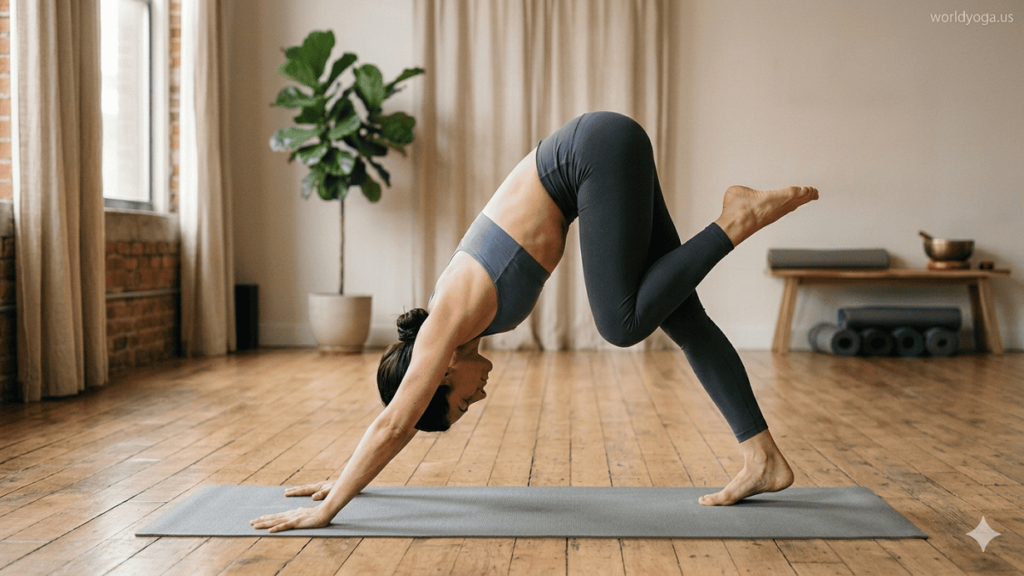
How is One-Legged Downward Dog with knees together performed correctly?
Step-by-step execution:
Begin in a standard Downward-Facing Dog. Your hands should be shoulder-width apart, fingers spread wide, with weight evenly distributed—especially through the index finger and thumb. Feet are hip-width apart, heels reaching toward the floor, Downward Dog and hips lifted to create an inverted “V” shape. Keep a slight bend in the knees if your hamstrings are tight to maintain a long, neutral spine.
From this stable base, shift your focus to your core. Engage your abdominal muscles gently by drawing the navel toward the spine. This engagement is critical for maintaining pelvic stability throughout the movement.
Next, inhale and slowly lift one leg off the ground. Unlike the more common Three-Legged Dog where the hip opens, Downward Dog, here you must keep both hips squared toward the floor. Avoid rotating or stacking the hips. Your lifted leg should extend straight back rather than up, keeping the pelvis level.
Now bend the lifted knee slightly and draw it inward toward the standing leg. The goal is to bring the knees close together or even touching. This action intensifies core engagement and prevents external hip rotation. Keep the thighs parallel and aligned.
Throughout the pose, press firmly into both hands to stabilize the shoulders. Avoid collapsing into the upper body—actively push the mat away, Downward Dog, broaden across the upper back, Downward Dog and keep the neck relaxed with the gaze toward your feet or slightly forward.
Hold the position for 3–5 steady breaths, maintaining control and alignment rather than height. Then slowly lower the lifted leg back to the mat with control and repeat on the other side.
Key alignment cues:
- Keep hips level; avoid opening the pelvis
- Engage the core to stabilize the torso
- Maintain even weight in both hands
- Prioritize spinal length over leg height
Common mistakes to avoid:
- Rotating the hips outward (losing the “knees together” intention)
- Overarching the lower back
- Locking the standing knee
- Letting shoulders collapse or elbows bend excessively
For visual guidance and deeper technique insights, you can refer to:
- Yoga Journal: https://www.yogajournal.com/poses/downward-facing-dog/
- DoYogaWithMe: https://www.doyogawithme.com/content/three-legged-dog-pose-variation
Practicing this variation regularly improves balance, builds functional strength, Downward Dog and refines body awareness—making it a valuable addition to both beginner and advanced yoga routines.
#Downward Dog: One-Legged—Knees Together in Chennai
What is the proper alignment in this variation?
1. Hands and upper body
Start with a strong foundation through the hands. Place them shoulder-width apart with fingers spread wide. Press firmly through the index finger and thumb to protect the wrists. Arms remain straight but not locked, with a subtle external rotation in the upper arms. The shoulders should be active—push the floor away to broaden the upper back and avoid collapsing into the joints. Keep the neck neutral, with the gaze directed toward the feet or slightly forward.
2. Spine and torso
The spine should remain long and neutral throughout the pose. Avoid rounding the upper back or overarching the lower back. To maintain this, Downward Dog, engage the core by drawing the navel inward. This engagement stabilizes the torso and prevents excessive movement in the lumbar spine.
3. Hips and pelvis (key focus)
The defining feature of this variation is a squared pelvis. Unlike Three-Legged Dog, where the hip often opens, here both hip points should face the floor evenly. There should be no external rotation of the lifted leg. Keeping the knees together or very close ensures that the pelvis stays level and aligned. This requires strong activation of the deep core and inner thighs.
4. Legs and knees
The standing leg should be grounded and stable, with a slight micro-bend in the knee to avoid locking. The lifted leg extends back in line with the torso rather than excessively upward. Bend the lifted knee slightly and draw it inward so that it stays close to the standing leg. The thighs should remain parallel, reinforcing hip alignment.
5. Weight distribution
Balance your weight evenly between both hands and the standing foot. A common misalignment is shifting too much weight into the arms when lifting the leg. Instead, Downward Dog, press back through the hips to keep the pose integrated and stable.
6. Breath and control
Maintain steady, Downward Dog, even breathing. Alignment should not be sacrificed for height or intensity—controlled movement and stillness are more important than how high the leg lifts.
Common alignment errors to watch for:
- Opening or stacking the hips
- Arching the lower back
- Collapsing into the shoulders
- Overlifting the leg at the expense of form
For additional reference, alignment breakdowns from Yoga Journal (https://www.yogajournal.com/poses/downward-facing-dog/) and DoYogaWithMe (https://www.doyogawithme.com/content/three-legged-dog-pose-variation) provide helpful visual cues.
In summary, proper alignment in this variation centers on a stable upper body, a long neutral spine, and—most importantly—a squared pelvis with knees kept together, Downward Dog, ensuring the pose develops strength, precision, and control.
#Downward Dog: One-Legged—Knees Together in Maharashtra
Which muscles are engaged during the pose?
1. Core muscles (primary stabilizers)
The most significant engagement comes from the core. The transverse abdominis acts like a deep corset, stabilizing the spine and preventing the pelvis from rotating. The obliques assist in resisting the natural tendency to open the hip of the lifted leg. Additionally, the rectus abdominis supports spinal integrity, especially in preventing the lower back from overarching. Because the knees are kept together, the inner core and deep stabilizers must work harder than in a typical Three-Legged Dog.
2. Shoulders and upper body
The shoulders bear a significant portion of body weight. The deltoids (especially the anterior fibers) help stabilize the arms, Downward Dog, while the rotator cuff muscles maintain joint integrity. The serratus anterior is highly active, helping to protract the scapulae and prevent collapsing into the shoulders. The trapezius (particularly the lower fibers) supports scapular stability. The triceps keep the arms extended and strong.
3. Back muscles
The latissimus dorsi assists in drawing the torso back toward the hips, maintaining the inverted “V” shape. The erector spinae run along the spine and help maintain a neutral, Downward Dog, elongated back without rounding or excessive arching.
4. Glutes and hips
The gluteus maximus of the lifted leg contributes to hip extension, but its role is more controlled compared to open-hip variations. The gluteus medius and minimus, particularly on the standing leg, Downward Dog, are crucial for pelvic stabilization. Because the hips remain squared, these muscles work isometrically to prevent rotation.
5. Inner thighs (adductors)
A defining feature of this variation is the engagement of the adductor group. Drawing the knees together activates the inner thighs, Downward Dog, which help maintain alignment and support the pelvis. This is often underutilized in other variations, making it a key strengthening component here.
6. Legs and lower body
The quadriceps of the standing leg engage to support and stabilize the knee, while the hamstrings assist in maintaining hip alignment. The calf muscles (gastrocnemius and soleus) work to stabilize the ankle and support balance.
7. Hands and forearms
The muscles of the forearms are actively engaged to stabilize the wrists and distribute weight evenly through the hands, preventing strain.
Summary
This variation is a full-body integration exercise. The core and inner thighs drive alignment, the shoulders and arms provide structural support, and the hips and legs stabilize the pose. The result is a balanced combination of strength, control, and endurance.
For further anatomical insights, resources like Yoga Journal (https://www.yogajournal.com/poses/downward-facing-dog/) and DoYogaWithMe (https://www.doyogawithme.com/content/three-legged-dog-pose-variation) offer detailed breakdowns of muscle engagement in related poses.
#Downward Dog: One-Legged—Knees Together in Ahemadabad
What preparatory poses are recommended?
1. Foundational alignment poses
Start with Downward-Facing Dog itself. Practicing this regularly helps establish proper hand placement, spinal length, and shoulder engagement. Focus on distributing weight evenly and maintaining a neutral spine—these are essential before progressing.
Another key pose is Plank Pose. Plank strengthens the shoulders, arms, and especially the core, which is critical for stabilizing the pelvis when one leg lifts. Holding plank with proper alignment builds endurance and control needed for the variation.
2. Core strengthening poses
Dolphin Pose is highly effective for building shoulder and core strength simultaneously. It also trains scapular stability, which prevents collapsing into the upper body.
Boat Pose (Navasana) specifically targets the deep core muscles, including the transverse abdominis. This helps maintain a squared pelvis when drawing the knees together in the one-legged variation.
3. Hamstring and calf preparation
Tight hamstrings can compromise spinal alignment in Downward Dog. Standing Forward Fold (Uttanasana) helps lengthen the posterior chain, allowing for a more stable and elongated spine.
Similarly, Half Split Pose (Ardha Hanumanasana) isolates hamstring flexibility and improves control in the legs, which is important when lifting one leg without distorting the pelvis.
4. Hip stability and control
Unlike Three-Legged Dog, this variation requires keeping the hips square. Bridge Pose (Setu Bandhasana) helps activate the glutes and teaches controlled hip extension without excessive rotation.
Low Lunge (Anjaneyasana) is also beneficial, as it opens the hip flexors while encouraging pelvic awareness and balance.
5. Balance and coordination
Bird Dog Pose is particularly useful for training cross-body coordination and core stability. It mimics the contralateral engagement required when one leg is lifted while maintaining a stable torso.
Summary
An effective preparation sequence should include:
- Foundational strength (Downward Dog, Plank)
- Core activation (Boat Pose, Dolphin Pose)
- Flexibility work (Forward Fold, Half Split)
- Hip stability (Bridge Pose, Low Lunge)
- Coordination training (Bird Dog Pose)
For further guidance and visual demonstrations, refer to Yoga Journal (https://www.yogajournal.com/poses/downward-facing-dog/) and DoYogaWithMe (https://www.doyogawithme.com/content/three-legged-dog-pose-variation), which provide structured progressions and technique insights.
#Downward Dog: One-Legged—Knees Together in Kolkata
What are the benefits and precautions of this variation?
Benefits
1. Enhanced core strength and stability
Keeping the knees together and the pelvis squared significantly increases activation of the deep core muscles, particularly the transverse abdominis and obliques. This improves spinal support and helps develop functional core strength that translates to other yoga poses and daily movements.
2. Improved pelvic alignment and control
This variation trains the body to resist rotational forces. By preventing the hips from opening, practitioners develop better awareness of pelvic positioning, which is essential for safe progression into more advanced postures and transitions.
3. Shoulder and upper body strengthening
Supporting uneven weight distribution challenges the shoulders, arms, and upper back. Muscles such as the deltoids, triceps, and serratus anterior become more engaged, leading to improved joint stability and endurance.
4. Greater balance and proprioception
Lifting one leg while maintaining strict alignment enhances coordination and body awareness. This improves balance and control, which are valuable both in yoga practice and general physical activity.
5. Safer alternative to open-hip variations
Because it avoids excessive spinal twisting and hip opening, this variation can be gentler on the lower back and sacroiliac joint when performed correctly. It encourages controlled movement rather than passive flexibility.
For further reading, Yoga Journal (https://www.yogajournal.com/poses/downward-facing-dog/) and DoYogaWithMe (https://www.doyogawithme.com/content/three-legged-dog-pose-variation) provide detailed insights into benefits and variations of related poses.
Precautions
1. Wrist and shoulder sensitivity
As with any weight-bearing pose on the hands, individuals with wrist pain, carpal tunnel concerns, or shoulder injuries should proceed cautiously. Using props like yoga blocks or modifying with forearm-based poses (e.g., Dolphin Pose) can reduce strain.
2. Avoid overloading the lower back
A common mistake is lifting the leg too high, causing the lower back to arch excessively. This can lead to discomfort or strain. The focus should remain on maintaining a neutral spine rather than maximizing height.
3. Maintain proper shoulder engagement
Collapsing into the shoulders or locking the elbows can increase injury risk. Active engagement through the arms and upper back is essential for joint protection.
4. Hamstring and calf limitations
Tightness in the posterior chain may pull the spine out of alignment. Practitioners should bend the standing knee slightly if needed to preserve spinal length.
5. Balance limitations
Since this is an asymmetrical pose, those with balance challenges should move slowly and with control, possibly practicing near a wall for support.
Summary
This variation offers a well-rounded combination of strength, stability, and alignment training. However, its benefits depend on precise execution and mindful progression. Prioritizing control over intensity ensures both effectiveness and safety in practice.
#Downward Dog: One-Legged—Knees Together in Delhi
Case Study of Downward Dog: One-Legged—Knees Together
Case Background
A 34-year-old office professional with a sedentary lifestyle presented with mild lower back discomfort and poor core engagement during yoga practice. Although familiar with Three-Legged Dog, the individual tended to over-rotate the hips and rely on flexibility rather than muscular control. The objective was to improve core stability, correct pelvic alignment, and reduce strain on the lumbar spine.
Intervention
Over a six-week period, the practitioner incorporated the “knees together” variation into a guided routine, practicing 4–5 times per week. Each session included preparatory poses such as Plank, Dolphin, and hamstring stretches, followed by focused holds of the variation for 3–5 breaths per side. Emphasis was placed on:
- Keeping the pelvis squared
- Engaging the transverse abdominis
- Maintaining even weight distribution through both hands
Verbal and visual feedback (via instructor cues and mirror work) helped reinforce alignment.
Observations and Progress
By the end of the second week, the practitioner demonstrated improved awareness of hip positioning and reduced tendency to open the pelvis. Core activation became more consistent, and shoulder stability improved as evidenced by reduced collapsing into the upper body.
At the four-week mark, the individual reported a noticeable decrease in lower back discomfort, particularly after long periods of sitting. Functional improvements were also observed in related poses, including stronger and more stable transitions from Downward Dog to lunges.
By week six, the practitioner could maintain the pose with steady breathing and proper alignment for up to five breaths without compensatory movements. The knees-together cue effectively limited excessive leg lift, encouraging controlled extension rather than height-driven effort.
Outcomes
- Enhanced core strength and endurance
- Improved pelvic control and alignment
- Reduced lower back strain
- Increased shoulder stability and weight-bearing capacity
- Better overall body awareness and movement efficiency
These outcomes align with guidance from reputable yoga resources such as Yoga Journal (https://www.yogajournal.com/poses/downward-facing-dog/) and DoYogaWithMe (https://www.doyogawithme.com/content/three-legged-dog-pose-variation), which emphasize alignment and controlled variations for long-term practice benefits.
Key Insights
This case highlights that restricting range of motion—by keeping the knees together and hips square—can enhance muscular engagement and reduce injury risk. It demonstrates that progression in yoga is not always about deeper stretches or higher lifts, but about refining control and precision.
Conclusion
The One-Legged Downward Dog with knees together is an effective corrective and strengthening tool when applied consistently and mindfully. In this case, it contributed to measurable improvements in stability, comfort, and functional movement, making it a valuable addition to both therapeutic and general yoga practices.
#Downward Dog: One-Legged—Knees Together in Hyderabad
White Paper of Downward Dog: One-Legged—Knees Together
Abstract
The One-Legged Downward Dog with knees together is a refined progression of Downward-Facing Dog that emphasizes neuromuscular control, core stabilization, and biomechanical alignment. Unlike the more common Three-Legged Dog, this variation minimizes hip external rotation to promote symmetrical loading and reduce compensatory movement patterns. This paper examines its biomechanical framework, physiological benefits, practical applications, and safety considerations.
Introduction
Modern yoga practice increasingly integrates principles from biomechanics and rehabilitation science. Variations such as this one are designed not to intensify flexibility but to improve joint stability and muscular coordination. By constraining movement—specifically keeping the knees together and hips squared—the pose becomes a tool for developing controlled strength rather than passive range of motion.
Biomechanical Analysis
In standard Downward-Facing Dog, the body distributes weight across a closed kinetic chain involving the hands and feet. When one leg is lifted, asymmetrical loading occurs, often leading to pelvic rotation. The knees-together variation counteracts this by enforcing neutral pelvic alignment.
Key biomechanical features include:
- Pelvic stabilization: Activation of the transverse abdominis and obliques resists rotational torque.
- Scapular integrity: Engagement of the serratus anterior and lower trapezius prevents shoulder collapse.
- Posterior chain coordination: Controlled engagement of hamstrings and gluteal muscles supports leg lift without spinal compensation.
This alignment-driven approach aligns with functional movement principles outlined in sources such as Yoga Journal (https://www.yogajournal.com/poses/downward-facing-dog/) and DoYogaWithMe (https://www.doyogawithme.com/content/three-legged-dog-pose-variation).
Physiological and Functional Benefits
- Core strengthening: Increased demand on deep stabilizers enhances spinal support.
- Joint protection: Reduced hip opening minimizes stress on the lumbar spine and sacroiliac joint.
- Improved proprioception: Maintaining alignment under asymmetrical load enhances body awareness.
- Upper body endurance: Sustained weight-bearing improves shoulder and arm strength.
These benefits make the variation particularly relevant for practitioners transitioning toward advanced postures or recovering from minor musculoskeletal imbalances.
Applications
- Rehabilitation settings: Useful for retraining pelvic alignment and core engagement in individuals with lower back discomfort.
- Athletic conditioning: Supports cross-training by improving unilateral stability and coordination.
- Yoga progression: Serves as a preparatory step for arm balances and controlled transitions.
Limitations and Precautions
Despite its advantages, improper execution may lead to strain:
- Excessive lumbar arching if core engagement is insufficient
- Wrist or shoulder overload due to poor weight distribution
- Compensation through leg height rather than alignment
Modifications, such as bending the standing knee or using props, can mitigate these risks.
Conclusion
The One-Legged Downward Dog with knees together represents a shift from flexibility-focused practice to precision-based movement training. Its emphasis on alignment, stability, and controlled muscular engagement positions it as a valuable component in both therapeutic and performance-oriented yoga contexts. Continued integration of biomechanical insights will further enhance its application in modern practice.
#Downward Dog: One-Legged—Knees Together in Mumbai
Ask FAQs
What makes the knees-together variation different from the standard one-legged version?
The primary difference lies in pelvic alignment. In the traditional Three-Legged Dog, the lifted leg often opens the hip, allowing external rotation. In contrast, the knees-together variation keeps the hips squared toward the floor, increasing core engagement and reducing reliance on flexibility. This makes the pose more stability-focused and alignment-driven.
Is this variation suitable for beginners?
Yes, but with modifications. Beginners can practice by lifting the leg only slightly and focusing on keeping the pelvis stable rather than achieving height. Bending the standing knee and shortening the stance can also help maintain proper spinal alignment while building strength gradually.
How long should the pose be held?
Typically, the pose is held for 3–5 steady breaths per side. The emphasis should be on maintaining proper alignment and controlled breathing rather than duration. As strength and stability improve, practitioners may gradually increase the hold time.
What are the most common mistakes in this variation?
Common errors include opening the hips, lifting the leg too high, collapsing into the shoulders, and overarching the lower back. These mistakes reduce the effectiveness of the pose and may increase the risk of strain. Proper technique prioritizes a neutral spine, active shoulders, and a squared pelvis.
Can this pose help with lower back discomfort?
When performed correctly, this variation can support lower back health by strengthening the core and promoting proper pelvic alignment. However, individuals with existing back issues should practice cautiously and consider guidance from a qualified instructor. Maintaining control and avoiding excessive spinal arching is essential for safety.
Table of Contents
Desclaimer
This content is for informational and educational purposes only and is not a substitute for professional medical or fitness advice. Always consult a qualified healthcare provider or certified yoga instructor before beginning or modifying any exercise practice, especially if you have existing injuries or health conditions.