One Hand Peacock Pose
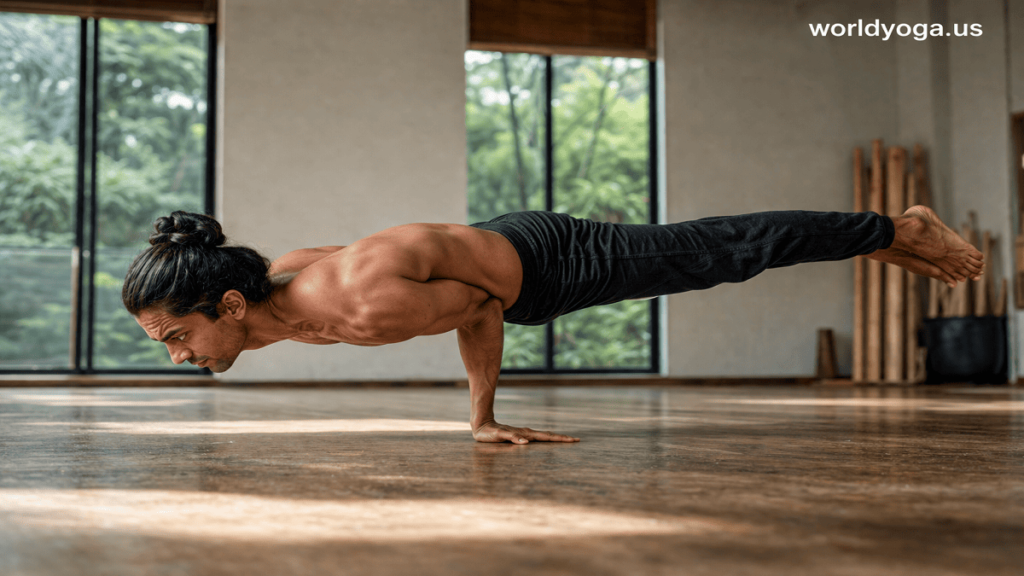
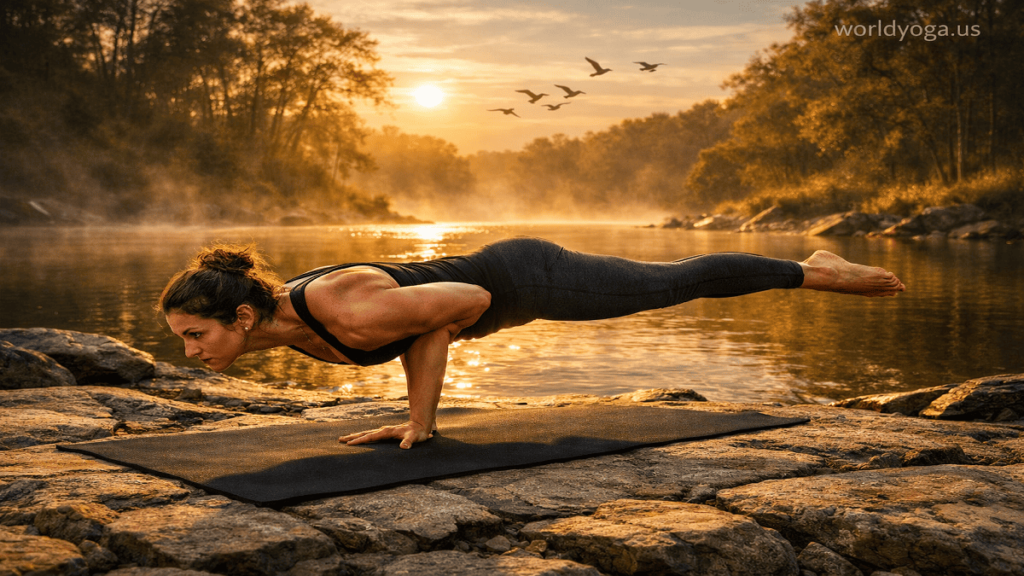
Mayurasana, in its advanced variation known as One Hand Peacock Pose (Eka Hasta Mayurasana), is an extremely high-level arm balance in yoga where the entire body is supported on a single forearm and hand while remaining parallel to the ground. It is a progression of the traditional Peacock Pose and is practiced only by highly advanced yoga practitioners with exceptional strength, balance, and control.
Overview
In One Hand Peacock Pose, the practitioner places one palm firmly on the ground while the elbow of the same arm presses into the abdomen just above the navel. The body is then lifted horizontally, with legs extended straight behind and fully engaged core muscles maintaining alignment. Unlike standard Mayurasana, the second arm does not assist in balance, making stability significantly more challenging.
Technique Summary
- Begin in a kneeling position
- Place one hand on the floor, fingers pointing backward
- Press the corresponding elbow into the abdomen
- Engage core muscles strongly
- Shift weight forward gradually
- Lift legs together into a horizontal line
- Maintain steady breathing and controlled balance
Key Strength Requirements
This variation demands extreme physical conditioning:
- Unilateral arm strength: One arm supports full body weight
- Core dominance: Deep abdominal activation prevents collapse
- Shoulder stability: Prevents lateral tipping
- Grip and wrist endurance: Maintains balance under pressure
Balance and Control Challenges
- Center of gravity shifts significantly to one side
- Requires precise micro-adjustments in wrist and shoulder
- Even slight misalignment causes loss of stability
- Strong proprioception is essential for control
Benefits
Practicing this advanced variation enhances:
- Exceptional core strength and stability
- Superior unilateral upper-body strength
- Advanced neuromuscular coordination
- Deep focus and mental discipline
- Improved control over body alignment
Risks and Precautions
Due to its difficulty, this pose carries high injury risk:
- Wrist strain or overloading
- Shoulder imbalance injuries
- Abdominal pressure discomfort
- Loss of balance and falls
It is not recommended for beginners or intermediate practitioners. Proper mastery of traditional Mayurasana and other arm balances is essential before attempting it.
Conclusion
One Hand Peacock Pose is an elite-level progression of Mayurasana that represents peak control of strength, balance, and body awareness. It should only be practiced under expert supervision with gradual preparation and strict attention to safety.
#One Hand Peacock Pose in Chennai
What is One Hand Peacock Pose?
One Hand Peacock Pose (Eka Hasta Mayurasana) is an extremely advanced variation of the traditional Peacock Pose in yoga.
Mayurasana is the base posture in which the body is lifted horizontally and balanced on both forearms with the elbows pressing into the abdomen. In the one-hand variation, this support is reduced to a single arm, making the pose significantly more difficult and requiring exceptional strength, control, and balance.
In One Hand Peacock Pose, the practitioner places one palm on the ground with the fingers pointing backward and presses the corresponding elbow firmly into the abdomen. The entire body is then lifted parallel to the floor while the legs are extended straight behind. Unlike the standard version, only one arm bears the full body weight, while the core and shoulder stabilize the alignment.
This pose is considered an elite-level yoga arm balance because it demands:
- Very strong wrist, forearm, and shoulder stability
- Extremely strong core engagement
- Advanced body awareness and balance control
- Precise weight distribution to avoid tipping sideways
It is not a beginner or intermediate posture and is typically practiced only after mastering traditional Mayurasana and other arm balances like Crow Pose and forearm balances.
In yogic tradition, this variation symbolizes high mastery over physical control and mental focus. It is used more in advanced practice and performance yoga rather than general fitness or therapeutic routines.
Because of the high risk of wrist, elbow, and shoulder strain, it should only be attempted under expert supervision with gradual progression and proper conditioning.
#One Hand Peacock Pose in India
How is this advanced arm balance performed step by step?Step 1: Proper Warm-Up
Begin with thorough preparation:
- Wrist circles and wrist strengthening exercises
- Forearm activation drills
- Core warm-ups like Plank and Boat Pose
- Shoulder stability exercises
This step is essential to prevent strain.
Step 2: Starting Position
- Kneel on a yoga mat
- Place one palm on the floor with fingers pointing backward toward the feet
- Keep the elbow bent and ready to press into the abdomen
- The other hand stays relaxed or lightly lifted for balance awareness (depending on style)
Step 3: Elbow Placement
- Gently press the elbow of the supporting arm into the abdomen (just above the navel)
- Engage the core muscles tightly
- Keep the spine slightly forward but controlled
This elbow-abdomen contact creates the lifting platform.
Step 4: Forward Weight Shift
- Slowly shift body weight onto the supporting arm
- Keep shoulders stable and not collapsed
- Move gradually to avoid sudden imbalance
At this stage, balance is controlled entirely by micro-adjustments.
Step 5: Lift the Legs
- Engage the core deeply
- Lift one leg slightly, followed by the other
- Once stable, extend both legs fully backward
- Bring the body into a straight horizontal line
The entire body is now supported by one arm and core strength.
Step 6: Maintain the Balance
- Keep breathing slow and steady
- Engage abdomen continuously
- Maintain a straight body line from head to toes
- Use small wrist and shoulder adjustments for stability
Step 7: Exit the Pose
- Slowly lower one foot at a time back to the ground
- Release the elbow pressure
- Return to kneeling position
- Rest in Child’s Pose to relax the wrists and abdomen
Important Safety Notes
Stop immediately if there is pain or instability
Do NOT attempt without mastering Mayurasana first
Avoid if you have wrist, elbow, or shoulder injuries
Practice only under expert supervision
#One Hand Peacock Pose in Maharashtra
What strength and stability are required?
1. Unilateral Upper Body Strength (Critical Requirement)
Since only one arm supports the full body weight, unilateral strength is the most important requirement.
- Wrist strength: Must tolerate high compressive load without collapsing
- Forearm endurance: Controls fine stability and prevents shaking
- Elbow integrity: Acts as a firm lever against the abdomen
- Shoulder stability: Prevents lateral collapse and rotation
The supporting arm must function like a rigid structural column under full-body load.
2. Extreme Core Strength
Core engagement is essential for lifting and maintaining alignment.
- Rectus abdominis: Provides lifting force for the legs
- Transverse abdominis: Stabilizes deep internal pressure
- Obliques: Prevent sideways tipping in single-arm balance
- Lower back muscles: Maintain spinal alignment
Without extremely strong core activation, the body will drop immediately.
3. Advanced Balance and Stability Control
Balance in this pose is significantly more difficult than standard Mayurasana.
- Asymmetrical load control: Body weight shifts entirely to one side
- Center of gravity precision: Must stay directly over one wrist
- Micro-adjustments: Continuous fine corrections in wrist and shoulder
- Anti-rotation control: Prevents twisting or sideways collapse
Even small misalignment can cause loss of balance.
4. Shoulder and Scapular Stability
The shoulder must remain highly active and stable.
- Prevents sinking into the joint
- Maintains upward and forward engagement
- Stabilizes scapula under extreme load
- Supports long-duration holds without collapse
Weak shoulder control is a major limiting factor.
5. Core-to-Limb Coordination (Neuromuscular Control)
This pose requires the nervous system to coordinate multiple muscle groups simultaneously:
- Timing of leg lift with core activation
- Coordination between breath and balance
- Real-time corrections for instability
- Strong proprioception (body awareness)
This level of control is typically found only in advanced practitioners.
6. Mental Stability and Focus
Mental strength is as important as physical strength.
- High concentration to maintain balance
- Fear control during one-arm load shift
- Calm breathing under strain
- Strong mind-body synchronization
Any hesitation can result in loss of control.
7. Prerequisite Strength Level
Before attempting this variation, practitioners should be able to:
- Hold Mayurasana comfortably
- Perform stable Crow Pose and Forearm balances
- Maintain strong plank holds (2+ minutes)
- Demonstrate controlled core compression strength
Conclusion
One Hand Peacock Pose requires elite unilateral strength, extreme core activation, precise balance control, and high mental focus. It is not suitable for general practice and should only be attempted after mastering foundational arm balances like Mayurasana under expert guidance.
#One Hand Peacock Pose in Kolkata
What are the benefits of this pose?
1. Exceptional Upper Body Strength
This pose significantly strengthens the entire supporting arm.
- Builds extreme wrist, forearm, and elbow strength
- Develops shoulder stability under full body load
- Enhances unilateral (one-sided) strength control
- Improves endurance of small stabilizing muscles
It is often considered comparable to high-level calisthenics strength training.
2. Deep Core Activation and Control
The core is continuously engaged throughout the pose.
- Strengthens deep abdominal muscles (transverse abdominis)
- Improves spinal stability and alignment control
- Enhances ability to maintain rigid body positioning
- Builds powerful core compression strength
This makes it one of the most demanding yoga-based core exercises.
3. Advanced Balance and Coordination
Because only one arm supports the body, balance improvements are significant.
- Develops fine neuromuscular control
- Enhances proprioception (body awareness)
- Improves ability to maintain balance under instability
- Trains the nervous system for rapid micro-adjustments
These skills transfer to other advanced physical movements.
4. Mental Focus and Discipline
The pose requires intense concentration.
- Strengthens mental clarity and focus under pressure
- Builds fear control during unstable positions
- Enhances breathing awareness and calmness
- Develops strong mind-body synchronization
This is often considered one of the most mentally demanding yoga balances.
5. Functional Strength and Athletic Carryover
Practicing this advanced variation improves overall athletic ability.
- Better control in gymnastics, calisthenics, and martial arts
- Improved shoulder and core coordination
- Enhanced body control in dynamic sports movements
- Increased injury resilience through stronger stabilizers
6. Energetic and Yogic Benefits
From a traditional yoga perspective:
- Intensifies internal energy activation
- Enhances focus and alertness
- Strengthens discipline in advanced practice
- Deepens awareness of internal body mechanics
It is viewed as a pose representing high mastery of physical control.
Important Caution
Because it is an extreme variation of Mayurasana, the One Hand Peacock Pose should only be practiced by highly advanced practitioners. Incorrect practice can lead to wrist, elbow, or shoulder injuries.
Conclusion
The One Hand Peacock Pose offers elite-level strength building, advanced balance control, and deep mental focus benefits, making it a highly specialized posture reserved for expert practitioners of Mayurasana and advanced arm balancing systems.
#One Hand Peacock Pose in Ahemadabad
What common mistakes should be avoided?
1. Attempting Without Mastery of Basics
Mistake:
- Trying the one-hand variation without mastering standard Mayurasana
- Skipping intermediate arm balances like Crow Pose
Why it matters:
Without foundational strength and balance, the body cannot safely handle unilateral loading.
2. Poor Wrist Alignment
Mistake:
- Collapsing into the wrist joint
- Not stacking the shoulder over the wrist
- Overloading the outer or inner edge of the palm
Why it matters:
This can cause wrist strain, instability, and long-term joint stress.
3. Weak Core Engagement
Mistake:
- Relying mainly on arm strength
- Relaxing abdominal muscles during lift or hold
Why it matters:
The core must act as the lifting engine. Without it, the body drops immediately.
4. Incorrect Elbow-to-Abdomen Pressure
Mistake:
- Elbow not firmly pressing into the abdomen
- Placing pressure too low or too high on the torso
Why it matters:
This reduces lifting efficiency and causes imbalance in the center of gravity.
5. Rushing the Lift
Mistake:
- Jumping into the pose instead of controlled shifting
- Lifting both legs too quickly
Why it matters:
Sudden movement disrupts alignment and increases fall risk.
6. Sideways Collapse (Lack of Stability)
Mistake:
- Leaning too far left or right
- Not engaging obliques for anti-rotation control
Why it matters:
Since only one arm supports the body, lateral imbalance is a major failure point.
7. Breath Holding
Mistake:
- Holding breath during effort
- Irregular breathing patterns
Why it matters:
Breath control is essential for stability and neuromuscular coordination.
8. Over-tension in Shoulder
Mistake:
- Shrugging shoulder excessively
- Locking the joint instead of stabilizing it
Why it matters:
Creates fatigue and reduces fine balance control.
9. Skipping Progression Training
Mistake:
- Not building wrist, core, and shoulder strength gradually
- Avoiding preparatory drills
Why it matters:
This pose requires long-term conditioning for safe execution.
Conclusion
Most mistakes in One Hand Peacock Pose come from lack of preparation, poor alignment, and rushing the movement. Since it is a highly advanced variation of Mayurasana, success depends on controlled progression, strong core engagement, and precise balance—not force.
#One Hand Peacock Pose in Hyderabad
Case Study of One Hand Peacock Pose
Introduction
This case study explores the progression, training methodology, and performance outcomes of an advanced yoga practitioner attempting the One Hand Peacock Pose (Eka Hasta Mayurasana), a highly advanced variation of Mayurasana (Peacock Pose). The pose requires extreme unilateral strength, core compression, and neuromuscular control.
The subject (“Practitioner B”) is a 32-year-old advanced yoga practitioner with 5+ years of experience in arm balances, including stable Crow Pose, Forearm Stand, and traditional Mayurasana holds of 20–30 seconds.
Initial Assessment
At baseline, Practitioner B demonstrated:
- Strong bilateral arm balance ability (both-arm supports stable)
- Adequate core strength but limited unilateral load adaptation
- Good wrist conditioning but mild asymmetry in shoulder stability
- No prior experience with full one-arm body support poses
Despite advanced yoga background, attempts at one-hand support immediately resulted in lateral collapse due to insufficient anti-rotation control.
Training Protocol (8–12 Weeks)
Phase 1: Foundation Strength
- One-arm plank holds (assisted)
- Wrist loading drills with partial body weight
- Core compression exercises (Boat Pose variations)
- Shoulder stability training with resistance bands
Phase 2: Transition to Unilateral Balance
- Assisted Eka Hasta Mayurasana drills using blocks
- Elbow-to-abdomen pressure refinement (based on Mayurasana mechanics)
- Slow weight shift training from both arms → one arm support
- Anti-rotation core drills
Phase 3: Controlled Lift Attempts
- Partial leg lifts (one leg at a time)
- Micro-hold balancing (1–3 seconds)
- Gradual reduction of external support
- Breath synchronization training
Phase 4: Full Pose Integration
- Full body lift into horizontal alignment
- Short holds (3–6 seconds initially)
- Focus on shoulder stacking and wrist alignment
- Progressive stability improvement
Observations and Results
By Week 10–12:
- Achieved stable 4–7 second holds in Eka Hasta Mayurasana
- Significant improvement in unilateral shoulder stability
- Enhanced core anti-rotation strength
- Reduced lateral collapse tendencies
- Improved neuromuscular coordination between breath and movement
However:
- Longer holds (>10 seconds) remained inconsistent
- Fatigue in wrist extensors occurred after repeated attempts
- Balance was highly sensitive to small misalignments
Key Findings
- Core anti-rotation strength is more critical than raw arm strength
- Progression from Mayurasana is essential before attempting unilateral variation
- Shoulder positioning is the primary limiting factor in stability
- Mental focus and fear control significantly influence performance success
Risks Identified
- Wrist overloading due to asymmetrical force distribution
- Shoulder strain from repeated micro-corrections
- Loss of balance leading to forward or lateral falls
- Fatigue-related instability in prolonged attempts
Conclusion
The One Hand Peacock Pose represents an elite-level progression of Mayurasana requiring structured, phased training. Success depends on gradual adaptation of unilateral strength, deep core control, and precise biomechanical alignment. Even advanced practitioners require extended preparation to achieve stable execution safely.
#One Hand Peacock Pose in Delhi
White Paper of One Hand Peacock Pose
Abstract
The One Hand Peacock Pose (Eka Hasta Mayurasana) is an advanced unilateral arm balance derived from the classical yoga posture Mayurasana (Peacock Pose). This white paper examines its biomechanical structure, physiological demands, neuromuscular requirements, risks, and applications in modern movement science, athletic conditioning, and advanced yoga practice. It highlights how unilateral load-bearing transforms a traditional bilateral stability pose into an elite-level strength and balance challenge.
1. Introduction
One Hand Peacock Pose is an extreme variation of Mayurasana in which the entire body is supported on a single arm while maintained in a horizontal alignment. Unlike the classical version that distributes load across both forearms, this variation introduces asymmetrical loading, making it significantly more demanding in strength, coordination, and stability.
2. Biomechanical Structure
The pose operates through a complex biomechanical system:
- Single-point support system: One palm acts as the sole ground contact
- Elbow-to-abdomen leverage: The elbow presses into the abdomen to assist lift
- Center of gravity shift: Fully displaced over one wrist joint
- Rotational resistance requirement: Core muscles prevent lateral collapse
Primary muscles engaged include:
- Shoulder stabilizers (deltoids, rotator cuff)
- Forearm flexors and extensors
- Deep core musculature (transverse abdominis, obliques)
- Spinal stabilizers
3. Physiological Demands
The pose creates high neuromuscular and systemic demand:
- Intense isometric contraction across upper body chains
- Elevated intra-abdominal pressure due to elbow compression
- Increased proprioceptive feedback for balance control
- High energy expenditure in stabilizer muscles
The unilateral load significantly increases joint stress compared to traditional Mayurasana.
4. Neuromuscular Coordination
Successful execution requires advanced motor control:
- Fine motor adjustments in wrist and shoulder joints
- Synchronized core activation to prevent rotation
- Real-time balance corrections via proprioception
- Integration of breath control with stability maintenance
This coordination is typically developed only in advanced practitioners.
5. Training Requirements
Minimum prerequisites include:
- Mastery of standard Mayurasana
- Strong plank and hollow body endurance
- Stable crow and forearm balance capabilities
- Developed shoulder and wrist conditioning
Progression must follow phased training:
- Bilateral arm balance mastery
- Assisted unilateral weight shifting
- Partial lift drills
- Full pose integration
6. Risk Assessment
Due to extreme unilateral loading, risks include:
- Wrist compression injuries
- Shoulder joint instability
- Elbow strain from abdominal pressure
- Loss of balance and fall-related injury
It is contraindicated for individuals with musculoskeletal injuries or insufficient upper-body conditioning.
7. Applications in Modern Fields
Sports Science
- Research on unilateral load adaptation
- Shoulder stability and injury prevention studies
Calisthenics & Strength Training
- Advanced bodyweight strength progression model
- Elite core and balance conditioning exercise
Yoga Therapy (Advanced Level)
- Neuromuscular re-education
- Deep core stabilization training (selective use only)
8. Conclusion
The One Hand Peacock Pose represents an elite evolution of Mayurasana, transforming a bilateral balance posture into a highly demanding unilateral strength and coordination challenge. While it offers significant benefits in strength, stability, and neuromuscular control, it requires strict progression, expert supervision, and advanced physical conditioning to perform safely.
References
- https://www.yogajournal.com/poses/peacock-pose/
- https://www.britannica.com/topic/peacock-pose
- https://www.iyengaryoga.org.uk/
- https://www.artofliving.org/yoga/poses/peacock-pose/
#One Hand Peacock Pose in Pune
Industry Application of One Hand Peacock Pose
1. Advanced Fitness & Calisthenics Industry
In elite bodyweight training systems, this pose is viewed as a high-level strength benchmark.
Applications:
- Progression model for one-arm strength development
- Advanced core compression training
- Wrist, elbow, and shoulder conditioning at elite level
- Skill development in static holds similar to planche progressions
It helps athletes develop extreme body control and unilateral strength symmetry.
2. Sports Performance & Elite Athletics
In sports science, its principles are applied indirectly for performance enhancement.
Applications:
- Core anti-rotation training for athletes in combat sports
- Shoulder stability conditioning for gymnasts and climbers
- Balance and proprioception training for field athletes
- Injury prevention through controlled unilateral loading
The pose’s instability demands improve neuromuscular adaptability.
3. Biomechanics & Human Movement Research
The pose is valuable in research settings due to its rare loading pattern.
Applications:
- Study of unilateral center-of-mass control
- Analysis of elbow-as-lever biomechanics under full-body load
- EMG studies of deep core activation under instability
- Shoulder joint stress distribution modeling
Because it extends principles of Mayurasana into asymmetry, it is useful for advanced movement modeling.
4. Rehabilitation & Physiotherapy (Highly Modified Use)
The full pose is not used in rehab, but its principles are applied safely.
Applications:
- Progressive unilateral weight-bearing drills
- Post-injury shoulder stabilization programs
- Core reactivation after musculoskeletal imbalance
- Controlled proprioception training for recovery patients
It is always scaled down significantly in clinical environments.
5. Yoga Therapy & High-Level Training Systems
In advanced yoga education, it is used as a mastery progression concept.
Applications:
- Demonstration of peak body control in teacher training
- Advanced sequencing for experienced practitioners
- Deep core engagement and breath-control integration
- Mental discipline and focus training at expert level
It is not used for general wellness classes due to risk level.
6. Mind-Body Performance & Cognitive Training
The pose’s demand for focus and stability has psychological applications.
Applications:
- Attention control and focus training modules
- Stress management through high-concentration balance tasks
- Neuro-motor coordination development
- Mindfulness under physical instability
7. Limitations in Industry Use
Despite its value, adoption is limited because:
- Extremely high injury risk if misused
- Requires expert-level conditioning
- Not suitable for mass fitness programs
- Needs progressive scaling from Mayurasana and other arm balances
Conclusion
The One Hand Peacock Pose is primarily an elite training concept rather than a mainstream exercise, but its principles significantly influence fitness, sports science, biomechanics, and advanced yoga systems. As a progression of Mayurasana, it serves as a model for studying extreme unilateral strength, balance, and neuromuscular control in human movement.
#One Hand Peacock Pose in Mumbai
Ask FAQs
What is One Hand Peacock Pose?
One Hand Peacock Pose is an advanced yoga arm balance and a unilateral variation of Mayurasana (Peacock Pose), where the entire body is supported on a single arm while held parallel to the ground. It requires extreme strength, balance, and core control.
Is One Hand Peacock Pose suitable for beginners?
No. It is strictly an advanced-level posture. Beginners should first master foundational poses like Plank Pose, Crow Pose, and standard Mayurasana before attempting any one-arm variations.
What are the main benefits of this pose?
The main benefits include:
Exceptional unilateral arm and shoulder strength
Advanced core stability and anti-rotation control
Improved balance and body awareness
Enhanced mental focus and discipline
What are the risks of practicing this pose?
Because of its difficulty, risks include:
Wrist, elbow, or shoulder strain
Loss of balance and potential falls
Abdominal pressure discomfort
Muscle fatigue from improper alignment or overtraining
How can someone safely progress toward this pose?
Safe progression involves:
Strengthening wrists, shoulders, and core gradually
Practicing preparatory poses like Plank and Crow Pose
Mastering Mayurasana first
Training under guidance of an experienced yoga instructor
Table of Contents
Disclaimer: One Hand Peacock Pose is an advanced yoga posture and a highly difficult variation of Mayurasana. It should only be practiced by experienced practitioners under qualified supervision. Improper practice may lead to wrist, elbow, shoulder, or abdominal injuries. Always progress gradually and avoid attempting the pose if you have any medical conditions or joint issues.