Mayurasana
Mayurasana, commonly known as the Peacock Pose, is a traditional arm-balancing posture in classical yoga. The word comes from Sanskrit: “Mayura” meaning peacock and “Asana” meaning posture or seat. This advanced pose is widely practiced in Hatha and Ashtanga yoga systems and is considered one of the most powerful detoxifying and strength-building asanas.
Technique and Execution
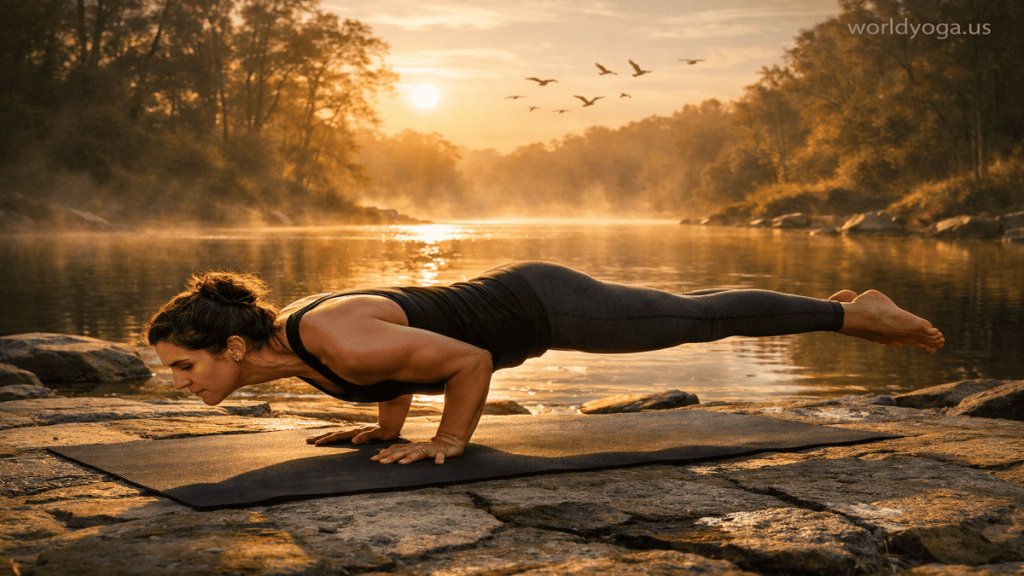
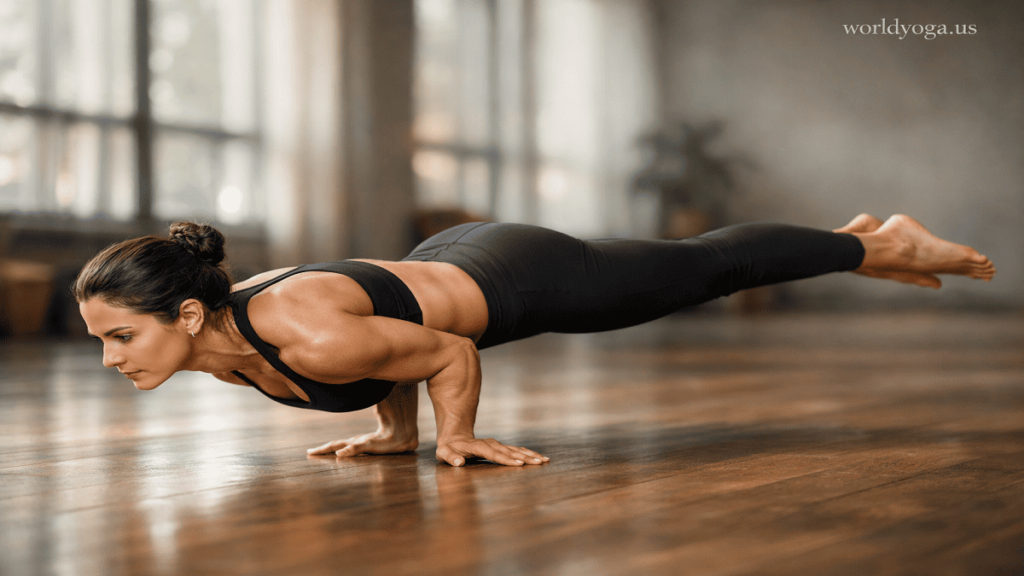
In Mayurasana, the practitioner balances the entire body horizontally on the elbows, which are pressed firmly into the abdomen. The hands point backward, and the legs are extended straight behind, parallel to the ground. The body resembles a rigid plank supported only by the forearms. Achieving stability requires significant core strength, wrist endurance, and mental focus.
The pose is typically entered from a kneeling position. The hands are placed on the floor with fingers pointing backward toward the feet. The elbows are bent and pressed into the abdominal region, just above the navel. The practitioner then gradually lifts the legs and torso until the entire body becomes parallel to the ground.
Benefits
Mayurasana offers a wide range of physical and physiological benefits:
- Digestive stimulation: The pressure on the abdomen massages internal organs, improving digestion and metabolism.
- Detoxification: Traditional yoga texts claim it helps eliminate toxins from the body by enhancing internal organ function.
- Strength development: It significantly strengthens the wrists, forearms, shoulders, and core muscles.
- Improved balance and concentration: The posture requires intense focus, enhancing mental discipline.
- Energy activation: In yogic philosophy, it is believed to stimulate agni (digestive fire), increasing vitality.
Precautions
Mayurasana is an advanced posture and should not be attempted without proper preparation. Individuals with wrist injuries, hernia, high blood pressure, or abdominal surgeries should avoid it or practice under expert supervision. Beginners are advised to build strength through preparatory poses like plank, crow pose, and forearm balance exercises.
Variations and Preparations
- Baddha Mayurasana: A more advanced variation where the legs are locked in a lotus position while balancing.
- Preparatory poses: Plank pose, Dolphin pose, and Crow pose help develop the required strength and control.
Historical and Yogic Context
Mayurasana is described in classical yoga texts such as the Hatha Yoga Pradipika, where it is praised for its cleansing effects and ability to destroy toxins. Traditionally, it is considered a “kriya-like” posture due to its strong influence on internal purification.
References and Further Reading
- https://www.yogajournal.com/poses/peacock-pose/
- https://www.britannica.com/topic/peacock-pose
- https://www.iyengaryoga.org.uk/
- https://www.hathayogapradipika.net/
#Mayurasana in India
What is Mayurasana (Peacock Pose)?
Mayurasana, commonly known as the Peacock Pose, is a traditional advanced arm-balancing yoga posture in Hatha Yoga. The Sanskrit word Mayura means peacock and Asana means posture. In this pose, the body is lifted parallel to the ground while balancing solely on the elbows, which press into the abdomen. It resembles a peacock displaying its feathers in stability and control. Mayurasana is considered both a strength-building and detoxifying posture, requiring significant core strength, wrist stability, and mental focus.
In practice, the pose begins from a kneeling position. The hands are placed on the floor with fingers pointing backward toward the feet. The elbows are bent and pressed into the abdomen just above the navel. With controlled breathing and gradual weight shift, the legs are lifted until the body becomes horizontal and fully balanced. The practitioner maintains a straight line from head to heels, engaging abdominal muscles and maintaining steady gaze. Advanced practitioners may hold the pose for several seconds to build endurance and concentration.
Mayurasana offers multiple benefits including improved digestion, strengthened core muscles, enhanced wrist and forearm strength, and increased body balance. The abdominal compression stimulates internal organs and is traditionally believed to activate digestive fire, known as agni. It also improves focus and mental discipline due to the concentration required to maintain balance. Regular practice may help develop upper body endurance and posture alignment, making it beneficial for advanced yoga practitioners.
Mayurasana is an advanced posture and should be practiced with caution. Individuals with wrist injuries, hernia, or high blood pressure should avoid it unless guided by an expert. Proper warm-up and preparatory poses are essential to prevent strain. It is recommended to learn under supervision to ensure correct alignment and safety. For further study, refer to https://www.yogajournal.com/poses/peacock-pose/ and https://www.britannica.com/topic/peacock-pose and https://www.iyengaryoga.org.uk/
From a yogic perspective, Mayurasana is described in classical texts such as the Hatha Yoga Pradipika as a powerful cleansing posture that helps regulate internal energy flow. It is often practiced on an empty stomach in a calm environment. Breathing should remain steady and controlled, avoiding strain or breath-holding for beginners. Over time, practitioners may explore variations such as Baddha Mayurasana, where the legs are placed in lotus position for increased intensity. Consistent practice improves neuromuscular coordination and enhances overall body awareness.
Because of its difficulty, Mayurasana is generally recommended only after building strong foundational strength through simpler arm balances and core training exercises. Progress should be gradual, and any pain in the wrists or abdomen should be immediately addressed by stopping the practice. With patience and correct guidance, it becomes a highly rewarding posture for strength and discipline.
#Mayurasana in Maharashtra
How is Mayurasana performed step by step?
Step 1: Preparation
Begin by warming up the wrists, elbows, shoulders, and core muscles. Simple preparatory poses such as Plank Pose, Dolphin Pose, and gentle wrist stretches help build the required strength and flexibility. It is recommended to practice on an empty stomach.
Step 2: Starting Position
Kneel on the floor in a comfortable kneeling position. Bring your knees slightly apart. Lean your upper body forward and place your hands on the ground between your knees.
- Fingers should point backward toward your feet
- Elbows should bend slightly and press firmly into the abdomen (just above the navel)
- Keep palms flat and stable on the ground
This arm placement is crucial as it acts as the main support system for the pose.
Step 3: Engaging the Core
Take a deep breath and engage your abdominal muscles. The elbows should gently press into the stomach area, creating a firm platform. This compression is essential for lifting the body.
Focus your gaze slightly forward to maintain balance and stability.
Step 4: Shifting Weight Forward
Slowly shift your body weight forward onto your arms. The knees will begin to lighten as the center of gravity moves over the elbows.
This step requires patience—avoid rushing the movement to prevent strain or loss of balance.
Step 5: Lifting the Legs
With controlled breathing, gradually extend one leg backward, followed by the other. Once balance is achieved, lift both legs simultaneously until the body becomes parallel to the ground.
At this stage:
- Legs are straight and together
- Body forms a horizontal line
- Only the palms and elbows support the body
Step 6: Holding the Pose
Maintain the posture for a few seconds initially. Keep breathing steady and avoid holding the breath. The core should remain tight, and the body should stay stable without sagging.
Over time, increase the duration gradually as strength improves.
Step 7: Releasing the Pose
To exit, gently lower the feet back to the ground in a controlled manner. Return to the kneeling position and rest in Child’s Pose to relax the wrists and abdominal muscles.
Important Safety Notes
- Avoid if you have wrist injuries, hernia, or abdominal issues
- Do not practice on hard or slippery surfaces
- Beginners should practice under expert supervision
- Stop immediately if there is pain or dizziness
References for Further Study
- https://www.yogajournal.com/poses/peacock-pose/
- https://www.britannica.com/topic/peacock-pose
- https://www.artofliving.org/yoga/poses/peacock-pose
- https://www.iyengaryoga.org.uk/
#Mayurasana in Chennai
What strength and balance are required?
1. Upper Body Strength Requirements
A significant amount of strength is required in the wrists, forearms, elbows, and shoulders. These muscle groups must support nearly the entire body weight.
- Wrist strength: The wrists must be conditioned to bear compressive force without collapsing. Weak wrists often lead to instability or strain.
- Forearm endurance: The forearms stabilize the pressure created by the elbows pressing into the abdomen.
- Shoulder stability: The shoulders must remain engaged and slightly protracted to prevent sinking or wobbling.
Without adequate upper body conditioning, the practitioner cannot safely lift or hold the body parallel to the ground.
2. Core Strength Requirements
Core strength is the most critical element in Mayurasana.
- The abdominal muscles (rectus abdominis and transverse abdominis) must contract strongly to lift the legs.
- The obliques help maintain side-to-side stability.
- The lower back muscles assist in keeping the spine straight.
The elbows press into the abdomen, creating internal support that allows the core to act like a rigid lifting platform. Without strong core engagement, the body will collapse downward or tilt forward.
3. Balance and Body Control
Balance in Mayurasana is not just about stillness—it is about dynamic micro-adjustments.
Key balance requirements include:
- Center of gravity control: The body must shift forward gradually until it is directly over the elbows.
- Even weight distribution: Both arms must bear equal load to prevent tipping.
- Leg alignment control: The legs must remain fully extended and together to avoid destabilizing rotation.
- Proprioception (body awareness): The practitioner must constantly sense small shifts in body position and correct them instantly.
This level of balance requires practice and refined neuromuscular coordination.
4. Mental Focus and Stability
Although physical strength is essential, mental discipline is equally important.
- Concentration helps maintain stillness in the posture
- Calm breathing prevents sudden loss of balance
- Fear control is necessary, especially during forward weight shifting
Many practitioners find that hesitation or anxiety is the main barrier rather than physical inability.
5. Preparatory Strength Level
Before attempting Mayurasana, a practitioner should ideally be comfortable with:
- Plank Pose for at least 1–2 minutes
- Crow Pose (Bakasana) balance control
- Forearm strengthening exercises
- Strong core engagement practices like Boat Pose
Conclusion
Mayurasana requires a rare combination of upper-body strength, deep core activation, precise balance control, and mental focus. It is not a beginner posture and should be approached gradually through structured training and proper guidance.
References
- https://www.yogajournal.com/poses/peacock-pose/
- https://www.britannica.com/topic/peacock-pose
- https://www.artofliving.org/yoga/poses/peacock-pose
- https://www.iyengaryoga.org.uk/
#Mayurasana in Delhi
What are the benefits of this pose?
1. Strengthens Upper Body
One of the most immediate benefits is the development of upper body strength.
- Strengthens wrists, forearms, and elbows
- Builds shoulder stability and endurance
- Improves ability to support body weight on the arms
Because the entire body is lifted on the arms, it acts like a full upper-body strength workout.
2. Builds Core Power
The posture heavily engages the abdominal region.
- Strengthens rectus abdominis and deep core muscles
- Improves spinal stability and control
- Enhances overall core endurance
The abdominal compression required in Mayurasana makes it one of the most effective yoga poses for core strengthening.
3. Improves Digestion
Traditional yoga texts emphasize the digestive benefits of Mayurasana.
- Massages internal organs such as the stomach and intestines
- Stimulates digestive fire (agni)
- Helps improve metabolism and reduce bloating
This is why it is often recommended for individuals with sluggish digestion.
4. Detoxification and Internal Organ Activation
The pressure created by the elbows on the abdomen is believed to:
- Improve blood circulation to abdominal organs
- Support liver and kidney function
- Enhance internal cleansing processes
In yogic tradition, this pose is associated with purification of internal systems.
5. Enhances Balance and Coordination
Maintaining Mayurasana requires precise control.
- Improves neuromuscular coordination
- Develops body awareness (proprioception)
- Enhances ability to maintain stillness under pressure
Over time, practitioners gain better control over their body movements in other physical activities as well.
6. Boosts Mental Focus and Discipline
The pose demands intense concentration.
- Improves focus and mindfulness
- Reduces mental distraction during practice
- Builds discipline and patience
Because even slight imbalance can cause collapse, mental stability becomes essential.
7. Increases Energy and Vitality
According to classical yogic philosophy:
- Activates internal energy flow
- Improves alertness and vitality
- Reduces heaviness and lethargy in the body
Practitioners often report feeling energized after consistent practice.
Important Caution
Despite its benefits, Mayurasana is an advanced pose and should not be attempted without preparation. It may strain wrists or abdomen if done incorrectly.
Avoid if you have:
- Wrist or elbow injuries
- Hernia or abdominal surgery history
- Severe high blood pressure
References
- https://www.yogajournal.com/poses/peacock-pose/
- https://www.britannica.com/topic/peacock-pose
- https://www.artofliving.org/yoga/poses/peacock-pose
- https://www.iyengaryoga.org.uk/
#Mayurasana in Kolkata
What common mistakes should be avoided?
1. Incorrect Hand Placement
One of the most frequent errors is placing the hands incorrectly.
Mistake:
- Fingers pointing sideways or forward instead of backward
- Hands placed too wide or too close together
Why it matters:
Proper hand alignment ensures stable leverage. Incorrect placement reduces control and increases wrist strain.
2. Weak Elbow-to-Abdomen Contact
The elbows must press firmly into the abdomen just above the navel.
Mistake:
- Elbows slipping away from the stomach
- Not creating enough abdominal pressure
Why it matters:
Without firm elbow pressure, the body cannot be lifted efficiently, leading to collapse or imbalance.
3. Poor Core Engagement
Core strength is the foundation of Mayurasana.
Mistake:
- Relying only on arm strength
- Relaxing abdominal muscles during lift
Why it matters:
A weak core causes the hips to drop, making it impossible to maintain a horizontal position.
4. Lifting the Legs Too Quickly
Many practitioners try to rush into the full pose.
Mistake:
- Sudden kick-up instead of controlled lift
- Jumping into balance without stabilization
Why it matters:
Quick movements disrupt balance and increase the risk of falling forward or straining wrists.
5. Improper Weight Distribution
Balance depends on even weight on both arms.
Mistake:
- Shifting too much weight onto one side
- Leaning too far forward or backward
Why it matters:
Uneven pressure leads to instability and possible joint strain.
6. Bent or Misaligned Legs
Leg positioning plays a major role in maintaining stability.
Mistake:
- Bending knees during lift or hold
- Spreading legs apart unintentionally
Why it matters:
Bent or separated legs shift the center of gravity, making balance harder.
7. Holding Breath
Breathing is often neglected in advanced poses.
Mistake:
- Holding breath during lift or hold
- Irregular breathing patterns
Why it matters:
Breath-holding increases tension and reduces focus, making balance harder to maintain.
8. Overstraining Wrists
Wrist safety is often ignored by beginners.
Mistake:
- Practicing without warm-up
- Locking wrists under full body weight suddenly
Why it matters:
This can lead to pain, inflammation, or long-term wrist injury.
9. Skipping Preparatory Poses
Jumping directly into Mayurasana is a major mistake.
Mistake:
- Not practicing plank, crow pose, or core drills
- Lack of gradual progression
Why it matters:
Preparation builds the strength and control required for safe execution.
Conclusion
Avoiding these mistakes is essential for safely mastering Mayurasana. The pose demands patience, progressive training, and precise alignment rather than force or speed. Controlled movement, strong core engagement, and mindful breathing are key to success.
References
- https://www.yogajournal.com/poses/peacock-pose/
- https://www.britannica.com/topic/peacock-pose
- https://www.artofliving.org/yoga/poses/peacock-pose/
- https://www.iyengaryoga.org.uk/
#Mayurasana in Ahemadabad
Case Study of Mayurasana
Background
This case study examines the progression of a 28-year-old intermediate yoga practitioner (referred to as “Participant A”) who aimed to master Mayurasana over a 10-week structured training program. The participant had 2 years of regular yoga practice, including basic arm balances like Crow Pose and Plank variations, but lacked advanced core compression strength and wrist stability required for Mayurasana.
The objective was to improve upper-body strength, core control, and balance coordination while safely achieving a stable horizontal hold in Mayurasana.
Initial Assessment
At baseline, Participant A demonstrated:
- Moderate core strength but difficulty sustaining engagement under load
- Weak wrist endurance during prolonged arm support
- Limited ability to shift body weight forward without fear of falling
- Inability to lift both legs simultaneously in balance poses
Attempts at Mayurasana resulted in premature collapse due to insufficient abdominal compression and poor weight distribution.
Intervention Strategy
A progressive 10-week plan was designed focusing on four key components:
- Strength Conditioning
- Plank holds (gradually increasing from 30 seconds to 2 minutes)
- Forearm strengthening drills
- Shoulder stability exercises
- Core Activation Training
- Boat Pose variations
- Leg raises and hollow body holds
- Controlled breathing with abdominal engagement
- Balance Development
- Crow Pose progression
- Forward weight-shift drills
- Static hold transitions
- Technique Refinement for Mayurasana
- Elbow-to-abdomen placement practice
- Assisted lifts using yoga blocks
- Slow lift-and-hold attempts under supervision
Progress Observations
By Week 4, Participant A showed improved wrist endurance and better control during forward weight shifting. By Week 7, they could briefly lift both feet off the ground but struggled with maintaining a horizontal alignment.
By Week 10:
- Successfully held Mayurasana for 6–8 seconds
- Demonstrated stable elbow-abdomen engagement
- Improved breathing control under physical stress
- Reduced fear response during balance transition
Results and Outcomes
The structured progression resulted in measurable improvements:
- Core strength increased significantly, improving stability in multiple yoga poses
- Wrist endurance improved, reducing strain during arm balances
- Balance coordination became more refined, especially in static holds
- Participant achieved initial competency in Mayurasana with safe alignment
However, longer holds (>15 seconds) still required further conditioning, particularly in shoulder endurance and abdominal compression strength.
Conclusion
This case study highlights that successful practice of Mayurasana requires a systematic progression approach rather than direct execution. The combination of strength training, balance drills, and technique refinement is essential for safe mastery. Gradual adaptation significantly reduces injury risk while improving performance outcomes.
References
- https://www.yogajournal.com/poses/peacock-pose/
- https://www.britannica.com/topic/peacock-pose
- https://www.artofliving.org/yoga/poses/peacock-pose
- https://www.iyengaryoga.org.uk/
#Mayurasana in Hyderabad
White Paper of Mayurasana
Abstract
Mayurasana is an advanced classical yoga arm-balancing posture that integrates strength, stability, neuromuscular coordination, and internal organ compression. This white paper examines its biomechanical structure, physiological effects, training requirements, safety considerations, and practical applications in modern yoga practice. It also evaluates its role in improving core strength, digestive function, and motor control.
1. Introduction
Mayurasana (Peacock Pose) originates from traditional Hatha Yoga texts and is considered one of the most demanding balancing postures. The pose requires the practitioner to elevate the body horizontally while supporting it only on the forearms and wrists, which press into the abdominal region. This creates a unique combination of external load-bearing and internal organ compression.
2. Biomechanics of the Pose
The structural foundation of Mayurasana relies on three key biomechanical principles:
- Leverage system: The elbows act as a fulcrum against the abdomen
- Center of gravity shift: Forward displacement over the wrists enables lift
- Isometric stabilization: Continuous muscle engagement maintains alignment
Primary muscle groups involved include the rectus abdominis, transverse abdominis, deltoids, forearm flexors, and spinal stabilizers. Proper alignment ensures that load distribution remains symmetrical across both upper limbs.
3. Physiological Impact
Practicing Mayurasana produces multiple physiological responses:
- Digestive stimulation: Abdominal compression enhances gastrointestinal activity
- Core strengthening: Deep activation of abdominal musculature improves trunk stability
- Circulatory enhancement: Increased blood flow to abdominal organs
- Neuromuscular coordination: Requires precise motor control and proprioception
Traditional yogic philosophy also associates the pose with activation of “agni” (digestive fire), supporting metabolic balance.
4. Training Requirements
Effective performance of Mayurasana requires progressive conditioning:
- Strong wrist and forearm endurance
- Core stability training (plank, hollow holds, boat pose)
- Shoulder stabilization and scapular control
- Balance training through intermediate arm poses such as Crow Pose
Without adequate preparation, the pose increases risk of wrist strain and abdominal discomfort.
5. Risk and Safety Considerations
Mayurasana is classified as an advanced posture. Key risks include:
- Wrist hyperextension injuries
- Abdominal pressure strain
- Loss of balance leading to falls
It is contraindicated for individuals with hernia, recent abdominal surgery, or severe joint instability. Proper supervision and gradual progression are strongly recommended.
6. Applications in Modern Practice
In contemporary yoga and fitness systems, Mayurasana is used for:
- Core strengthening programs
- Advanced balance and mobility training
- Rehabilitation of neuromuscular control (under supervision)
- Performance conditioning in bodyweight training systems
Its integration into modern fitness highlights its functional strength benefits beyond traditional yoga contexts.
7. Conclusion
Mayurasana represents a highly advanced synthesis of strength, balance, and internal physiological engagement. When practiced progressively and safely, it offers significant benefits for core stability, digestive activation, and neuromuscular coordination. However, due to its complexity, it requires structured training, expert guidance, and disciplined progression.
References
- https://www.yogajournal.com/poses/peacock-pose/
- https://www.britannica.com/topic/peacock-pose
- https://www.iyengaryoga.org.uk/
- https://www.artofliving.org/yoga/poses/peacock-pose/
#Mayurasana in Pune
Industry Application of Mayurasana
Overview
Mayurasana, or Peacock Pose, is an advanced yoga arm balance traditionally rooted in Hatha Yoga. In modern contexts, it is increasingly studied and applied beyond classical yoga practice. Its combination of core compression, upper-body load-bearing, and neuromuscular control makes it relevant in several industries including fitness training, sports performance, rehabilitation, wellness, and biomechanics research.
1. Fitness and Strength Training Industry
In modern fitness systems, Mayurasana is used as a bodyweight strength benchmark.
Applications:
- Advanced calisthenics training programs
- Core stabilization development routines
- Wrist and forearm conditioning protocols
- Functional strength progression for bodyweight athletes
It is often treated as an “elite-level” movement similar to planche progressions due to its high strength demands.
2. Sports Performance and Athletics
Athletes use variations of Mayurasana principles for performance enhancement.
Applications:
- Core stability training for gymnasts and martial artists
- Balance and proprioception development in field sports
- Injury prevention through improved trunk control
- Shoulder and wrist resilience training
The pose’s requirement for full-body coordination makes it valuable for sports requiring explosive control and stability.
3. Rehabilitation and Physiotherapy (Controlled Use)
In rehabilitation settings, modified versions of Mayurasana principles may be used under supervision.
Applications:
- Gradual wrist strengthening after injury recovery
- Core reactivation exercises for postural correction
- Neuromuscular retraining for balance disorders
- Controlled isometric strengthening for abdominal stability
Important: Full Mayurasana is NOT used in early rehabilitation stages due to high load demands.
4. Yoga Therapy and Wellness Industry
Within therapeutic yoga, Mayurasana is applied in structured, progressive formats.
Applications:
- Digestive health improvement programs
- Metabolic activation routines
- Stress reduction through focused balance training
- Energy regulation practices in traditional yoga therapy
It is often included in advanced therapeutic sequences for internal organ stimulation.
5. Biomechanics and Sports Science Research
Mayurasana is of interest in movement science due to its unique load distribution.
Applications:
- Analysis of elbow-as-fulcrum biomechanics
- Studies on abdominal compression and organ response
- Research on center-of-mass control in static holds
- EMG studies of core and upper limb activation patterns
It provides a real-world model for studying closed-chain kinetic loading.
6. Mental Performance and Corporate Wellness
Some wellness programs incorporate Mayurasana-based training principles.
Applications:
- Focus and attention training exercises
- Stress resilience development through balance control
- Mind-body coordination programs in corporate yoga sessions
- Cognitive discipline improvement via static hold training
The intense focus required makes it useful for mindfulness-based performance training.
7. Limitations in Industry Use
Despite its value, there are constraints:
- Requires high skill level and supervision
- Not suitable for mass beginner fitness programs
- Risk of wrist and abdominal strain if misapplied
- Needs progressive scaling in all professional settings
Conclusion
Mayurasana has evolved from a traditional yogic posture into a multidisciplinary tool with applications in fitness, sports science, rehabilitation, and wellness industries. Its combination of strength, balance, and internal compression mechanics makes it a valuable model for studying human movement and functional stability, provided it is implemented safely and progressively.
References
- https://www.yogajournal.com/poses/peacock-pose/
- https://www.britannica.com/topic/peacock-pose
- https://www.artofliving.org/yoga/poses/peacock-pose/
- https://www.iyengaryoga.org.uk/
#Mayurasana in Mumbai
Ask FAQs
What is Mayurasana?
Mayurasana, or Peacock Pose, is an advanced arm-balancing yoga posture where the body is lifted parallel to the ground using only the support of the palms and elbows, which press into the abdomen. It is known for developing core strength, balance, and internal organ stimulation.
Who can practice Mayurasana?
It is generally suitable only for intermediate to advanced yoga practitioners who already have strong core strength and arm stability. Beginners should first master preparatory poses like Plank Pose and Crow Pose before attempting it.
What are the main benefits of Mayurasana?
Key benefits include:
Stronger core muscles
Improved wrist and forearm strength
Better digestion due to abdominal compression
Enhanced balance and concentration
Improved body control and coordination
Are there any risks in practicing Mayurasana?
Yes. If performed incorrectly, it can cause:
Wrist or elbow strain
Abdominal pressure discomfort
Loss of balance leading to falls
It is not recommended for people with hernia, recent abdominal surgery, or severe wrist injuries.
How long does it take to master Mayurasana?
The time varies depending on strength, flexibility, and practice consistency. For most practitioners, it may take several weeks to months of consistent preparation before achieving a stable hold, and longer to master extended duration and perfect alignment.
Table of Contents
Disclaimer: Mayurasana is an advanced yoga posture that should be practiced only under the guidance of a qualified instructor. Individuals with wrist injuries, abdominal conditions, hernia, or other medical concerns should avoid this pose or seek medical advice before attempting it. Practice should be gradual, with proper warm-up and attention to correct technique to prevent injury.