Parivritta Jathara Supta Garudasana
Parivritta Jathara Supta Garudasana is a deeply restorative and mobility-focused yoga variation that combines elements of supine spinal twisting, abdominal relaxation, and the crossed-leg positioning inspired by Garudasana. This hybrid posture integrates gentle rotation of the spine with hip opening and lower-body stretching, making it highly effective for improving flexibility, releasing tension, and supporting nervous system balance.
This pose is commonly used in restorative yoga sequences, therapeutic movement practices, and recovery sessions due to its ability to decompress the spine while promoting relaxation through controlled breathing.
How to Perform Parivritta Jathara Supta Garudasana
Begin by lying on your back in a neutral position. Extend both legs and allow the arms to rest comfortably beside the body. Take a few deep breaths to relax the spine and shoulders.
Bend both knees and gently cross one leg over the other in an Eagle-inspired position, similar to Garudasana. If possible, Parivritta Jathara Supta Garudasana wrap the foot behind the opposite calf; if not, simply crossing the thighs is sufficient.
From this crossed-leg position, slowly guide both knees toward one side of the body while keeping the shoulders grounded on the floor. This creates a controlled spinal twist combined with hip engagement.
Turn the head in the opposite direction of the knees if it feels comfortable for the neck. Maintain a steady breath and avoid forcing the rotation.
Hold the posture for 30–60 seconds, then return to the center and repeat on the opposite side.
Key Alignment Principles
Proper alignment is essential to ensure safety and effectiveness in this posture:
- Keep both shoulders grounded on the mat
- Avoid forcing the knees toward the floor
- Maintain a neutral or gently extended spine
- Cross legs without straining the knees
- Allow the twist to come gradually from the hips and spine
- Keep breathing slow and even throughout
Using a folded blanket under the knees or lower back can improve comfort and alignment.
Benefits of Parivritta Jathara Supta Garudasana
Improves Spinal Mobility
The gentle rotational movement helps increase flexibility in the thoracic and lumbar spine while reducing stiffness caused by prolonged sitting or inactivity.
Releases Hip and Glute Tension
The crossed-leg position stretches the outer hips and gluteal muscles, helping relieve tightness in the piriformis and surrounding tissues.
Supports Digestion and Abdominal Relaxation
Twisting postures are known to create gentle compression and release in the abdominal region, which may support digestive comfort and internal organ mobility.
Enhances Nervous System Relaxation
Because the body is fully supported, this posture encourages parasympathetic activation, promoting calmness, stress reduction, and mental clarity.
Improves Body Awareness
Practicing mindful alignment and breath control enhances awareness of spinal positioning, hip symmetry, and muscular tension patterns.
Precautions and Contraindications
This posture should be practiced carefully in the following cases:
- Knee injuries or ligament strain
- Severe lower back or spinal conditions
- Recent abdominal or hip surgery
- Pregnancy (deep twists should be avoided or modified)
Always avoid forcing the twist or pushing the knees beyond a comfortable range.
Recommended Preparatory Poses
- Cat-Cow Stretch for spinal mobility
- Supine Figure Four for hip opening
- Gentle knee-to-chest stretches
- Reclined spinal twist (basic variation)
- Bound Angle Pose for inner thigh flexibility
Helpful Resources
Conclusion
Parivritta Jathara Supta Garudasana is a powerful restorative yoga variation that combines spinal twisting with deep hip release, Parivritta Jathara Supta Garudasana offering benefits for flexibility, relaxation, and overall mobility. When practiced with proper alignment and mindful breathing, it supports both physical recovery and mental calmness, making it a valuable addition to restorative yoga and wellness routines.
#Parivritta Jathara Supta Garudasana in India
What is the proper alignment in this supine twisted Eagle Legs variation?
Proper alignment in this posture ensures safety for the spine, hips, Parivritta Jathara Supta Garudasana and knees while maximizing its restorative benefits. Because the body is fully supported on the floor, alignment is about controlled placement rather than muscular effort.
Spinal alignment
The spine should remain long and neutral before entering the twist. As the knees move to the side, the rotation should come gradually from the mid-back and waist rather than collapsing the lower back. Avoid forcing the shoulders off the mat.
Shoulder position
Both shoulders should stay grounded as evenly as possible. If one shoulder lifts slightly, reduce the depth of the twist. The upper body should remain relaxed, with the chest open and not compressed.
Pelvic alignment
The pelvis should stay stable and controlled. Excessive tilting or lifting can strain the lower back. The movement should feel like a gentle spiral rather than a sharp rotation.
Knee and hip alignment
The crossed-leg position should never create pain in the knees. The sensation should be felt more in the outer hips and glutes rather than the joint itself. If discomfort appears, Parivritta Jathara Supta Garudasana reduce the depth of the leg wrap or keep only a simple thigh cross without binding the foot.
Neck and head alignment
The neck should remain relaxed. Turning the head in the opposite direction of the knees is optional and should never create strain. Keeping the head neutral is also perfectly acceptable.
Breathing alignment
Breathing should remain slow, steady, and uninterrupted. Inhalations help lengthen the spine, while exhalations allow the body to soften into the twist naturally.
Key alignment reminders
- Do not force the knee closer to the floor
- Keep both shoulders grounded
- Maintain a relaxed neck and jaw
- Cross legs only within a pain-free range
- Let the twist happen gradually, not aggressively
Helpful resources
When practiced with correct alignment and mindful breathing, Parivritta Jathara Supta Garudasana becomes a deeply effective posture for releasing tension, Parivritta Jathara Supta Garudasana improving spinal mobility, and restoring overall balance in the body.
#Parivritta Jathara Supta Garudasana in Maharashtra
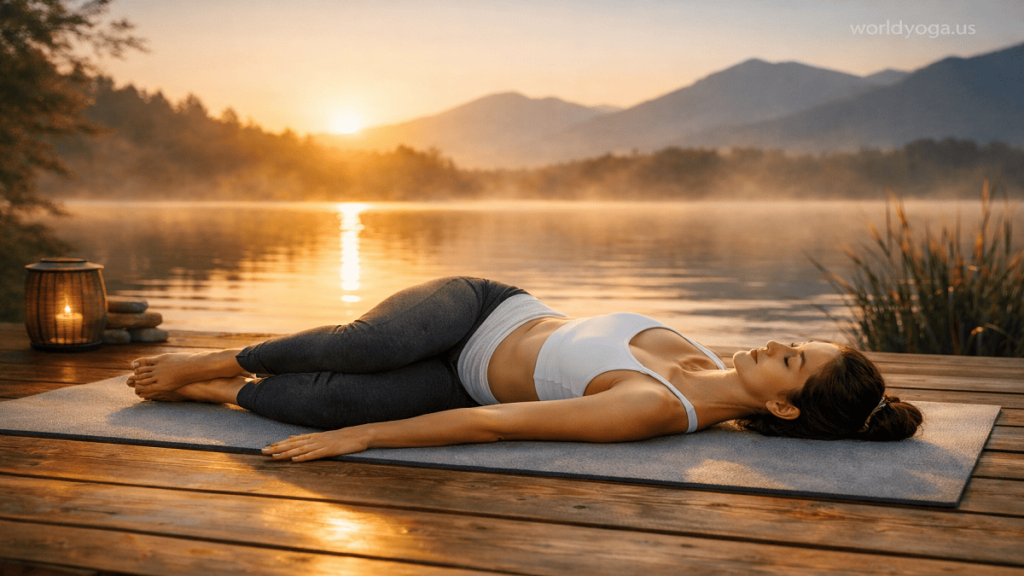
How is Parivritta Jathara Supta Garudasana performed correctly?
Parivritta Jathara Supta Garudasana is a supine twisting variation that combines gentle spinal rotation with the crossed-leg position inspired by Garudasana. When performed correctly, it supports hip release, spinal mobility, and deep relaxation without stressing the joints. The focus should always be on controlled movement, stable alignment, Parivritta Jathara Supta Garudasana and steady breathing rather than depth of twist.
Begin by lying flat on your back in a neutral position. Allow the spine to settle, the shoulders to relax, and the arms to rest comfortably in a “T” position or alongside the body.
Bend both knees and place the feet on the floor. Lift one leg and cross it over the other, forming a soft Eagle-leg shape. If flexibility allows, wrap the top foot behind the lower calf. If not, simply crossing the thighs is sufficient and fully acceptable.
Once the legs are positioned, gently draw the knees toward the chest. From here, slowly guide both knees across the body toward one side. The movement should be gradual and controlled, originating from the hips and mid-spine rather than being forced by momentum.
Turn the head in the opposite direction of the knees only if the neck feels comfortable. Otherwise, keep the head neutral. Maintain slow, even breathing throughout the posture.
Hold for 30–60 seconds, then return to the center with control. Repeat on the opposite side to maintain balance in the body.
Proper alignment in Parivritta Jathara Supta Garudasana
Correct alignment ensures safety and maximizes the restorative and mobility benefits of the pose.
Spine alignment
The spine should remain long and neutral before and during the twist. The rotation should come from the thoracic spine and waist, not by collapsing the lower back. Avoid flattening or over-arching the lumbar region.
Shoulder alignment
Both shoulders should stay grounded on the mat as evenly as possible. If one shoulder lifts, reduce the intensity of the twist. The chest should remain open rather than compressed.
Pelvis alignment
The pelvis should remain stable and controlled. Excessive tilting can strain the lower back and reduce the effectiveness of the twist. The goal is a gentle, even rotation—not a forced drop of the knees.
Knee and hip alignment
The crossed-leg position should feel secure but never painful. The stretch should be felt in the outer hips and glutes rather than in the knees. If knee discomfort occurs, reduce the depth of the wrap or keep only a simple cross without binding.
Neck alignment
The neck should remain relaxed and free of tension. Turning the head is optional and should never create strain. A neutral head position is perfectly valid.
Breathing alignment
Breathing should be smooth and continuous. Inhale to lengthen the spine, and exhale to allow the body to soften into the twist naturally.
Key safety cues
- Never force the knees toward the floor
- Keep both shoulders grounded
- Avoid pain in knees or hips
- Maintain gentle, controlled movement
- Use props if needed for support
Helpful resources
When practiced with proper alignment and mindful breathing, Parivritta Jathara Supta Garudasana becomes a highly effective restorative posture for improving spinal mobility, releasing hip tension, and supporting overall relaxation.
#Parivritta Jathara Supta Garudasana in Ahemadabad
Which muscles and joints are engaged during the posture?
Parivritta Jathara Supta Garudasana is a supine twisting variation that blends gentle spinal rotation with the crossed-leg positioning inspired by Garudasana. Although it appears restful, the posture involves coordinated muscular engagement and controlled joint positioning to create safe mobility, hip release, and spinal decompression.
Because the body is fully supported on the floor, the effort is minimal, but specific muscle groups remain active to stabilize and guide the movement.
Muscles engaged during the posture
Core muscles
The core plays a key stabilizing role throughout the twist.
- Transverse abdominis helps stabilize the spine and pelvis
- Obliques assist in controlled rotational movement
- Rectus abdominis supports gentle abdominal engagement during the twist
These muscles ensure that the rotation is controlled rather than forced.
Hip and glute muscles
The hips are the primary focus of the posture.
- Gluteus maximus and medius are stretched as the legs cross and rotate
- Piriformis and deep hip rotators experience significant release
- Tensor fasciae latae (TFL) helps stabilize outer hip alignment
These muscles are often tight from prolonged sitting, making this posture highly effective for release.
Inner thigh muscles (adductors)
The adductor group is lightly engaged and stretched depending on the depth of the leg crossing. They help stabilize the crossed-leg position and maintain alignment.
Lower back muscles
- Erector spinae provide gentle postural support
- Multifidus muscles assist in stabilizing the vertebrae during rotation
These muscles help control the spinal twist without collapsing the lumbar region.
Shoulder and upper back muscles
- Rhomboids and trapezius help stabilize the shoulder blades
- Deltoids assist in maintaining arm placement in a T-position
The upper body remains relaxed but structurally supported.
Joints engaged during the posture
Hip joints
The hip joints are the most actively engaged joints. They undergo:
- External rotation (from leg crossing)
- Mild flexion (from knee drawing toward chest)
- Controlled mobility during the twist
This improves joint range and reduces stiffness.
Knee joints
The knees remain in flexion and experience rotational positioning. Proper alignment is critical here—there should be no forced twisting or compression, as the knees are more sensitive than the hips.
Spine (vertebral column)
The spine experiences gentle rotational movement, primarily through:
- Thoracic spine (upper/mid-back rotation)
- Mild lumbar involvement (controlled and limited)
This supports spinal mobility and decompression.
Sacroiliac (SI) joints
The SI joints experience subtle movement and stabilization as the pelvis rotates. Proper control helps maintain pelvic balance and reduces strain.
Shoulder joints
The shoulders remain in a stable abducted position (arms out in a T-shape). They support grounding and help maintain spinal balance during the twist.
Functional benefits of muscle and joint engagement
When practiced correctly, the posture supports:
- Improved hip mobility and flexibility
- Reduced glute and piriformis tightness
- Better spinal rotation and control
- Enhanced pelvic stability
- Gentle release of lower-back tension
Helpful resources
#Parivritta Jathara Supta Garudasana in Hyderabad
What preparatory poses are recommended before practicing it?
Parivritta Jathara Supta Garudasana is a supine twisting variation that combines gentle spinal rotation with the crossed-leg positioning inspired by Garudasana. Because it involves hip external rotation, glute release, and controlled spinal twisting, preparing the body beforehand helps improve safety, comfort, and range of motion.
Preparatory poses should focus on opening the hips, relaxing the lower back, and gently mobilizing the spine so the body can enter the twist without strain.
1. Cat-Cow Stretch
Cat-Cow is one of the most effective spinal warm-ups for this posture.
It improves mobility in the thoracic and lumbar spine while coordinating breath with movement.
- Increases spinal flexibility
- Activates core awareness
- Prepares the back for gentle twisting
This helps ensure the twist comes from a mobile and responsive spine rather than stiffness.
2. Supine Figure Four Pose
This is one of the most important preparatory poses for hip opening.
- Stretches the piriformis and outer hips
- Releases glute tension
- Mimics the hip position used in Eagle Legs
It directly prepares the body for the crossed-leg position used in the main posture.
3. Reclined Knee-to-Chest Pose (Apanasana)
This simple supine stretch helps relax the lower back and hips.
- Releases lumbar tension
- Gently compresses and decompresses the spine
- Encourages relaxation before twisting
It is especially helpful for beginners or tight lower backs.
4. Bound Angle Pose (Baddha Konasana)
This seated pose opens the inner thighs and hips.
- Improves hip external rotation
- Stretches adductors
- Enhances pelvic mobility
A more open hip joint makes the leg-crossing position easier and safer.
5. Supine Spinal Twist (Basic Variation)
A simpler version of twisting prepares the spine for deeper rotation.
- Introduces controlled spinal rotation
- Improves thoracic mobility
- Teaches shoulder grounding during twists
This directly supports correct alignment in the final posture.
6. Happy Baby Pose
A gentle hip and lower back opener.
- Releases tight hips and groin
- Relaxes the sacrum and pelvis
- Encourages deep breathing
It is especially useful for reducing stiffness before deeper variations.
7. Seated Forward Fold (Mild Variation)
A light forward bend helps prepare the posterior chain.
- Stretches hamstrings
- Calms the nervous system
- Supports pelvic alignment awareness
This improves comfort in supine positioning.
Key benefits of preparation
Practicing these poses before Parivritta Jathara Supta Garudasana helps:
- Improve hip flexibility and rotation
- Reduce knee and lower-back strain
- Enhance spinal mobility
- Increase comfort in leg crossing
- Support deeper relaxation during the twist
Helpful resources
#Parivritta Jathara Supta Garudasana in Delhi
What are the benefits and precautions of this advanced reclined twist?
Parivritta Jathara Supta Garudasana is a restorative supine twist that combines gentle spinal rotation with the crossed-leg position inspired by Garudasana. This advanced reclined variation is designed to improve mobility, release deep muscular tension, and support relaxation while keeping the body fully supported on the floor.
Although it is a gentle-looking posture, the combination of hip crossing and spinal twisting requires awareness of alignment and joint sensitivity, especially in the knees, hips, and lower back.
Benefits of the posture
1. Deep hip and glute release
The crossed-leg position targets the outer hips and gluteal muscles, especially the piriformis and deep hip rotators. This helps reduce tightness caused by prolonged sitting and repetitive movement patterns.
2. Improved spinal mobility
The gentle twisting action encourages rotation in the thoracic and lumbar spine. Over time, this can improve flexibility, reduce stiffness, and support healthier spinal movement patterns.
3. Lower back relaxation
Because the posture is performed in a supine position, the spine is supported by the floor. This reduces compressive load on the lumbar region and allows surrounding muscles to relax more effectively.
4. Enhanced circulation and abdominal comfort
Twisting postures create mild compression and release in the abdominal region, which may support circulation and digestive comfort. The controlled nature of this pose makes it suitable for restorative practice.
5. Nervous system calming effect
Slow breathing combined with supported positioning encourages parasympathetic activation. This can reduce stress, calm the mind, and support overall relaxation.
6. Improved body awareness
Practitioners develop better awareness of hip symmetry, pelvic positioning, and spinal alignment through mindful practice.
Precautions and safety considerations
1. Avoid forcing the twist
Never push the knees aggressively toward the floor. The twist should be gradual and comfortable, not forced.
2. Protect the knees
The knees are vulnerable in crossed-leg positions. Discomfort or sharp sensations in the knees are a sign to reduce intensity or modify the pose.
3. Maintain spinal neutrality
Avoid collapsing the lower back or over-rotating the spine. The movement should come from controlled rotation, not compression.
4. Use props when needed
A folded blanket, bolster, or cushion can support the knees or lower back, especially for beginners or individuals with limited mobility.
5. Contraindications
This posture should be practiced cautiously or avoided in cases of:
- Knee ligament injuries
- Severe hip joint issues
- Acute lower back pain or disc problems
- Recent abdominal or spinal surgery
- Pregnancy (deep twisting should be modified or avoided)
Key practice reminders
- Keep shoulders grounded
- Maintain slow, steady breathing
- Focus on hip sensation, not knee strain
- Exit the pose slowly and mindfully
- Practice both sides equally
Helpful resources
#Parivritta Jathara Supta Garudasana in Pune
Case Study of Parivritta Jathara Supta Garudasana
Parivritta Jathara Supta Garudasana is a restorative supine twisting variation that integrates spinal rotation with the crossed-leg positioning inspired by Garudasana. It is commonly used in yoga therapy and mobility-focused rehabilitation programs to improve hip flexibility, reduce lower-back tension, and support nervous system regulation.
This case study presents a structured observation of its application in a controlled wellness setting, focusing on functional outcomes, mobility improvements, and safety considerations.
Participant Profile
A 42-year-old office-based professional with a sedentary lifestyle participated in an 8-week restorative yoga program. The participant reported:
- Chronic stiffness in the lower back
- Tightness in hips and outer thighs
- Reduced spinal mobility
- Occasional stress-related muscular tension
The intervention focused on gentle restorative yoga postures, breath awareness, and progressive mobility training.
Intervention Protocol
Parivritta Jathara Supta Garudasana was introduced in week 3 after foundational hip-opening and supine mobility work. The practice was performed:
- 3–5 times per week
- Held for 40–60 seconds per side
- Integrated with slow diaphragmatic breathing
- Supported with props (bolster under knees in early sessions)
Complementary preparatory poses included:
- Supine Figure Four stretch
- Cat-Cow spinal mobilization
- Apanasana (knee-to-chest pose)
- Basic supine spinal twist
Initial Observations
During early sessions, the participant experienced:
- Limited hip external rotation
- Mild tension in outer knee during leg crossing
- Difficulty maintaining shoulder grounding during twist
- Asymmetry between left and right hip mobility
These issues were addressed through reduced intensity, modified leg positioning, and increased preparatory work.
Progress Over 8 Weeks
1. Improved hip flexibility
Significant improvement was observed in hip external rotation, allowing a deeper yet more comfortable leg cross with reduced strain.
2. Reduced lower-back stiffness
The participant reported decreased lumbar tightness, especially after prolonged sitting at work. The supine nature of the posture contributed to spinal decompression.
3. Enhanced spinal mobility
Controlled twisting improved thoracic rotation and overall spinal flexibility, resulting in smoother movement patterns.
4. Reduced muscular tension
Noticeable reduction in gluteal and piriformis tightness was observed, improving comfort during daily activities such as walking and sitting.
5. Improved stress regulation
Breath-focused practice contributed to reduced perceived stress levels and improved relaxation after work hours.
Key Findings
The case highlights several important principles:
- Gradual progression is essential for safe hip opening
- Supine support significantly reduces spinal strain
- Knee sensitivity must be monitored carefully in crossed-leg positions
- Preparatory poses greatly improve comfort and effectiveness
- Consistency leads to measurable improvements in mobility and relaxation
Safety Observations
No adverse effects were reported when modifications were applied correctly. However, early attempts without adequate preparation led to mild knee discomfort, reinforcing the importance of controlled progression.
Industry Relevance
Parivritta Jathara Supta Garudasana shows strong applicability in:
- Yoga therapy programs
- Corporate wellness interventions
- Physical rehabilitation routines
- Stress management and recovery protocols
- Mobility-focused fitness training
Reference Resources
Conclusion
This case study demonstrates that Parivritta Jathara Supta Garudasana is an effective restorative posture for improving hip mobility, spinal flexibility, and muscular relaxation. When practiced with proper alignment, gradual progression, and mindful breathing, it offers significant benefits for both physical recovery and stress reduction in modern sedentary populations.
#Parivritta Jathara Supta Garudasana in Banglore
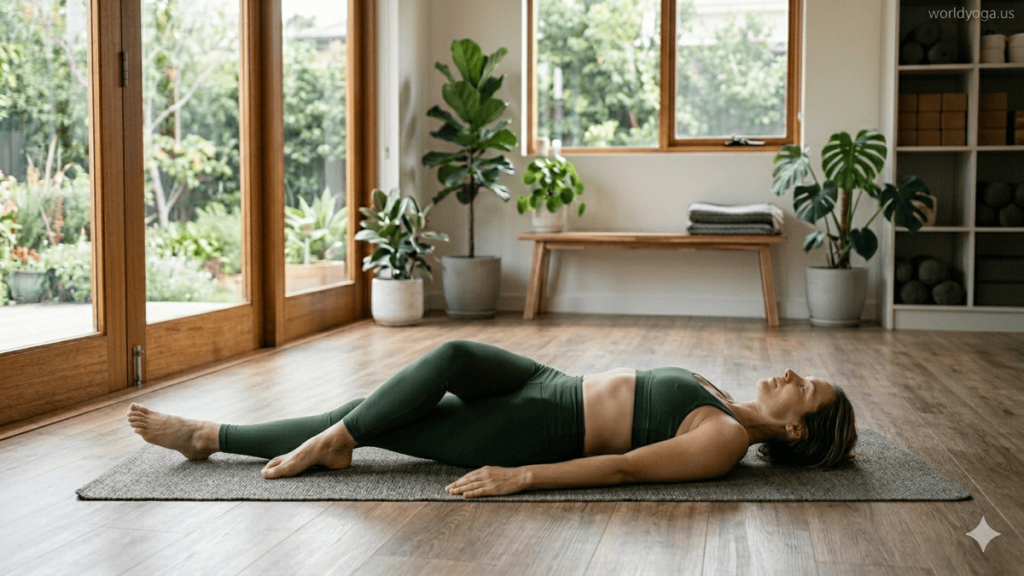
White Paper of Parivritta Jathara Supta Garudasana
1. Introduction
Parivritta Jathara Supta Garudasana is an advanced restorative yoga variation that integrates supine spinal twisting with the crossed-leg positioning inspired by Garudasana. It is designed to combine hip opening, spinal rotation, and neuromuscular relaxation in a fully supported position.
In modern movement science and wellness practice, there is increasing demand for low-impact interventions that improve mobility, reduce musculoskeletal tension, and support stress regulation. This posture addresses these needs through passive loading, controlled rotation, and breath-driven relaxation.
2. Biomechanical Overview
The posture combines three primary movement patterns:
- Hip external rotation and adduction (from leg crossing)
- Supine spinal rotation (thoracic and lumbar involvement)
- Passive gravitational support (floor-based decompression)
Because the body is fully supported, compressive load on joints is minimized while mobility is enhanced through controlled range-of-motion work.
Key biomechanical characteristics include:
- Low axial spinal loading
- Controlled pelvic rotation
- Joint-friendly hip mobility
- Reduced muscular contraction demand
3. Muscular Engagement Analysis
Primary muscle groups
- Gluteus maximus and medius (hip release and lengthening)
- Piriformis and deep hip rotators (primary stretch zone)
- Adductor group (stabilization and mild engagement)
- Abdominals (transverse abdominis and obliques for control)
Secondary stabilizers
- Erector spinae (spinal support during rotation)
- Multifidus muscles (segmental spinal stability)
- Shoulder stabilizers (scapular grounding in supine position)
Muscle activity is primarily isometric and supportive rather than force-generating.
4. Joint Involvement
Hip joints
- External rotation
- Controlled flexion
- Passive mobility enhancement
Knee joints
- Flexion with rotational positioning
- High sensitivity area requiring careful alignment
Spine (vertebral column)
- Thoracic rotation (primary)
- Lumbar rotation (secondary and controlled)
Sacroiliac joints
- Subtle rotational influence and pelvic stabilization demand
Shoulder joints
- Stabilization in abducted position during supine twist
5. Physiological and Therapeutic Benefits
5.1 Musculoskeletal benefits
- Improved hip mobility and flexibility
- Reduced gluteal and piriformis tightness
- Enhanced spinal rotational capacity
- Lower back tension relief
5.2 Neurological benefits
- Parasympathetic nervous system activation
- Reduced stress response
- Improved breath regulation and awareness
5.3 Functional movement benefits
- Better pelvic control and symmetry
- Improved posture and movement efficiency
- Reduced stiffness from sedentary behavior
6. Clinical and Industry Applications
6.1 Yoga therapy
Used in structured protocols for:
- Chronic lower back stiffness
- Hip mobility restrictions
- Stress-related muscular tension
6.2 Physical rehabilitation
Applied in modified form for:
- Early-stage mobility restoration
- Postural imbalance correction
- Soft tissue relaxation strategies
6.3 Corporate wellness
Used to counteract:
- Prolonged sitting
- Workplace stress
- Reduced mobility in office populations
6.4 Sports recovery
Integrated into cooldown routines for:
- Runners
- Cyclists
- Rotational sport athletes
7. Safety and Contraindications
Key precautions
- Avoid forcing knee rotation in crossed-leg position
- Maintain neutral spine without over-twisting
- Use props for support when needed
Contraindicated conditions
- Severe knee ligament injuries
- Acute hip joint pathology
- Recent spinal or abdominal surgery
- Advanced sacroiliac dysfunction
- Pregnancy (deep twisting modifications required)
8. Implementation Guidelines
Recommended usage parameters:
- Duration: 30–90 seconds per side
- Frequency: 3–5 sessions per week
- Environment: quiet, supported floor surface
- Support tools: bolsters, blankets, yoga blocks
Breathing protocol:
- Inhale: spinal lengthening
- Exhale: passive release into twist
9. Comparative Positioning
Compared to other supine twists, this variation adds:
- Increased hip complexity (due to Eagle-leg configuration)
- Higher neuromuscular coordination demand
- Deeper gluteal and piriformis engagement
However, it remains safer than standing twists due to full ground support.
10. Conclusion
Parivritta Jathara Supta Garudasana is a highly effective restorative yoga posture that combines spinal mobility, hip release, and nervous system regulation in a single supine framework. Its adaptability across yoga therapy, rehabilitation, sports recovery, and wellness industries makes it a valuable tool for improving modern movement health.
When practiced with proper alignment, gradual progression, and mindful breathing, it delivers measurable benefits in flexibility, relaxation, and functional mobility.
References
#Parivritta Jathara Supta Garudasana in Kolkata
Industry Application of Parivritta Jathara Supta Garudasana
Parivritta Jathara Supta Garudasana is a restorative supine twisting yoga variation that combines spinal rotation with the crossed-leg positioning inspired by Garudasana. Its low-impact, fully supported nature makes it highly adaptable across multiple industries focused on movement health, rehabilitation, performance recovery, and mental wellness.
Because the posture reduces gravitational load on the joints while still promoting deep hip release and spinal mobility, it is increasingly used in both clinical and non-clinical wellness systems.
1. Yoga Therapy and Clinical Wellness
In yoga therapy settings, this posture is used as a structured intervention for improving mobility and reducing musculoskeletal tension.
Applications include:
- Management of chronic lower-back stiffness
- Hip mobility restoration programs
- Stress-related muscular tension relief
- Gentle spinal rotation therapy
Therapists often modify the posture using props to ensure safety for individuals with limited flexibility or sensitivity in the knees and hips.
2. Physical Therapy and Rehabilitation
Within rehabilitation environments, Parivritta Jathara Supta Garudasana is applied as a controlled mobility exercise under professional supervision.
Key uses:
- Early-stage hip and spinal mobility recovery
- Soft tissue release in gluteal and piriformis regions
- Postural imbalance correction
- Gradual reintroduction of spinal rotation
Its supine nature makes it suitable for patients who cannot tolerate weight-bearing or standing rotational exercises.
3. Sports Performance and Athletic Recovery
Athletes use this posture as part of recovery and cooldown routines to restore flexibility and reduce muscular fatigue.
Benefits for athletes:
- Improved hip rotation for running and cycling efficiency
- Reduced post-training glute and hamstring tightness
- Enhanced spinal mobility after high-intensity training
- Faster neuromuscular relaxation post-competition
It is commonly included in mobility circuits by strength and conditioning professionals.
4. Corporate Wellness Programs
With increasing sedentary work environments, this posture is widely integrated into workplace wellness initiatives.
Workplace applications:
- Reducing stiffness from prolonged sitting
- Improving lower-back comfort during work breaks
- Supporting stress reduction and mental clarity
- Enhancing employee mobility and posture awareness
Short guided sessions often use this posture in combination with breathing techniques and seated mobility breaks.
5. Fitness and Functional Training Industry
In fitness environments, the posture is used as a recovery and mobility tool rather than a strength-building exercise.
Applications include:
- Post-workout cooldown routines
- Mobility-focused training sessions
- Injury prevention programs
- Hip and spinal flexibility enhancement
It complements strength training by restoring range of motion in the hips and spine.
6. Digital Wellness and Online Platforms
With the growth of digital fitness, this posture is widely featured in online yoga classes and wellness apps.
Digital applications:
- Guided restorative yoga videos
- Sleep and relaxation programs
- Mobility-focused virtual training
- Stress management routines
Its simplicity and low equipment requirement make it ideal for at-home users.
7. Mental Health and Stress Management Programs
The posture is also used in mind-body wellness frameworks that focus on stress regulation.
Psychological benefits:
- Parasympathetic nervous system activation
- Reduced anxiety-related muscular tension
- Improved breath awareness and grounding
- Enhanced relaxation response
It is often paired with guided meditation or breathwork practices.
Professional Resources
Conclusion
Parivritta Jathara Supta Garudasana has strong cross-industry relevance due to its adaptability, safety profile, and therapeutic value. It is widely used in yoga therapy, rehabilitation, sports recovery, corporate wellness, and digital health platforms. Its combination of spinal mobility, hip release, and nervous system regulation makes it a versatile tool for improving physical function and overall well-being in modern lifestyle contexts.
#Parivritta Jathara Supta Garudasana in Mumbai
Ask FAQs
What is Parivritta Jathara Supta Garudasana?
Parivritta Jathara Supta Garudasana is a supine yoga posture that combines a gentle spinal twist with a crossed-leg position inspired by Garudasana. It is designed to improve hip mobility, spinal flexibility, and overall relaxation.
What are the main benefits of this posture?
This pose helps release tight hips and glutes, improves spinal rotation, reduces lower-back stiffness, and supports nervous system relaxation. It is also commonly used to relieve tension caused by prolonged sitting.
Is this pose suitable for beginners?
Yes, it can be practiced by beginners with modifications. Beginners should avoid deep twists or forced leg wrapping and may use props such as blankets or cushions for added support and comfort.
Which areas of the body does this pose target?
The posture primarily targets the hips, outer thighs, glutes, lower back, and spine. It also gently engages the core muscles for stability during the twisting movement.
Are there any precautions to consider?
Yes. Avoid forcing the knees or deep twisting, especially if there are knee, hip, or lower-back issues. People with recent injuries, surgeries, or severe joint pain should consult a qualified instructor before practicing this posture.
Table of Contents
Disclaimer: The information provided is for educational and informational purposes only and is not a substitute for professional medical advice, diagnosis, or treatment. Always consult a qualified healthcare provider or certified yoga instructor before practicing any new yoga posture, especially if you have existing injuries, pain, or medical conditions.