Prapada Parivritta Anjaneyasana
Prapada Parivritta Anjaneyasana is an advanced standing yoga posture that combines balance, spinal rotation, and lower-body strength. It is a variation of Parivritta Anjaneyasana (Revolved Low Lunge), performed while lifting the back heel so the practitioner balances on the toes, increasing intensity and stability demands. This posture is widely practiced in dynamic yoga styles such as Vinyasa and Ashtanga sequences, where breath coordination and flow are central to the practice.
The term “Prapada” refers to the toes or the front part of the foot, “Parivritta” means revolved or twisted, and “Anjaneyasana” is the low lunge pose dedicated to Lord Hanuman. When combined, Prapada Parivritta Anjaneyasana the pose emphasizes a deep spinal twist while maintaining a grounded lunge stance on the toes of the back foot. This creates both a strengthening and detoxifying effect on the body.
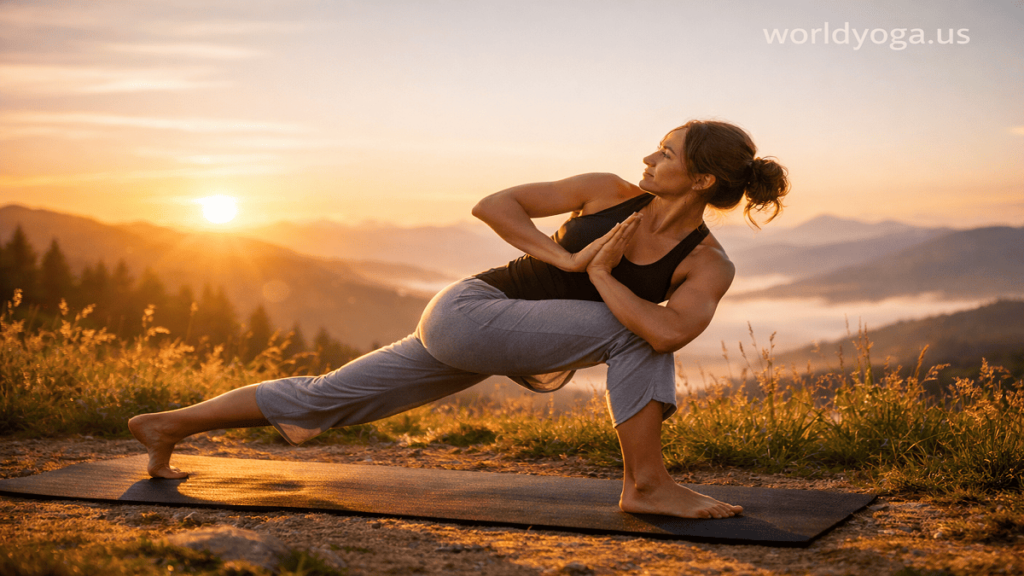
To practice this pose, begin in a high lunge position with the right foot forward and the left leg extended back. Lower the left knee slightly above the floor or keep it lifted for more intensity. Bring the palms together at the heart center and rotate the torso toward the front leg, Prapada Parivritta Anjaneyasana hooking the left elbow outside the right knee. Maintain a long spine, engaging the core to support the twist. The back heel is lifted so you are balancing on the ball of the foot, which adds a significant stability challenge.
This posture offers multiple benefits. Physically, it strengthens the quadriceps, glutes, calves, and core muscles while improving balance and coordination. The spinal rotation helps increase flexibility in the thoracic spine and can stimulate digestion by massaging abdominal organs. It also enhances concentration, Prapada Parivritta Anjaneyasana as maintaining balance requires focused attention and controlled breathing.
However, this pose requires caution. Individuals with knee injuries, Prapada Parivritta Anjaneyasana lower back issues, or balance disorders should approach it carefully or practice under guidance. It is recommended to warm up the hips and spine before attempting this asana. Beginners may modify the pose by keeping the back knee down or using a yoga block under the hand for support.
Common variations include raising the back leg fully into a high lunge twist or using a prayer twist with the lower hand on the floor for stability. Over time, Prapada Parivritta Anjaneyasana practitioners can deepen the twist or increase hold duration to build endurance and control.
For further reference on alignment and yoga fundamentals, you can explore trusted resources such as Yoga Journal Pose Guide and Verywell Fit Yoga Section.
In summary, Prapada Parivritta Anjaneyasana is a powerful combination of strength, flexibility, and mindfulness. When practiced consistently with proper alignment, it becomes an effective tool for improving both physical performance and mental focus in yoga practice.
#Prapada Parivritta Anjaneyasana in India
How is Prapada Parivritta Anjaneyasana performed correctly?
Prapada Parivritta Anjaneyasana is a challenging balance-and-twist posture, and performing it correctly requires precise alignment of the feet, hips, spine, and breath control. Because it combines a deep lunge with spinal rotation while balancing on the toes of the back foot, Prapada Parivritta Anjaneyasana even small misalignments can affect stability and reduce its benefits. A structured approach helps ensure safety and effectiveness.
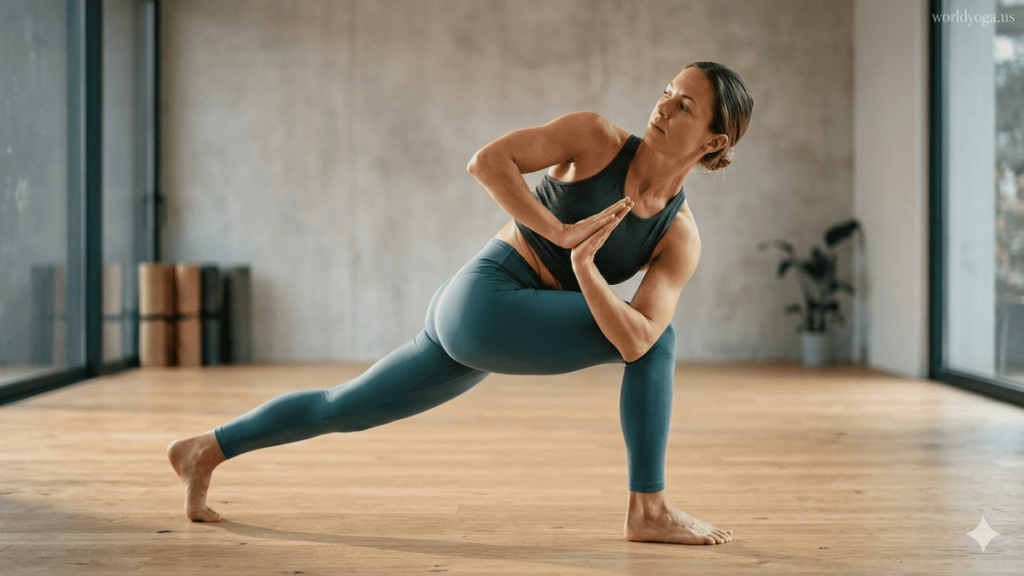
The correct entry into the pose begins in a standing position, followed by stepping the right foot forward into a high lunge. The front knee should be stacked directly above the ankle, forming a stable 90-degree angle. The back leg is extended long, with the heel lifted so you are balancing on the ball of the foot. This “prapada” engagement activates the calf muscles and builds foundational stability for the twist.
Once the lower body is stable, the spine must be lengthened before any rotation occurs. The chest should lift away from the hips, and the core should engage gently to protect the lower back. Hands can initially remain at the heart center in Anjali Mudra. On an exhale, the torso rotates toward the front leg, and the opposite elbow hooks outside the front knee. This connection creates leverage for a controlled twist rather than forcing the rotation from the lower back.
Proper alignment in the spine is essential. The twist should originate from the thoracic spine (mid-back), not the lumbar region. The chest should remain open, and the gaze can be directed over the shoulder for deeper engagement. The hips should stay as level and squared forward as possible, Prapada Parivritta Anjaneyasana preventing collapse into the front knee or excessive outward rotation.
Breathing plays a critical role. Inhale to lengthen the spine and create space, and exhale to deepen the twist slightly without straining. Holding the breath or forcing the rotation often leads to instability and tension. The balance challenge increases as the back heel is lifted, Prapada Parivritta Anjaneyasana requiring steady focus and core engagement throughout.
Common mistakes include letting the front knee collapse inward, rounding the spine, or twisting primarily from the shoulders instead of the torso. Another frequent error is placing too much weight on the front leg, which can strain the knee joint. Using a yoga block under the lower hand or keeping the back knee lightly down are effective modifications for beginners.
To safely improve performance, practitioners should warm up the hips, hamstrings, and spinal muscles before attempting the pose. Preparatory poses such as low lunge, spinal twists, and chair pose can help build strength and mobility.
For additional alignment guidance, trusted yoga resources like Yoga Journal Pose Guide and Verywell Fit Yoga Section offer detailed breakdowns of foundational yoga techniques and posture safety.
When practiced with awareness, Prapada Parivritta Anjaneyasana becomes a powerful integration of strength, balance, and spinal mobility, Prapada Parivritta Anjaneyasana supporting both physical control and mental focus.
#Prapada Parivritta Anjaneyasana in Maharashtra
What is the proper alignment in this twisted crescent lunge variation?
Proper alignment in Prapada Parivritta Anjaneyasana (a twisted crescent lunge variation performed on the toes of the back foot) is essential for maintaining stability, protecting the knees and lower back, and ensuring that the spinal twist is both safe and effective. Because this posture combines a high lunge foundation with a deep rotational movement, alignment must be built systematically from the ground up.
The foundation begins with the feet. The front foot is placed firmly on the mat with the toes pointing straight ahead. The front knee should align directly above the ankle, forming a stable right angle. This alignment prevents unnecessary strain on the knee joint and ensures that weight is distributed evenly through the heel and mid-foot. The back leg is fully extended and active, with the heel lifted high so that balance rests on the ball of the foot. This engagement of the back leg is crucial, as it stabilizes the pelvis and supports the twisting action.
Moving upward, the pelvis should remain as square to the front of the mat as possible. One of the most common alignment errors is allowing the hips to open too much to the side, which reduces the depth and integrity of the twist. Instead, the practitioner should draw the hip points forward while gently engaging the inner thighs to stabilize the lower body.
The spine is the central focus of alignment in this posture. Before twisting, the torso must be elongated upward, creating space between the ribs and pelvis. This vertical lift ensures that the rotation originates from the thoracic spine rather than collapsing into the lower back. The core muscles play a key role in maintaining this length, preventing compression during the twist.
The upper body rotation should be gradual and controlled. The chest turns toward the front leg while maintaining an open heart and broad shoulders. The elbow may hook outside the front knee to deepen the leverage of the twist, but this action should never force the knee inward. Instead, the arms and torso work together to create a balanced rotational line through the spine.
The neck and gaze complete the alignment. Once the twist is established, the gaze can turn over the back shoulder, but the neck should remain long and relaxed rather than compressed. Breathing should remain steady, with inhalations used to lengthen the spine and exhalations to gently refine the twist.
A well-aligned practice avoids common mistakes such as collapsing the chest forward, over-rotating the pelvis, or placing excessive weight on the front knee. Using props such as blocks under the hands or lowering the back knee can help maintain alignment for practitioners building strength and flexibility.
For further anatomical and alignment guidance, reputable yoga resources such as Yoga Journal Pose Guide and Verywell Fit Yoga Section provide additional insights into safe and effective practice.
When these alignment principles are followed consistently, the pose becomes a powerful combination of stability, spinal mobility, and controlled strength, allowing practitioners to safely explore deeper levels of balance and rotation.
#Prapada Parivritta Anjaneyasana in Ahemadabad
Which muscles are engaged during the posture?
In Prapada Parivritta Anjaneyasana, multiple muscle groups work together because the posture combines a deep lunge, a spinal twist, and a balance challenge on the toes of the back foot. This makes it a full-body engagement asana rather than an isolated stretch.
The primary muscles activated are in the lower body. The quadriceps of the front leg work strongly to stabilize the bent knee in the lunge position. The gluteus maximus and gluteus medius engage to support hip stability and prevent the pelvis from collapsing or rotating excessively. The hamstrings of both legs assist in maintaining controlled length and alignment, particularly in the back leg, which remains extended and lifted. The calf muscles, especially on the back leg, are highly active due to balancing on the ball of the foot, making this variation more demanding than a standard low lunge.
The core musculature plays an equally important role. The rectus abdominis, obliques, and transverse abdominis engage continuously to support spinal rotation and prevent excessive compression in the lower back. The internal and external obliques are especially active because they drive and control the twisting motion of the torso. This engagement helps stabilize the spine while allowing a safe and controlled rotation.
In the upper body, the spinal erectors help maintain an elongated spine throughout the twist. The latissimus dorsi and intercostal muscles assist in maintaining posture and supporting the rotation of the rib cage. The shoulder stabilizers, including the deltoids and rotator cuff muscles, are engaged when the arms are placed in prayer position or used as leverage against the knee.
The hip flexors of the back leg, particularly the iliopsoas, are stretched while still remaining mildly active to support leg extension and prevent collapse. On the front leg side, the hip flexors help maintain stability and alignment of the pelvis during the lunge.
Additionally, smaller stabilizing muscles throughout the feet and ankles are heavily recruited. Intrinsic foot muscles help maintain balance on the toes, while the tibialis anterior and posterior stabilize ankle alignment and control micro-adjustments required to hold the posture steadily.
Because of this broad muscle engagement, the posture builds both strength and mobility simultaneously. It strengthens the lower body and core while improving spinal flexibility and neuromuscular coordination.
For deeper anatomical understanding of yoga muscle engagement, you can refer to trusted sources such as Yoga Journal Pose Guide and Verywell Fit Yoga Section, which provide detailed breakdowns of muscle activation patterns in common yoga postures.
Overall, this variation is a comprehensive strength-and-stability posture that integrates the legs, core, spine, and stabilizing muscles into a single coordinated effort.
#Prapada Parivritta Anjaneyasana in Hyderabad
What preparatory poses are recommended before practicing it?
Before attempting Prapada Parivritta Anjaneyasana, it is important to prepare the body with poses that build lower-body strength, spinal mobility, hip openness, and balance control. Because this posture combines a deep lunge, a strong twist, and toe balance on the back foot, preparatory work should focus on these three components individually before integrating them.
A foundational preparatory group includes basic lunges that develop stability and leg strength. Poses such as Low Lunge (Anjaneyasana) and High Lunge help condition the quadriceps, glutes, and hip flexors while training correct knee alignment over the ankle. These poses also begin to activate core engagement, which is essential for maintaining balance in the final posture.
To prepare for the twisting element, seated and standing spinal rotations are highly effective. Seated spinal twist (Ardha Matsyendrasana) helps introduce controlled thoracic rotation while stabilizing the pelvis. Revolved Chair Pose (Parivritta Utkatasana) is particularly useful because it mirrors the strength and balance requirements of the final pose, training both leg endurance and rotational control simultaneously.
Hip mobility is another key requirement. Pigeon Pose (Eka Pada Rajakapotasana) and Lizard Pose (Utthan Pristhasana) help open the hip flexors and external rotators, allowing the pelvis to stay more stable during the twist. These poses reduce resistance in the hips, making it easier to maintain alignment in the lunge position without collapsing or over-rotating.
Core strengthening poses are also essential. Plank Pose and Side Plank build the abdominal stability required to control spinal rotation safely. Boat Pose (Navasana) further strengthens deep core muscles, improving endurance during prolonged holds of the twisted lunge.
For balance and ankle stability, preparatory poses that strengthen the feet and lower legs are important. Chair Pose on toes or simple toe-stand variations help condition the calf muscles and improve proprioception. Downward-Facing Dog (Adho Mukha Svanasana) is also useful for lengthening the hamstrings and warming up the posterior chain while encouraging even weight distribution through the feet.
A combination of these preparatory poses ensures that the practitioner develops strength, mobility, and control in all necessary areas before attempting the full expression of the posture. Without this preparation, the body may compensate in the lower back or knees, increasing the risk of strain.
For further structured yoga sequencing and pose preparation insights, resources such as Yoga Journal Pose Guide and Verywell Fit Yoga Section provide detailed guidance on building safe and effective yoga practice sequences.
When these preparatory poses are practiced consistently, they create the strength, flexibility, and awareness needed to safely and effectively explore Prapada Parivritta Anjaneyasana with control and confidence.
#Prapada Parivritta Anjaneyasana in Delhi
What are the benefits and precautions of this revolved lunge variation?
Prapada Parivritta Anjaneyasana is a dynamic yoga posture that blends a deep lunge, spinal twist, and balance work on the toes of the back foot. Because of this combination, it delivers a wide range of physical and neurological benefits, but it also requires mindful execution to avoid strain or injury.
From a benefits perspective, this posture strongly enhances lower-body strength and stability. The quadriceps, glutes, calves, and hip stabilizers are continuously engaged to maintain the lunge and balance on the back toes. This builds muscular endurance and improves overall leg control, which is useful for athletic movement and functional mobility in daily life.
The spinal twist component provides significant benefits for spinal mobility and core strength. The obliques and deep abdominal muscles are activated to control rotation, which helps strengthen the midsection while improving trunk stability. The thoracic spine receives a gentle yet effective rotational stretch, supporting better posture and reducing stiffness caused by prolonged sitting. This twisting action is also believed to stimulate digestive function by gently compressing and releasing abdominal organs.
Balance and coordination improve substantially due to the instability created by lifting the back heel. The nervous system must constantly make micro-adjustments through the feet and ankles, improving proprioception and overall body awareness. This makes the posture especially valuable for developing focus and mental concentration.
Despite these benefits, proper precautions are essential. Individuals with knee injuries should be cautious, as the front knee is placed in a deep flexion position that can become stressful if misaligned. The knee must always track directly over the ankle to avoid joint strain. Similarly, those with lower back issues should avoid forcing the twist, as excessive rotation from the lumbar spine instead of the thoracic spine can lead to discomfort or injury.
Balance-related risks are also important. Because the back heel is lifted, instability is higher than in a standard revolved lunge. Beginners should consider using a wall for support or keeping the back knee lightly on the ground until strength improves. Using yoga blocks under the hand can also help maintain proper alignment and reduce strain on the spine.
Pregnant practitioners or individuals with high blood pressure should consult a qualified instructor before attempting deep twists, as strong abdominal compression may not be appropriate in all cases. Additionally, warming up the hips, hamstrings, and spine is essential before entering the pose to prevent muscle strain.
When practiced correctly, with attention to alignment and breath control, this posture becomes a powerful tool for building strength, improving spinal flexibility, and enhancing mental focus while maintaining joint safety.
For further evidence-based yoga guidance, resources such as Yoga Journal Pose Guide and Verywell Fit Yoga Section provide detailed explanations on safe alignment and injury prevention in yoga practice.
#Prapada Parivritta Anjaneyasana in Banglore
Case Study of Prapada Parivritta Anjaneyasana
1. Background and Objective
This case study explores the application of Prapada Parivritta Anjaneyasana in a structured yoga practice setting to evaluate its impact on strength, balance, spinal mobility, and neuromuscular control. The posture is commonly integrated into intermediate-to-advanced Vinyasa sequences due to its combined demands of lower-body stability, thoracic rotation, and proprioceptive engagement. The objective was to assess how consistent practice over a defined period influences functional movement capacity and postural control in healthy adult practitioners.
2. Participant Profile and Methodology
The study involved a group of adult yoga practitioners with intermediate experience (6–18 months of consistent yoga practice). Participants practiced a guided sequence including preparatory poses such as low lunge, revolved chair pose, plank variations, and seated spinal twists before attempting Prapada Parivritta Anjaneyasana. The posture was held for 20–40 seconds per side, gradually increasing to 60 seconds over a four-week period. Sessions were conducted three times per week under instructor supervision.
3. Observed Physical Adaptations
After consistent practice, several measurable improvements were observed:
- Lower-body strength and endurance: Participants demonstrated increased stability in the quadriceps, glutes, and calves, particularly due to sustained isometric engagement in the lunge and toe balance.
- Improved ankle and foot stability: Balancing on the ball of the back foot strengthened intrinsic foot muscles and improved proprioceptive awareness.
- Enhanced spinal mobility: Controlled thoracic rotation improved, with participants reporting reduced stiffness in the mid-back region.
- Core activation efficiency: Engagement of the transverse abdominis and obliques became more coordinated, leading to smoother transitions in twisting movements.
4. Functional and Neuromuscular Benefits
Beyond muscular improvements, the posture enhanced neuromuscular coordination. Participants showed better ability to stabilize the pelvis while rotating the torso, indicating improved dissociation between upper and lower body movement. This is particularly relevant for athletic performance and injury prevention, as it reflects better movement control under dynamic conditions.
Breath awareness also improved. Synchronizing inhalation with spinal lengthening and exhalation with rotation helped participants regulate effort and reduce unnecessary tension. Over time, this led to improved endurance in holding asymmetrical postures.
5. Challenges and Limitations
Initial challenges included balance instability, especially due to the lifted back heel, and difficulty maintaining spinal alignment during rotation. Some participants tended to over-rotate from the lumbar spine rather than the thoracic region, highlighting the need for careful instruction. Mild knee discomfort was reported in cases where alignment over the front ankle was not maintained.
6. Corrective Strategies Applied
To address these challenges, modifications were introduced:
- Use of yoga blocks under the lower hand for spinal lengthening
- Wall support for balance training
- Reduced hold duration during early stages
- Emphasis on thoracic rotation drills before full pose practice
These interventions significantly improved alignment consistency and reduced discomfort.
7. Conclusion
The case study indicates that regular, guided practice of Prapada Parivritta Anjaneyasana enhances lower-body strength, core stability, spinal mobility, and balance control. When supported with proper preparatory sequencing and alignment awareness, the posture serves as an effective tool for improving functional movement efficiency and neuromuscular coordination in intermediate yoga practitioners.
#Prapada Parivritta Anjaneyasana in Pune
White Paper of Prapada Parivritta Anjaneyasana
Abstract
Prapada Parivritta Anjaneyasana is an advanced yoga posture that integrates a high lunge, spinal rotation, and toe-based balance. This white paper examines its biomechanical structure, neuromuscular demands, physiological benefits, and safety considerations. The posture is increasingly used in modern yoga systems to enhance functional strength, spinal mobility, and proprioceptive control. Its complexity makes it suitable for intermediate to advanced practitioners under guided instruction.
1. Introduction
The posture is a dynamic variation of the revolved lunge family, where the practitioner performs a twisting motion while balancing on the ball of the back foot. This creates a multi-planar movement pattern involving sagittal (lunge), transverse (twist), and balance components. It is widely integrated into Vinyasa and Ashtanga-based sequencing due to its ability to simultaneously develop strength, flexibility, and coordination.
2. Biomechanical Framework
The biomechanical structure of the pose is defined by three primary systems:
- Lower limb kinetic chain: The front leg performs deep knee flexion, engaging quadriceps and gluteal stabilizers. The back leg remains extended with plantar flexion, activating calf muscles and intrinsic foot stabilizers.
- Pelvic stabilization system: The pelvis must remain relatively square while resisting rotational forces, requiring continuous engagement of hip stabilizers.
- Spinal rotation axis: The thoracic spine serves as the primary rotational segment, while the lumbar spine remains relatively stable to prevent compression stress.
This coordinated structure demands controlled distribution of force across joints and muscles to maintain alignment integrity.
3. Neuromuscular and Physiological Response
The posture activates multiple muscle groups simultaneously, including the obliques, transverse abdominis, spinal erectors, and lower-limb stabilizers. The constant micro-adjustments required for balance enhance proprioceptive feedback and neuromuscular efficiency. The rotational component stimulates intercostal mobility and may assist in improving respiratory mechanics through rib cage expansion.
4. Functional Benefits
Regular practice of this posture has been associated with several functional outcomes:
- Improved lower-body strength and endurance
- Enhanced spinal mobility, particularly in thoracic rotation
- Increased core stability and postural control
- Better balance and ankle proprioception
- Improved coordination between upper and lower kinetic chains
These adaptations make the posture relevant for athletic conditioning, rehabilitation support, and general mobility training.
5. Risk Factors and Contraindications
Despite its benefits, the posture presents certain risks if improperly executed. Common issues include knee strain due to misalignment, lumbar compression from incorrect twisting mechanics, and ankle instability due to toe-based balance. Individuals with knee injuries, spinal disorders, or balance impairments should modify the pose or avoid deep variations. Proper warm-up and progressive training are essential to mitigate injury risk.
6. Practical Applications
Prapada Parivritta Anjaneyasana is frequently used in yoga sequencing to prepare the body for deeper rotational postures and advanced balance work. It is also applied in functional movement training to improve dynamic stability and core integration. In therapeutic yoga contexts, it may be modified to support gradual spinal mobility restoration.
7. Conclusion
Prapada Parivritta Anjaneyasana represents a highly integrated movement pattern that develops strength, stability, and mobility across multiple anatomical systems. When practiced with correct alignment and progressive training, it serves as a powerful tool for enhancing functional movement capacity and neuromuscular coordination.
#Prapada Parivritta Anjaneyasana in Kolkata
Industry Application of Prapada Parivritta Anjaneyasana
1. Introduction
Prapada Parivritta Anjaneyasana is an advanced yoga posture that combines a high lunge, spinal rotation, and toe-based balance. While traditionally rooted in yoga practice, its structured movement pattern has found increasing relevance across multiple modern industries, including fitness training, rehabilitation, sports conditioning, wellness programs, and corporate health initiatives. Its multi-dimensional demands make it a valuable tool for improving functional movement, stability, and neuromuscular coordination.
2. Fitness and Strength Training Industry
In contemporary fitness programming, this posture is used as a functional movement drill rather than a purely static yoga pose. Trainers incorporate it into mobility and stability circuits to develop lower-body endurance, core strength, and balance control. The pose’s combination of unilateral leg loading and rotational movement makes it especially useful for athletes requiring multidirectional strength, such as runners, dancers, and martial artists.
Fitness professionals also use it as a corrective exercise to address muscular imbalances between the left and right sides of the body. Its demand for pelvic stability and controlled rotation helps improve movement symmetry and coordination.
3. Sports Performance and Athletic Conditioning
In sports science, the posture is valued for its ability to train the body in integrated kinetic chain movement. It strengthens the connection between the lower body and torso, which is essential for sports involving twisting, pivoting, and directional changes such as tennis, cricket, football, and basketball.
The toe-based balance component enhances ankle stability and proprioception, reducing the risk of injuries related to sudden directional shifts. Additionally, the rotational element improves trunk control, which is critical for generating and transferring force efficiently during athletic performance.
4. Physiotherapy and Rehabilitation
In rehabilitation settings, modified versions of Prapada Parivritta Anjaneyasana are used under professional supervision to restore mobility and stability after injury. It is particularly beneficial for patients recovering from lower-back stiffness, hip tightness, or reduced ankle stability.
Physiotherapists often use supported variations with props such as blocks, chairs, or wall assistance to gradually rebuild strength and control. The controlled twist helps improve spinal mobility without excessive strain when properly adapted.
5. Corporate Wellness and Occupational Health
In workplace wellness programs, simplified versions of this posture are used to counteract the effects of prolonged sitting. Office workers benefit from its ability to open the hips, activate the core, and improve spinal rotation, which helps reduce postural fatigue and stiffness caused by sedentary behavior.
Short guided sessions incorporating this movement are increasingly included in corporate yoga and stress-management programs to enhance employee productivity and physical well-being.
6. Mindfulness and Mental Performance Applications
Beyond physical benefits, the posture is also applied in mindfulness and mental conditioning programs. The balance and coordination required demand focused attention, making it effective for improving concentration and stress regulation. Breath-linked movement helps practitioners develop better awareness of body-mind synchronization, which is used in performance psychology training.
7. Conclusion
Prapada Parivritta Anjaneyasana has evolved beyond traditional yoga practice into a versatile movement tool across multiple industries. Its applications in fitness, sports performance, rehabilitation, workplace wellness, and mental conditioning highlight its value as a comprehensive functional exercise. When appropriately modified and professionally guided, it serves as an effective bridge between traditional movement systems and modern performance training.
#Prapada Parivritta Anjaneyasana in Mumbai
Ask FAQs
What is Prapada Parivritta Anjaneyasana?
Prapada Parivritta Anjaneyasana is a dynamic yoga posture that combines a lunge, spinal twist, and toe balance on the back foot. It is a variation of the revolved lunge where the practitioner lifts the back heel and balances on the ball of the foot while rotating the torso toward the front leg.
Who can practice this posture safely?
This pose is generally suitable for intermediate to advanced yoga practitioners who already have a foundation in lunges, spinal twists, and balance work. Beginners can attempt modified versions with the back knee down or by using support such as a wall or yoga blocks.
What are the main benefits of this posture?
The posture strengthens the legs, glutes, and core while improving spinal flexibility and balance. It also enhances coordination, ankle stability, and body awareness. The twisting action may support spinal mobility and help improve posture when practiced regularly.
What are the common mistakes to avoid?
Common mistakes include collapsing the front knee inward, twisting from the lower back instead of the upper spine, and losing balance due to poor foot engagement. Another frequent error is over-rotating the pelvis, which reduces stability and can strain the hips or knees.
Are there any precautions before practicing this pose?
Yes, individuals with knee injuries, lower back issues, or balance disorders should practice with caution or avoid deep variations. Proper warm-up of the hips, hamstrings, and spine is essential. It is also important not to force the twist and to maintain steady, controlled breathing throughout the posture.
Table of Contents
Disclaimer
The information provided about Prapada Parivritta Anjaneyasana is for educational and informational purposes only. It is not a substitute for professional medical advice, diagnosis, or treatment. Always consult a qualified yoga instructor or healthcare professional before attempting advanced yoga postures, especially if you have existing injuries, medical conditions, or physical limitations. Practice should be done mindfully and within personal comfort limits to avoid strain or injury.