Vatayanasana
Vatayanasana, commonly known as Horse Face Pose, is an advanced balancing posture in traditional yoga practice that combines elements of strength, flexibility, and deep concentration. The name is derived from Sanskrit, where “Vata” refers to horse and “Asana” means posture, symbolizing the grounded yet powerful stance of a horse.
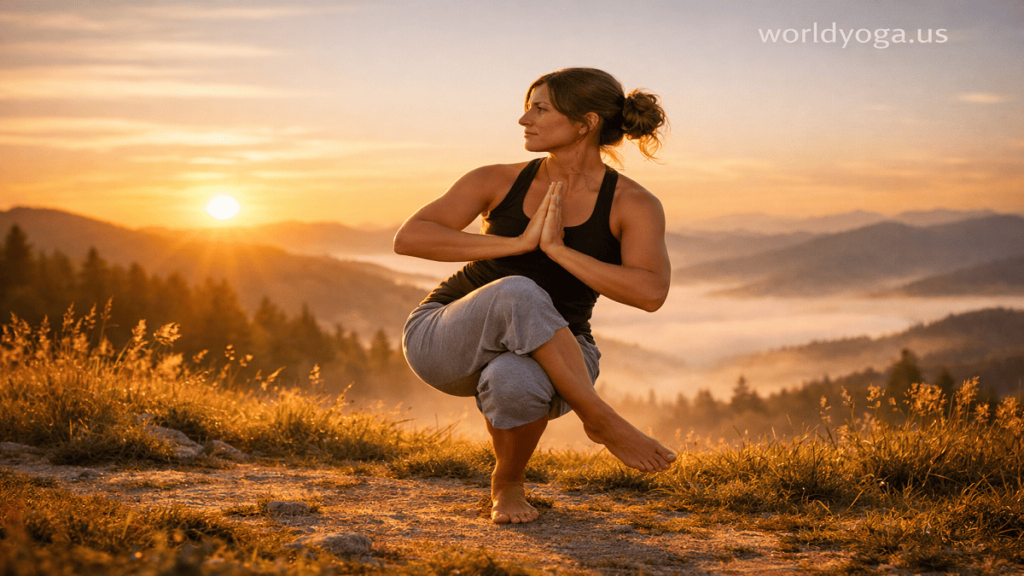
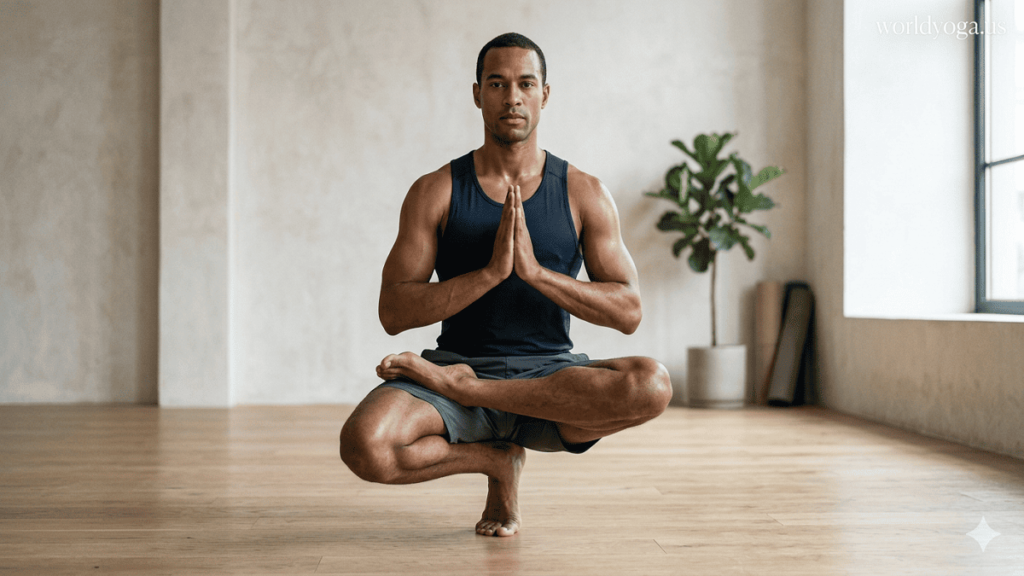
This asana is typically performed by balancing on one leg while the other leg is folded in a position resembling half-lotus or a deep hip fold, with the body lowered into a controlled squat. The hands are often brought together in a prayer position, and the torso is slightly inclined forward to maintain balance. Because of its complexity, Vatayanasana is generally practiced in advanced Hatha Yoga and Ashtanga Yoga sequences under proper guidance.
The posture demands a high level of lower-body strength, particularly in the quadriceps, glutes, and calves, while also requiring flexibility in the hips and knees. At the same time, it challenges the core muscles and stabilizing structures of the ankles and feet. Beyond physical strength, Vatayanasana also emphasizes mental focus, as maintaining balance in this position requires sustained concentration and breath awareness.
Regular practice of this pose is believed to improve body coordination, enhance proprioception, and develop a stronger mind-body connection. It also supports hip opening and strengthens the muscles responsible for postural alignment.
However, due to its advanced nature, Vatayanasana should be approached gradually. Practitioners are encouraged to build foundational strength through preparatory poses such as single-leg balances, hip openers, and squatting variations before attempting the full posture.
#Vatayanasana in India
How is Vatayanasana performed correctly?
Correct performance of Vatayanasana requires a careful combination of balance, hip flexibility, and controlled lowering into a stable squat-like position. Because it is an advanced posture, precision in alignment and gradual progression are essential to avoid strain in the knees, hips, or ankles.
The practice typically begins in a standing position with both feet grounded. The practitioner then shifts weight onto one leg, ensuring the standing foot is firmly rooted with the toes spread and the arch engaged for stability. The spine should remain tall, and the core lightly activated to support balance before moving into the next phase.
Next, one leg is slowly lifted and folded into a half-lotus-like position or deep hip fold, depending on flexibility. The placement of the foot is critical—it should rest securely in the opposite hip crease without forcing the knee. Any discomfort in the knee indicates misalignment and requires immediate adjustment or modification.
Once the folded leg is stabilized, the practitioner begins to lower the body into a controlled squat on the standing leg. The knee of the supporting leg bends deeply while tracking in line with the toes, avoiding inward collapse. The hips descend evenly, and the spine remains elongated rather than rounded. This descent must be slow and mindful to maintain balance and joint safety.
The upper body is typically brought into a prayer position at the chest (Anjali Mudra), which helps stabilize the torso and improve focus. The gaze should remain steady at a fixed point (drishti) to support balance. In some variations, the torso may incline slightly forward, but without collapsing the chest or compressing the lower back.
Breathing plays a crucial role throughout the posture. Inhalation should support spinal lengthening, while exhalation helps deepen the squat and stabilize the balance. Holding the breath can lead to instability and should be avoided.
Common alignment errors include placing excessive pressure on the knee of the folded leg, collapsing the standing knee inward, and rounding the spine. Another frequent mistake is rushing into the full depth of the squat without sufficient hip or ankle preparation.
To safely build toward the full expression of Vatayanasana, practitioners often use preparatory poses such as Tree Pose, Half Lotus, Garland Pose (Malasana), and single-leg balance drills. These help develop the required strength and mobility progressively.
For additional guidance on alignment principles and safe yoga progression, resources like Yoga Journal Pose Guide and Verywell Fit Yoga Section provide structured insights into foundational yoga techniques.
#Vatayanasana in Maharashtra
What is the proper alignment in this advanced balancing pose?
Proper alignment in Vatayanasana is critical because the posture combines single-leg balance, deep hip flexion, and a controlled squat. Even small misalignments can shift stress onto the knees or lower back, so the structure of the pose must be built carefully from the ground up.
The foundation begins with the standing leg. The foot should be firmly rooted into the mat with even pressure distributed across the heel, base of the big toe, and little toe. The arch remains active to prevent collapsing inward. The knee of the standing leg must track directly over the second or third toe, avoiding inward caving (valgus collapse), which is one of the most common alignment errors in this posture.
The second key alignment component is the folded leg. The lifted leg is typically placed into a half-lotus or deep hip fold position, but the most important rule is that the knee must never be forced. The hip joint should externally rotate naturally, allowing the foot to rest securely in the opposite hip crease. If the hip does not permit this rotation, a modified foot placement (such as a bent knee tuck) is safer and more appropriate.
Pelvic alignment plays a central role in stability. The hips should remain as level as possible rather than tilting or twisting to one side. This requires active engagement of the gluteal muscles and deep hip stabilizers. Uneven hips can destabilize the entire posture and increase strain on the lower back and standing knee.
The spine should remain elongated throughout the pose. Instead of collapsing forward, the practitioner should lift through the crown of the head while maintaining a natural curve in the lumbar spine. The chest remains open, and the ribs are gently drawn inward to support core engagement. This vertical alignment ensures that the balance is controlled rather than compensatory.
The upper body is usually held in Anjali Mudra (hands in prayer at the chest), which helps center balance and stabilize the torso. The elbows stay relaxed and close to the body. The gaze (drishti) is fixed at a steady point in front, which is essential for maintaining equilibrium and reducing unnecessary movement.
Breath alignment is equally important. Inhalation supports spinal length and postural lift, while exhalation helps deepen stability in the squat without collapsing the structure. Breath should remain smooth and uninterrupted.
Common alignment faults include collapsing the standing knee inward, forcing the folded leg into position, rounding the spine, or leaning too far forward without core control. These errors reduce stability and increase injury risk.
For safer progression, preparatory alignment work from poses like Tree Pose, Garland Pose (Malasana), and supported single-leg balances helps train the body for the demands of this posture.
#Vatayanasana in Ahemadabad
Which muscles and joints are engaged during the posture?
During Vatayanasana, the body works as an integrated kinetic chain involving multiple muscles and joints simultaneously due to its combination of single-leg balance, deep hip positioning, and partial squat mechanics.
Muscles engaged
The lower body muscles are the primary drivers of stability. The quadriceps of the standing leg work intensely to control knee flexion during the squat-like descent. The gluteus maximus provides hip extension control, while the gluteus medius and minimus stabilize the pelvis and prevent lateral collapse. The hamstrings assist in maintaining controlled alignment of the hip and knee throughout the balance phase.
The calf muscles (gastrocnemius and soleus) remain highly active in the standing leg to stabilize the ankle and maintain grounding through the foot. Intrinsic foot muscles also engage continuously to support balance and distribute weight evenly across the sole.
The hip muscles play a central role. The deep external rotators and adductors of the folded leg are engaged to maintain the half-lotus or folded position without strain. The iliopsoas and surrounding hip flexors help control leg positioning and stability in the lifted leg.
The core musculature is heavily involved, especially the transverse abdominis and obliques, which stabilize the spine and pelvis during the asymmetric load. The rectus abdominis assists in maintaining upright posture, while the spinal erectors support controlled vertical alignment.
In the upper body, the deltoids and scapular stabilizers engage lightly when the hands are held in prayer position, helping maintain shoulder alignment and postural control.
Joints engaged
The ankle joint of the standing leg undergoes continuous micro-adjustments to maintain balance and prevent collapse, requiring both stability and mobility.
The knee joint of the standing leg is deeply flexed and bears significant load, making alignment crucial to avoid stress on ligaments such as the ACL and MCL.
The hip joint is the most complex area of engagement. The standing hip is in flexion and stabilization, while the lifted hip is in deep external rotation and flexion (or modified lotus positioning). This dual action demands both mobility and joint control.
The spine (vertebral column) remains in an elongated, mostly neutral position with subtle engagement of thoracic extension muscles to maintain upright posture during the squat.
The shoulder and wrist joints are minimally engaged in terms of load but contribute to postural centering when hands are in Anjali Mudra.
Summary of functional demand
Vatayanasana creates a high level of multi-joint coordination, where stability in the ankle, knee, and hip must work in sync with core control and spinal alignment. This integrated engagement improves balance, proprioception, and lower-body strength, but also requires careful progression to protect load-bearing joints.
For broader anatomical references on yoga-based muscle engagement, resources like Yoga Journal Pose Guide and Verywell Fit Yoga Section provide additional breakdowns of joint and muscle function in advanced yoga postures.
#Vatayanasana in Hyderabad
What preparatory poses are recommended before practicing Vatayanasana?
Before attempting Vatayanasana, it is essential to build strength, hip mobility, balance, and joint stability through a structured set of preparatory poses. Because this posture combines single-leg balance, deep knee flexion, and advanced hip positioning, preparation should target each of these components progressively to reduce injury risk and improve control.
1. Hip Opening Preparatory Poses
Hip flexibility is a major requirement for Vatayanasana, especially for safely positioning the folded leg.
- Bound Angle Pose (Baddha Konasana): Helps open the inner thighs and groin region.
- Pigeon Pose (Eka Pada Rajakapotasana): Improves external hip rotation and deep glute flexibility.
- Lizard Pose (Utthan Pristhasana): Enhances hip flexor and groin mobility needed for deep positioning.
These poses gradually prepare the hip joint for safe rotation and folding without strain on the knees.
2. Balance and Single-Leg Strength Poses
Since Vatayanasana is a one-leg balancing posture, stability training is essential.
- Tree Pose (Vrikshasana): Builds foundational balance and ankle stability.
- Eagle Pose (Garudasana): Strengthens focus, coordination, and lower-body engagement.
- Warrior III (Virabhadrasana III): Develops full-body balance and core integration.
These poses train proprioception and improve control over micro-adjustments in the standing leg.
3. Squat and Lower-Body Strength Poses
Deep knee flexion and controlled lowering are critical in Vatayanasana.
- Garland Pose (Malasana): Builds ankle mobility, hip opening, and squat endurance.
- Chair Pose (Utkatasana): Strengthens quadriceps and glutes for sustained load-bearing.
- Supported Squats: Improve knee tracking and leg endurance safely.
These help condition the lower body for the deep squat-like position in the final pose.
4. Lotus and Knee-Safe Folding Preparation
Because the folded leg may resemble a half-lotus position, gradual preparation is necessary.
- Half Lotus Prep (Ardha Padmasana variations): Improves external hip rotation gradually.
- Supine Figure-Four Stretch: Safely opens the hip without compressing the knee.
These should always be practiced carefully to avoid forcing the knee joint.
5. Core and Stability Training
Core strength ensures spinal alignment and balance control during the posture.
- Plank Pose: Builds full-core stability and shoulder support.
- Side Plank (Vasisthasana): Enhances lateral stability and oblique strength.
- Boat Pose (Navasana): Strengthens deep abdominal muscles for balance control.
Conclusion
A well-rounded preparation for Vatayanasana focuses on hip mobility, single-leg balance, lower-body strength, and core stability. Without these foundational elements, the posture can place unnecessary stress on the knees and hips. When practiced progressively, these preparatory poses create the strength and flexibility needed to safely approach the full expression of the posture.
#Vatayanasana in Banglore
What are the benefits and precautions of this horse-face inspired pose?
Practicing Vatayanasana offers a combination of strength, flexibility, balance, and mental focus benefits, but it also carries specific risks due to its advanced structure involving single-leg balance, deep hip rotation, and controlled squat mechanics. Understanding both sides is essential for safe and effective practice.
Benefits of Vatayanasana
One of the primary benefits is lower-body strengthening. The standing leg works intensely to support body weight in a deep bent-knee position, engaging the quadriceps, glutes, hamstrings, and calves. This builds endurance and improves functional leg strength used in daily activities such as climbing, squatting, and walking on uneven surfaces.
The pose also significantly improves hip flexibility and joint mobility. The folded leg position encourages external hip rotation, helping release stiffness in the hip joints and improving range of motion. Over time, this can contribute to better posture and reduced tightness in the lower body.
Another key benefit is balance and proprioception development. Because the posture requires maintaining stability on one leg while the body is partially folded, the nervous system must continuously make micro-adjustments. This enhances coordination, body awareness, and neuromuscular control.
The posture also strengthens the core muscles, especially the transverse abdominis and obliques, which stabilize the torso during imbalance. This supports better spinal alignment and reduces unnecessary strain on the lower back.
Additionally, Vatayanasana promotes mental focus and concentration. The complexity of the posture requires steady breathing and a fixed gaze, which helps train mindfulness, patience, and mental discipline.
Precautions and Safety Considerations
Despite its benefits, this pose requires caution due to its demand on the knees, hips, and balance system.
The most important precaution involves the knees. The folded leg should never be forced into position, especially if the hip lacks flexibility. Forcing the knee into a lotus-like position can cause serious joint strain or injury.
The standing knee is also at risk if it collapses inward or extends beyond proper alignment. It should always track over the toes to avoid stress on ligaments such as the ACL.
Individuals with hip tightness or injuries should proceed slowly, as deep external rotation is required. Pushing beyond natural range can lead to discomfort or strain.
Because the pose requires single-leg balance, there is also a risk of loss of stability and falling. Practicing near a wall or with support is recommended for beginners.
Those with ankle instability, knee issues, or recent lower-body injuries should modify or avoid the full expression of the pose. Pregnant practitioners or individuals with balance disorders should also practice under professional guidance.
Proper warm-up is essential. Without preparing the hips, knees, and ankles, the risk of strain increases significantly. Preparatory poses and gradual progression are strongly recommended.
Conclusion
Vatayanasana is a powerful posture that builds strength, flexibility, balance, and mental focus, but it must be approached with respect for joint limitations and alignment principles. When practiced mindfully and progressively, it becomes a highly effective tool for developing integrated body control and stability.
#Vatayanasana in Delhi
Case Study of Vatayanasana
1. Background and Objective
This case study examines the effects of Vatayanasana in a structured yoga training environment, focusing on its impact on balance, lower-body strength, hip mobility, and neuromuscular coordination. As an advanced balancing posture, Vatayanasana combines single-leg stability with deep hip rotation and controlled squat mechanics, making it a suitable subject for evaluating integrated functional movement performance in experienced yoga practitioners.
2. Participant Profile and Methodology
The study involved intermediate-to-advanced yoga practitioners with a consistent practice history of at least 12–24 months. Participants were trained in progressive preparation phases before attempting the full posture. Training included hip-opening sequences, single-leg balance drills, and squat conditioning.
The protocol was conducted over four weeks with sessions held three times per week. Each practitioner held Vatayanasana for 15–30 seconds per side, gradually increasing hold duration based on comfort and stability. Modifications such as wall support and half-depth squats were used during early stages.
3. Observed Physical Outcomes
Lower-Body Strength Development
Participants showed noticeable improvement in quadriceps and glute strength, particularly in the standing leg. The sustained load-bearing position enhanced muscular endurance and improved control during deep knee flexion.
Hip Mobility Enhancement
Regular practice contributed to increased external hip rotation and improved flexibility in the hip joint of the folded leg. Participants reported reduced stiffness in the groin and inner thigh regions over time.
Balance and Proprioception Gains
Significant improvement was observed in single-leg stability. The neuromuscular system adapted to the imbalance created by the posture, resulting in better ankle control, reduced sway, and improved body awareness.
Core Activation and Spinal Control
Core muscles, especially the transverse abdominis and obliques, showed improved engagement efficiency. This led to better spinal alignment and reduced compensatory movement during balance phases.
4. Functional and Neurological Adaptations
Vatayanasana training enhanced coordination between the lower limbs and core stabilizers. Participants demonstrated improved ability to maintain stability under asymmetrical loading conditions, indicating better motor control integration. Reaction to imbalance became faster and more efficient, suggesting enhanced proprioceptive feedback mechanisms.
Mental focus also improved. The requirement to maintain steady gaze and controlled breathing increased attention span and reduced cognitive distraction during balancing tasks.
5. Challenges and Limitations
Initial difficulties included loss of balance during transition into the squat position and discomfort in the folded knee when hip flexibility was insufficient. Some participants also experienced ankle instability in the standing leg during early sessions.
These challenges highlighted the importance of gradual progression and proper preparatory sequencing before attempting full expression of the posture.
6. Corrective and Supportive Strategies
To address these issues, the following interventions were applied:
- Wall-assisted balance practice for stability support
- Use of props under hips during squat descent
- Progressive hip-opening sequences before practice
- Reduced hold duration with gradual progression
- Emphasis on alignment cues for knee tracking and pelvic stability
These strategies significantly improved safety and execution quality.
7. Conclusion
The case study indicates that Vatayanasana effectively enhances lower-body strength, hip flexibility, balance control, and neuromuscular coordination when practiced progressively. However, due to its complexity, structured preparation and alignment awareness are essential to prevent joint strain and ensure safe progression.
#Vatayanasana in Banglore
White Paper of Vatayanasana
Abstract
Vatayanasana is an advanced balancing yoga posture that integrates single-leg stability, deep hip flexion, and controlled squat mechanics. This white paper examines its biomechanical structure, neuromuscular demands, physiological benefits, and safety considerations. The posture is widely used in advanced Hatha and Ashtanga yoga systems to develop lower-body strength, joint mobility, proprioception, and mental focus.
1. Introduction
Vatayanasana, often referred to as Horse Face Pose, is a complex asymmetrical posture requiring simultaneous engagement of balance, flexibility, and strength. It involves standing on one leg while the opposite leg is folded into a deep hip rotation position, followed by a controlled lowering of the body into a squat-like stance. The pose represents a multi-planar movement pattern involving stability, rotation, and compression.
Due to its complexity, it is considered an advanced posture typically introduced after mastery of foundational balance and hip-opening asanas.
2. Biomechanical Structure
The posture can be analyzed through three primary biomechanical systems:
2.1 Lower Limb Load System
The standing leg bears full body weight in deep flexion. The quadriceps control knee stability, while the gluteal muscles stabilize the hip joint. The calf muscles and intrinsic foot structures maintain balance through continuous micro-adjustments.
2.2 Hip Rotation System
The folded leg requires deep external rotation at the hip joint. This places significant demand on the gluteus medius, piriformis, and surrounding rotator muscles while maintaining knee safety through proper alignment.
2.3 Spinal Stabilization System
The spine remains elongated in a near-neutral position. The erector spinae maintain vertical alignment, while the core musculature stabilizes the pelvis against asymmetrical loading forces.
3. Neuromuscular and Physiological Response
Vatayanasana activates multiple muscle groups simultaneously, requiring coordinated neuromuscular control. Key adaptations include:
- Enhanced proprioceptive feedback in ankle and knee joints
- Increased core muscle recruitment for spinal stability
- Improved intermuscular coordination between lower limbs and trunk
- Strengthened neuromotor response to imbalance
- Increased static endurance under asymmetric load
The posture also supports improved breath-body synchronization, enhancing parasympathetic regulation during controlled holds.
4. Functional Benefits
Regular practice contributes to:
- Improved single-leg strength and stability
- Enhanced hip joint mobility and flexibility
- Better knee alignment awareness and control
- Increased core endurance and postural stability
- Improved balance and coordination in dynamic movement patterns
- Greater mental focus and sustained attention capacity
These benefits make the posture relevant not only in yoga practice but also in functional movement training and rehabilitation support systems.
5. Risk Factors and Contraindications
Despite its benefits, Vatayanasana carries significant risk if improperly executed:
- Knee strain due to forced hip rotation or incorrect folding of the leg
- Ankle instability in the standing leg under prolonged load
- Lower back compression from poor spinal alignment
- Loss of balance leading to falls or joint impact injuries
Contraindications include knee injuries, severe hip restrictions, balance disorders, and recent lower-limb trauma. Pregnant practitioners should avoid deep variations unless medically cleared.
6. Practical Applications
Vatayanasana is applied in multiple domains:
- Advanced yoga sequencing for strength and balance development
- Athletic training programs focusing on unilateral stability
- Physiotherapy (modified versions) for controlled hip mobility restoration
- Mindfulness and cognitive focus training through balance-based drills
It is often used as a peak posture following progressive hip-opening and balance preparation sequences.
7. Conclusion
Vatayanasana is a highly integrated posture that develops strength, flexibility, balance, and neuromuscular coordination. While it offers significant functional benefits, it requires structured progression, anatomical awareness, and careful alignment to ensure safety. When practiced correctly, it serves as a powerful tool for improving overall movement efficiency and body control.
#Vatayanasana in Kolkata
Industry Application of Vatayanasana
1. Introduction
Vatayanasana is an advanced balancing yoga posture that integrates single-leg stability, deep hip rotation, and controlled squat mechanics. While traditionally rooted in classical yoga systems, its functional movement pattern has expanded into several modern industries, including fitness training, sports performance, rehabilitation therapy, corporate wellness, and mindfulness-based performance coaching. Its multi-joint and multi-plane demands make it highly relevant for developing integrated human movement efficiency.
2. Fitness and Functional Training Industry
In modern fitness programming, Vatayanasana is used as a functional strength and mobility drill rather than a static pose. Trainers incorporate it into balance circuits and unilateral training programs to improve lower-body strength, core stability, and joint control.
The posture is particularly valuable for:
- Building single-leg strength and endurance
- Enhancing hip mobility and squat control
- Improving ankle stability and proprioception
- Correcting muscular imbalances between limbs
It is often programmed in advanced mobility or “movement quality” sessions alongside squats, lunges, and balance drills.
3. Sports Performance and Athletic Conditioning
In sports science, Vatayanasana is recognized for its contribution to dynamic stability and neuromuscular control. Athletes in sports requiring directional changes, pivoting, and unilateral loading—such as football, basketball, tennis, and martial arts—benefit from its training effects.
Key applications include:
- Improved balance under asymmetrical load
- Enhanced hip rotation control for agility
- Better knee alignment awareness during movement
- Increased core stability for force transfer
The posture helps athletes develop controlled movement under instability, reducing injury risk during high-impact actions.
4. Physiotherapy and Rehabilitation
In rehabilitation settings, modified versions of Vatayanasana are used under clinical supervision to restore mobility and strength after injury. It is especially useful for:
- Post-knee injury stabilization (in modified form)
- Hip joint mobility restoration
- Ankle proprioception retraining
- Controlled balance re-education
Therapists often use wall support, reduced depth, or partial versions to ensure safe progression. The focus is on rebuilding neuromuscular control rather than achieving full posture depth.
5. Corporate Wellness and Occupational Health
Vatayanasana-inspired movements are increasingly included in corporate wellness programs to counteract sedentary lifestyle effects. Simplified versions help office workers:
- Reduce hip and lower-back stiffness
- Improve posture and spinal alignment
- Enhance circulation through active movement
- Reduce physical fatigue from prolonged sitting
Short guided sessions improve both physical comfort and mental alertness in workplace environments.
6. Mindfulness, Cognitive Training, and Performance Coaching
Beyond physical conditioning, Vatayanasana is used in mindfulness-based training programs due to its high demand for concentration and breath control. The posture requires sustained focus, steady gaze, and controlled breathing, making it effective for:
- Attention training and mental discipline
- Stress regulation through breath awareness
- Body-mind coordination development
- Cognitive focus enhancement in performance coaching
It is sometimes integrated into yoga-based executive training and sports psychology programs.
7. Conclusion
Vatayanasana has evolved from a traditional advanced yoga posture into a multi-industry functional tool. Its applications in fitness, sports performance, rehabilitation, workplace wellness, and cognitive training highlight its value as a comprehensive movement system for improving strength, stability, and mental focus. When appropriately modified and guided, it bridges classical yoga practice with modern performance and health sciences.
#Vatayanasana in Mumbai
Ask FAQs
What is Vatayanasana?
Vatayanasana, also known as Horse Face Pose, is an advanced balancing yoga posture where the practitioner stands on one leg while the other leg is folded into a deep hip rotation and the body is lowered into a controlled squat. It requires strength, flexibility, and focus.
Who can practice Vatayanasana safely?
This posture is generally suitable for intermediate to advanced yoga practitioners who already have strong balance, hip flexibility, and lower-body strength. Beginners should first build stability through simpler poses like Tree Pose, Garland Pose, and basic hip openers.
What are the main benefits of Vatayanasana?
Vatayanasana helps improve leg strength, hip flexibility, core stability, and overall balance. It also enhances coordination, body awareness, and mental concentration due to its demanding single-leg and twisting nature.
What are the common mistakes in this pose?
Common mistakes include forcing the folded leg into position, collapsing the standing knee inward, rounding the spine, and losing balance due to poor core engagement. Incorrect alignment can increase stress on the knees and hips.
Are there any precautions before practicing Vatayanasana?
Yes, practitioners should avoid this pose if they have knee, hip, or ankle injuries. Proper warm-up and preparatory poses are essential. It is also recommended to practice near a wall or with supervision to ensure safe alignment and balance control.
Table of Contents
Disclaimer
The information provided about Vatayanasana is for educational and informational purposes only. It is not a substitute for professional medical advice, diagnosis, or treatment. This advanced yoga posture should be practiced only under the guidance of a qualified instructor. Individuals with knee, hip, ankle, or balance-related conditions should consult a healthcare professional before attempting this pose.