Scales Pose
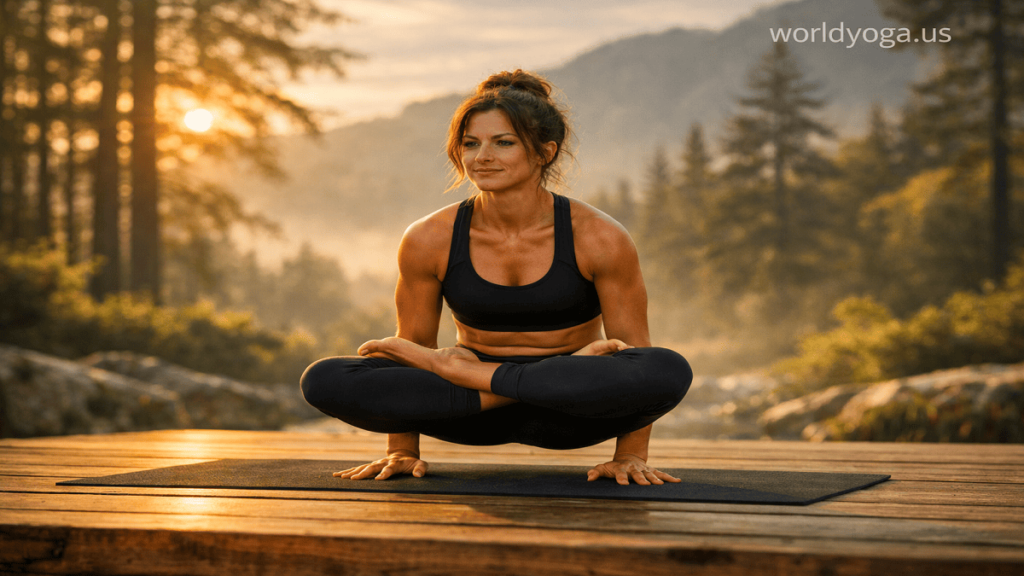
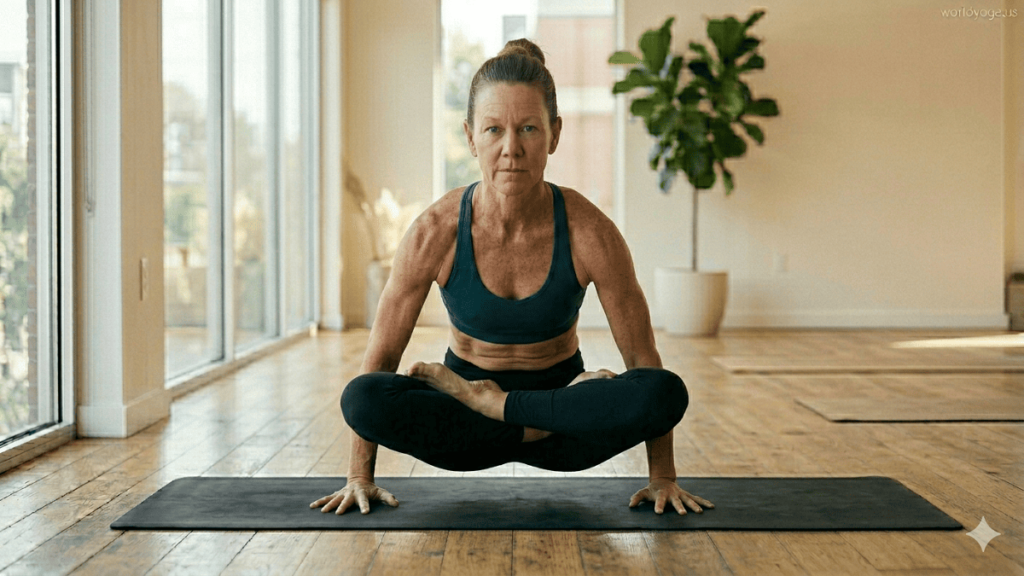
Scales Pose, known in Sanskrit as Tolasana, is an advanced arm-balancing yoga posture in which the practitioner lifts the body off the ground while seated in a lotus position, balancing entirely on the hands. The name comes from the Sanskrit word “tola”, meaning scale or balance, symbolizing steadiness and equilibrium.
Overview and Technique
Tolasana is typically performed from Padmasana (Full Lotus Pose). Once seated, the practitioner places the palms on the floor beside the hips, fingers spread wide for stability. By engaging the core muscles and pressing firmly through the hands, the body is lifted off the ground so that the entire weight is supported by the arms.
Key alignment points include:
- Full Lotus position as the base
- Hands placed firmly beside the hips
- Core muscles strongly engaged for lift
- Shoulders active and slightly lifted
- Gaze steady and calm for balance
Benefits of Scales Pose
Tolasana offers multiple physical and mental benefits:
- Strengthens the arms, wrists, shoulders, and chest
- Builds core stability and abdominal strength
- Improves balance and body awareness
- Enhances hip flexibility due to lotus position requirement
- Develops mental focus, discipline, and concentration
It also helps improve control over body weight distribution and enhances overall coordination.
Reference:
https://www.yogajournal.com/poses/scales-pose/
Precautions
Because of its difficulty, Scales Pose should be practiced carefully:
- Avoid if you have wrist, shoulder, knee, or hip injuries
- Ensure Full Lotus is comfortable before attempting
- Warm up with hip-opening and wrist-strengthening exercises
- Practice under guidance of a qualified yoga instructor
Reference:
https://www.verywellfit.com/yoga-arm-balances-3566918
Preparatory Poses
Helpful preparatory poses include:
- Padmasana (Lotus Pose)
- Bakasana (Crow Pose)
- Phalakasana (Plank Pose)
- Baddha Konasana (Butterfly Pose)
External References
- https://www.yogapedia.com/definition/5950/tolasana
- https://www.yogajournal.com/poses/scales-pose/
- https://www.ekhartyoga.com/resources/yoga-poses/scales-pose
- https://www.arhantayoga.org/blog/tolasana-scales-pose/
#Scales Pose in India
What is Scales Pose (Tolasana)?
Scales Pose (Tolasana) is an advanced arm-balancing yoga posture in which the practitioner lifts the entire body off the ground while seated in Full Lotus Pose (Padmasana), using the hands for support. The name comes from the Sanskrit word “tola”, meaning “scale,” representing balance, steadiness, and equal weight distribution.
In this posture, the hands are placed firmly on the floor beside the hips, fingers spread wide for stability. By engaging the core muscles and pressing strongly through the palms, the practitioner lifts the body upward so that only the hands are in contact with the ground while the legs remain locked in lotus position.
Key Characteristics of Tolasana
- Requires Full Lotus (Padmasana) as the base
- Entire body is lifted using arm and core strength
- Hands act as the only support point
- Emphasizes balance, control, and stability
- Demands strong hip flexibility and upper-body strength
Primary Focus
Tolasana is not only a physical challenge but also a test of concentration and control. It requires synchronized engagement of the arms, shoulders, and abdominal muscles while maintaining calm breathing and mental focus.
Benefits
This pose helps strengthen the wrists, arms, shoulders, and core muscles. It also improves balance, enhances hip flexibility, and develops mental discipline and body awareness.
Reference:
https://www.yogajournal.com/poses/scales-pose/
Summary
Scales Pose (Tolasana) is an advanced yoga arm balance that combines Full Lotus flexibility with upper-body strength and core stability. It represents physical and mental equilibrium, requiring precise control to lift and sustain the body in a balanced, weightless position.
#Scales Pose in Maharshtra
How is Scales Pose performed step by step?
Step 1: Begin in a Seated Position
Sit on the floor with legs extended forward. Keep the spine upright, shoulders relaxed, and breathing steady.
Step 2: Move into Full Lotus Pose (Padmasana)
Bend the right knee and place the right foot on the left thigh. Then bend the left knee and place the left foot on the right thigh. Ensure both knees are relaxed and close to the ground without strain.
Step 3: Place Hands Beside the Hips
Bring your palms flat on the floor beside your hips. Fingers should be spread wide to create a strong base of support.
Step 4: Engage the Core Muscles
Draw the abdomen inward and activate the core. Lift the chest slightly upward while maintaining a tall spine. This prepares the body for elevation.
Step 5: Press Into the Hands
Firmly press the palms into the ground. Engage the wrists, forearms, and shoulders while shifting weight into the arms.
Step 6: Lift the Body Off the Floor
Slowly lift your hips and entire body off the ground while keeping the legs locked in Full Lotus. The lift should come from core engagement and arm strength working together.
Step 7: Stabilize the Balance
Once lifted, hold the position by:
- Keeping shoulders active
- Engaging the core continuously
- Maintaining steady breathing
- Keeping gaze forward or slightly downward
Step 8: Hold the Pose
Maintain the lift for a few seconds to build strength and control. Focus on even weight distribution between both hands.
Step 9: Controlled Release
Gently lower the body back to the floor with control. Carefully release the lotus position by uncrossing the legs slowly and extending them forward.
Safety Notes
Avoid forcing the lotus position, as it can strain the knees. Do not attempt the lift without proper hip flexibility and wrist strength.
External References
- https://www.yogajournal.com/poses/scales-pose/
- https://www.yogapedia.com/definition/5950/tolasana
- https://www.ekhartyoga.com/resources/yoga-poses/scales-pose
- https://www.verywellfit.com/yoga-arm-balances-3566918
#Scales Pose in Patna
What strength and flexibility are required?
1. Hip Flexibility (Essential Requirement)
The most important flexibility requirement is in the hips to achieve Full Lotus comfortably.
Required flexibility includes:
- Deep external rotation of both hips
- Ability to place each foot securely on the opposite thigh
- Relaxed inner thighs and groin muscles
- Free movement in the hip joints without strain
Without adequate hip opening, the foundation of the pose cannot be safely established.
2. Knee and Ankle Mobility (Controlled Flexibility)
Although flexibility is needed, joint safety is more important than range.
Required qualities:
- Comfortable knee flexion without pain
- Controlled ankle positioning in lotus
- No twisting pressure on knee joints
Forcing Lotus can lead to serious knee injuries.
3. Upper Body Strength (Primary Lifting Force)
The entire body weight is lifted using the arms, making upper-body strength essential.
Key muscle groups:
- Wrists – support full body weight in extension
- Forearms – stabilize and control pressure distribution
- Shoulders (deltoids & stabilizers) – support lift and prevent collapse
- Chest (pectorals) – assist in forward lift and balance
4. Core Strength (Critical for Lift and Stability)
Core engagement is what connects lower and upper body movement.
Required core activation:
- Rectus abdominis for upward lift
- Transverse abdominis for deep stability
- Obliques for balance and control
Weak core strength is the main reason for failed lift-offs.
5. Wrist Endurance and Stability
Since all weight passes through the hands:
- Strong wrist extension capacity is required
- Gradual conditioning is necessary to avoid strain
- Proper finger spread improves load distribution
6. Shoulder Stability and Control
Shoulders must remain active throughout the pose:
- Scapular engagement prevents collapse
- Controlled lift through shoulder girdle strength
- Stability under isometric load is essential
7. Balance and Neuromuscular Coordination
Beyond strength and flexibility, the pose demands:
- Fine motor control for balance adjustments
- Body awareness (proprioception)
- Coordination between breath, core, and limbs
External References
- https://www.yogajournal.com/poses/scales-pose/
- https://www.verywellfit.com/yoga-arm-balances-3566918
- https://www.yogapedia.com/definition/5950/tolasana
- https://www.ekhartyoga.com/resources/yoga-poses/scales-pose
#Scales Pose in Delhi
What are the benefits of this pose?
1. Strengthens Upper Body Muscles
One of the primary benefits of Tolasana is improved upper-body strength due to full body weight support on the hands.
It strengthens:
- Wrists (load-bearing endurance)
- Forearms (stability and control)
- Shoulders (lifting and support strength)
- Chest muscles (assisting elevation)
This improves overall functional strength and stability in arm-supported movements.
Reference: https://www.yogajournal.com/poses/scales-pose/
2. Builds Core Stability and Control
The pose strongly activates the abdominal muscles, making the core a key driver of the lift.
Benefits include:
- Stronger abdominal muscles (rectus abdominis)
- Improved deep core stability (transverse abdominis)
- Better balance control through oblique engagement
A stronger core improves posture and reduces risk of back strain in daily life.
3. Improves Hip Flexibility
Since the pose is performed in Full Lotus, it enhances hip mobility over time.
It helps:
- Increase external hip rotation
- Improve joint range of motion
- Release tension in hip flexors and glutes
This is especially beneficial for people who sit for long hours.
Reference: https://www.ekhartyoga.com/resources/yoga-poses/scales-pose
4. Enhances Balance and Body Awareness
Tolasana improves neuromuscular coordination by requiring precise control of body weight.
It develops:
- Proprioception (awareness of body position)
- Balance under full-body load
- Fine motor control in hands and shoulders
This translates into improved coordination in other physical activities.
5. Develops Mental Focus and Discipline
Because the pose is physically demanding, it requires concentration and calm breathing.
It helps:
- Improve focus and mindfulness
- Build patience during physical challenge
- Enhance mental discipline under stress
6. Builds Confidence and Body Control
Successfully lifting the body off the ground creates a strong sense of achievement.
Benefits include:
- Overcoming fear of instability
- Increased confidence in physical strength
- Better trust in body coordination
7. Energizing Effect
In traditional yoga practice, arm balances like Tolasana are considered energizing postures.
They may:
- Increase alertness
- Activate the nervous system
- Improve overall energy flow
Reference: https://www.yogapedia.com/definition/5950/tolasana
Summary
Scales Pose strengthens the upper body and core, improves hip flexibility, enhances balance and coordination, and develops mental focus. It is a powerful posture that builds both physical control and psychological resilience through integrated full-body engagement.
#Scales Pose in Kolkata
What common mistakes should be avoided?
1. Forcing Full Lotus Position
One of the most serious mistakes is forcing the legs into Full Lotus without proper hip flexibility.
Avoid:
- Pressing knees down aggressively
- Forcing feet onto thighs when hips are tight
- Ignoring discomfort in knees or ankles
This can lead to knee joint strain or long-term injury. Lotus should feel stable and pain-free.
Reference: https://www.yogajournal.com/poses/scales-pose/
2. Weak Core Engagement
Many practitioners rely only on arm strength, which leads to collapse.
Avoid:
- Lifting without abdominal activation
- Letting the spine round backward
- Holding breath during effort
A weak core makes lifting impossible or unstable.
3. Improper Hand Placement
Hand positioning directly affects balance and lift efficiency.
Avoid:
- Placing hands too far behind the hips
- Narrow hand base reducing stability
- Uneven pressure between palms
Hands should be firmly grounded beside the hips with fingers spread wide.
4. Collapsing Through the Shoulders
Shoulder engagement is critical in this pose.
Avoid:
- Letting shoulders sink downward
- Passive chest collapse
- Lack of scapular activation
Active shoulders help maintain lift and protect joints.
5. Rushing the Lift-Off
Attempting to lift too quickly often results in failure or imbalance.
Avoid:
- Jerking upward using momentum
- Skipping gradual weight shift onto hands
- Lifting before stabilizing the core
Controlled movement ensures better balance and safety.
6. Poor Wrist Alignment
Since wrists bear full body weight, alignment is crucial.
Avoid:
- Collapsing into wrists
- Not spreading fingers for support
- Uneven pressure distribution
Proper hand grounding prevents strain and improves stability.
7. Holding Breath
Breathing is often neglected in advanced arm balances.
Avoid:
- Breath holding during lift
- Irregular or shallow breathing
Steady breathing improves focus and muscular control.
8. Skipping Preparatory Poses
Attempting Tolasana without preparation increases injury risk.
Avoid:
- Skipping hip-opening exercises
- Ignoring core strengthening work
- Practicing without wrist conditioning
External References
- https://www.yogajournal.com/poses/scales-pose/
- https://www.verywellfit.com/yoga-arm-balances-3566918
- https://www.yogapedia.com/definition/5950/tolasana
- https://www.ekhartyoga.com/resources/yoga-poses/scales-pose
#Scales Pose in Banglore
Case Study of Scales Pose
1. Introduction
Scales Pose (Tolasana) is an advanced arm-balancing yoga posture performed in Full Lotus (Padmasana) where the entire body is lifted off the ground using the hands as the only point of support. This case study examines the physical progression, training methodology, biomechanical demands, and outcomes associated with learning Tolasana in a structured yoga practice environment.
The pose is traditionally used in Hatha Yoga as a test of balance, strength, and neuromuscular control.
2. Participant Profile
The subject in this case study is an intermediate yoga practitioner with:
- 18–24 months of consistent yoga practice
- Comfortable Full Lotus (Padmasana) hold for 1–2 minutes
- Basic proficiency in Crow Pose (Bakasana)
- Moderate wrist and shoulder strength
- Mild hip stiffness in external rotation
The goal was to achieve a stable lift in Tolasana within 8–10 weeks.
3. Methodology and Training Phases
Phase 1: Foundation Building (Weeks 1–3)
Focus areas included:
- Hip opening exercises (Butterfly Pose, Pigeon Pose, Low Lunge)
- Wrist conditioning and strengthening drills
- Core activation training (planks, hollow holds)
- Full Lotus comfort and joint safety awareness
Reference support:
https://www.yogajournal.com/poses/scales-pose/
Phase 2: Strength and Control Development (Weeks 4–6)
Training progressed to:
- Extended holds in Bakasana (Crow Pose)
- Seated arm pressure drills in Lotus position
- Controlled weight shifting onto palms
- Breath synchronization during static holds
Emphasis was placed on slow transitions and controlled engagement.
Reference:
https://www.verywellfit.com/yoga-arm-balances-3566918
Phase 3: Integration and Lift Practice (Weeks 7–10)
The practitioner worked on:
- Placing hands firmly beside hips in Lotus
- Gradual core-driven lift attempts
- Maintaining balance for 3–10 second holds
- Refining scapular engagement and wrist stability
Initial attempts resulted in partial lift, progressing to full controlled elevation.
Reference:
https://www.ekhartyoga.com/resources/yoga-poses/scales-pose
4. Observations and Outcomes
Physical Improvements
- Increased wrist endurance and load-bearing capacity
- Improved hip flexibility for stable Lotus
- Stronger abdominal activation and core control
Technical Outcomes
- Ability to maintain stable Full Lotus under load
- Successful lift-off from ground with controlled balance
- Improved symmetry in hand pressure distribution
Neuromuscular Adaptations
- Better proprioceptive awareness during arm loading
- Improved coordination between core and upper body
- Reduced instability during transitions
5. Challenges Encountered
- Difficulty maintaining balance during initial lift attempts
- Wrist fatigue under full body weight
- Core disengagement during transition phase
- Tight hips limiting comfortable Lotus positioning
These challenges were addressed through regression training and gradual strengthening.
6. Conclusion
This case study demonstrates that Scales Pose requires systematic development of hip flexibility, upper-body strength, and core stability. Successful execution depends on progressive training rather than forceful attempts. The pose highlights the importance of integrated body mechanics and controlled neuromuscular coordination.
External References
- https://www.yogajournal.com/poses/scales-pose/
- https://www.yogapedia.com/definition/5950/tolasana
- https://www.verywellfit.com/yoga-arm-balances-3566918
- https://www.ekhartyoga.com/resources/yoga-poses/scales-pose
- https://www.arhantayoga.org/blog/tolasana-scales-pose/
#Scales Pose in Ahemadabad
White Paper of Scales Pose
Abstract
Scales Pose (Tolasana) is an advanced arm-balancing yoga posture performed in Full Lotus (Padmasana), where the practitioner lifts the entire body off the ground using upper-limb strength and core activation. This white paper examines its biomechanical structure, physiological requirements, training methodology, safety considerations, and applications in modern movement science and fitness systems.
1. Introduction
Tolasana derives from the Sanskrit word “tola”, meaning “scale,” symbolizing balance and equilibrium. The posture is traditionally part of Hatha Yoga practices and is used as a measure of physical control, stability, and internal focus. It requires simultaneous integration of flexibility (lower body) and strength (upper body).
2. Biomechanical Analysis
Scales Pose involves a closed-chain kinetic system where force is distributed through the upper limbs while the lower body remains fixed in Lotus.
Key biomechanical components:
- Upper limb loading: Wrists, elbows, and shoulders bear full body weight in axial extension.
- Scapular stabilization: Shoulder girdle protraction and depression maintain lift.
- Core engagement: Abdominal muscles provide anti-gravity stabilization and lift generation.
- Hip positioning: Full external rotation maintains structural base in Padmasana.
The pose requires synchronized multi-joint coordination under static load.
3. Physiological Requirements
Successful execution requires:
- Hip flexibility: Deep external rotation for stable Lotus position
- Wrist strength: Load-bearing endurance under full body weight
- Shoulder stability: Rotator cuff and scapular control
- Core strength: Abdominal engagement for elevation and control
- Joint integrity: Knee safety and controlled ankle positioning
4. Training Methodology
A structured progression model is recommended:
Phase 1: Mobility and Conditioning
- Hip-opening drills (Pigeon Pose, Butterfly Pose)
- Wrist strengthening exercises
- Core stabilization training (planks, hollow holds)
Phase 2: Foundational Strength Development
- Crow Pose (Bakasana) practice
- Seated arm-loading drills in Lotus
- Controlled weight shift exercises
Phase 3: Integration Phase
- Full Lotus stabilization
- Gradual lift attempts using core engagement
- Incremental hold-time progression
5. Risk Assessment and Safety Considerations
Tolasana carries moderate risk due to joint loading in non-neutral positions.
Potential risks:
- Knee strain from improper Lotus execution
- Wrist overuse injuries
- Shoulder impingement from poor alignment
Preventive strategies:
- Progressive training and conditioning
- Avoiding forced Lotus position
- Proper warm-up and joint preparation
- Use of preparatory poses before full execution
6. Functional and Industry Applications
Scales Pose is applied in:
- Yoga training systems: Advanced strength and balance progression
- Fitness and calisthenics: Relative bodyweight strength development
- Sports conditioning: Proprioception and stability enhancement
- Rehabilitation (modified forms): Controlled upper-limb loading progression
- Movement science research: Closed-chain kinetic and balance studies
7. Conclusion
Scales Pose is a complex integration of strength, flexibility, and neuromuscular control. Its execution depends on structured progression rather than isolated physical ability. From a biomechanical perspective, it represents an advanced model of full-body load transfer and stability under static conditions.
External References
- https://www.yogajournal.com/poses/scales-pose/
- https://www.yogapedia.com/definition/5950/tolasana
- https://www.verywellfit.com/yoga-arm-balances-3566918
- https://www.ekhartyoga.com/resources/yoga-poses/scales-pose
- https://www.arhantayoga.org/blog/tolasana-scales-pose/
#Scales Pose in Hyderabad
Industry Application of Scales Pose
1. Overview
Scales Pose (Tolasana) is an advanced arm-balancing yoga posture performed in Full Lotus (Padmasana) where the body is lifted entirely off the ground using the hands and core strength. In modern industry contexts, it is not used as a standalone exercise in most professional settings, but its movement principles are widely applied in fitness training, sports conditioning, rehabilitation, performing arts, and biomechanics research.
2. Fitness and Strength Training Industry
In fitness and calisthenics-based systems, Tolasana is used as a benchmark for:
- Relative bodyweight strength development
- Wrist, forearm, and shoulder endurance
- Core isometric control under load
It is often included in advanced yoga-fitness hybrid programs to improve functional strength without external weights.
Reference:
https://www.verywellfit.com/yoga-arm-balances-3566918
3. Sports Performance and Athletic Conditioning
In sports science, Scales Pose is used indirectly for training:
- Gymnasts (static strength and body control)
- Martial artists (core stability and balance under load)
- Climbers (upper-body endurance and grip strength)
It improves proprioception, neuromuscular coordination, and joint stability—key factors in high-performance athletics.
4. Physical Therapy and Rehabilitation
In rehabilitation settings, full Tolasana is generally not used in early recovery stages. However, modified progressions are applied for:
- Wrist strengthening after injury
- Shoulder stability rehabilitation
- Gradual upper-limb weight-bearing progression
Therapists prefer preparatory poses such as plank variations and supported seated arm-loading drills before introducing advanced arm balances.
Reference:
https://www.yogajournal.com/poses/scales-pose/
5. Dance, Circus Arts, and Performing Arts
In performance industries, Scales Pose contributes to:
- Floor choreography strength development
- Static balance control in dance transitions
- Aesthetic arm-supported lift positions
It is particularly relevant in contemporary dance, aerial performance, and acrobatic movement training.
6. Corporate Wellness and Mental Conditioning
In corporate wellness programs, Tolasana is used (or demonstrated in progression form) to develop:
- Focus under physical stress
- Mental resilience and discipline
- Mind-body coordination under pressure
It is often used symbolically to represent balance, control, and stability.
Reference:
https://www.ekhartyoga.com/resources/yoga-poses/scales-pose
7. Biomechanics and Movement Research
Researchers use Scales Pose as a model to study:
- Closed-chain kinetic loading patterns
- Load distribution across upper limb joints
- Interaction between flexibility (hips) and strength (upper body)
It helps in understanding how the human body manages stability under full-body weight support.
8. Conclusion
Scales Pose has broad indirect applications across multiple industries. While it is not commonly used as a direct training drill in most professional environments, its underlying mechanics are valuable for developing strength, balance, coordination, and neuromuscular control. It serves as a functional model for integrated human movement under load-bearing conditions.
External References
- https://www.yogajournal.com/poses/scales-pose/
- https://www.yogapedia.com/definition/5950/tolasana
- https://www.verywellfit.com/yoga-arm-balances-3566918
- https://www.ekhartyoga.com/resources/yoga-poses/scales-pose
- https://www.arhantayoga.org/blog/tolasana-scales-pose/
#Scales Pose in Mumbai
Ask FAQs
What is Scales Pose (Tolasana)?
Scales Pose (Tolasana) is an advanced yoga arm balance where the practitioner lifts the entire body off the ground while seated in Full Lotus Pose, using the hands and core strength for support and balance.
Reference: https://www.yogapedia.com/definition/5950/tolasana
Is Scales Pose suitable for beginners?
No, Scales Pose is not suitable for beginners. It requires prior experience with Full Lotus (Padmasana), strong core strength, and basic arm balances like Crow Pose. Beginners should focus on preparatory flexibility and strength training first.
Reference: https://www.verywellfit.com/yoga-arm-balances-3566918
What muscles are used in Scales Pose?
The pose primarily engages the wrists, forearms, shoulders, chest, abdominal muscles, hip flexors, and stabilizing core muscles. These groups work together to lift and maintain the body in balance.
Reference: https://www.yogajournal.com/poses/scales-pose/
What are the benefits of practicing Scales Pose?
Scales Pose improves upper-body strength, core stability, hip flexibility, balance, coordination, and mental focus. It also enhances body awareness and develops discipline due to its challenging nature.
Reference: https://www.ekhartyoga.com/resources/yoga-poses/scales-pose
What are the common mistakes in Scales Pose?
Common mistakes include forcing Full Lotus, weak core engagement, incorrect hand placement, collapsing shoulders, rushing the lift, and poor wrist alignment. These errors can reduce stability and increase injury risk.
Reference: https://www.arhantayoga.org/blog/tolasana-scales-pose/
Table of Contents
Disclaimer:
The information provided about Scales Pose (Tolasana) is for educational and informational purposes only and is not a substitute for professional medical advice or certified yoga instruction. This advanced posture should only be practiced under the guidance of a qualified yoga teacher. Individuals with injuries or medical conditions should consult a healthcare professional before attempting this pose.