Side Rooster Pose
Parsva Bakasana, commonly referred to as Side Crow or Side Rooster Pose, is an advanced arm-balancing posture in modern yoga that combines strength, balance, and spinal rotation. It is a variation of Bakasana (Crow Pose), but instead of balancing straight forward, the practitioner twists the torso and balances the legs to one side of the arms.
Overview and Technique
This pose requires significant engagement of the core, wrists, shoulders, and oblique abdominal muscles. To begin, the practitioner typically starts in a squat (Malasana) with feet together or slightly apart. The torso is then twisted to one side so that both knees or thighs rest on the upper arm (triceps area). Hands are placed firmly on the mat shoulder-width apart, fingers spread wide for stability. By shifting weight forward, the feet lift off the ground, and the body balances sideways.
Proper alignment is critical. The elbows remain bent at about a 90-degree angle, and the gaze is directed slightly forward rather than downward to help maintain balance. The twist originates from the thoracic spine rather than forcing the lower back.
Benefits
Side Crow Pose offers multiple physical and mental benefits:
- Strengthens the wrists, arms, shoulders, and upper back
- Deepens core engagement, particularly the obliques and transverse abdominis
- Improves spinal flexibility through rotational movement
- Enhances balance, coordination, and body awareness
- Builds mental focus and concentration due to its challenging nature
Regular practice can also improve confidence in arm balances and prepare the body for more advanced transitions.
Preparatory Poses
Before attempting Side Crow, practitioners are advised to build strength and mobility through:
- Plank Pose
- Chaturanga Dandasana
- Marichyasana twists
- Basic Crow Pose (Bakasana)
- Hip-opening poses like Malasana
These help develop the necessary foundation for safe execution.
Common Mistakes
Many practitioners struggle with collapsing elbows, insufficient core engagement, or placing weight too far back. Another common error is forcing the twist from the lumbar spine instead of the upper back, which can cause strain.
Precautions
Individuals with wrist injuries, shoulder issues, or lower back problems should approach this pose cautiously or avoid it. Proper warm-up and gradual progression are essential to prevent injury.
Modifications and Variations
Beginners may keep one foot on the ground while practicing the twist. A yoga block under the feet can also provide support. Advanced practitioners may transition into arm balances or extend the legs for a more challenging variation.
Further Reading
- https://www.yogajournal.com/poses/side-crow-pose/
- https://www.verywellfit.com/side-crow-pose-3567190
- https://www.gaia.com/yoga/poses/side-crow-pose
#Side Rooster Pose in India
What is Side Rooster Pose?
Parsva Bakasana, often informally called Side Rooster Pose, is an advanced arm-balancing yoga posture that involves twisting the torso while balancing the body on the hands. It is a variation of Crow Pose (Bakasana), but instead of lifting straight forward, the practitioner rotates the body sideways so that both legs rest on one side of the upper arms.
Meaning and Concept
The term “Parsva” in Sanskrit means “side,” and “Bakasana” refers to “crane” or “crow.” Therefore, the pose is commonly translated as Side Crow Pose. The “rooster” name is an informal variation used in some yoga communities, but the classical yoga term remains Parsva Bakasana.
How the Pose is Performed
The practice typically begins in a deep squat position. The practitioner places the hands on the mat shoulder-width apart and twists the torso to one side. Both knees are then brought onto the opposite upper arm (triceps region). By engaging the core and leaning forward, the body weight shifts into the hands until the feet lift off the ground.
Balance is maintained through:
- Strong wrist and arm engagement
- Core activation, especially the obliques
- Controlled spinal twist from the upper back
- Steady forward gaze for focus
Key Benefits
Side Rooster Pose provides several physical and mental benefits:
- Strengthens arms, wrists, shoulders, and upper back
- Builds deep core strength and stability
- Improves spinal rotation and flexibility
- Enhances balance, coordination, and body awareness
- Develops mental focus and concentration under pressure
Preparatory Poses
Because it is an advanced posture, preparation is essential. Common preparatory poses include:
- Bakasana (to build basic arm balance strength)
- Plank Pose for core activation
- Twisting poses such as seated spinal twists
- Hip openers like Malasana
Safety and Precautions
This pose places pressure on the wrists and requires strong shoulder stability. People with wrist injuries, shoulder problems, or low core strength should avoid forcing the posture. Proper warm-up and gradual progression are important to prevent strain.
Modifications
Beginners may:
- Keep one foot lightly touching the ground for support
- Use a yoga block under the feet
- Practice lifting one leg at a time before attempting full balance
Further Reading
- https://www.yogajournal.com/poses/side-crow-pose/
- https://www.verywellfit.com/side-crow-pose-3567190
- https://www.gaia.com/yoga/poses/side-crow-pose
#Side Rooster Pose in Singapore
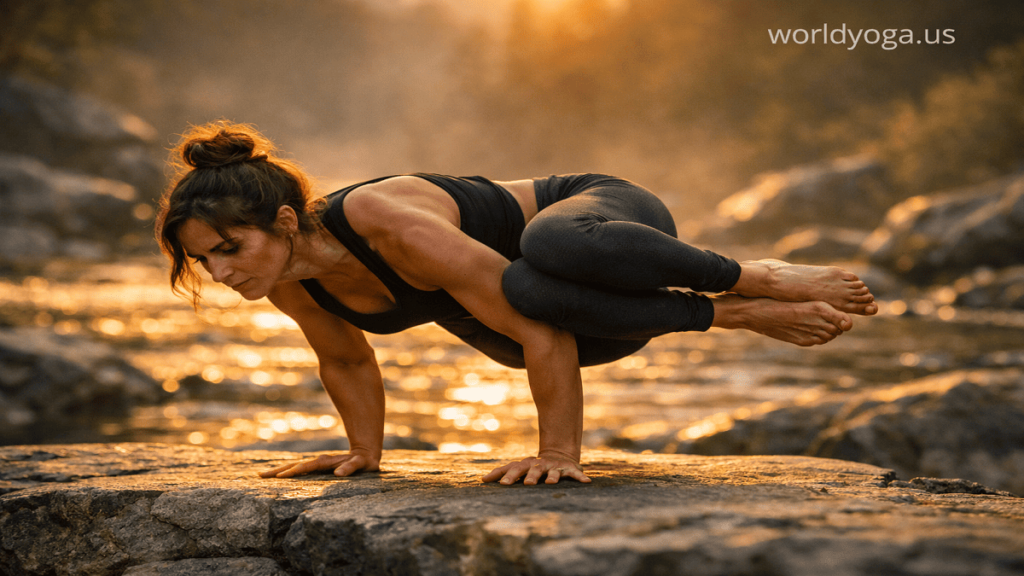
How is this pose performed step by step?
Step-by-Step Execution
1. Start in a Stable Squat Position
Begin in a deep squat (Malasana). Keep your feet either together or hip-width apart depending on comfort. Ensure your heels are grounded or supported if mobility is limited. Place your palms on the mat in front of you, shoulder-width apart, with fingers spread wide to maximize stability and distribute weight evenly across the hands.
2. Prepare the Twist
Rotate your torso to one side. For example, if twisting to the right, your knees will move toward the left upper arm. This twisting action should come from the thoracic spine (upper back), not the lower back, to avoid strain. Engage your abdominal muscles to control the rotation.
3. Position the Legs on the Arm
Bring both knees or thighs onto the opposite upper arm (triceps). The outer knee typically rests higher near the armpit, while the other leg stacks or presses against it. This creates a stable “shelf” for the legs.
4. Hand and Arm Alignment
Keep your elbows bent at approximately 90 degrees, similar to Chaturanga Dandasana. Press firmly into the ground through your palms, especially through the index finger and thumb base. Engage the shoulders by drawing them slightly back and down to avoid collapsing.
5. Weight Transfer Forward
Shift your body weight forward slowly. This is the most critical phase. Keep looking slightly ahead of your hands, not down between them, as this helps maintain balance. As you lean forward, your toes will gradually become lighter.
6. Lift-Off
Once the weight is sufficiently forward, lift both feet off the ground. Keep the legs compact and engaged, pressing firmly into the arm. The core, especially the obliques, must remain fully activated to stabilize the twist.
7. Maintain the Balance
Hold the position by:
- Keeping steady breath control
- Engaging abdominal muscles continuously
- Maintaining even pressure in both hands
- Keeping gaze slightly forward
Hold for a few seconds initially and gradually increase duration with practice.
8. Exit Safely
To release, gently lower the feet back to the ground with control. Untwist the torso slowly and return to a neutral squat before resting.
Common Alignment Focus
- Do not let elbows flare outward
- Avoid collapsing into the shoulders
- Keep the core active throughout the hold
- Do not force the twist from the lower back
Preparatory Practice
Before attempting this pose, build strength with:
- Bakasana
- Plank Pose
- Twisting seated poses
- Core strengthening drills
Safety Notes
Avoid this pose if you have wrist injuries, shoulder instability, or acute back pain. Warm-up thoroughly before practice and use a yoga block under the feet if needed.
Reference Links
- https://www.yogajournal.com/poses/side-crow-pose/
- https://www.verywellfit.com/side-crow-pose-3567190
- https://www.gaia.com/yoga/poses/side-crow-pose/
#Side Rooster Pose in Maharashtra
What strength and flexibility are required?
1. Strength Requirements
Upper Body Strength
A major requirement is strong weight-bearing capacity in the arms and shoulders. You need:
- Strong wrists to support full body weight in extension
- Stable shoulders to prevent collapsing forward
- Triceps and chest activation to hold the elbow bend at roughly 90 degrees
- Scapular stability (control of shoulder blades)
Without this foundation, the body will collapse forward or the elbows will flare outward, making balance impossible.
Core Strength
Core engagement is the most critical element of this pose. You need:
- Strong rectus abdominis (front core) to lift the body
- Highly developed obliques for twisting control
- Transverse abdominis for deep stabilization
The core is responsible for lifting the feet off the ground and maintaining the sideways balance once airborne.
Wrist and Forearm Strength
Since all body weight is supported on the hands, endurance in the forearms and wrists is essential. Weak wrists often cause instability or discomfort early in practice.
2. Flexibility Requirements
Spinal Rotation (Most Important)
A key requirement is thoracic spine mobility. You must be able to:
- Rotate the upper back deeply without forcing the lower back
- Maintain length in the spine while twisting
Limited spinal rotation is one of the biggest barriers to achieving the correct alignment.
Hip Flexibility
Moderate hip flexibility is needed to:
- Bring the knees high onto the upper arm (triceps shelf)
- Maintain compact leg positioning without strain
Tight hips often prevent secure placement of the legs.
Hamstring and Groin Flexibility
While not extreme, some flexibility helps in:
- Deep squatting position (Malasana)
- Keeping the body compact during lift-off
3. Balance and Neuromuscular Control
Beyond raw strength and flexibility, this pose requires:
- Strong proprioception (body awareness in space)
- Controlled forward weight shift
- Ability to coordinate breath with movement
- Mental focus under instability
Many practitioners fail not due to lack of strength, but due to hesitation during the forward lean.
4. Foundational Poses That Build Requirements
To develop the necessary strength and flexibility, practice:
- Bakasana (core arm balance foundation)
- Plank Pose (full-body strength)
- Side plank variations (oblique strength)
- Seated spinal twists (rotation mobility)
- Malasana (hip opening and squat depth)
5. Summary
To perform Side Rooster Pose successfully, you need:
- Strong arms, shoulders, wrists, and core
- Deep thoracic spinal rotation
- Moderate hip and squat flexibility
- High balance control and coordination
It is best approached progressively, as the pose integrates strength and mobility rather than relying on one dominant physical quality.
References
- https://www.yogajournal.com/poses/side-crow-pose/
- https://www.verywellfit.com/side-crow-pose-3567190
- https://www.gaia.com/yoga/poses/side-crow-pose/
#Side Rooster Pose in Kolkata
What are the benefits of Side Rooster Pose?
1. Builds Upper Body Strength
One of the most direct benefits of Side Rooster Pose is significant strengthening of the upper body. The posture requires sustained weight-bearing through the hands, wrists, and forearms, which helps develop muscular endurance and stability. The shoulders and triceps are heavily engaged to support the body in a controlled elbow bend. Over time, this leads to improved functional strength that can support other arm balances and even daily activities requiring pushing or lifting.
2. Strengthens the Core Deeply
This pose is highly effective for core conditioning, particularly the oblique muscles. Since the posture involves a sideways twist while lifting the entire body off the ground, the abdominal muscles must remain constantly active. The rectus abdominis and transverse abdominis stabilize the lift, while the obliques control rotation. This combination strengthens the midsection more effectively than many traditional abdominal exercises.
A strong core developed through this posture also improves posture, spinal support, and overall body control.
3. Improves Spinal Mobility and Rotation
Side Rooster Pose encourages deep thoracic spine rotation, which is often underused in daily movement. The controlled twist helps increase flexibility in the upper and middle back while maintaining spinal integrity. This can improve posture and reduce stiffness in the upper spine caused by prolonged sitting or poor alignment habits.
4. Enhances Balance and Coordination
Balancing the entire body on the hands while rotated sideways requires refined neuromuscular coordination. Practicing this pose improves proprioception—your body’s awareness of position in space. The forward weight shift and controlled lift develop fine motor control and stability. This benefit extends beyond yoga into athletic performance and everyday movement efficiency.
5. Builds Mental Focus and Concentration
Because the pose is challenging and requires precise alignment, it naturally trains the mind to remain focused. Practitioners must coordinate breath, strength, and balance simultaneously. This develops mindfulness, patience, and the ability to stay calm under physical challenge. Regular practice can improve concentration and reduce mental distraction.
6. Prepares the Body for Advanced Arm Balances
Side Rooster Pose is often used as a progression toward more advanced arm balances and transitions. It builds on foundational strength developed in poses like Bakasana. It strengthens the same muscle groups while adding rotational complexity, making it a key stepping stone in advanced yoga practice.
7. Supports Functional Fitness and Body Awareness
Beyond yoga, this posture contributes to functional fitness by improving pushing strength, core stability, and controlled body movement. It enhances how the body responds to instability, making movements more efficient and injury-resistant in daily life.
Safety Note
While beneficial, Side Rooster Pose places pressure on wrists and shoulders. It should be practiced with proper warm-up and gradual progression to avoid strain.
External References
- https://www.yogajournal.com/poses/side-crow-pose/
- https://www.verywellfit.com/side-crow-pose-3567190
- https://www.gaia.com/yoga/poses/side-crow-pose/
#Side Rooster Pose in Surat
What common mistakes should be avoided?
1. Collapsing into the Shoulders
A very common mistake is allowing the shoulders to drop toward the wrists. This creates excessive pressure on the joints and reduces lift.
Why it happens: Lack of scapular engagement and insufficient upper-body strength.
How to fix it: Actively push the floor away and keep the shoulder blades lifted and stable.
2. Placing Weight Too Far Back
Many practitioners fail to shift their body weight forward enough, causing the feet to remain on the ground.
Why it happens: Fear of falling forward or hesitation during lift-off.
How to fix it: Gradually lean the chest forward until the center of gravity moves past the hands. Focus on controlled forward motion rather than sudden lifting.
3. Poor Elbow Alignment
Elbows that flare outward or straighten too much reduce stability and increase wrist strain.
Why it happens: Weak triceps or improper setup.
How to fix it: Keep elbows bent at about 90 degrees and aligned close to the body, similar to Chaturanga Dandasana.
4. Twisting from the Lower Back Instead of the Upper Back
Forcing the twist from the lumbar spine is both ineffective and unsafe.
Why it happens: Limited thoracic spine mobility.
How to fix it: Initiate rotation from the upper back (thoracic spine) while keeping the lower back stable and supported.
5. Improper Hand Placement
Hands placed too narrow or too wide can destabilize the entire pose.
Why it happens: Lack of awareness of shoulder-width alignment.
How to fix it: Position hands shoulder-width apart with fingers spread evenly for maximum grip and balance.
6. Weak Core Engagement
Without active core control, the legs will not lift or will drop immediately.
Why it happens: Insufficient engagement of abdominal muscles, especially obliques.
How to fix it: Actively draw the navel inward and engage the side abdominal muscles throughout the lift.
7. Holding Breath
Many practitioners unintentionally hold their breath during the effort phase, which reduces stability and focus.
Why it happens: Concentration under physical strain.
How to fix it: Maintain steady, controlled breathing to support balance and reduce tension.
8. Not Using the Legs Properly
Failing to “hug” the legs onto the upper arm reduces the structural support needed for balance.
Why it happens: Weak hip engagement or poor leg activation.
How to fix it: Actively squeeze the knees or thighs against the upper arm to create a stable shelf.
Foundational Practice Tip
Strength and control developed in Bakasana can significantly reduce these mistakes by building proper arm balance mechanics before adding the twist.
Safety Consideration
Avoid rushing into full lift-off. Falling forward or overloading the wrists is usually caused by improper weight shift and poor alignment. Progress gradually using props or partial lifts if needed.
External References
- https://www.yogajournal.com/poses/side-crow-pose/
- https://www.verywellfit.com/side-crow-pose-3567190
- https://www.gaia.com/yoga/poses/side-crow-pose/
#Side Rooster Pose in Ahemadabad
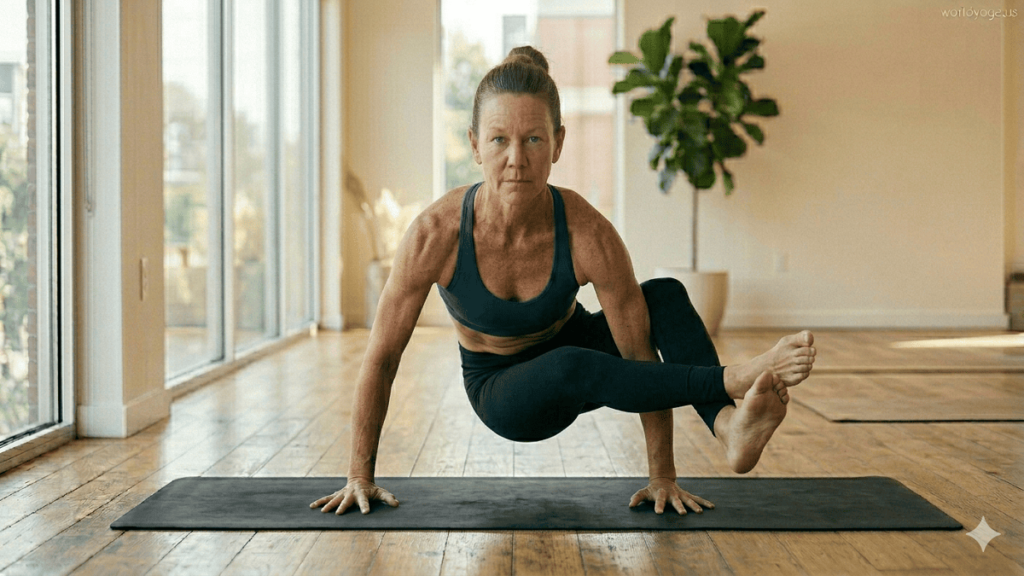
Case Study of Side Rooster Pose
1. Background and Objective
This case study examines the progression of an intermediate yoga practitioner attempting Side Rooster Pose over a structured 6-week training period. The objective was to develop safe entry into the posture while improving arm balance strength, spinal rotation, and core stability.
The practitioner had prior experience with foundational yoga postures, including basic arm balances such as Crow Pose and regular core strengthening exercises.
2. Initial Assessment
At the beginning of the study, the practitioner demonstrated:
- Moderate upper body strength but limited wrist endurance
- Good general flexibility, but restricted thoracic spinal rotation
- Weak oblique engagement during twisting movements
- Inability to lift feet fully off the ground in Side Crow setup
- Tendency to shift weight backward due to fear of falling
Primary limitation identified: lack of coordinated forward weight transfer combined with insufficient core activation.
3. Training Protocol
The training program focused on progressive preparation rather than immediate full pose execution.
Phase 1: Strength Foundation (Weeks 1–2)
- Plank holds for shoulder stability
- Chaturanga Dandasana repetitions for arm control
- Core activation drills focusing on obliques
- Wrist conditioning exercises
Phase 2: Mobility and Setup Training (Weeks 2–4)
- Deep squat practice (Malasana) for hip opening
- Seated spinal twists to improve thoracic rotation
- Supported Side Crow preparation with feet lightly touching the floor
- Knee-to-arm positioning drills without lift-off
Phase 3: Assisted Balance Development (Weeks 4–6)
- Partial lift-offs with toes supported
- Use of yoga blocks for controlled elevation
- Breath coordination during forward lean
- Gradual reduction of ground support time
4. Observed Progress
By the end of week 6, significant improvements were noted:
- Improved ability to shift weight forward without hesitation
- Increased core engagement, particularly in oblique muscles
- Better elbow alignment and shoulder stability
- Ability to hold partial Side Rooster balance for 3–5 seconds
- Reduced wrist discomfort due to improved load distribution
Full independent lift-off was achieved in the final sessions, though hold time remained inconsistent.
5. Key Challenges Identified
- Psychological barrier: fear of falling forward limited full commitment
- Core fatigue during sustained holds
- Difficulty maintaining spinal twist while lifting simultaneously
- Occasional elbow flare under fatigue
These challenges highlighted that Side Rooster Pose is as much neurological and psychological as it is physical.
6. Outcome and Conclusion
The case study concluded that successful progression into Side Rooster Pose depends on:
- Gradual strengthening of arm and core systems
- Structured exposure to balance instability
- Progressive spinal rotation training
- Mental adaptation to forward weight shift
The practitioner achieved functional competence in the pose, with the ability to enter and exit safely and hold brief balances with control.
7. Key Insight
The most critical factor in mastering Parsva Bakasana is not raw strength alone, but the integration of:
- Controlled forward momentum
- Oblique-driven core stability
- Calm mental focus under instability
8. External References
- https://www.yogajournal.com/poses/side-crow-pose/
- https://www.verywellfit.com/side-crow-pose-3567190
- https://www.gaia.com/yoga/poses/side-crow-pose/
#Side Rooster Pose in Hyderabad
White Paper of Side Rooster Pose
1. Abstract
This white paper analyzes Side Rooster Pose (Parsva Bakasana), an advanced yoga arm balance that integrates spinal rotation, upper-body strength, and core stabilization. The posture is examined from biomechanical, physiological, and motor-control perspectives. The objective is to outline its structural demands, benefits, risks, and training methodology for safe and effective practice.
2. Introduction
Side Rooster Pose is a rotational arm balance derived from Crow Pose (Bakasana). It requires simultaneous engagement of multiple kinetic chains: wrist extension, elbow flexion stability, shoulder protraction control, core anti-rotation strength, and thoracic spinal mobility. Unlike linear arm balances, it introduces asymmetrical loading, making it a higher neuromuscular challenge.
3. Biomechanical Analysis
3.1 Load Distribution
Body weight is supported primarily through:
- Palmar surface of hands (wrist extension load-bearing)
- Elbow flexion at approximately 90 degrees
- Shoulder girdle stabilization via scapular protraction
The center of mass must shift anteriorly beyond the wrist line for lift-off.
3.2 Rotational Mechanics
The pose requires thoracic rotation while maintaining lumbar stability. The obliques act as primary rotational controllers, while the transverse abdominis stabilizes intra-abdominal pressure.
3.3 Kinetic Chain Activation
- Distal: wrist extensors and finger flexors for grip stability
- Mid-chain: triceps and deltoids for structural support
- Proximal: rectus abdominis and obliques for lift and rotation control
4. Physiological Demands
Strength Requirements
- High isometric strength in upper limbs
- Core endurance under asymmetrical load
- Wrist and forearm load tolerance
Flexibility Requirements
- Thoracic spine rotational mobility
- Hip flexion for compact knee placement
- Moderate adductor flexibility for squat entry
5. Neuromuscular Control
Side Rooster Pose is heavily dependent on motor coordination rather than pure strength. Key components include:
- Proprioceptive awareness during forward weight shift
- Dynamic stabilization of scapula under load
- Fine control of micro-adjustments in wrist pressure
- Breath synchronization for balance regulation
6. Benefits Profile
Musculoskeletal Benefits
- Strengthens shoulders, triceps, and forearms
- Enhances core stability, especially obliques
- Improves thoracic spinal rotation
Neurological Benefits
- Enhances balance-related proprioception
- Develops concentration under instability
- Improves motor planning for complex movement transitions
Functional Transfer
Supports improved performance in pushing, lifting, and rotational athletic movements.
7. Risk Assessment
Common Risks
- Wrist overload due to poor weight distribution
- Shoulder strain from collapsed scapular engagement
- Lumbar strain from improper twisting mechanics
- Loss of balance leading to forward falls
Contraindications
- Wrist injuries
- Shoulder instability
- Acute lower back pain
- Severe core weakness
8. Training Methodology
Phase 1: Foundational Strength
- Plank variations
- Bakasana practice
- Wrist conditioning drills
Phase 2: Mobility Development
- Malasana (deep squat conditioning)
- Thoracic rotation exercises
- Seated spinal twists
Phase 3: Integration
- Supported side balances
- Partial lift-off drills
- Controlled weight-shift practice
9. Performance Indicators
Progress is measured through:
- Duration of stable hold (seconds)
- Ability to lift both feet without support
- Consistency of elbow alignment
- Reduction in instability during transition phase
10. Conclusion
Side Rooster Pose is a complex integrative posture requiring synchronized strength, mobility, and neuromotor control. It is not purely a strength-based arm balance but a coordination-intensive rotational stability skill. Proper progression significantly reduces injury risk and improves long-term performance capacity.
11. References
- https://www.yogajournal.com/poses/side-crow-pose/
- https://www.verywellfit.com/side-crow-pose-3567190
- https://www.gaia.com/yoga/poses/side-crow-pose/
#Side Rooster Pose in Pune
Industry Application of Side Rooster Pose
1. Overview
Side Rooster Pose (Parsva Bakasana) is an advanced yoga arm balance involving rotational core strength, upper-body loading, and neuromuscular coordination. While it originates in traditional yoga practice, its movement mechanics have valuable applications across multiple modern industries, particularly in fitness, rehabilitation, sports science, and human performance training.
2. Fitness and Strength Training Industry
In the fitness sector, Side Rooster Pose is used as a benchmark movement for advanced bodyweight control.
Applications include:
- Assessment of relative upper-body strength without external weights
- Development of calisthenics and functional training programs
- Progression marker for advanced arm balance training systems
It is often integrated into programs that focus on bodyweight mastery, similar to gymnastics-based conditioning or calisthenics progression models.
3. Yoga and Mind–Body Training Industry
Within yoga education and teacher training systems, Side Rooster Pose is used to:
- Evaluate intermediate-to-advanced practitioner readiness
- Teach sequencing strategies for peak poses
- Develop safe progression frameworks for arm balances
It also serves as a teaching tool for understanding biomechanical alignment in twisting arm balances and transitions.
4. Physical Therapy and Rehabilitation (Selective Use)
Although not typically used directly in rehabilitation due to its difficulty, modified versions are relevant in clinical movement therapy.
Applications include:
- Shoulder stability and scapular control training (in simplified forms)
- Wrist strengthening protocols for gradual load adaptation
- Core anti-rotation exercises inspired by the pose mechanics
Therapists may extract components of the posture rather than the full expression.
5. Sports Science and Athletic Conditioning
The movement principles of Side Rooster Pose are relevant in sports requiring rotational strength and upper-body stability.
Transferable benefits:
- Enhanced trunk rotation control for sports like tennis, baseball, and martial arts
- Improved closed-chain upper-limb stability
- Development of proprioception under asymmetrical load
Athletic trainers may use its mechanics to design drills that improve force transmission through the kinetic chain.
6. Performance and Movement Arts
In disciplines such as contemporary dance, circus arts, and movement choreography, Side Rooster Pose contributes to:
- Development of aerial strength and floor-based transitions
- Artistic arm balance integration in choreography
- Enhanced body control during inverted or off-axis movement
It is especially relevant in disciplines influenced by hand-balancing traditions like acro-yoga and circus conditioning.
7. Ergonomics and Occupational Training Insights
Although not practiced directly, the biomechanical principles inform ergonomic studies:
- Importance of wrist load management under sustained pressure
- Spinal rotation control under load-bearing conditions
- Core stabilization for asymmetrical lifting tasks
These insights help design safer movement protocols in physically demanding professions.
8. Human Performance and Neuromotor Research
Researchers studying balance and motor control use similar postural patterns to analyze:
- Proprioceptive adaptation under instability
- Motor learning in complex coordinated tasks
- Neural efficiency in multi-joint stabilization
Side Rooster Pose serves as a real-world model of high-level integrated motor control.
9. Limitations in Industry Use
Despite its value, direct application is limited by:
- High injury risk for untrained individuals
- Requirement for advanced mobility and strength
- Need for supervised progression in most contexts
Therefore, industries typically use scaled or derivative versions rather than full execution.
10. Conclusion
Parsva Bakasana is more than a yoga posture; it is a high-complexity movement model with applications across fitness training, sports performance, rehabilitation principles, and movement science. Its greatest industry value lies not in replication, but in the principles it teaches—rotational strength, controlled instability, and integrated body awareness.
11. External References
- https://www.yogajournal.com/poses/side-crow-pose/
- https://www.verywellfit.com/side-crow-pose-3567190
- https://www.gaia.com/yoga/poses/side-crow-pose/
#Side Rooster Pose In Mumbai
Ask FAQs
What is Side Rooster Pose?
Side Rooster Pose, also known as Side Crow Pose or Parsva Bakasana, is an advanced yoga arm balance where the body is twisted sideways and balanced on the hands while both legs rest on one upper arm. It combines core strength, arm stability, and spinal rotation.
Is Side Rooster Pose suitable for beginners?
No, it is generally not suitable for beginners. It is an advanced posture that requires prior experience with foundational arm balances such as Bakasana. Beginners should first develop wrist strength, core stability, and basic balance skills before attempting it.
What muscles are mainly used in Side Rooster Pose?
This pose primarily engages the core muscles (especially the obliques), shoulders, triceps, forearms, and wrists. It also activates the hip flexors and requires strong scapular stability to maintain balance and prevent collapse.
What are the main benefits of practicing Side Rooster Pose?
Regular practice improves upper-body strength, core stability, spinal rotation, balance, and mental focus. It also enhances body awareness and coordination by training the nervous system to manage complex movement patterns under load.
What are common mistakes to avoid in Side Rooster Pose?
Common mistakes include collapsing the shoulders, not leaning forward enough, flaring the elbows, twisting from the lower back instead of the upper back, and holding the breath. These errors can reduce stability and increase the risk of wrist or shoulder strain.
Table of Contents
Disclaimer:
Parsva Bakasana is an advanced yoga posture that should be practiced with proper guidance and preparation. The information provided is for educational purposes only and is not a substitute for professional instruction. Individuals with wrist, shoulder, or back injuries should avoid or modify this pose under expert supervision. Practice at your own risk.