
Shoulder Pressure Pose
Shoulder Pressure Pose, known in Sanskrit as Bhujapidasana, is an intermediate-level yoga arm balance that builds foundational strength and control for more advanced postures. The name is derived from “bhuja” (arm or shoulder), “pida” (pressure), and “asana” (pose), reflecting the key action of pressing the shoulders with the legs while lifting the body off the ground.
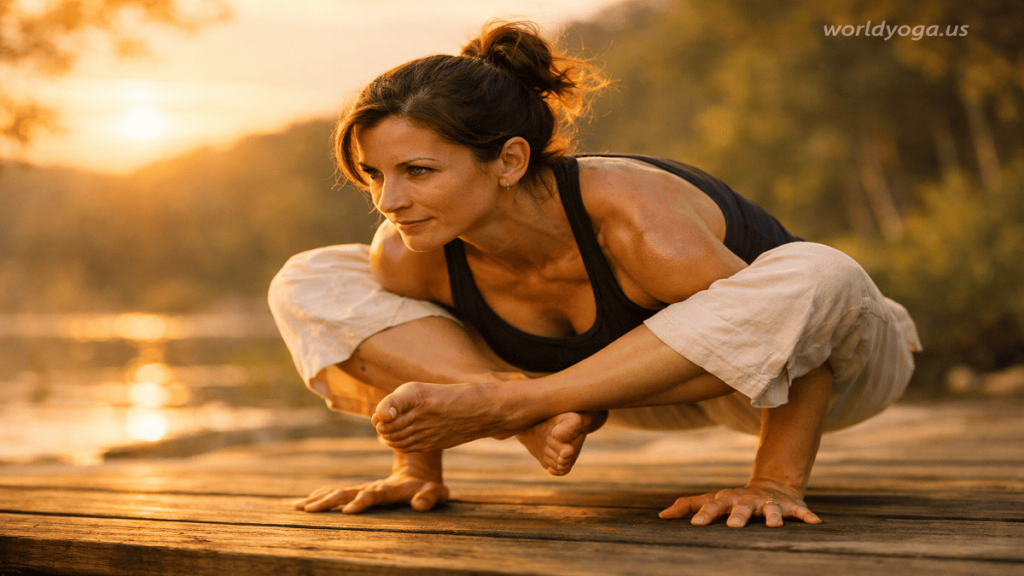
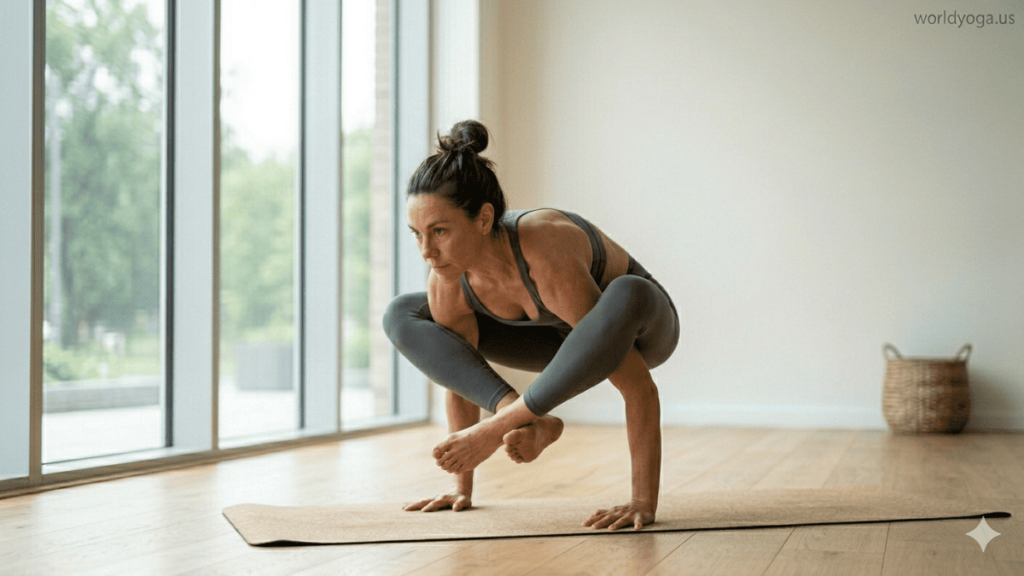
In this posture, the practitioner begins in a low squat, placing the shoulders underneath the thighs. The legs then wrap around the upper arms, and the ankles are typically crossed in front. By shifting weight into the hands, the body lifts off the floor, supported entirely by the arms. The pose emphasizes compression—bringing the torso and thighs close together—to create stability and balance.
From a biomechanical standpoint, Shoulder Pressure Pose engages multiple muscle groups simultaneously. The arms, shoulders, and wrists تحمل the body’s weight, while the core muscles stabilize the pelvis and spine. The inner thighs (adductors) actively squeeze inward to maintain grip on the arms, and the hip flexors assist in lifting the legs. This integrated engagement makes the pose an effective full-body exercise.
The benefits of Bhujapidasana are both physical and mental. Physically, it strengthens the upper body and core, improves hip mobility, and enhances flexibility in the groin and hamstrings. It also develops balance and coordination. Mentally, the pose requires focus, patience, and controlled breathing, helping to cultivate mindfulness and confidence.
Shoulder Pressure Pose is often taught as a preparatory posture for more advanced arm balances such as Firefly Pose (Tittibhasana). It helps practitioners understand weight distribution, arm engagement, and the importance of core activation. Because of this, it plays a crucial role in progressive yoga training.
However, like other arm balances, it carries some risk if practiced incorrectly. Common concerns include wrist strain and shoulder overload, especially if the practitioner lacks sufficient strength or skips proper warm-up. It is advisable to practice under the guidance of a qualified instructor and to build strength gradually.
In conclusion, Shoulder Pressure Pose is a foundational arm balance that bridges beginner and advanced yoga practices. It develops essential strength, flexibility, and coordination, making it a valuable addition to any structured yoga progression.
#Shoulder Pressure Pose in India
What is Shoulder Pressure Pose?
Shoulder Pressure Pose, known in Sanskrit as Bhujapidasana, is an intermediate-level yoga arm balance where the body is lifted off the ground using the hands while the legs wrap tightly around the upper arms.
In this pose, the practitioner starts in a low squat, places the shoulders under the thighs, and then squeezes the legs inward against the arms. By shifting weight forward into the hands, the feet lift off the floor and the ankles are often crossed in front. The arms act as the main support, while the core and inner thighs help stabilize the body.
The defining feature of Shoulder Pressure Pose is the “compression” between the thighs and shoulders. This close contact creates the stability needed to balance and lift, making it a key foundational skill for more advanced arm balances.
Bhujapidasana requires a combination of upper body strength, core engagement, and hip flexibility. It is commonly practiced as a preparatory pose for advanced postures like Firefly Pose, helping practitioners build confidence, coordination, and control.
Overall, Shoulder Pressure Pose is a strengthening and balancing posture that develops both physical stability and mental focus, making it an important step in progressing toward more complex yoga arm balances.
#Shoulder Pressure Pose in Maharashtra
How is this arm balance performed step by step?
1. Begin in a Low Squat
Start with your feet slightly wider than hip-width apart. Lower into a deep squat, keeping your heels grounded as much as possible and your spine upright.
2. Position Your Shoulders Under the Thighs
Lean your torso forward and carefully bring your shoulders underneath your thighs. Aim to place your thighs as high up on your upper arms as possible for better leverage.
3. Place Your Hands Firmly on the Floor
Set your palms flat on the ground, shoulder-width apart, slightly behind your feet. Spread your fingers wide to create a stable base.
4. Squeeze the Legs Inward
Engage your inner thighs and wrap them tightly around your upper arms. This “hugging” action is essential for stability and lift.
5. Shift Your Weight Forward
Slowly transfer your body weight into your hands. Keep your elbows slightly bent and your gaze forward to maintain balance.
6. Lift Your Feet Off the Ground
Engage your core and gently lift both feet off the floor. At this stage, your body is fully supported by your arms.
7. Cross the Ankles (Optional but Common)
For added stability, cross your ankles in front of you. Continue pressing your thighs into your arms and your hands into the floor.
8. Hold and Breathe
Maintain steady breathing while holding the pose. Keep your core engaged and shoulders stable to avoid collapsing.
9. Exit the Pose Safely
Slowly lower your feet back to the ground with control and return to a squat or standing position.
Important Tips:
- Warm up with hip openers and hamstring stretches before attempting.
- Keep a slight bend in the elbows to protect the joints.
- Focus on squeezing the thighs inward rather than relying only on arm strength.
- Practice consistently to build strength and confidence.
#Shoulder Pressure Pose in Kolkata
What strength and flexibility are required?
1. Upper Body Strength
The arms, shoulders, and wrists support the entire body weight in this pose. Strong deltoids, triceps, and chest muscles are necessary to lift and hold the body. Additionally, the muscles around the shoulder blades (scapular stabilizers) help maintain proper alignment and prevent collapsing into the joints.
2. Core Strength and Stability
Core engagement is crucial for lifting the feet off the ground and maintaining balance. The abdominal muscles—especially the transverse abdominis and obliques—work to stabilize the pelvis and keep the body compact. Without sufficient core strength, the pose becomes unstable and difficult to sustain.
3. Hip Flexibility and Mobility
Deep hip opening is a key requirement. The practitioner must be able to squat low and bring the thighs high onto the upper arms. Tight hips can limit this positioning and reduce the ability to create the necessary “compression” for lift.
4. Inner Thigh (Adductor) Strength
The inner thighs play an active role by squeezing inward against the arms. This gripping action is essential for stability and helps keep the body lifted. Both strength and control in the adductors are required.
5. Hamstring Flexibility
Flexible hamstrings allow for a deeper squat and better positioning of the legs over the arms. Limited hamstring mobility can restrict entry into the pose and affect overall balance.
6. Wrist Strength and Mobility
The wrists تحمل significant load, so they must be strong and mobile. Proper wrist preparation helps prevent discomfort and injury, especially for those new to arm balances.
7. Balance and Coordination
Although not purely physical, coordination is vital. The body must synchronize multiple muscle groups while maintaining steady breathing and focus.
Conclusion
Shoulder Pressure Pose requires balanced development of upper body and core strength along with hip and hamstring flexibility. By building these components progressively, practitioners can achieve better control, stability, and confidence in this foundational arm balance.
#Shoulder Pressure Pose in Ahemadabad
What are the benefits of this pose?
1. Builds Upper Body Strength
This pose strengthens the arms, shoulders, and wrists by requiring them to support the entire body weight. Regular practice improves muscular endurance and stability, which is beneficial for other arm balances and functional movements.
2. Strengthens the Core
Core engagement is essential to lift and hold the body. The abdominal muscles work continuously to stabilize the torso, helping improve posture, balance, and overall core strength.
3. Improves Hip Mobility and Flexibility
The deep squat and leg positioning enhance flexibility in the hips and groin. Over time, this increases range of motion and reduces stiffness in the lower body.
4. Enhances Balance and Coordination
Maintaining this arm balance requires precise coordination between the upper and lower body. Practitioners develop better proprioception (body awareness) and control.
5. Engages Inner Thigh Muscles
The inner thighs actively squeeze against the arms to maintain stability. This strengthens the adductors and improves muscle control in the lower body.
6. Prepares for Advanced Arm Balances
Shoulder Pressure Pose is often used as a stepping stone for more advanced poses like Firefly Pose. It teaches essential skills such as weight shifting, arm engagement, and body compression.
7. Boosts Mental Focus and Confidence
Balancing on the hands requires concentration and controlled breathing. Successfully holding the pose builds confidence and encourages a mindful, focused state.
Conclusion
Shoulder Pressure Pose is a highly effective posture for developing strength, flexibility, and coordination. Its benefits extend beyond physical conditioning, supporting mental clarity and confidence while preparing practitioners for more advanced yoga challenges.
#Shoulder Pressure Pose in Chennai
What common mistakes should be avoided?
1. Inadequate Hip Placement
One of the most frequent mistakes is not positioning the thighs high enough on the upper arms. If the legs sit too low, it becomes difficult to create the compression needed to lift the body.
2. Skipping Warm-Up
Attempting the pose without preparing the hips, hamstrings, and wrists can limit mobility and increase the risk of strain. Proper warm-up is essential for safe execution.
3. Weak Core Engagement
Relying only on arm strength often leads to failure in lifting the feet. Without strong core activation, the body lacks the stability required to balance.
4. Not Squeezing the Inner Thighs
The legs must actively press inward against the arms. If this engagement is missing, the body loses grip and becomes unstable.
5. Improper Weight Shift
Failing to shift enough weight forward into the hands prevents lift-off. On the other hand, shifting too abruptly can cause loss of balance. Controlled movement is key.
6. Locking the Elbows
Straightening the arms completely and locking the elbows can strain the joints. Keeping a slight bend provides better control and protects the arms.
7. Collapsing Shoulders
Allowing the shoulders to sink or round forward reduces support and increases joint stress. Proper shoulder engagement helps maintain structure and balance.
8. Holding the Breath
Many practitioners unintentionally hold their breath, creating tension and reducing focus. Steady breathing is essential for maintaining control.
9. Ignoring Wrist Alignment
Poor hand placement or uneven pressure on the wrists can lead to discomfort or injury. Hands should be firmly grounded with fingers spread for stability.
Conclusion
Avoiding these common mistakes allows for a safer and more effective practice of Shoulder Pressure Pose. Focusing on alignment, controlled movement, and proper muscle engagement ensures steady progress and reduces the risk of injury.
#Shoulder Pressure Pose in Hyderabad
Case Study of Shoulder Pressure Pose
Background
This case study examines a 35-year-old beginner-to-intermediate yoga practitioner with six months of consistent practice. The individual aimed to achieve Shoulder Pressure Pose (Bhujapidasana) as part of building foundational strength for arm balances. Initial limitations included restricted hip mobility, weak core engagement, and lack of confidence in weight-bearing on the hands.
Initial Assessment
The practitioner could comfortably perform basic poses such as Plank and forward folds but struggled with deep squatting and lifting the feet off the ground. The thighs could not be positioned high enough on the arms, and there was hesitation in shifting weight forward due to fear of falling.
Intervention Plan
A structured 6-week program was implemented with three key focus areas:
- Strength Development: Core exercises (plank variations, knee-to-chest drills) and upper body strengthening (Chaturanga, modified arm balances).
- Flexibility Training: Daily hip-opening exercises, including Malasana (deep squat), groin stretches, and hamstring mobility work.
- Technique Practice: Repeated drills of arm placement and controlled weight shifting, initially with feet supported on the floor.
The practitioner trained four times per week, gradually increasing intensity and hold duration.
Challenges Encountered
The main challenges were limited hip mobility and insufficient inner thigh engagement. Wrist discomfort also appeared during early sessions due to increased load. Additionally, fear of falling forward slowed progress in achieving full lift.
Adaptations and Solutions
To address these issues:
- Yoga blocks were used under the hands to create more space for lifting
- Longer holds in hip-opening poses improved flexibility
- Wrist-strengthening and mobility exercises reduced discomfort
- Gradual forward weight shifts helped build confidence
Outcomes
By week three, the practitioner was able to briefly lift one foot off the ground. By week six, both feet were lifted with ankles crossed, and the pose was held for 5–7 seconds with improved stability and breathing control. Noticeable gains were observed in core strength, hip flexibility, and overall coordination.
Conclusion
This case study highlights that Shoulder Pressure Pose can be achieved through consistent, targeted practice. Addressing individual limitations in strength, flexibility, and confidence is essential. With a progressive approach, practitioners can safely develop the skills needed to perform this foundational arm balance and prepare for more advanced poses.
#Shoulder Pressure Pose in Banglore
White Paper of Shoulder Pressure Pose
Abstract
Shoulder Pressure Pose (Bhujapidasana) is an intermediate yoga arm balance that emphasizes upper body strength, core stability, and hip mobility. This white paper examines the biomechanical principles, physiological benefits, risk considerations, and structured training approach required for safe and effective practice.
Introduction
As yoga continues to integrate into modern fitness and rehabilitation systems, foundational arm balances like Shoulder Pressure Pose play a critical role in developing functional movement patterns. It serves as a preparatory posture for advanced poses such as Firefly Pose and supports the progression of strength and coordination.
Biomechanical Analysis
Shoulder Pressure Pose operates within a closed kinetic chain, where the hands act as the base of support. Key biomechanical components include:
- Upper Body Engagement: Deltoids, triceps, and pectoral muscles support body weight
- Core Stabilization: Abdominal muscles maintain pelvic lift and spinal alignment
- Hip Flexion and Compression: Thighs press against the shoulders to create stability
- Adductor Activation: Inner thighs engage to maintain grip on the arms
Joint actions involve shoulder stabilization, slight elbow flexion, hip flexion, and ankle crossing. Maintaining the center of gravity over the hands is essential for balance.
Physiological Benefits
The pose provides multiple physical and mental benefits:
- Increased upper body and core strength
- Improved hip mobility and hamstring flexibility
- Enhanced balance, coordination, and proprioception
- Greater focus, body awareness, and mental discipline
Research on yoga-based movement suggests that arm balances contribute to improved functional fitness and neuromuscular control.
Training and Progression Framework
A structured approach is recommended:
- Foundation Phase: Build strength through plank, Chaturanga, and basic core exercises
- Mobility Phase: Improve hip and hamstring flexibility with squats and forward folds
- Technique Phase: Practice arm placement and controlled weight shifting
- Integration Phase: Lift both feet and maintain balance with steady breathing
Consistent practice (3–4 sessions per week) supports gradual progression.
Risk Factors and Injury Prevention
Potential risks include wrist strain, shoulder overload, and muscle tightness. Preventive strategies include:
- Proper warm-up and mobility preparation
- Gradual progression without forcing the pose
- Strengthening supporting muscle groups
- Practicing under qualified supervision
Conclusion
Shoulder Pressure Pose is a foundational arm balance that integrates strength, flexibility, and coordination. When practiced systematically, it enhances functional movement and prepares practitioners for advanced yoga postures. Its application extends beyond yoga into broader fitness and rehabilitation contexts, making it a valuable component of holistic training programs.
#Shoulder Pressure Pose in Delhi
Industry Application of Shoulder Pressure Pose
Shoulder Pressure Pose (Bhujapidasana) is widely used as a foundational arm balance within modern movement systems. Beyond traditional yoga practice, it has practical applications across fitness, rehabilitation, sports conditioning, and digital wellness industries due to its emphasis on strength, mobility, and neuromuscular control.
1. Fitness and Yoga Training Industry
In yoga studios and functional fitness programs, Shoulder Pressure Pose is used as a progression milestone for arm balance training. It helps practitioners develop the strength and coordination needed for advanced poses like Firefly Pose. Platforms such as Yoga Journal frequently feature Bhujapidasana as part of structured arm balance progressions and mobility-focused training systems.
2. Strength and Athletic Conditioning
In athletic training environments, the pose (or its components) is used to improve core stability, upper body endurance, and body control. Sports requiring agility and balance—such as gymnastics, martial arts, rock climbing, and dance—benefit from similar movement patterns. The compression and lift mechanics help enhance joint stability and functional strength.
3. Physical Therapy and Rehabilitation
While the full pose is not typically used in early-stage rehabilitation, its foundational movements are highly relevant in therapeutic settings. Elements such as controlled weight-bearing through the hands, hip mobility drills, and core engagement are integrated into recovery programs. Organizations like the American Physical Therapy Association emphasize functional, multi-joint movement patterns similar to those seen in Bhujapidasana for improving patient mobility and strength.
4. Corporate Wellness and Workplace Health
Corporate wellness programs increasingly incorporate yoga-based movement to reduce stress and improve physical health. Shoulder Pressure Pose is often used as a developmental goal within progressive yoga sessions rather than a beginner-level exercise. Wellness providers such as Headspace integrate structured movement and mindfulness practices that support physical engagement and mental focus.
5. Digital Fitness Platforms and Online Coaching
With the growth of online fitness ecosystems, Bhujapidasana is commonly included in guided progression programs. Digital platforms offer step-by-step tutorials, mobility drills, and strength-building sequences that prepare users for advanced arm balances. This supports the broader trend of skill-based fitness training with measurable progression paths.
Conclusion
Shoulder Pressure Pose serves as an important functional movement across multiple industries. Its ability to develop strength, flexibility, and coordination makes it valuable in yoga training, athletic performance, rehabilitation, and digital wellness systems. As demand for holistic and functional fitness continues to grow, this pose remains a key component in structured movement education and performance development.
#Shoulder Pressure Pose in Mumbai
Ask FAQs
What is Shoulder Pressure Pose (Bhujapidasana)?
Shoulder Pressure Pose is an intermediate arm balance where the body is lifted off the ground using the hands while the legs wrap around and press against the upper arms for support and stability.
Is Shoulder Pressure Pose suitable for beginners?
It is generally recommended for intermediate practitioners. Beginners should first build strength and flexibility through foundational poses like Plank, Malasana, and basic arm balances.
What are the main benefits of this pose?
It strengthens the arms, shoulders, and core, improves hip mobility, enhances balance and coordination, and develops focus and body awareness.
What are the most important safety tips?
Always warm up properly, avoid forcing the legs too tightly if flexibility is limited, keep a slight bend in the elbows, and practice under guidance if you are new to arm balances.
Which poses help prepare for Shoulder Pressure Pose?
Preparatory poses include Crow Pose, Firefly Pose, deep squats (Malasana), and hip-opening stretches that improve flexibility and arm strength.
Table of Contents
Disclaimer:
This content is for informational purposes only and does not replace professional medical or yoga instruction. Practice Shoulder Pressure Pose under the guidance of a qualified instructor and avoid attempting it if you have any injuries or health concerns.