Two-Handed Arm Balance
The “Two-Handed Arm Balance” generally refers to a category of intermediate-to-advanced yoga arm balancing postures where the entire body weight is supported by the hands, requiring coordinated engagement of the arms, core, and shoulder girdle. While the term is not a single standardized pose name in classical yoga texts, it is commonly used in modern fitness and yoga instruction to describe foundational arm balances such as Bakasana (Crow Pose) variations or preparatory stages for more advanced transitions like Eka Pada Bakasana or Handstand progressions.
At its core, a two-handed arm balance emphasizes strength, stability, and neuromuscular control. Practitioners must develop strong wrist flexion capacity, triceps endurance, and scapular stability. Equally important is core activation, particularly the transverse abdominis and hip flexors, which help lift the lower body off the ground and maintain alignment.
Key Technical Components
- Foundation (Hands and Wrists):
The hands act as the primary base of support. Fingers are spread wide to distribute weight evenly, reducing strain on the wrists. Proper grounding through the index finger and thumb helps maintain balance. - Upper Body Engagement:
The shoulders must be protracted (rounded forward slightly) to create a stable “shelf” for the knees or thighs in poses like Crow Pose. The elbows are typically bent and hugged inward to engage the triceps. - Core Activation:
The abdominal muscles play a crucial role in lifting and stabilizing the body. Without sufficient core engagement, the body will collapse forward. - Balance and Focus:
Drishti (focused gaze) and controlled breathing are essential for maintaining equilibrium. Mental focus is as important as physical strength in arm balancing.
Benefits
Practicing two-handed arm balances improves upper body strength, proprioception, and mental concentration. It also enhances wrist resilience and builds confidence in body control. Additionally, these poses stimulate core integration, which can benefit posture and athletic performance in other physical activities.
Precautions
Beginners should approach arm balances gradually, ideally under supervision. Individuals with wrist injuries, shoulder instability, or hypertension should exercise caution. Proper warm-up, especially wrist and shoulder mobility work, is essential before attempting these poses.
External References
- Yoga Journal – Arm Balance Fundamentals:
https://www.yogajournal.com/poses/types-of-poses/arm-balances/ - Ekhart Yoga – Crow Pose Tutorial:
https://www.ekhartyoga.com/everything-yoga/poses/bakasana-crow-pose - Yoga International – Building Arm Balance Strength:
https://yogainternational.com/article/view/how-to-build-arm-balance-strength
#Two-Handed Arm Balance in India
What is the Two-Handed Arm Balance?
The Two-Handed Arm Balance refers to a group of physical balancing positions—commonly seen in yoga and calisthenics—where the entire body weight is supported only by the hands while both feet are lifted off the ground. As the name suggests, it uses both hands as the sole point of contact with the floor, requiring significant strength, coordination, and balance.
In yoga, this concept is not a single fixed pose but rather includes several postures such as Bakasana (Crow Pose), Kakasana (variation of Crow Pose), and preparatory forms of handstand-based balances. These poses are widely practiced to develop upper body control and mental focus.
How it works
A two-handed arm balance relies on the integration of multiple muscle groups working together:
- Arms and shoulders: Provide structural support and hold the body weight.
- Core muscles: Engage deeply to lift the legs and stabilize the torso.
- Wrists and hands: Act as the foundation, distributing weight evenly across the palms.
- Back and hip flexors: Assist in lifting and maintaining alignment.
The practitioner shifts their body weight forward onto the hands while using core engagement to lift the lower body off the ground. Balance is maintained through controlled breathing, steady gaze (drishti), and fine muscular adjustments.
Purpose and Benefits
Two-handed arm balances are practiced for both physical and mental benefits:
- Builds upper body strength (shoulders, triceps, forearms)
- Improves core stability and control
- Enhances balance and body awareness (proprioception)
- Develops focus, patience, and mental discipline
- Increases wrist strength and flexibility
These poses also help prepare the body for more advanced movements such as handstands and arm balance transitions.
Beginner Considerations
Because these poses require strength and coordination, beginners are advised to start with foundational exercises like plank holds, crow pose drills, and wrist conditioning. Proper warm-up is essential to avoid strain, especially in the wrists and shoulders.
Summary
In simple terms, the Two-Handed Arm Balance is a physical skill where the body is lifted and stabilized using only the hands, combining strength, control, and focus. It is a foundational category of advanced movement training in yoga and bodyweight fitness.
External References
- Yoga Journal – Arm Balance Guide:
https://www.yogajournal.com/poses/types-of-poses/arm-balances/ - Ekhart Yoga – Bakasana (Crow Pose):
https://www.ekhartyoga.com/everything-yoga/poses/bakasana-crow-pose - Yoga International – Arm Balance Training Basics:
https://yogainternational.com/article/view/how-to-build-arm-balance-strength
#Two-Handed Arm Balance in Maharashtra
How is this pose performed step by step?
1. Prepare the Body
Start in a squat position (Malasana) with your feet slightly apart. Place your hands firmly on the mat, shoulder-width apart, fingers spread wide. This creates a stable base and helps distribute weight evenly across the palms.
Engage your wrists by pressing through the knuckles, especially the index finger and thumb. This reduces pressure on the wrist joint.
2. Position the Knees
Bring your knees toward your upper arms, as close to the armpits as possible. This contact point acts like a “shelf” for balance. Keep your elbows slightly bent and hugged inward rather than flaring out.
3. Shift Your Weight Forward
Slowly lean your body forward, transferring weight from your feet into your hands. This is the most critical step. Do not rush—control is more important than lifting quickly.
Your gaze should move slightly forward, not down, to help maintain balance.
4. Engage the Core and Lift
Activate your abdominal muscles and gently lift one foot off the ground, then the other. At first, you may just tiptoe or lift briefly—this is normal.
Once balanced, draw your heels toward your sitting bones and round your upper back slightly to stabilize the posture.
5. Maintain Balance
Keep your breathing steady and controlled. Focus your eyes on a single point (drishti) ahead of your hands. Micro-adjust through your fingers to prevent tipping forward.
Hold the position for a few seconds initially, gradually increasing duration as strength improves.
6. Exit Safely
To come out of the pose, slowly lower your feet back to the ground with control. Return to a squat position and rest.
Key Tips for Success
- Warm up wrists and shoulders before attempting
- Keep core engagement active throughout
- Avoid locking elbows or collapsing the chest
- Practice patience—balance improves over time
Safety Note
Avoid forcing the lift if you feel strain in the wrists or shoulders. Use a cushion or yoga block under the forehead as a safety support when practicing early attempts.
External References
- Yoga Journal – Crow Pose Instructions:
https://www.yogajournal.com/poses/bakasana-crow-pose/ - Ekhart Yoga – Step-by-Step Bakasana Guide:
https://www.ekhartyoga.com/everything-yoga/poses/bakasana-crow-pose - Yoga International – Learning Arm Balances Safely:
https://yogainternational.com/article/view/how-to-build-arm-balance-strength
#Two-Handed Arm Balance in Ahemadabad
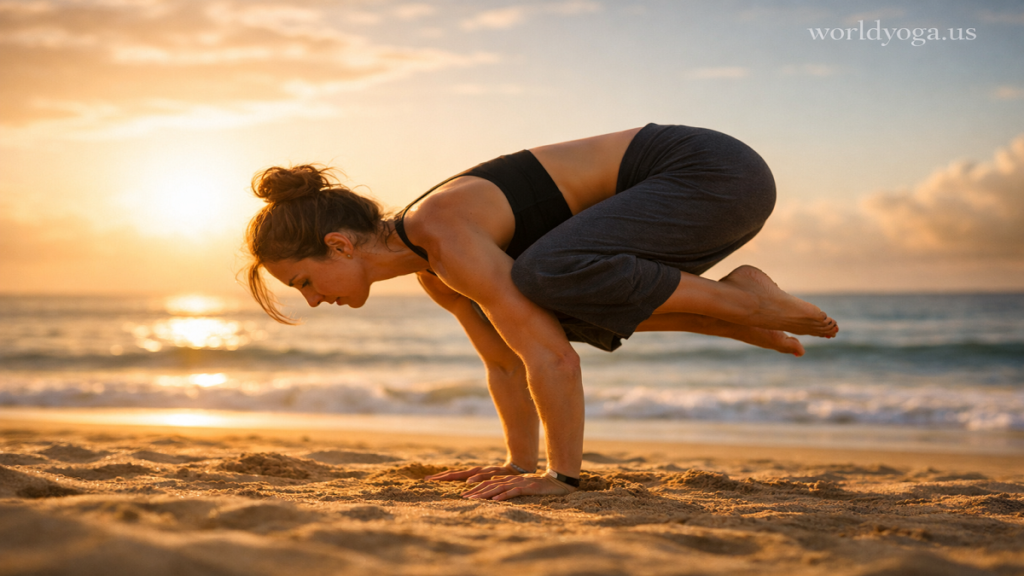
What strength and flexibility are required?
1. Upper Body Strength Requirements
The arms and shoulders are the primary support system in this posture.
- Wrist strength: Must tolerate and stabilize body weight in extension. Weak wrists are the most common limitation for beginners.
- Forearm strength: Controls fine adjustments and balance shifts through finger pressure.
- Triceps strength: Keeps the elbows stable and slightly bent without collapsing.
- Shoulder stability: The scapulae must be protracted (pushed forward) and strong enough to support the torso.
Without adequate upper body conditioning, the pose becomes unstable or places excessive strain on the wrists.
2. Core Strength Requirements
Core engagement is what allows the feet to lift off the ground.
- Abdominal muscles (especially transverse abdominis): Provide inward bracing and body lift.
- Hip flexors: Help draw the knees toward the chest or upper arms.
- Lower back support: Maintains spinal rounding and prevents collapse.
A strong core reduces dependency on arm strength alone and improves balance control.
3. Flexibility Requirements
Flexibility in a two-handed arm balance is functional rather than extreme.
- Hip flexibility: Required to bring knees high onto the upper arms (important in Crow Pose).
- Groin and inner thigh flexibility: Helps in deep squatting positions used to enter the pose.
- Wrist and shoulder mobility: Allows safe weight-bearing and proper alignment.
- Spinal flexibility (mild rounding): Helps shift the center of gravity forward for balance.
Unlike advanced contortion poses, extreme flexibility is not needed, but restricted mobility can limit proper alignment.
4. Balance and Neuromuscular Control
Beyond raw strength and flexibility, the nervous system plays a key role:
- Proprioception: Awareness of body position in space
- Fine motor control: Small adjustments through fingers and palms
- Focus (drishti): Visual concentration improves stability
- Breath control: Prevents tension and supports endurance in the pose
5. Summary
To successfully perform a two-handed arm balance, you need:
- Moderate to strong upper body strength (arms, shoulders, wrists)
- Solid core strength for lift and stability
- Functional hip and wrist mobility for positioning
- Good balance and body awareness
It is not about being extremely flexible or extremely strong, but about integrating strength, mobility, and control into one coordinated movement.
External References
- Yoga Journal – Arm Balance Basics:
https://www.yogajournal.com/poses/types-of-poses/arm-balances/ - Yoga International – Building Strength for Arm Balances:
https://yogainternational.com/article/view/how-to-build-arm-balance-strength - Ekhart Yoga – Crow Pose Anatomy and Alignment:
https://www.ekhartyoga.com/everything-yoga/poses/bakasana-crow-pose
#Two-Handed Arm Balance in Hyderabad
What are the benefits of this arm balance?
1. Builds Upper Body Strength
One of the most direct benefits is improved strength in the upper body:
- Strengthens wrists, forearms, triceps, and shoulders
- Enhances scapular stability (important for injury prevention)
- Improves ability to support body weight through the arms
This makes it valuable not only for yoga but also for general fitness and calisthenics training.
2. Strengthens the Core
Arm balances heavily engage the abdominal muscles:
- Activates the deep core (transverse abdominis)
- Strengthens rectus abdominis and obliques
- Improves control of pelvis and spinal alignment
A strong core developed through these poses supports better posture and reduces strain on the lower back in daily movement.
3. Improves Balance and Body Awareness
These poses train the nervous system to refine movement control:
- Enhances proprioception (awareness of body position in space)
- Improves coordination between upper and lower body
- Develops fine motor control through fingers and hands
This leads to better overall balance, even in everyday activities like walking, running, or sports.
4. Increases Mental Focus and Concentration
Arm balances require strong mental discipline:
- Improves attention and focus (drishti practice)
- Encourages calm breathing under physical challenge
- Builds confidence through progressive skill development
The mind must stay calm while the body is under strain, which improves stress management.
5. Enhances Wrist Health and Resilience
When practiced correctly and progressively:
- Strengthens wrist joints and connective tissues
- Improves load tolerance in wrist extension
- Helps prevent weakness-related strain in daily hand use
6. Boosts Functional Fitness
These poses translate into real-world physical benefits:
- Better pushing strength (useful in sports and workouts)
- Improved stability during dynamic movements
- Enhanced coordination for athletic performance
7. Emotional and Psychological Benefits
Beyond physical gains:
- Builds patience and persistence through gradual progress
- Reduces fear of falling or instability
- Promotes a sense of achievement and body confidence
Summary
A two-handed arm balance is a full-body training system disguised as a yoga posture. It strengthens the arms and core, sharpens balance and coordination, and improves mental focus, while also building confidence through controlled physical challenge.
External References
- Yoga Journal – Benefits of Arm Balances:
https://www.yogajournal.com/poses/types-of-poses/arm-balances/ - Yoga International – Why Practice Arm Balances:
https://yogainternational.com/article/view/why-arm-balances-are-worth-the-effort/ - Ekhart Yoga – Crow Pose Benefits:
https://www.ekhartyoga.com/everything-yoga/poses/bakasana-crow-pose
#Two-Handed Arm Balance in Kolkata
What common mistakes should be avoided?
1. Placing Too Much Weight on the Wrists
One of the most frequent errors is collapsing directly into the wrists.
- This creates excess pressure on wrist joints and ligaments
- Leads to discomfort or injury over time
Correction: Spread fingers wide, press evenly through the palms, and actively push the floor away to engage forearms and shoulders.
2. Not Engaging the Core
Many beginners try to lift using only arm strength.
- This causes the body to feel heavy and unstable
- Legs remain stuck on the ground or fall quickly
Correction: Actively draw the navel inward and engage abdominal muscles before lifting the feet.
3. Elbows Flaring Out
Allowing elbows to spread outward reduces stability.
- Weakens structural support
- Increases strain on shoulders and wrists
Correction: Keep elbows hugging inward toward the midline to create a strong “shelf” for balance.
4. Looking Down Instead of Forward
Eye placement plays a major role in balance.
- Looking down shifts weight too far forward
- Causes tipping or loss of control
Correction: Focus gaze slightly forward on a fixed point to stabilize balance.
5. Lifting Too Quickly
Attempting to jump into the pose without control is a common mistake.
- Leads to sudden imbalance or collapse
- Prevents proper muscle engagement
Correction: Shift weight gradually forward and lift one foot at a time with control.
6. Poor Knee Placement
Incorrect knee positioning reduces stability.
- Knees slipping off arms makes balance difficult
- Causes over-reliance on arm strength alone
Correction: Place knees high on the upper arms near the armpits for a stable contact point.
7. Holding Breath
Many practitioners unconsciously stop breathing while balancing.
- Increases tension in the body
- Reduces coordination and focus
Correction: Maintain steady, calm breathing throughout the pose.
8. Skipping Wrist and Shoulder Warm-Up
Jumping directly into arm balances can strain joints.
- Cold wrists are more prone to injury
- Shoulders may lack mobility for safe alignment
Correction: Always include wrist circles, plank holds, and shoulder activation drills before practice.
Summary
Avoiding these mistakes comes down to three key principles:
- Engage the core before lifting
- Distribute weight through fingers, not wrists
- Move slowly with control and focus
Mastery of arm balances is less about force and more about precision, alignment, and patience.
External References
- Yoga Journal – Arm Balance Alignment Tips:
https://www.yogajournal.com/poses/types-of-poses/arm-balances/ - Yoga International – Common Arm Balance Mistakes:
https://yogainternational.com/article/view/how-to-build-arm-balance-strength - Ekhart Yoga – Crow Pose Technique Guide:
https://www.ekhartyoga.com/everything-yoga/poses/bakasana-crow-pose
#Two-Handed Arm Balance in Chennai
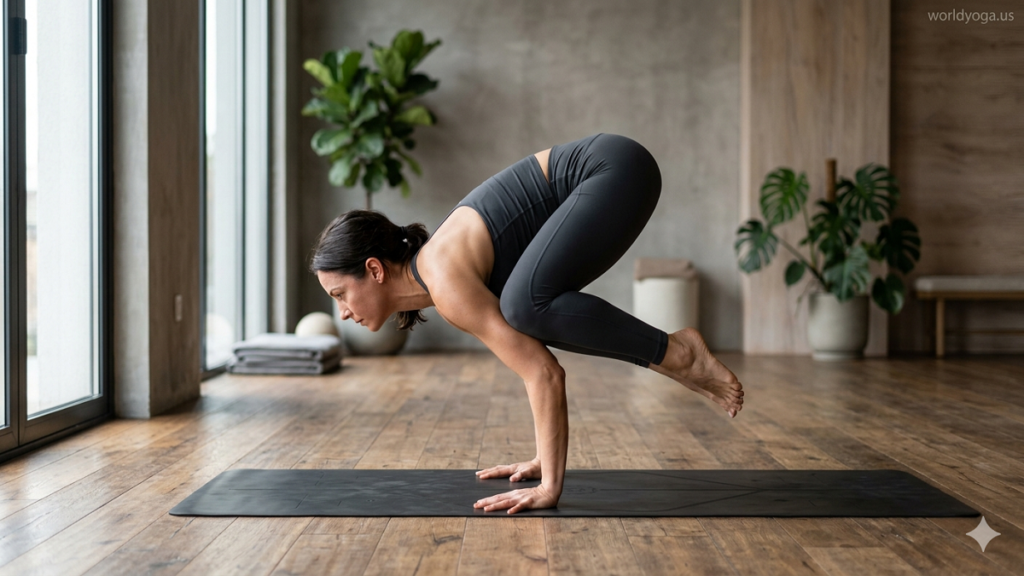
Case Study of Two-Handed Arm Balance
Introduction
This case study examines the progression, challenges, and outcomes of learning a two-handed arm balance, specifically Crow Pose (Bakasana), within a structured yoga training program. The subject is an intermediate fitness practitioner with basic yoga experience but no prior arm balance ability.
The objective was to develop safe entry into arm balancing, improve upper-body strength, and enhance neuromuscular control over an 8-week period.
Initial Assessment
At the beginning of the study, the practitioner demonstrated:
- Moderate core strength but limited shoulder stability
- Weak wrist endurance under load-bearing positions
- Difficulty shifting body weight forward without fear of falling
- Lack of coordination between core engagement and arm support
The primary barrier was not flexibility, but insufficient load tolerance in the upper body and hesitation in weight transfer.
Training Methodology
The intervention followed a progressive structure:
Weeks 1–2: Foundational Strength
- Plank holds (30–60 seconds)
- Wrist conditioning drills (circles, palm lifts)
- Core activation exercises (dead bug, hollow hold)
Weeks 3–5: Preparation Phase
- Frog stand drills
- Knee-to-triceps placement practice
- Elevated crow pose using yoga blocks
Weeks 6–8: Full Integration
- Controlled weight shifting into Bakasana
- Assisted lift-offs with spotter support
- Independent holds of 5–20 seconds
Emphasis was placed on slow progression, breath control, and repetition rather than duration.
Key Observations
- Neuromuscular Adaptation:
By week 4, the practitioner showed improved ability to coordinate core engagement with forward weight shift. - Wrist Adaptation:
Initial discomfort reduced significantly after consistent conditioning, allowing stable weight distribution through the palms. - Fear Response Reduction:
Psychological hesitation decreased as controlled partial lifts replaced full attempts. - Balance Development:
By week 7, short independent holds became possible with improved finger micro-adjustments.
Results
By the end of 8 weeks:
- The practitioner could hold Crow Pose for 15–25 seconds
- Noticeable improvement in upper body endurance and core control
- Increased confidence in other bodyweight movements (plank, chaturanga)
- Reduced wrist strain during load-bearing exercises
The most significant improvement was not just physical strength, but coordination and trust in body alignment under load.
Conclusion
This case study demonstrates that mastery of a two-handed arm balance is achieved through progressive conditioning, technical refinement, and psychological adaptation. Strength alone was insufficient; success depended on integrating core engagement, wrist conditioning, and controlled weight transfer mechanics.
Arm balances should therefore be taught as systematic skill development rather than isolated strength feats.
External References
- Yoga Journal – Crow Pose Breakdown:
https://www.yogajournal.com/poses/bakasana-crow-pose/ - Yoga International – Building Arm Balance Progressions:
https://yogainternational.com/article/view/how-to-build-arm-balance-strength - Ekhart Yoga – Bakasana Tutorial:
https://www.ekhartyoga.com/everything-yoga/poses/bakasana-crow-pose
#Two-Handed Arm Balance in Delhi
White Paper of Two-Handed Arm Balance
1. Abstract
The two-handed arm balance is a class of bodyweight movement patterns in which the entire body mass is supported through both upper limbs, typically with the hands as the sole contact points with the ground. Commonly represented by yoga postures such as Bakasana (Crow Pose), this movement integrates upper-body strength, core stability, and neuromuscular coordination. This paper examines the biomechanical requirements, training methodology, physiological adaptations, and applied benefits of two-handed arm balances in movement practice and functional fitness systems.
2. Definition and Classification
A two-handed arm balance is defined as a closed kinetic chain position where:
- Both hands are fixed on the ground
- The center of mass is elevated above the base of support
- Lower limbs are fully unloaded from ground contact
These movements are commonly found in yoga, calisthenics, and gymnastics-based conditioning systems. They range from beginner-friendly static holds (Crow Pose) to advanced dynamic transitions (arm balance flows and handstand entries).
Reference: https://www.yogajournal.com/poses/types-of-poses/arm-balances/
3. Biomechanical Requirements
Two-handed arm balances require coordinated activation across multiple systems:
- Upper limb loading: Wrist extension tolerance, forearm stabilization, triceps engagement
- Scapular control: Protraction and upward rotation to create a stable shoulder base
- Core integration: Anti-gravity stabilization via rectus abdominis, obliques, and transverse abdominis
- Hip flexion mechanics: Knee-to-upper-arm contact in compression-based balances
The movement is governed by controlled anterior weight shift and fine motor adjustments through finger pressure distribution.
4. Physiological Adaptations
Regular practice produces measurable adaptations:
- Increased isometric strength in shoulder and triceps complex
- Improved proprioception and balance control
- Enhanced wrist load tolerance and connective tissue resilience
- Greater neuromuscular efficiency in core-to-limb coordination
These adaptations improve performance in both athletic and daily functional tasks.
Reference: https://yogainternational.com/article/view/how-to-build-arm-balance-strength
5. Training Methodology
Effective training follows a progressive overload model:
- Foundation Phase: Plank holds, wrist conditioning, hollow body activation
- Skill Acquisition Phase: Supported balances (blocks, wall assistance, partial lifts)
- Integration Phase: Full unassisted holds with controlled exits
Emphasis is placed on incremental exposure to load rather than maximal strength output.
6. Safety Considerations
Primary risk factors include wrist overload, shoulder instability, and premature load progression. Risk mitigation strategies include:
- Structured warm-up of wrists and shoulders
- Gradual weight-bearing progression
- Avoidance of ballistic entry techniques
- Use of supportive props during early stages
Reference: https://www.ekhartyoga.com/everything-yoga/poses/bakasana-crow-pose
7. Conclusion
The two-handed arm balance represents a multidimensional movement requiring synchronized strength, stability, and motor control. Beyond physical conditioning, it develops cognitive focus and movement awareness. When trained progressively and safely, it serves as an effective model for integrated upper-body and core performance development.
External References
- Yoga Journal – Arm Balances Overview: https://www.yogajournal.com/poses/types-of-poses/arm-balances/
- Yoga International – Strength Development in Arm Balances: https://yogainternational.com/article/view/how-to-build-arm-balance-strength
- Ekhart Yoga – Bakasana Guide: https://www.ekhartyoga.com/everything-yoga/poses/bakasana-crow-pose
#Two-Handed Arm Balance in Banglore
Industry Application of Two-Handed Arm Balance
1. Overview
A two-handed arm balance (such as Crow Pose/Bakasana and related variations) is primarily known from yoga, but its underlying principles—load-bearing through the upper limbs, core integration, balance control, and neuromuscular coordination—have broad applications across multiple industries. These include fitness training, rehabilitation, sports performance, performing arts, and even occupational conditioning. The value lies not in the pose itself, but in the movement mechanics and physical adaptations it develops.
2. Fitness and Strength Training Industry
In modern fitness systems, two-handed arm balances are used as progressive bodyweight training tools.
Applications include:
- Calisthenics progression for advanced pushing strength
- Core conditioning programs in functional fitness
- Shoulder stability training in gym-based workouts
These movements help athletes develop closed-chain upper-body strength, which is essential for push-ups, dips, and handstand work. Fitness trainers often integrate arm balances into mobility-strength hybrid routines.
Reference: https://www.yogajournal.com/poses/types-of-poses/arm-balances/
3. Yoga and Mind-Body Wellness Industry
In yoga systems, arm balances are considered advanced asana categories used for:
- Developing body awareness (proprioception)
- Enhancing focus and breath control
- Building progressive strength safely
They are widely used in Hatha, Vinyasa, and Power Yoga classes as milestone poses that indicate physical readiness and mental discipline.
4. Sports Performance and Athletic Training
Athletes in sports requiring upper-body control benefit significantly from arm balance training.
Examples:
- Gymnastics (balance, aerial control, transitions)
- Martial arts (core stability and explosive balance recovery)
- Rock climbing (shoulder endurance and grip integration)
- Parkour (landing control and weight transfer mechanics)
The key transferable skill is dynamic stability under load, which improves injury resistance and movement efficiency.
Reference: https://yogainternational.com/article/view/how-to-build-arm-balance-strength
5. Physiotherapy and Rehabilitation Applications
In clinical and rehabilitation settings, modified arm balances are used carefully for:
- Shoulder stabilization after injury
- Wrist strengthening and load reintroduction
- Core reactivation post-injury or surgery
Therapists often use supported versions (blocks, walls, partial weight-bearing) to safely rebuild strength and neuromuscular control.
6. Performing Arts and Movement Industries
Arm balance principles are widely applied in:
- Contemporary dance (floor-work transitions and balance lifts)
- Circus arts (acrobatics and hand balancing acts)
- Stunt performance (body control in dynamic environments)
These industries rely heavily on aesthetic control combined with physical precision, both developed through arm balance training.
7. Occupational and Military Conditioning
Some elite training programs incorporate similar mechanics to improve:
- Load-bearing endurance
- Fall prevention and recovery control
- Upper-body resilience under fatigue
This is especially relevant in tactical training, firefighting, and rescue operations, where controlled body weight support and stability are critical.
8. Conclusion
The two-handed arm balance is more than a yoga posture—it is a functional movement framework applicable across fitness, rehabilitation, sports science, and performance arts. Its core value lies in developing integrated strength, balance, and neuromuscular coordination, which translates into improved performance and injury resilience in real-world physical systems.
External References
- Yoga Journal – Arm Balance Training: https://www.yogajournal.com/poses/types-of-poses/arm-balances/
- Yoga International – Strength and Stability in Arm Balances: https://yogainternational.com/article/view/how-to-build-arm-balance-strength
- Ekhart Yoga – Crow Pose Mechanics: https://www.ekhartyoga.com/everything-yoga/poses/bakasana-crow-pose
#Two-Handed Arm Balance in Mumbai
Ask FAQs
What is a two-handed arm balance?
A two-handed arm balance is a bodyweight movement where the entire body is supported on both hands while the feet are lifted off the ground. It is commonly seen in yoga poses like Crow Pose (Bakasana) and requires a combination of upper-body strength, core control, and balance.
Is a two-handed arm balance suitable for beginners?
Yes, but only with proper preparation. Beginners should first build foundational strength through exercises like planks, wrist conditioning, and core training. Assisted variations (using blocks or keeping feet lightly on the ground) can help safely develop the required strength and coordination.
What muscles are mainly used in this arm balance?
This movement primarily engages:
Shoulders and triceps (for body support)
Forearms and wrists (for stability and load control)
Core muscles (for lifting and balance)
Hip flexors (for bringing knees toward the upper arms)
It is a full-body engagement exercise rather than an isolated strength movement.
How long does it take to master a two-handed arm balance?
The timeline varies depending on fitness level, consistency, and body awareness. Some people may achieve basic balance in a few weeks, while others may take several months. Progress depends more on consistent practice and technique than raw strength.
Reference: https://www.yogajournal.com/poses/types-of-poses/arm-balances/
What are the common risks or injuries?
The most common issues include:
Wrist strain due to improper weight distribution
Shoulder discomfort from poor alignment
Loss of balance leading to minor falls
These risks can be reduced by warming up properly, progressing gradually, and using correct alignment techniques.
Reference: https://www.ekhartyoga.com/everything-yoga/poses/bakasana-crow-pose
Table of Contents
Disclaimer: The information provided is for educational and informational purposes only and should not be considered medical or professional fitness advice. Practice arm balances only under proper guidance, and consult a qualified instructor or healthcare professional if you have any injuries or health concerns.