
Squat: Heels Up-Knees Apart
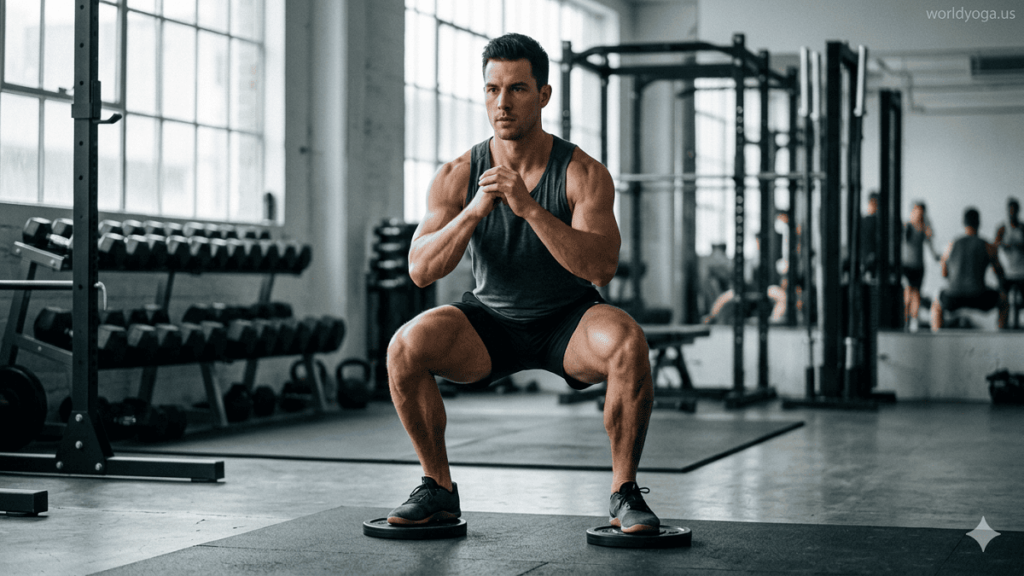
The heels-up, knees-apart variation of the Squat is a specialized movement pattern used to improve quad engagement, knee tracking, and ankle mobility control. Unlike a conventional, this variation intentionally elevates the heels—often using a small wedge, weight plates, or a slant board—while encouraging the knees to track outward during the descent and ascent. This subtle modification changes biomechanics significantly and can help lifters overcome mobility restrictions or strengthen weak movement patterns.
From a technical standpoint, elevating the heels shifts the center of mass slightly forward. This reduces the demand on ankle dorsiflexion, allowing individuals with tight calves or limited ankle mobility to achieve a deeper position without compensating by rounding the back or falling backward. As a result, the quadriceps are placed under greater mechanical tension, making this variation especially useful for hypertrophy-focused training. According to strength training discussions and biomechanics analysis, heel elevation can increase knee flexion demand while decreasing hip dominance, which is beneficial for quad development.
The cue “knees apart” plays an equally important role. Actively pushing the knees outward during the helps maintain alignment between the hips, knees, and toes. This reduces valgus collapse (knees caving inward), a common issue that can increase stress on the knee joint over time. When performed correctly, the knees-apart cue also improves glute activation, particularly the gluteus medius, which stabilizes the pelvis during movement.
To perform this variation correctly, begin with a stable heel elevation of 1–2 inches. Position your feet roughly shoulder-width apart, with toes slightly turned out. As you descend, keep your chest upright, brace your core, and push your knees outward in line with your toes. Aim for controlled depth, ideally reaching below parallel if mobility allows. Drive through the midfoot and heels (even though elevated) to return to standing, maintaining knee alignment throughout.
This variation is commonly used in physical therapy, athletic conditioning, and bodybuilding programs. It is particularly effective for beginners learning mechanics, as well as advanced lifters looking to refine quad dominance. However, it should not completely replace flat-foot squatting, as both patterns serve different functional purposes.
Coaches often recommend integrating this variation as an accessory movement after compound lifts. It can also be used as a regression tool for individuals struggling with balance or ankle stiffness. Over time, consistent practice can improve overall depth and movement quality.
For additional reading on biomechanics and lower-body training principles, reputable resources include:
- https://www.acefitness.org
- https://www.strengthandconditioningresearch.com
- https://www.exrx.net/WeightExercises/Quadriceps/BBSquat
When programmed correctly, the heels-up, knees-apart variation becomes a powerful tool for enhancing lower-body strength, improving joint stability, and reinforcing proper movement mechanics that carry over into athletic performance and everyday functional activities.
#Squat: Heels Up-Knees Apart in India
How is Squat with heels up and knees apart performed correctly?
The heels-up, knees-apart variation of the is performed by deliberately adjusting foot support and knee tracking to emphasize quad engagement, improve stability, and assist individuals with limited ankle mobility. Although it appears simple, correct execution depends on precise alignment, controlled movement, and consistent tension throughout the lift.
To begin, place your heels on a stable elevated surface such as weight plates, a wedge, or a slant board. The elevation should typically be around 1–2 inches. This adjustment reduces the demand on ankle dorsiflexion, allowing a deeper and more upright position. Stand with your feet about shoulder-width apart, and turn your toes slightly outward—generally 10 to 30 degrees depending on hip structure and comfort.
Before initiating the movement, brace your core by tightening your abdominal muscles and keeping your ribcage stacked over your pelvis. This helps prevent excessive forward lean during the descent. Maintain a neutral spine with your chest lifted and eyes focused forward or slightly upward.
As you descend, push your knees outward in line with your toes. This “knees apart” cue is critical for maintaining proper joint alignment and preventing inward knee collapse (valgus). At the same time, sit your hips down between your feet rather than pushing them too far backward, which helps keep the torso more upright and increases quadriceps loading. Lower yourself in a slow, controlled manner until you reach at least parallel depth, or deeper if mobility allows without compromising form.
At the bottom position, ensure that your knees remain stable and do not cave inward. Your weight should be distributed through the midfoot and the elevated heel area, maintaining balance despite the altered foot position. Avoid shifting excessively onto the toes, as this reduces stability and can strain the knees.
To ascend, drive through your feet while actively maintaining outward knee pressure. Engage the quadriceps and glutes simultaneously as you extend the hips and knees. Keep your torso stable and avoid collapsing forward as you rise. Exhale during the upward phase to help maintain core engagement and control.
Common mistakes include letting the knees collapse inward, lifting the heels off the elevated surface during movement, rounding the lower back at the bottom, or leaning too far forward. These errors reduce effectiveness and may increase injury risk.
When performed correctly, this variation of the improves lower-body strength, enhances quad activation, and helps reinforce proper movement mechanics. It is often used in strength training and rehabilitation settings as a progression tool for individuals working toward a more efficient and deeper pattern.
#Squat: Heels Up-Knees Apart in Maharashtra
What is the proper alignment in this squat variation?
Proper alignment in the heels-up, knees-apart variation of the is essential for maximizing effectiveness while minimizing joint stress. Because this variation alters foot positioning by elevating the heels, it changes the body’s balance and loading mechanics. Correct alignment ensures that these changes work in your favor rather than creating instability or injury risk.
The foundation of proper alignment begins at the feet. Even though the heels are elevated on a wedge or plates, the entire foot should remain “active.” This means maintaining contact pressure through the heel (on the elevated surface), the base of the big toe, and the base of the little toe—often referred to as a tripod foot position. The feet should be about shoulder-width apart, with toes slightly turned outward (typically 10–30 degrees), depending on individual hip structure.
Moving upward, the knees must track consistently in line with the toes throughout the entire movement. This is the defining characteristic of the “knees apart” cue. The knees should not collapse inward (valgus collapse), nor should they excessively flare outward beyond toe direction. Instead, they should open naturally as the hips flex and extend. This alignment helps distribute force evenly across the knee joint and improves glute engagement, particularly the gluteus medius, which stabilizes the pelvis during squatting.
At the hip and pelvis level, alignment requires controlled hip flexion while maintaining a neutral pelvis. The hips should descend straight down between the feet rather than shifting too far backward or forward. Excessive backward shift can turn the movement into a hip-dominant pattern, while excessive forward shift can overload the knees. A neutral pelvis prevents lower-back rounding (posterior pelvic tilt) at the bottom of the, which is critical for spinal safety.
The spine should remain neutral from the cervical to lumbar region. The chest stays lifted without excessive arching of the lower back. A slight forward torso lean is natural, but it should be controlled and balanced with core engagement. Bracing the abdominal muscles helps maintain this alignment under load and prevents spinal collapse.
From a head and neck perspective, the gaze should remain forward or slightly upward. Looking down excessively can disrupt spinal alignment and shift the center of mass forward, reducing stability.
Finally, the overall center of mass should remain balanced over the midfoot despite heel elevation. A common mistake is shifting too far onto the toes, which reduces stability and increases knee stress. Instead, pressure should feel evenly distributed across the foot platform.
For deeper technical understanding of squat mechanics and alignment principles, reliable resources include:
- https://www.exrx.net/WeightExercises/Quadriceps/BBSquat
- https://www.acefitness.org/education-and-resources/lifestyle/exercise-library/
- https://www.strengthandconditioningresearch.com
In summary, proper alignment in this squat variation is achieved when the feet are stable, knees track over toes, hips descend evenly, the spine remains neutral, and bodyweight is balanced through the midfoot. When these elements work together, the heels-up, knees-apart squat becomes a highly effective tool for building lower-body strength, improving movement quality, and reinforcing safe squatting mechanics.
#Squat: Heels Up-Knees Apart in Ahemadabad

Which muscles are engaged during the pose?
The heels-up, knees-apart variation of the Squat is a compound lower-body movement that activates multiple muscle groups simultaneously, with a strong emphasis on the quadriceps due to the altered foot and knee positioning. By elevating the heels and encouraging outward knee tracking, the exercise shifts loading patterns compared to a traditional flat-foot squat, increasing knee-dominant demand while still engaging the hips and core for stability.
The primary muscles engaged are the quadriceps femoris group. This includes the rectus femoris, vastus lateralis, vastus medialis, and vastus intermedius. Heel elevation increases forward knee travel and reduces ankle mobility limitations, allowing the quadriceps to take on a greater share of the workload. As a result, this variation is commonly used for hypertrophy and strength development in the front of the thighs.
The gluteal muscles also play a major role, particularly the gluteus maximus and gluteus medius. The gluteus maximus is responsible for hip extension during the upward phase of the squat, helping drive the body back to a standing position. Meanwhile, the gluteus medius is heavily engaged in stabilizing the pelvis and maintaining outward knee alignment, especially when actively pushing the knees apart during the movement.
The hamstrings assist as secondary stabilizers. Although they are not the primary drivers in this variation, they help control hip movement and contribute to overall joint stability during both the descent and ascent. Their role is more supportive compared to hip-dominant squat variations, as the heel elevation shifts emphasis away from posterior chain dominance.
The calves, specifically the gastrocnemius and soleus, are also engaged due to the elevated heel position. While the heels remain supported, the reduced ankle angle changes tension distribution, requiring these muscles to stabilize the lower leg throughout the movement.
Core musculature is essential for maintaining posture and balance. The rectus abdominis, obliques, and transverse abdominis work together to stabilize the spine and pelvis, preventing excessive forward lean or lower-back rounding. This core engagement becomes even more important because heel elevation slightly alters the center of gravity.
Additionally, smaller stabilizing muscles in the lower back, such as the erector spinae, help maintain spinal neutrality during the squat. The adductors of the inner thigh also contribute, particularly in controlling knee alignment and assisting hip stability during deeper ranges of motion.
In summary, this squat variation is not an isolated muscle exercise but a coordinated full lower-body movement. It primarily targets the quadriceps, while the glutes provide powerful hip extension and stabilization. The hamstrings, calves, core, and spinal stabilizers all contribute to controlled movement, balance, and joint safety.
For further reference on muscle activation patterns in squat variations, you can explore:
- https://www.exrx.net/WeightExercises/Quadriceps/BBSquat
- https://www.acefitness.org/resources/everyone/exercise-library/
- https://www.nsca.com/education/articles/kinetic-select/squat-biomechanics/
#Squat: Heels Up-Knees Apart in Hyderabad
What preparatory exercises are recommended?
Preparing for the heels-up, knees-apart variation of the Squat involves building mobility, stability, and motor control so the altered mechanics (heel elevation + outward knee tracking) can be performed safely and effectively. Since this variation reduces ankle mobility demands but increases knee-dominant loading, the best preparatory exercises focus on ankles, hips, quads, and core control.
A key preparation area is ankle mobility and lower-leg control, even though the heels are elevated. Exercises like controlled ankle dorsiflexion drills against a wall help maintain joint readiness and prevent stiffness from limiting squat depth. Calf stretches (both gastrocnemius and soleus variations) also improve comfort and reduce compensatory forward lean. These drills ensure that even with heel elevation, the lower leg remains stable and responsive.
Hip mobility is equally important, especially for achieving proper depth while keeping knees aligned outward. Deep bodyweight squat holds, hip openers such as 90/90 transitions, and adductor stretches help improve range of motion. These movements prepare the hips to support outward knee tracking without collapse, which is essential for the “knees apart” cue.
Strength activation drills are another critical component. Glute activation exercises such as glute bridges, clamshells, and banded lateral walks help engage the gluteus medius and gluteus maximus. This is important because the glutes stabilize the pelvis and control knee alignment during the squat. Without this activation, the knees are more likely to cave inward under load.
Quadriceps preparation improves tolerance for the increased knee-dominant stress of this squat variation. Exercises like split squats, wall sits, and step-ups help build strength in a similar movement pattern. These drills reinforce controlled knee tracking and prepare the quads for deeper flexion angles created by heel elevation.
Core stability training is also essential. Movements such as planks, dead bugs, and Pallof presses improve trunk control and prevent excessive forward lean or spinal rounding during squatting. A strong core ensures that force transfer between the lower and upper body remains efficient.
Finally, movement pattern rehearsals are highly recommended. Practicing bodyweight squats with a controlled tempo, or performing assisted squats using a support (like a pole or suspension strap), helps integrate mobility and stability into a coordinated pattern. Once this feels comfortable, transitioning to a light heel-elevated squat without load is ideal before adding resistance.
For further evidence-based guidance on squat preparation and mobility training, you can explore:
- https://www.acefitness.org/education-and-resources/lifestyle/exercise-library/
- https://www.nsca.com/education/articles/kinetic-select/squat-biomechanics/
- https://www.exrx.net/ExInfo/Squats
In summary, effective preparation for this squat variation combines ankle and hip mobility work, glute activation, quad strengthening, and core stability training. When these elements are developed together, the heels-up, knees-apart squat becomes smoother, safer, and significantly more effective for building lower-body strength and improving movement quality.
#Squat: Heels Up-Knees Apart in Banglore
What are the benefits and precautions of this variation?
The heels-up, knees-apart variation of the Squat offers specific performance and mobility benefits, but it also requires careful attention to technique due to the altered biomechanics created by heel elevation and intentional knee tracking.
One of the primary benefits is improved quadriceps activation. Elevating the heels shifts the body’s center of mass slightly forward, allowing the knees to travel further over the toes in a controlled manner. This increases knee flexion demand and places greater mechanical load on the front thigh muscles. As a result, this variation is often used for hypertrophy and strength development of the quads, especially when lifters struggle to engage them effectively in traditional squats.
Another important benefit is enhanced squat depth and mobility assistance. For individuals with limited ankle dorsiflexion, heel elevation reduces the mobility requirement, making it easier to maintain an upright torso while reaching deeper squat positions. This can improve movement confidence and help users gradually develop better overall squat mechanics.
The “knees apart” cue contributes to better hip stability and alignment. Actively pushing the knees outward helps reinforce proper tracking over the toes and reduces the risk of valgus collapse (knees caving inward). This improves activation of the gluteus medius, which plays a key role in stabilizing the pelvis and maintaining lower-body alignment under load.
From a functional perspective, this variation can also serve as a useful regression tool for beginners or rehabilitation settings. It helps teach proper squat mechanics in a more controlled and accessible way, especially for those with balance or mobility limitations.
However, there are important precautions to consider. One key concern is over-reliance on heel elevation. While it can improve mechanics temporarily, consistently avoiding flat-foot squatting may prevent long-term development of natural ankle mobility. Therefore, it should be used as an accessory or corrective tool rather than a permanent replacement for standard squats.
Another precaution involves knee tracking. Although knees are encouraged to move outward, excessive forced abduction can place unnecessary stress on the hip joint. The movement should feel natural and controlled rather than exaggerated. Similarly, allowing the knees to collapse inward can increase strain on the ligaments and reduce exercise effectiveness.
Balance and stability are also considerations. Elevating the heels slightly reduces the base of support, making improper weight distribution more likely. If weight shifts too far onto the toes, it can increase knee stress and reduce control. Maintaining a midfoot balance is essential for safety.
Spinal alignment is another critical factor. Excessive forward leaning or rounding of the lower back can occur if core engagement is weak or if depth is forced beyond mobility limits. Proper bracing is necessary to protect the lumbar spine.
For additional technical insights into squat mechanics and safe training practices, you can refer to:
- https://www.exrx.net/WeightExercises/Quadriceps/BBSquat
- https://www.acefitness.org/education-and-resources/lifestyle/exercise-library/
- https://www.nsca.com/education/articles/kinetic-select/squat-biomechanics/
In summary, this squat variation offers strong benefits for quad development, mobility assistance, and movement correction, but it must be performed with controlled knee tracking, balanced foot pressure, and proper spinal alignment. When used appropriately, it is a valuable tool in both strength training and movement education.
#Squat: Heels Up-Knees Apart in Kolkata
Case Study of Squat: Heels Up-Knees Apart
This case study examines the application of the heels-up, knees-apart variation of the Squat in a corrective strength and conditioning context. The objective is to improve lower-body strength, enhance squat depth, and address movement inefficiencies related to limited ankle mobility and poor knee tracking.
Client Profile
The subject is a recreational trainee with moderate training experience who reports difficulty achieving full squat depth while maintaining an upright torso. Observational screening revealed restricted ankle dorsiflexion, early heel lift during squatting, and mild knee valgus (inward collapse) under load. These limitations reduced quadriceps engagement and shifted excessive stress to the lower back.
Intervention Strategy
A heels-up, knees-apart squat variation was introduced as a corrective and developmental tool. The heels were elevated using 2 cm weight plates to reduce ankle mobility demands. The stance was set at shoulder width with slight toe-out positioning. The primary coaching cues included maintaining a tripod foot, driving the knees outward in line with the toes, and keeping the torso upright through core bracing.
The exercise was programmed twice weekly as an accessory movement following primary lower-body lifts. Initial load was bodyweight, progressing gradually to goblet-loaded variations.
Observed Biomechanical Changes
Within three weeks, notable improvements were observed in movement mechanics. Heel elevation allowed the client to reach below-parallel depth without compensatory lumbar flexion. Knee tracking improved significantly due to reinforced outward hip engagement, reducing valgus collapse.
Quadriceps activation increased visibly, as evidenced by improved control during ascent and reduced reliance on hip dominance. The gluteus medius showed enhanced engagement, contributing to better pelvic stability. These adaptations aligned with findings in squat biomechanics literature, which highlight the influence of heel elevation on knee-dominant loading patterns .
Performance Outcomes
After six weeks, the client demonstrated a 15–20% improvement in goblet squat load capacity while maintaining controlled depth and alignment. Ankle mobility improved modestly due to repeated exposure to deeper squat positions, even with heel assistance. Importantly, carryover was observed in bodyweight squats performed without heel elevation, indicating improved motor control rather than dependence on the modification.
Discussion
The heels-up, knees-apart squat proved effective as both a regression and corrective strategy. By reducing ankle mobility constraints and reinforcing proper knee tracking, the variation allowed the client to internalize correct squat mechanics. However, it was emphasized that this method should not replace flat-foot squatting long term, as balanced development of ankle mobility and posterior chain engagement remains essential for functional strength.
Guidelines from strength and conditioning organizations support the use of modified squat variations to address movement limitations while reinforcing safe loading patterns .
Conclusion
This case study demonstrates that the heels-up, knees-apart squat variation can effectively improve squat depth, quadriceps activation, and knee alignment in individuals with mobility restrictions. When integrated progressively and paired with mobility work, it serves as a powerful tool for movement correction, strength development, and long-term squat performance enhancement.
#Squat: Heels Up-Knees Apart in Pune
White Paper of Squat: Heels Up-Knees Apart
1. Executive Summary
The heels-up, knees-apart variation of the Squat is a modified lower-body training method designed to enhance quadriceps activation, improve squat depth, and address common movement limitations such as restricted ankle dorsiflexion and poor knee tracking. By elevating the heels and encouraging outward knee alignment, this variation shifts squat mechanics toward a more knee-dominant pattern while maintaining functional lower-body integration. This white paper outlines its biomechanical rationale, applications, benefits, risks, and programming considerations in strength training and corrective exercise contexts.
2. Biomechanical Overview
Heel elevation alters the center of mass by reducing the ankle joint’s mobility requirement. This allows the torso to remain more upright during descent, increasing knee flexion demand and shifting load emphasis toward the quadriceps. At the same time, actively driving the knees outward improves femoral alignment over the toes, reducing valgus collapse and enhancing hip stability.
Research in squat biomechanics indicates that small changes in foot elevation can significantly influence joint loading distribution, particularly increasing knee extensor torque while reducing hip dominance .
Key biomechanical effects include:
- Increased knee flexion angle
- Reduced ankle dorsiflexion requirement
- Greater quadriceps recruitment
- Improved knee tracking control
- Enhanced upright torso positioning
3. Primary Applications
This squat variation is commonly applied in three primary domains:
3.1 Strength and Hypertrophy Training
Used to emphasize quadriceps development by increasing knee-dominant loading. It is frequently programmed as an accessory lift following compound barbell squats.
3.2 Movement Correction
Applied in individuals with limited ankle mobility or poor squat mechanics. Heel elevation allows safer depth achievement while reinforcing proper alignment patterns.
3.3 Athletic Conditioning and Rehabilitation
Used in controlled environments to retrain squat mechanics and improve joint stability, particularly in early-stage rehabilitation or return-to-sport progression.
4. Benefits
The heels-up, knees-apart squat provides multiple performance and structural benefits:
- Enhanced quadriceps activation due to increased knee flexion demand
- Improved squat depth for individuals with ankle restrictions
- Better knee alignment through reinforced hip external rotation
- Increased gluteus medius engagement for pelvic stability
- Improved motor learning of upright squat mechanics
Strength and conditioning frameworks support modified squat variations as effective tools for addressing movement deficits while maintaining load exposure .
5. Risks and Limitations
Despite its benefits, this variation carries specific considerations:
- Over-reliance on heel elevation may reduce ankle mobility development over time
- Excessive knee tracking outward can stress hip structures if forced
- Poor load distribution may shift pressure onto the forefoot
- Inadequate core engagement can lead to spinal rounding under load
- Not suitable as a sole replacement for flat-foot squatting patterns
6. Programming Recommendations
- Use as an accessory movement (1–3 times per week)
- Begin with bodyweight or light goblet loading
- Maintain controlled tempo (2–3 seconds eccentric phase)
- Prioritize technical mastery over load progression
- Combine with ankle mobility and glute activation drills
7. Conclusion
The heels-up, knees-apart squat is a strategically valuable variation for improving lower-body mechanics, particularly in populations with mobility restrictions or movement inefficiencies. When applied correctly, it enhances quadriceps development, reinforces proper knee alignment, and supports deeper squat positions. However, it should be integrated as part of a balanced training system that also develops ankle mobility and posterior chain strength to ensure long-term functional performance.
#Squat: Heels Up-Knees Apart in Delhi
Industry Application of Squat: Heels Up-Knees Apart
The heels-up, knees-apart variation of the Squat is widely used across multiple industries where lower-body strength, movement efficiency, and joint safety are critical. Its modified mechanics—heel elevation and controlled outward knee tracking—make it a versatile tool in performance training, rehabilitation, ergonomics, and research settings.
1. Strength and Conditioning Industry
In strength and conditioning programs, this variation is primarily used to increase quadriceps dominance and improve squat depth mechanics. Coaches often apply it as an accessory lift for athletes who require stronger knee extension patterns, such as sprinters, football players, and weightlifters.
By elevating the heels, athletes can maintain a more upright torso position, allowing greater knee flexion without excessive ankle mobility demands. This helps reinforce proper alignment while still enabling progressive overload. It is also commonly used during off-season training phases to refine movement patterns before transitioning to heavier barbell squats.
2. Rehabilitation and Physiotherapy
In physiotherapy and clinical rehabilitation, the heels-up, knees-apart squat is used as a regression tool for patients recovering from lower-limb injuries or dealing with mobility restrictions.
Heel elevation reduces strain on the ankle joint, making it easier for patients with limited dorsiflexion or post-injury stiffness to perform squatting movements safely. The “knees apart” cue is particularly useful for retraining neuromuscular control in individuals with knee valgus tendencies or weak hip stabilizers.
Rehabilitation professionals often integrate this variation into progressive loading protocols, ensuring controlled exposure to functional movement patterns before advancing to full squats.
3. Sports Performance and Athletic Development
In athletic development environments, this variation is used to improve movement efficiency and injury prevention. Coaches apply it to teach athletes proper knee tracking, pelvic stability, and controlled depth mechanics.
It is especially beneficial in sports requiring explosive lower-body strength such as basketball, volleyball, and track and field. The movement reinforces gluteus medius activation, which is essential for lateral stability and directional control during athletic performance.
Biomechanical studies in strength training highlight that small modifications in foot elevation can significantly alter muscle recruitment patterns, increasing knee extensor demand while improving posture control .
4. Fitness and Personal Training Industry
Personal trainers frequently use this variation with beginners or general fitness clients who struggle with standard squat mechanics. It serves as a teaching tool for developing correct movement patterns before progressing to more complex loaded exercises.
It is also used in hypertrophy-focused programming to isolate quadriceps engagement while reducing fatigue from posterior chain dominance. Trainers often incorporate it into circuit training or accessory work for lower-body development.
5. Occupational Health and Human Performance
In occupational health, squat training variations like this are used to assess and improve functional movement patterns relevant to workplace tasks such as lifting, bending, and carrying.
Ergonomics specialists use it to evaluate lower-body mobility and joint coordination in workers engaged in physically demanding roles. Improved squat mechanics are associated with reduced injury risk in manual labor environments.
Guidelines from strength and conditioning organizations emphasize the importance of movement quality training for long-term musculoskeletal health .
6. Research and Biomechanics Studies
In academic and sports science research, this squat variation is used to study load distribution changes caused by small alterations in foot position. Researchers analyze how heel elevation influences joint torque, muscle activation, and movement efficiency.
It serves as a controlled model for understanding human movement variability and for developing evidence-based training recommendations.
Conclusion
The heels-up, knees-apart squat is a highly adaptable movement used across multiple industries. In strength training, it enhances performance and hypertrophy; in rehabilitation, it supports safe movement re-education; in sports, it improves stability and injury prevention; and in research, it provides insight into biomechanical function. Its versatility makes it a valuable tool in both applied and scientific domains of human movement.
#Squat: Heels Up-Knees Apart in Mumbai
Ask FAQs
What is the main purpose of the heels-up, knees-apart squat?
The primary purpose of the heels-up, knees-apart variation of the Squat is to improve quadriceps activation, enhance squat depth, and assist individuals with limited ankle mobility. Heel elevation reduces the demand on ankle dorsiflexion, while the “knees apart” cue improves hip stability and alignment during the movement.
Who should perform this squat variation?
This variation is suitable for beginners learning squat mechanics, individuals with restricted ankle mobility, and athletes looking to improve quadriceps strength and knee tracking. It is also commonly used in rehabilitation and corrective exercise programs to retrain proper lower-body movement patterns.
Does elevating the heels reduce injury risk?
Heel elevation can reduce stress on the ankles by allowing a more upright torso and deeper squat position. However, injury risk is only reduced when the movement is performed with proper technique. Poor form—such as letting the knees collapse inward or shifting weight excessively onto the toes—can still increase joint stress.
What muscles are most activated in this variation?
The primary muscles engaged are the quadriceps, which work harder due to increased knee flexion. The gluteus maximus and gluteus medius assist with hip extension and knee stabilization. Core muscles help maintain posture, while the calves and hamstrings act as secondary stabilizers.
Can this variation replace regular squats in a workout routine?
No, it should not replace traditional flat-foot squats entirely. While it is highly effective for improving form, quad strength, and mobility, it is best used as an accessory or corrective exercise. Standard squats are still important for developing full lower-body strength, balance, and functional movement patterns. Strength and conditioning guidelines recommend combining both variations for balanced development:
Table of Contents
Disclaimer: This content is for educational and informational purposes only and is not a substitute for professional medical, fitness, or rehabilitation advice. Always consult a qualified trainer or healthcare professional before starting or modifying any exercise program, especially if you have existing injuries or medical conditions.