
Supine: Full Lotus
Supine Full Lotus, traditionally known as Supta Padmasana, is a deep restorative yoga posture performed in a reclined position while maintaining the full lotus leg configuration. It is considered an advanced variation of Padmasana and is commonly practiced in traditional Hatha yoga, meditation preparation, and flexibility training.
In this posture, the practitioner lies on their back and carefully places both legs into the lotus position before reclining fully onto the floor. The spine remains aligned and supported, while the chest stays open. The arms may rest alongside the body or be extended overhead to deepen the chest expansion. Because of the intensity of the hip rotation required, this pose demands significant flexibility in the hips, knees, and ankles.
The primary focus of Supta Padmasana is deep hip opening and increased joint mobility. It stretches the hip flexors, outer hips, and adductors while encouraging internal rotation and flexibility in the lower body. At the same time, the reclined position promotes relaxation in the nervous system, making it beneficial for calming the mind and preparing for meditation or pranayama practices.
Core engagement is subtle but important. The abdominal muscles help stabilize the pelvis and protect the lower back while the spine remains grounded. When practiced correctly, the posture encourages spinal decompression and improves postural awareness.
This pose also supports improved circulation in the pelvic region and can help release long-held muscular tension caused by prolonged sitting. It is often used in advanced yoga sequences as a restorative counterbalance after intense standing or hip-opening postures.
However, Supine Full Lotus requires careful preparation. It is not recommended for beginners without prior experience in hip-opening practices. Individuals with knee, ankle, or hip injuries should avoid forcing the position, as improper alignment can place strain on sensitive joints. Using preparatory poses such as half lotus, bound angle pose, and gentle hip openers is essential before attempting this posture.
Breathing plays a key role in this pose. Slow, steady breathing helps relax the hips and allows the body to settle deeper into the posture without tension. The goal is not forceful stretching but gradual release and comfort within alignment.
In summary, Supine Full Lotus (Supta Padmasana) is a deeply restorative yet advanced yoga posture that enhances hip flexibility, supports spinal relaxation, and prepares the body for meditation when practiced with proper alignment, patience, and awareness.
#Supine: Full Lotus in India
How is Supine Full Lotus performed correctly?
Supine Full Lotus (Supta Padmasana) is an advanced reclined yoga posture that requires careful alignment, controlled flexibility, and patience. It should never be forced, as it places significant demand on the hips, knees, and ankles. Proper technique focuses on preparation, gradual entry, and stable relaxation.
To begin, sit on the mat and first establish Full Lotus (Padmasana) in a seated position. Place one foot gently on the opposite thigh, then bring the other foot over the opposite thigh, ensuring both knees rest comfortably on the ground. The spine should remain upright and tall, with the chest open and shoulders relaxed. This seated setup ensures the legs are correctly aligned before reclining.
Once stable in Full Lotus, place your hands beside your hips for support. Engage the core lightly to protect the lower back, then slowly begin to recline backward. Lower yourself gradually, using your elbows for support if needed, until your back is fully resting on the mat. The movement should be slow and controlled to avoid strain on the knees or hips.
When lying down, ensure the spine remains neutral and evenly supported. The knees should stay grounded or comfortably resting without lifting excessively. If the knees are floating or causing discomfort, it indicates insufficient hip flexibility and the pose should be modified or avoided.
The arms can be placed in different positions depending on comfort and experience. Beginners often keep the arms alongside the body with palms facing up or down. Advanced practitioners may extend the arms overhead to deepen chest opening and spinal extension.
Breathing should be slow, deep, and natural. This helps relax the hip joints and allows the body to settle into the posture without resistance. The goal is not to force the knees downward but to let gravity assist in a controlled and relaxed manner.
Core engagement remains subtle but important. A gentle activation of the abdominal muscles helps stabilize the pelvis and prevents excessive arching of the lower back. The shoulders and neck should remain relaxed throughout the pose.
This posture is closely associated with deep hip opening practices and is often used in meditation preparation. However, it should only be practiced when the practitioner already has sufficient hip mobility from preparatory poses such as Bound Angle Pose, Half Lotus, and hip-opening stretches.
In summary, Supine Full Lotus is performed by first establishing a stable seated lotus, reclining slowly with control, maintaining spinal neutrality, and relaxing into the posture with mindful breathing. Correct execution depends on gradual progression, proper hip flexibility, and avoidance of forceful movement.
#Supine: Full Lotus in Maharashtra
What is the proper alignment in this supine lotus variation?
Proper alignment in Supine Full Lotus (Supta Padmasana) is critical because the posture places significant stress on the knees, hips, and ankles if even slight misalignment occurs. The goal is not depth of stretch, but balanced joint positioning, spinal neutrality, and relaxed support through the hips rather than the knees.
The foundation of alignment begins with the spine. The practitioner lies fully on the back with the spine in a neutral, evenly supported position. The natural curve of the lumbar region is maintained without excessive arching or flattening. The ribcage should remain relaxed, not flared, and the shoulders should rest evenly on the mat.
The pelvis should remain centered and stable, without tilting to either side. Both sides of the hip bones should feel equally grounded. This prevents uneven load distribution, which is especially important in lotus positions where asymmetry can quickly stress the knee joints.
The legs form the full lotus configuration, but alignment priority is placed on the hips rather than the knees. Each foot is placed high on the opposite thigh, close toward the hip crease rather than drifting down toward the knee. This ensures that the rotation originates from the hip joints, not forced bending at the knees.
The knees should ideally rest toward the floor in a relaxed manner. However, they should never be forced downward. If the knees are elevated or floating significantly, it indicates limited hip external rotation and the posture should be modified immediately to avoid strain.
The ankles should remain neutral and comfortable, without sharp pressure or twisting. Both feet should feel secure but not compressed. Any discomfort in the ankles is a sign of improper setup or insufficient flexibility.
The spine and head remain fully supported on the mat. The neck should be long and relaxed, with the chin in a neutral position—not tucked excessively or lifted. The gaze is naturally upward or eyes may be closed for relaxation.
The arms can either rest alongside the body or extend overhead depending on the practitioner’s level. In both cases, the shoulders should remain relaxed and not drawn upward toward the ears.
Core engagement is subtle but important. Gentle activation of the abdominal muscles helps stabilize the pelvis and prevents excessive arching in the lower back. However, the posture should feel more like release than effort.
This alignment principle is consistent with deep hip-opening practices, but it differs significantly from dynamic core-based movements such as Scissor kicks, where the focus is stability under motion rather than passive joint positioning.
In summary, correct alignment in Supine Full Lotus requires a neutral spine, level pelvis, hip-driven leg rotation, relaxed knees (without force), and fully supported upper body. When these principles are maintained, the posture becomes a deeply restorative and meditative position rather than a strain on the joints.
#Supine: Full Lotus in Ahemadabad
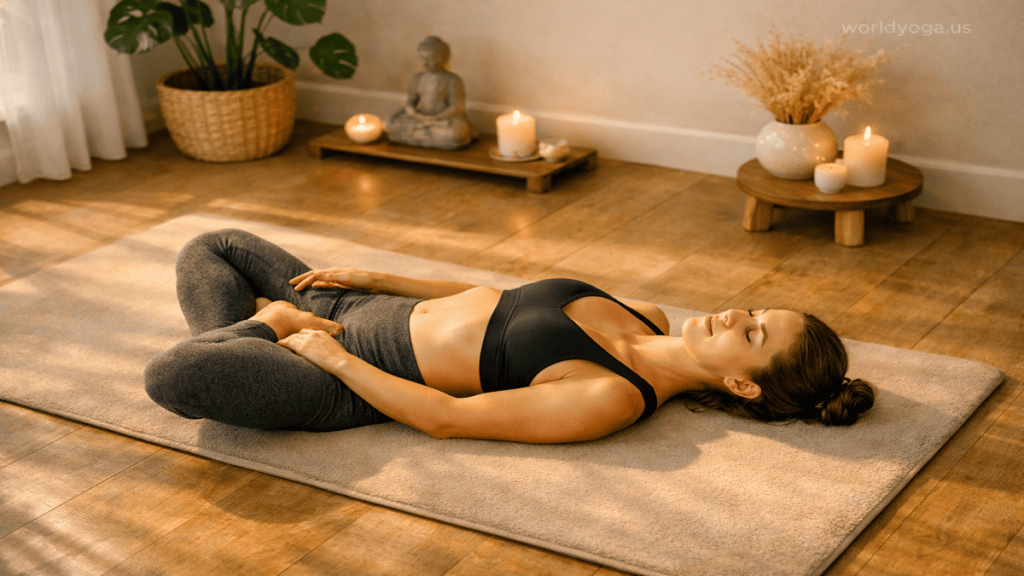
Which muscles and joints are engaged during the posture?
Joints Engaged
1. Hip Joints (Primary Joint Focus)
The hip joints undergo deep external rotation, flexion, and abduction. This is the most significant joint action in the posture. The movement must originate from the hips; otherwise, stress can shift to the knees.
2. Knee Joints (High-Sensitivity Area)
The knees are placed in a deep flexed position, but they should remain passive. Ideally, there is no lateral stress. Improper alignment can place strain on the menisci and ligaments.
3. Ankle Joints
The ankles are gently positioned in a neutral-to-slight plantar flexed state, depending on natural mobility. Excess twisting or compression should be avoided.
4. Lumbo-Pelvic Joint Complex
The lower spine and pelvis remain in a neutral supine alignment, with minimal movement. This region acts as a stabilizing base rather than a primary mover.
Muscles Engaged
1. Hip External Rotators (Primary Engagement)
These include:
- Piriformis
- Obturator internus and externus
- Gemelli muscles
They are deeply engaged to maintain the lotus position and control hip rotation.
2. Hip Flexors
- Iliopsoas
- Rectus femoris
These assist in maintaining the flexed hip position and stabilizing leg placement.
3. Adductor Muscles (Inner Thighs)
- Adductor longus
- Adductor brevis
- Adductor magnus
These muscles are lengthened and gently stretched, especially if tightness is present.
4. Quadriceps
The quadriceps assist in maintaining knee positioning, though activity is minimal due to the passive nature of the posture.
5. Gluteal Muscles
- Gluteus maximus and medius provide pelvic stabilization and hip control, especially in maintaining external rotation alignment.
6. Core Muscles
- Rectus abdominis
- Transverse abdominis
- Obliques
These muscles work isometrically to stabilize the pelvis and protect the lumbar spine from over-arching.
7. Lower Back Muscles
- Erector spinae (low-level engagement)
These support spinal neutrality without active movement.
Functional Summary
This posture creates a deep hip-opening environment where the joints of the lower body are placed into maximum controlled range, while the core and surrounding stabilizers maintain safety and alignment. It is more of a passive flexibility posture with strategic isometric support, rather than a dynamic strength exercise.
Unlike active core drills such as Scissor kicks, which emphasize repetitive motion and stabilization under movement, Supine Full Lotus emphasizes static joint positioning and long-duration release of connective tissue tension.
Conclusion
Supine Full Lotus engages the hip joints most intensely, followed by the knees and ankles in supportive positions. Muscular involvement is primarily centered around the hip rotators, adductors, and core stabilizers, while the posture itself promotes deep relaxation and flexibility when practiced with correct alignment and without force.
#Supine: Full Lotus in Hyderabad
What preparatory poses are recommended before attempting it?
Before attempting Supine Full Lotus (Supta Padmasana), the body must be properly prepared through progressive hip-opening, knee-safety, and ankle-mobility work. Because this posture demands deep external rotation of the hips and significant knee flexion, preparation is essential to avoid joint strain and to ensure that movement comes from the hips rather than the knees.
A foundational preparatory posture is Baddha Konasana (Bound Angle Pose). This seated position opens the inner thighs and groins while teaching controlled external rotation of the hips. Practicing this regularly helps develop the flexibility needed to bring the feet toward the opposite hip crease safely.
Another key preparation is Ardha Padmasana (Half Lotus Pose). This posture introduces one leg at a time into the lotus position, allowing gradual adaptation of the hip joint. It is one of the most important stepping stones toward full lotus because it helps identify tightness or imbalance before progressing further.
Janu Sirsasana (Head-to-Knee Forward Bend) is also highly beneficial. It stretches the hamstrings and improves pelvic flexibility, which indirectly supports easier hip rotation. It also teaches spinal alignment while one leg is extended and the other is flexed.
For deeper hip opening, Eka Pada Rajakapotasana (Pigeon Pose) is commonly used. This posture targets the external rotators of the hip, particularly the piriformis, which is crucial for achieving a safe lotus position. Regular practice improves range of motion in the hip socket.
Ankle and knee conditioning exercises are equally important. Gentle ankle rotations, toe flexion drills, and controlled knee flexion movements help prepare the smaller stabilizing structures that are heavily involved in lotus positioning.
Supine-based preparatory work is also recommended. Poses such as Supta Baddha Konasana (Reclined Bound Angle Pose) help relax the hips in a supported environment, allowing passive opening without load on the joints.
Core activation practices like dead bugs or gentle supine bracing are useful to ensure pelvic stability. A stable core prevents unnecessary strain on the lower back when transitioning into deeper hip postures.
It is important to note that Supine Full Lotus shares underlying structural demands with dynamic stabilization exercises such as Scissor kicks, but differs significantly in intensity and movement pattern. While scissor kicks develop control under motion, lotus preparation focuses on joint mobility and passive range development.
In summary, effective preparation for Supine Full Lotus includes Baddha Konasana, Ardha Padmasana, Pigeon Pose, hamstring stretches, ankle conditioning, and core stability work. These practices gradually build the flexibility, joint safety, and control required for safe progression into the full posture.
#Supine: Full Lotus in Pune
What are the benefits and precautions of Supine Full Lotus?
Benefits of Supine Full Lotus
One of the primary benefits of this posture is deep hip joint opening. The position places the hips in strong external rotation, helping to release long-held tension in the gluteal muscles, adductors, and hip rotators. Over time, this can improve overall lower-body mobility and reduce stiffness caused by prolonged sitting.
The posture also supports improved spinal relaxation and decompression. In the supine position, the back is fully supported by the floor, allowing the spine to rest while the hips open. This combination can reduce fatigue in the lower back and encourage postural awareness.
Another key benefit is enhanced nervous system calmness. Because the posture is typically held in stillness, it encourages parasympathetic activation, which may help reduce stress and support meditation preparation. It is often used in traditional yoga practices as a transitional pose for deeper breathwork.
Supine Full Lotus also contributes to better pelvic awareness and alignment control. Maintaining symmetry in the hips and knees requires subtle core engagement, improving neuromuscular coordination and body awareness.
In advanced practitioners, the pose can also improve joint resilience and mobility range, particularly in the hips and ankles, when practiced progressively and safely.
Precautions of Supine Full Lotus
Despite its benefits, this posture carries significant risk for the knees and hips if performed incorrectly. The most important precaution is to avoid forcing the legs into the lotus position. The rotation must come from the hips, not the knees, as the knee joint is not designed for deep twisting.
Individuals with knee injuries, meniscus issues, or ligament instability should avoid this posture entirely or practice only under professional supervision. Even slight misalignment can place harmful pressure on sensitive knee structures.
People with tight hips or limited external rotation should not attempt full lotus prematurely. Instead, they should work with preparatory poses such as half lotus or bound angle pose to gradually build mobility.
Another key precaution is to avoid holding tension in the ankles and feet. Excess compression or awkward foot placement can lead to discomfort or strain over time.
The posture should never be approached with force or pain. Discomfort in the joints is a warning sign, not a milestone. Practitioners should prioritize ease and symmetry over depth.
Breathing should remain steady and relaxed. Holding the breath or straining can increase muscular tension and reduce the restorative benefits of the posture.
Functional Note
While Supine Full Lotus emphasizes stillness and joint positioning, it differs greatly from dynamic core stability exercises such as Scissor kicks, which build strength through controlled movement rather than static hip opening.
Conclusion
Supine Full Lotus offers deep hip opening, improved relaxation, and enhanced body awareness when practiced with proper preparation. However, it demands respect for joint limitations, especially in the knees and hips. Safe progression, mindful practice, and avoidance of force are essential to fully benefit from this advanced supine posture.
#Supine: Full Lotus in Delhi
Case Study of Supine: Full Lotus
Introduction
Supine Full Lotus (Supta Padmasana) is an advanced supine yoga posture used in traditional yoga systems for deep hip opening, nervous system regulation, and meditative preparation. This case study examines its application in improving lower-body flexibility, postural control, and stress reduction in a structured practice setting.
Subject Profile
A 32-year-old yoga practitioner with intermediate experience presented with:
- Moderate hip tightness
- Difficulty maintaining seated meditation posture
- Occasional lower back fatigue during prolonged sitting
- Limited external hip rotation
The subject had no acute injuries but demonstrated restricted mobility in the hips and adductor region.
Intervention Plan
A 10-week progressive program was designed to safely introduce Supine Full Lotus. The approach emphasized gradual hip opening, joint protection, and neuromuscular awareness.
Key components included:
- Preparatory poses: Baddha Konasana, Ardha Padmasana, and Supta Baddha Konasana
- Progressive hip-opening drills
- Controlled breathing techniques for relaxation
- Gradual exposure to half lotus before full lotus transition
- Supine practice with support before full recline
Frequency: 4–5 sessions per week
Duration per session: 20–40 minutes of integrated mobility and posture work
Method of Execution
The subject first achieved Ardha Padmasana (Half Lotus) in seated position before attempting full lotus. Once stable, they slowly reclined onto the mat using controlled support from the arms.
During supine practice:
- The spine remained neutral and fully supported
- Hips were externally rotated without knee strain
- Knees were allowed to descend naturally without force
- Breath remained slow and diaphragmatic
A gradual progression strategy was used to avoid joint compression and ensure proper hip-driven movement.
Observations and Progress
By Week 4:
- Improved comfort in half lotus position
- Reduced hip stiffness during daily activities
- Increased awareness of pelvic alignment
By Week 7:
- Ability to hold seated full lotus for short durations
- Improved symmetry between left and right hip rotation
- Reduced tension in lower back during sitting
By Week 10:
- Successful execution of Supine Full Lotus with supported relaxation
- Noticeable improvement in hip external rotation range
- Enhanced ability to remain still in meditative posture for extended periods
Key Outcomes
The intervention resulted in:
- Significant improvement in hip flexibility and external rotation
- Better pelvic stability and postural control
- Reduced lower back fatigue during sitting and meditation
- Improved parasympathetic relaxation response
The subject also reported increased mental calmness during supine holds.
Discussion
This case highlights that Supine Full Lotus is most effective when introduced progressively. Direct entry into the posture without preparation significantly increases risk to the knee joint. Instead, gradual hip opening and structured progression are essential for safe outcomes.
#Supine: Full Lotus in Kolkata
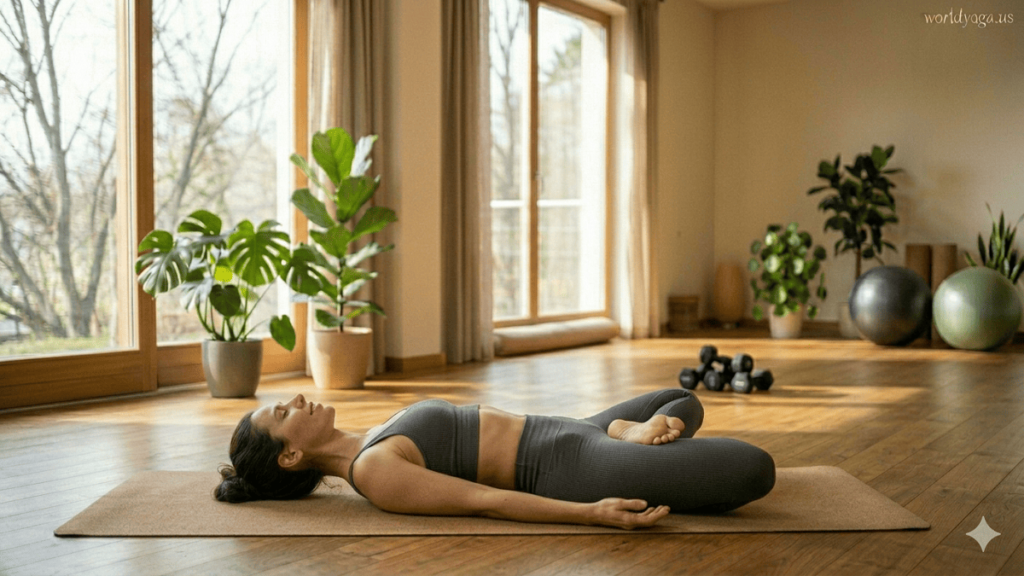
White Paper of Supine: Full Lotus
Abstract
Supine Full Lotus (Supta Padmasana) is an advanced supine yoga posture characterized by deep external hip rotation and complete lotus leg configuration performed in a reclined position. This white paper examines its biomechanical demands, muscular activation patterns, functional benefits, therapeutic applications, and associated safety considerations. The posture is primarily used in traditional yoga, meditation preparation, and advanced mobility training systems.
1. Introduction
Supine Full Lotus is a classical posture in Hatha yoga that combines hip mobility, knee flexion, and spinal relaxation. Unlike dynamic exercises, it emphasizes static joint positioning and controlled relaxation. It is typically reserved for practitioners with advanced hip flexibility and strong joint awareness.
2. Biomechanical Analysis
The posture involves seated entry into full lotus followed by a controlled recline into a supine position.
Key biomechanical characteristics include:
- Deep external rotation of both hip joints
- Maximum knee flexion under passive load
- Stabilization of pelvis in neutral supine alignment
- Low-load spinal decompression due to floor support
The greatest mechanical stress occurs at the hip-knee transition chain, where insufficient hip mobility can transfer torque to the knee joint.
3. Muscular Activation Profile
Primary muscles engaged (stabilization):
- Transverse abdominis (core stabilization)
- Rectus abdominis (anti-extension control)
- Obliques (pelvic symmetry control)
Hip external rotators (active positioning):
- Piriformis
- Obturator internus and externus
- Gemelli muscles
Supporting muscles:
- Gluteus medius and maximus (pelvic alignment)
- Adductor group (passively lengthened)
- Iliopsoas (low-level stabilization)
- Erector spinae (isometric spinal support)
Lower limb involvement:
- Knee joint structures remain passively loaded
- Ankle stabilizers maintain neutral positioning
4. Functional Benefits
When practiced correctly, Supine Full Lotus provides:
- Deep hip joint opening and increased external rotation
- Improved pelvic awareness and symmetry
- Enhanced parasympathetic nervous system activation
- Reduced lower back muscular tension through spinal support
- Improved meditation readiness and prolonged sitting tolerance
- Increased joint mobility in advanced practitioners
5. Clinical and Performance Applications
Supine Full Lotus is utilized in:
- Advanced yoga therapy for hip mobility restoration
- Meditation training and pranayama preparation
- Mobility development in experienced practitioners
- Restorative sequencing in traditional Hatha yoga systems
- Body awareness and neuromuscular control training
However, its application is limited to individuals with sufficient hip and knee mobility due to its high joint specificity.
6. Safety and Risk Management
Despite its benefits, Supine Full Lotus carries high risk if improperly executed, particularly for the knee joint.
Key precautions include:
- Avoid forcing lotus position at the knee joint
- Ensure hip-driven external rotation only
- Do not attempt without preparatory hip opening
- Discontinue if knee pain or compression occurs
- Use progression from half lotus before full lotus
- Avoid in cases of knee ligament or meniscus injury
- Maintain relaxed breathing to prevent muscular guarding
Improper alignment can result in irreversible knee damage, making progressive training essential.
7. Comparative Functional Insight
Supine Full Lotus is fundamentally a static, joint-based mobility posture, contrasting sharply with dynamic core-conditioning exercises such as Scissor kicks, which emphasize repetitive movement, abdominal endurance, and active stabilization under motion.
While both improve core engagement, Supine Full Lotus prioritizes passive joint opening and neuromuscular relaxation rather than muscular repetition or strength building.
8. Conclusion
Supine Full Lotus is a highly advanced yoga posture that offers significant benefits in hip mobility, nervous system regulation, and meditative readiness. However, it demands strict attention to anatomical limits, progressive preparation, and safe execution. When practiced correctly, it serves as a powerful tool for deep structural opening and advanced mind-body integration.
#Supine: Full Lotus in Banglore
Industry Application of Supine: Full Lotus
Supine Full Lotus (Supta Padmasana) is an advanced supine yoga posture used across specialized sectors where deep hip mobility, relaxation response training, and meditative conditioning are required. Its application is limited to trained practitioners due to its high joint specificity, but it remains highly valuable in niche wellness and performance industries.
1. Yoga Therapy and Traditional Hatha Yoga Systems
In yoga therapy, Supine Full Lotus is used as a deep restorative and meditative posture for advanced practitioners. It is often integrated into classical Hatha yoga sequences to support long-duration stillness and spinal relaxation.
Applications include:
- Advanced hip-opening therapy
- Preparation for prolonged meditation (Dhyana practices)
- Nervous system downregulation techniques
- Energy balancing sequences in traditional yoga frameworks
It is considered a peak posture rather than a foundational movement.
2. Meditation and Mindfulness Training
In meditation-focused programs, Supine Full Lotus is used to condition the body for extended stillness without spinal fatigue. The supine position allows the spine to rest fully while maintaining a structured lower-body lock.
Benefits for this industry include:
- Improved ability to maintain non-movement states
- Reduced physical discomfort during long meditation sessions
- Enhanced breath awareness and parasympathetic activation
- Support for advanced yogic concentration practices
It is often used as a transitional posture for practitioners working toward seated lotus meditation.
3. Rehabilitation and Mobility Specialist Programs
In controlled therapeutic environments, Supine Full Lotus may be used only for advanced mobility screening or trained individuals. It is not a primary rehabilitation tool but can provide insight into hip external rotation capacity.
Applications include:
- Assessment of hip joint mobility symmetry
- Identification of movement compensations in lower-body mechanics
- Advanced-stage mobility progression in experienced patients
- Soft-tissue release protocols in controlled settings
Due to high knee stress risk, it is rarely used in early rehabilitation stages.
4. Elite Yoga Training and Teacher Education
In advanced yoga teacher training programs, this posture is included to educate practitioners on:
- Safe progression into full lotus
- Biomechanical risk management for knee joints
- Deep hip rotation mechanics
- Structural alignment principles in extreme flexibility postures
It serves as a reference posture for advanced anatomy education rather than a daily practice requirement.
5. Sports Science and Movement Performance (Limited Use)
In sports science, Supine Full Lotus is not widely used for performance training but may appear in:
- Flexibility profiling for elite dancers or martial artists
- Hip mobility benchmarking in movement specialists
- Recovery and relaxation protocols in niche flexibility disciplines
Its usage is highly selective due to joint safety considerations.
6. Wellness, Spa, and Recovery Industry
In high-end wellness and spa environments, modified versions of Supine Full Lotus may be used for:
- Deep relaxation therapy sessions
- Breathwork integration practices
- Guided restorative yoga experiences
- Nervous system recovery programs
However, full lotus is often replaced with safer alternatives for general clients.
Conclusion
Supine Full Lotus is a specialized posture with limited but high-value applications across yoga therapy, meditation training, elite yoga education, and niche mobility assessment contexts. Its primary role is not general fitness but advanced flexibility conditioning, meditative preparation, and anatomical education.
#Supine: Full Lotus in Mumbai
Ask FAQs
What is Supine Full Lotus used for?
Supine Full Lotus (Supta Padmasana) is primarily used for deep hip opening, spinal relaxation, and meditation preparation. It helps advanced practitioners improve flexibility while promoting calmness and stillness in the body and mind.
Is Supine Full Lotus suitable for beginners?
No, it is generally not recommended for beginners. The posture requires advanced hip flexibility and knee safety awareness. Beginners should first practice preparatory poses like Half Lotus and Bound Angle Pose before attempting it.
Which muscles and joints are involved in this pose?
The pose mainly engages the hip joints in deep external rotation and knee flexion. It stretches the adductors and glutes while activating stabilizing muscles such as the core, hip rotators, and lower back muscles to maintain alignment.
What are the common mistakes to avoid?
Common mistakes include forcing the knees into position, allowing hip misalignment, rounding or over-arching the lower back, and pushing beyond natural flexibility limits. These errors can increase the risk of knee or hip injury.
Can Supine Full Lotus help with meditation?
Yes, when practiced safely, it can support meditation by promoting physical stillness, spinal relaxation, and a calm nervous system state. However, discomfort in the knees or hips can distract from meditation, so proper preparation is essential.
Table of Contents
Disclaimer: This content is for educational and informational purposes only and is not a substitute for professional medical or yoga guidance. Supine Full Lotus (Supta Padmasana) is an advanced posture and should be practiced only with proper preparation and, if needed, under the supervision of a qualified instructor. Avoid forcing any position that causes pain or discomfort.