
Supine: One Leg Straight, One Knee Bent
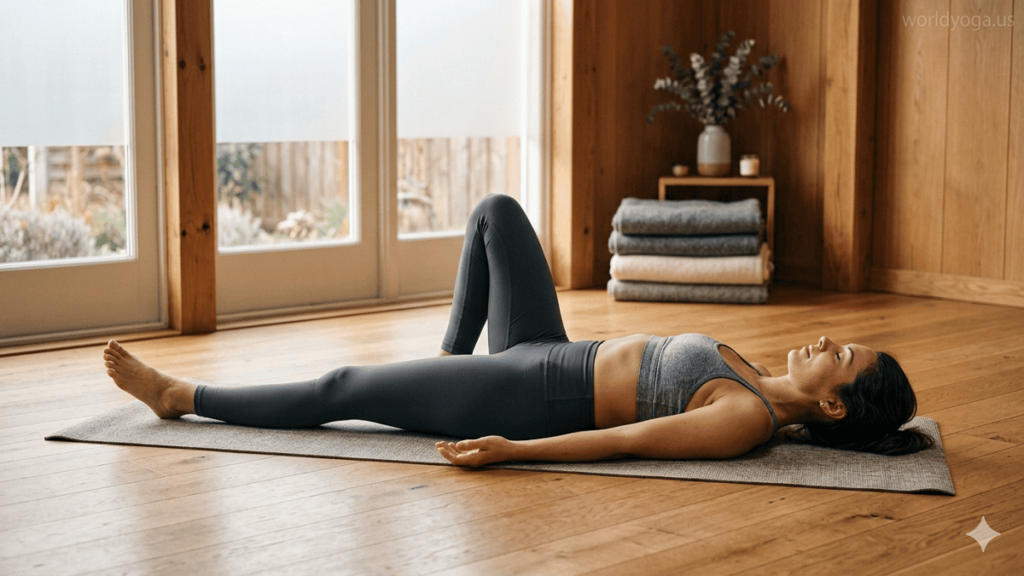
Supta Eka Pada Variation is a foundational supine yoga and movement therapy position often used in yoga, physiotherapy, and somatic training. It involves lying on the back with one leg extended straight on the mat while the opposite knee is bent, foot grounded comfortably. This simple yet highly effective position is widely used for spinal alignment awareness, pelvic balancing, and gentle muscular release.
Understanding the Position
This posture is a variation of constructive rest and is commonly used as a preparatory or recovery position. Unlike advanced postures such as lotus-based variations, it does not require extreme flexibility. Instead, it focuses on symmetry correction and neuromuscular relaxation.
The extended leg promotes hamstring lengthening and pelvic stabilization, while the bent knee reduces lumbar tension and allows the lower back to decompress naturally.
How to Perform the Position Correctly
Begin by lying flat on your back in a neutral position. Slowly extend one leg along the mat, ensuring the heel is relaxed and the toes are pointing naturally upward or slightly outward. The opposite leg is then bent, with the foot placed flat on the floor, close to the sitting bone.
Key alignment cues:
- Spine remains neutral and fully supported
- Pelvis stays level without tilting to one side
- Shoulders rest evenly on the mat
- Neck remains long and relaxed
- Breath is slow and diaphragmatic
Arms may rest alongside the body with palms facing upward to encourage shoulder relaxation.
Key Benefits
This supine variation provides several functional benefits:
- Reduces lower back tension and spinal compression
- Improves pelvic alignment awareness
- Gently stretches hamstrings of the extended leg
- Supports nervous system relaxation and stress reduction
- Enhances body awareness and postural re-education
It is often used as a reset position in restorative yoga sequences and physical therapy sessions.
Muscles and Joints Involved
The position primarily engages passive and stabilizing muscle groups:
- Hamstrings (extended leg, passive lengthening)
- Hip flexors (bent leg, mild relaxation)
- Core stabilizers (transverse abdominis, multifidus)
- Gluteal muscles (pelvic support)
- Spinal muscles (postural neutrality support)
Major joints involved:
- Hip joints (flexion and extension balance)
- Knee joints (one flexed, one extended)
- Pelvic joints (alignment and stabilization)
- Spinal joints (neutral decompression)
Precautions
While generally safe, attention should be given to:
- Avoiding pelvic rotation or tilting
- Not locking the extended knee excessively
- Ensuring no sharp pain in the lower back or hips
- Using a support under the head if neck strain occurs
Individuals with acute lumbar injuries should modify the position with additional support under the knees or lower back.
Conclusion
Supta Eka Pada Variation is a simple yet powerful foundational posture that supports spinal decompression, pelvic awareness, and muscular relaxation. It is widely used as both a therapeutic tool and a preparatory position for more advanced yoga practices, offering accessible benefits for practitioners of all levels.
Reference Links
#Supine: One Leg Straight, One Knee Bent in India
How is Supine: One Leg Straight, One Knee Bent performed correctly?
Supta Eka Pada Variation is a foundational supine alignment posture used in yoga therapy, movement training, and rehabilitation. Although it looks simple, correct execution depends on pelvic stability, spinal neutrality, and balanced muscular relaxation rather than passive lying down.
1. Starting Position
Begin by lying flat on your back on a comfortable, stable surface such as a yoga mat. Allow your body to settle fully before making any adjustments. The head, shoulders, and pelvis should rest evenly on the floor.
The spine should feel long and neutral, not overly arched or flattened.
2. Positioning the Legs
From the neutral supine position:
- Extend one leg straight along the mat
- Keep the heel relaxed and grounded
- Allow the toes to point naturally upward or slightly outward
Then:
- Bend the opposite knee slowly
- Place the foot flat on the floor, close to the pelvis
- Ensure the knee points upward and does not collapse inward or outward
This creates a stable asymmetrical base.
3. Pelvic and Spinal Alignment
The most important aspect of correct performance is maintaining pelvic balance.
Key alignment cues:
- Both sides of the pelvis remain level
- No rolling or tilting toward either side
- Lower back remains naturally supported, not strained
- Spine stays in a neutral position without compression
If the pelvis shifts, the effectiveness of the posture decreases significantly.
4. Upper Body Position
The upper body should remain relaxed and symmetrical:
- Shoulders rest evenly on the mat
- Arms lie comfortably by the sides
- Palms may face upward to encourage relaxation
- Neck remains neutral with no tension in the jaw or throat
A small cushion under the head may be used if needed for comfort.
5. Breathing Technique
Breath is central to correct execution:
- Inhale slowly through the nose, allowing the abdomen to expand
- Exhale gently, letting the body soften into the mat
- Maintain steady diaphragmatic breathing throughout
Avoid holding the breath or creating tension in the chest or abdomen.
6. Common Mistakes to Avoid
- Allowing the pelvis to rotate or tilt
- Locking the straight knee aggressively
- Letting the bent knee fall outward or inward
- Tensing the lower back or glutes unnecessarily
- Holding shallow or forced breathing patterns
These errors reduce the therapeutic benefit of the posture.
7. Exit from the Position
To exit safely:
- Slowly extend the bent knee back to neutral
- Bring both legs straight momentarily
- Take a few relaxed breaths in full supine position
- Roll gently to one side before sitting up
Avoid sudden movements, especially if the body feels deeply relaxed.
Conclusion
Supta Eka Pada Variation is correctly performed when the spine remains neutral, the pelvis stays stable, and the breath is slow and controlled. Its simplicity makes it powerful for restoring balance, releasing tension, and improving body awareness when practiced with attention to alignment.
Reference Links
#Supine: One Leg Straight, One Knee Bent in Maharashtra
What is the proper alignment in this asymmetrical lying position?
Supta Eka Pada Variation requires subtle but precise alignment even though it appears simple. The goal is not stretching intensity, but symmetrical control of the pelvis, neutral spinal positioning, and balanced muscular relaxation.
1. Pelvis Alignment (Most Important Principle)
The pelvis is the foundation of correct alignment in this asymmetrical supine position.
Key alignment cues:
- Both sides of the pelvis remain level and evenly grounded
- No tilting toward the bent-knee side or straight-leg side
- Front hip points (ASIS) stay aligned horizontally
- Sacrum remains flat and stable on the mat
If the pelvis rotates or lifts on one side, the posture loses its corrective and therapeutic effect.
2. Spinal Alignment
The spine should remain neutral and elongated without compression or excessive arching.
Correct alignment includes:
- Natural lumbar curve maintained (not flattened forcefully)
- Ribcage relaxed and not flaring upward
- Thoracic spine resting evenly on the mat
- Neck long with chin slightly neutral
The spine should feel supported rather than actively held.
3. Leg Alignment
Straight Leg
- Fully extended without locking the knee aggressively
- Heel grounded and relaxed
- Toes pointing upward or slightly outward in natural rotation
- Thigh remains in neutral hip alignment (not externally rotated excessively)
Bent Knee Leg
- Knee points upward toward the ceiling
- Foot placed flat on the mat, close enough to maintain pelvic neutrality
- Knee should not collapse inward or fall outward
The hip of the bent leg remains relaxed without lifting.
4. Shoulder and Upper Body Alignment
Upper body symmetry supports pelvic stability.
Correct positioning:
- Shoulders rest evenly on the mat
- Arms relaxed beside the body
- Palms facing upward to reduce shoulder tension
- Shoulder blades gently spread and grounded
The chest remains open but not forced upward.
5. Head and Neck Alignment
The head should remain in line with the spine:
- Back of the head resting comfortably on the mat
- No tilting or rotation of the neck
- Jaw relaxed and unclenched
- Optional small support under head if needed for cervical comfort
6. Breath and Internal Alignment
Breath helps maintain subtle postural balance:
- Diaphragmatic breathing expands the lower ribs evenly
- Abdomen softens on exhalation
- No bracing or holding in the core
- Breathing remains smooth and rhythmic
Proper breath ensures the body does not collapse into asymmetry.
7. Common Misalignments
- Pelvic tilt toward one side
- Bent knee falling outward or collapsing inward
- Straight leg rotating externally or lifting off alignment
- Lower back over-arching or flattening excessively
- Shoulders uneven or lifted off the mat
Conclusion
In Supta Eka Pada Variation, proper alignment is defined by a stable, level pelvis, neutral spinal positioning, and independently aligned legs that do not disturb the body’s symmetry. When these elements are balanced, the posture becomes a powerful tool for spinal decompression, postural awareness, and neuromuscular reset.
Reference Links
#Supine: One Leg Straight, One Knee Bent in Ahemadabad
Which muscles are engaged during this supine variation?
Supta Eka Pada Variation is a low-load, alignment-focused supine posture that appears passive but involves continuous low-level muscular engagement for stability, pelvic control, and postural balance.
1. Core Stabilizers (Primary Engagement)
Even in a relaxed supine position, deep core muscles remain lightly active to maintain pelvic neutrality.
Key muscles:
- Transverse abdominis (deep abdominal support)
- Multifidus (segmental spinal stability)
- Pelvic floor muscles (subtle internal support system)
These muscles prevent excessive arching or flattening of the lower back and help maintain alignment.
2. Hip Flexors and Extensors
The asymmetrical leg positioning creates different activation patterns on each side.
Bent Knee Side:
- Iliopsoas (light activation to stabilize hip flexion)
- Rectus femoris (assists in knee and hip positioning)
- Gluteus maximus (relaxation with mild stabilizing engagement)
Straight Leg Side:
- Hamstrings (passive lengthening, low-level eccentric awareness)
- Quadriceps (mild engagement if knee is actively extended)
- Tensor fasciae latae (helps stabilize hip alignment)
3. Pelvic Stabilizers
These muscles work continuously to prevent pelvic rotation or tilt.
Key muscles:
- Gluteus medius (primary pelvic stabilizer)
- Gluteus minimus (deep hip control)
- Adductor group (inner thigh stabilization and balance)
They ensure both sides of the pelvis remain level in the asymmetrical position.
4. Spinal Muscles
Although the spine is resting, stabilizing muscles maintain alignment.
Key muscles:
- Erector spinae (low-level postural tone)
- Quadratus lumborum (lateral spinal stability control)
- Deep paraspinal muscles (fine-tuned vertebral support)
These muscles prevent collapse or rotation of the lower back.
5. Lower Limb Muscles
Straight Leg:
- Hamstrings (passively lengthened)
- Gastrocnemius and soleus (relaxed calf muscles)
- Tibialis anterior (light engagement for foot positioning)
Bent Knee:
- Hamstrings (relaxed in shortened position)
- Quadriceps (light stabilizing tone depending on foot placement)
6. Upper Body Muscles
Even though the focus is on the lower body, upper body relaxation is essential.
Key muscles:
- Trapezius (mid and lower fibers, relaxation support)
- Rhomboids (scapular stability)
- Deltoids (posterior fibers remain relaxed)
- Intercostals (assist in rib expansion during breathing)
7. Respiratory Muscles (Functional Engagement)
Breathing plays a key role in maintaining relaxation and alignment.
Key muscles:
- Diaphragm (primary breathing muscle)
- Intercostals (rib cage expansion and control)
- Abdominal wall (gentle coordination during exhalation)
Conclusion
Supta Eka Pada Variation engages a subtle but important network of stabilizing muscles rather than strong movers. The posture primarily activates deep core stabilizers, pelvic control muscles, and low-level spinal support structures while allowing the limbs to alternate between passive stretch and gentle stabilization. This balance makes it highly effective for postural re-education, spinal decompression, and neuromuscular reset.
Reference Links
#Supine: One Leg Straight, One Knee Bent in Hyderabad
What preparatory poses help support this posture?
Supta Eka Pada Variation is a foundational alignment posture, but it still benefits from targeted preparation—especially for pelvic stability, hamstring flexibility, and gentle core activation. The goal of preparatory work is not intensity, but control and awareness of asymmetry.
1. Gentle Supine Awareness and Relaxation
Before introducing asymmetry, the body should be comfortable in neutral lying positions.
Recommended poses:
- Savasana
- Constructive rest position (knees bent, feet grounded)
- Supine breathing practice with hands on abdomen
These help the nervous system settle and establish baseline spinal neutrality.
2. Pelvic Stability Foundations
Since the posture depends heavily on a level pelvis, stability training is essential.
Recommended poses:
- Bridge Pose (Setu Bandhasana)
- Supine pelvic tilts (gentle rocking of pelvis)
- Supported bridge with block
These strengthen glutes and deep core muscles responsible for keeping the pelvis aligned.
3. Hamstring and Leg Extension Preparation
The straight leg in Supta Eka Pada Variation requires comfortable hamstring length without strain.
Recommended poses:
- Supta Padangusthasana (reclined hand-to-big-toe stretch)
- Hamstring stretch with strap (supine leg raise variation)
- Half Happy Baby Pose
These improve controlled lengthening without pulling on the lower back.
4. Hip Mobility and Release Work
The bent knee side requires relaxed hip flexion and rotation capacity.
Recommended poses:
- Apanasana
- Figure Four Stretch (Supta Kapotasana variation)
- Reclined hip circles (gentle mobility drills)
These reduce hip stiffness and prepare for asymmetrical positioning.
5. Core Activation and Spinal Control
A stable core ensures the pelvis does not tilt or rotate during the posture.
Recommended poses:
- Setu Bandhasana
- Dead Bug–style supine core engagement
- Gentle Boat Pose (modified Navasana)
These strengthen deep stabilizers like the transverse abdominis and multifidus.
6. Integrated Supine Control Practices
Before holding full variation, integration of asymmetry is helpful.
Recommended practices:
- Alternating supine leg extensions
- Slow one-leg-to-two-leg transitions in supine position
- Controlled knee-bent + leg-extended switching drills
These help the nervous system adapt to uneven load distribution.
Conclusion
Preparation for Supta Eka Pada Variation should focus on calming the body, stabilizing the pelvis, lengthening the hamstrings safely, and strengthening deep core control. When these elements are developed progressively, the posture becomes more effective for spinal alignment, relaxation, and neuromuscular balance.
Reference Links
#Supine: One Leg Straight, One Knee Bent in Banglore
What are the benefits and precautions of this supine leg position?
Supta Eka Pada Variation is a simple yet highly effective alignment posture used in yoga therapy, rehabilitation, and mobility training. Despite its simplicity, it produces meaningful effects on spinal alignment, pelvic awareness, and muscular balance when practiced correctly.
Key Benefits
1. Improves Pelvic Alignment Awareness
This asymmetrical position helps the practitioner recognize and correct uneven pelvic positioning. The grounded bent leg and extended straight leg create feedback that highlights imbalances in the hips and lower back.
2. Reduces Lower Back Tension
By placing the body in a supported supine position, the lumbar spine is allowed to decompress naturally. The bent knee reduces lumbar strain, making this posture useful for relieving mild lower back tightness.
3. Enhances Hamstring Flexibility
The straight leg encourages gentle, passive hamstring lengthening without aggressive stretching. This helps improve flexibility over time while minimizing risk of overstretching.
4. Supports Nervous System Relaxation
The supine position promotes parasympathetic activation, helping reduce stress and physical tension. When combined with slow breathing, it supports deep relaxation and recovery.
5. Improves Core Awareness and Stability
Even in a relaxed state, deep stabilizing muscles engage subtly to maintain pelvic symmetry. This enhances neuromuscular control and postural awareness.
Key Precautions
1. Avoid Pelvic Rotation or Tilting
One of the most common errors is allowing the pelvis to roll toward either side. This reduces effectiveness and may increase strain on the lower back.
2. Do Not Lock the Straight Knee
The extended leg should remain active but not forcefully locked. Overextension can stress the knee joint and hamstring attachments.
3. Knee Alignment in Bent Leg
The bent knee should point upward. Allowing it to collapse inward or fall outward can place unnecessary stress on the hip joint.
4. Lower Back Sensitivity
Individuals with acute lumbar issues should use additional support, such as a bolster under the bent knee, to reduce strain and maintain neutrality.
5. Avoid Forceful Stretching
This posture is not meant to be an intense stretch. Forcing either leg position can lead to compensatory strain in the hips or spine.
Conclusion
Supta Eka Pada Variation is a low-risk, high-benefit posture when performed with proper alignment awareness. It supports spinal decompression, improves pelvic balance, and enhances flexibility while promoting relaxation. However, its effectiveness depends on maintaining symmetry, avoiding force, and respecting individual mobility limits.
Reference Links
#Supine: One Leg Straight, One Knee Bent in Delhi
Case Study of Supine: One Leg Straight, One Knee Bent
Supta Eka Pada Variation is a foundational alignment-based supine posture widely used in yoga therapy, physiotherapy, and movement re-education. This case study examines its application in improving pelvic symmetry, reducing lower back tension, and enhancing neuromuscular awareness in a structured rehabilitation setting.
1. Subject Profile
The subject is a 34-year-old office professional experiencing chronic mild lower back stiffness and postural imbalance due to prolonged sitting. No structural spinal injury was present, but functional asymmetry in pelvic alignment was observed.
Primary concerns included:
- Tight hamstrings on the right side
- Mild anterior pelvic tilt
- Occasional lumbar discomfort after long work hours
- Reduced core awareness during daily movement
2. Intervention Approach
A conservative movement protocol was designed, centered on Supta Eka Pada Variation as a daily corrective positioning tool.
The posture was introduced as part of a 10–15 minute supine reset sequence, combined with:
- Breathing awareness exercises
- Gentle pelvic tilting drills
- Light hamstring mobility work
No forceful stretching or advanced postures were included during initial phases.
3. Implementation Protocol
The subject practiced the posture daily for 4 weeks:
Phase 1 (Week 1–2)
- Short holds (2–3 minutes per side)
- Focus on pelvic leveling awareness
- Use of breath to reduce lumbar tension
Phase 2 (Week 3–4)
- Increased hold time (5–8 minutes per side)
- Integration of subtle core engagement cues
- Reduction of compensatory pelvic rotation
The emphasis remained on relaxation with alignment correction rather than muscular exertion.
4. Observed Outcomes
After 4 weeks, the following improvements were recorded:
- Noticeable reduction in lower back stiffness
- Improved pelvic symmetry during standing posture
- Increased hamstring flexibility on the extended leg side
- Enhanced ability to identify and correct postural imbalance
- Improved diaphragmatic breathing consistency in supine position
The subject reported that the posture became a “reset position” after long working hours.
5. Key Insights
This case highlights several important principles:
- Small asymmetrical positions can significantly influence pelvic alignment
- Passive supine postures can be as corrective as active exercises
- Breath awareness enhances neuromuscular reorganization
- Consistency is more important than intensity in corrective postural work
- The posture is most effective when no pain or strain is introduced
6. Limitations
- Results are functional and not structural correction of spinal anatomy
- Overuse without awareness may lead to pelvic dependency patterns
- Not sufficient alone for severe musculoskeletal conditions
- Requires complementary movement training for long-term stability
7. Conclusion
Supta Eka Pada Variation is an effective low-intensity corrective posture for improving pelvic alignment, reducing lumbar tension, and enhancing body awareness. In this case study, consistent practice led to measurable functional improvements in posture, flexibility, and comfort during daily activities.
Reference Links
#Supine: One Leg Straight, One Knee Bent in Pune
White Paper of Supine: One Leg Straight, One Knee Bent
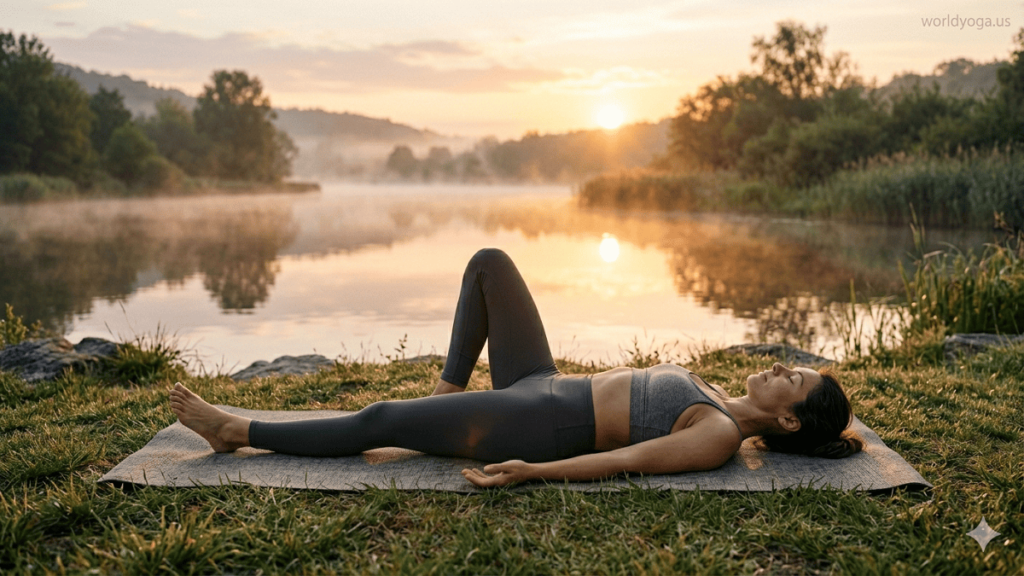
Supta Eka Pada Variation is a foundational supine alignment posture widely used in yoga therapy, rehabilitation science, and movement re-education systems. Although simple in appearance, it serves as a critical tool for assessing pelvic symmetry, improving spinal neutrality, and retraining neuromuscular coordination.
This white paper examines its biomechanical structure, muscular engagement, therapeutic applications, risk profile, and clinical relevance.
1. Introduction
The posture involves lying supine with one leg extended and the opposite knee bent with the foot grounded. It is often used as a baseline corrective position to observe asymmetry in the pelvis and lower limbs.
Unlike advanced postures, this variation does not aim to increase flexibility intensity but rather to restore structural balance and improve body awareness.
2. Biomechanical Structure
2.1 Pelvic Mechanics
The asymmetrical leg configuration creates a natural diagnostic environment for pelvic alignment assessment.
Key biomechanical features:
- One side of pelvis anchored via bent knee support
- Opposite side elongated through straight leg extension
- Subtle rotational forces reveal imbalance tendencies
This makes the posture valuable for identifying functional asymmetry.
2.2 Spinal Alignment
The spine remains in a neutral supine position, supported by the mat.
Key characteristics:
- Reduced gravitational compression on lumbar vertebrae
- Passive decompression of spinal segments
- Minimal rotational stress when performed correctly
This supports spinal unloading and relaxation.
2.3 Lower Limb Mechanics
The posture distributes load asymmetrically:
- Straight leg: passive hamstring lengthening
- Bent leg: hip flexion with stability support
- Both legs: coordinated neuromuscular balancing
3. Muscular Activation Profile
Although primarily restorative, the posture involves low-level stabilizing activation.
Primary muscles:
- Transverse abdominis (core stabilization)
- Gluteus medius and minimus (pelvic control)
- Hamstrings (lengthened support in straight leg)
- Iliopsoas (support in bent leg positioning)
Secondary stabilizers:
- Quadratus lumborum (lateral spinal stability)
- Multifidus (segmental spinal support)
- Adductor group (pelvic symmetry control)
4. Physiological and Therapeutic Effects
4.1 Postural Re-education
The posture helps retrain neuromuscular patterns by exposing asymmetry and encouraging balanced correction.
4.2 Spinal Decompression
Supine positioning reduces axial load on the spine, supporting relief from mild lumbar tension.
4.3 Flexibility Regulation
Gentle hamstring lengthening occurs without aggressive stretching, reducing injury risk.
4.4 Nervous System Regulation
The supine position encourages parasympathetic activation, supporting relaxation and stress reduction.
5. Clinical and Functional Applications
Rehabilitation Settings:
- Lumbar pain management protocols
- Pelvic alignment correction exercises
- Postural re-education programs
Physiotherapy Use:
- Baseline assessment of lower limb symmetry
- Gentle mobility restoration after inactivity
- Controlled movement reintroduction
Yoga Therapy:
- Preparation for more advanced asymmetrical or supine postures
- Breath awareness training in neutral positions
6. Risk Analysis and Contraindications
Low Risk Profile (Generally Safe)
When performed correctly, the posture is considered safe for most individuals.
Potential Risks:
- Pelvic rotation if not monitored
- Hamstring overstretching in aggressive straight-leg positioning
- Lower back discomfort if core is not relaxed
Contraindications:
- Acute lumbar injury without supervision
- Severe hamstring strain
- Post-surgical hip or pelvic conditions
7. Implementation Guidelines
Recommended protocol:
- Begin in neutral supine rest
- Slowly extend one leg fully
- Bend opposite knee with grounded foot
- Maintain pelvic neutrality and breath awareness
- Hold for 2–10 minutes depending on comfort
Progression should be gradual and symptom-guided.
8. Conclusion
Supta Eka Pada Variation is a clinically valuable, low-intensity posture that supports pelvic symmetry, spinal decompression, and neuromuscular re-education. Its strength lies not in physical intensity but in its ability to reveal and correct subtle postural imbalances through sustained, mindful positioning.
Reference Links
#Supine: One Leg Straight, One Knee Bent in Kolkata
Industry Application of Supine: One Leg Straight, One Knee Bent
Supta Eka Pada Variation is a foundational alignment and recovery posture used across multiple professional fields including physiotherapy, yoga therapy, sports science, ergonomics, and mental wellness programs. Although simple in structure, it provides measurable value in assessment, correction, and recovery-based protocols.
1. Physiotherapy and Rehabilitation Industry
In clinical rehabilitation settings, this posture is widely used as a low-load corrective position for spinal and pelvic re-education.
Key applications:
- Assessment of pelvic asymmetry and functional imbalance
- Gentle lumbar decompression for non-acute back pain
- Post-injury mobility reintroduction for lower limbs
- Controlled hamstring lengthening without high strain
Therapists use it as a baseline position to observe how the body responds to asymmetrical loading.
2. Yoga Therapy and Mind–Body Wellness
In yoga therapy systems, the posture is used as a preparatory and integrative pose within restorative sequences.
Applications include:
- Nervous system downregulation and stress relief
- Preparation for deeper supine postures
- Breath awareness training in neutral alignment
- Gentle correction of postural habits developed from sitting lifestyle
It is often included in therapeutic yoga sequences before progressing to advanced postures.
3. Sports Science and Athletic Conditioning
In performance training environments, this posture is used for recovery and mobility assessment.
Applications include:
- Post-training recovery and muscle relaxation
- Hamstring flexibility monitoring
- Hip stability and control assessment
- Core engagement awareness without load stress
Athletes use this position during cooldown routines to reset neuromuscular tension.
4. Ergonomics and Workplace Wellness
In corporate wellness programs, simplified versions of Supta Eka Pada Variation are used to counteract prolonged sitting posture effects.
Applications include:
- Desk-job posture correction routines
- Lower back tension relief sessions
- Micro-break recovery exercises
- Guided relaxation practices during work breaks
It helps reduce the impact of sedentary lifestyle-related musculoskeletal strain.
5. Mental Health and Stress Management Programs
The supine nature of the posture makes it valuable in mindfulness-based interventions.
Applications include:
- Guided relaxation and body scan therapies
- Anxiety reduction through parasympathetic activation
- Trauma-informed movement practices (modified forms)
- Breath regulation training for emotional balance
Its simplicity makes it accessible for beginners in therapeutic settings.
6. Movement Education and Fitness Training
In fitness and movement education, the posture is used as a foundational teaching tool.
Applications include:
- Teaching pelvic alignment awareness
- Introducing asymmetrical movement control
- Demonstrating spinal neutrality in supine positions
- Building awareness before progressing to advanced flexibility work
It is often used as a “reset posture” between exercises.
Conclusion
Supta Eka Pada Variation has wide cross-industry relevance due to its simplicity, safety, and effectiveness in revealing and correcting postural imbalance. Its primary value lies in rehabilitation, recovery, and awareness training rather than intensity, making it a versatile tool across healthcare, fitness, wellness, and ergonomic industries.
Reference Links
#Supine: One Leg Straight, One Knee Bent in Mumbai
Ask FAQs
What is Supine: One Leg Straight, One Knee Bent?
Supta Eka Pada Variation is a simple supine alignment posture where one leg remains extended on the floor while the opposite knee is bent with the foot grounded. It is commonly used in yoga therapy, rehabilitation, and relaxation practices to improve pelvic balance and spinal alignment.
What are the main benefits of this posture?
This position helps reduce lower back tension, improve pelvic awareness, support gentle hamstring stretching, and promote nervous system relaxation. It also enhances postural awareness and deep breathing in a low-stress environment.
Is this posture suitable for beginners?
Yes, it is generally beginner-friendly because it does not require advanced flexibility or strength. However, proper alignment should still be maintained to avoid unnecessary strain on the lower back or hips.
Which muscles are mainly engaged during the posture?
The posture lightly engages core stabilizers, gluteal muscles, hamstrings, and spinal support muscles. These muscles work together to maintain pelvic neutrality and spinal balance while the body remains relaxed.
Can this posture help with lower back discomfort?
Yes, when practiced correctly, Supta Eka Pada Variation may help relieve mild lower back tension by reducing spinal compression and encouraging pelvic stability. However, individuals with severe or acute back conditions should consult a healthcare professional before practice.
Table of Contents
Disclaimer
The information provided about Supta Eka Pada Variation is intended for educational and informational purposes only and should not replace professional medical advice, diagnosis, or treatment. Although this posture is generally gentle and beginner-friendly, individuals with lower back, hip, knee, or pelvic conditions should practice cautiously and consult a qualified healthcare provider or yoga professional if needed.