Tolasana
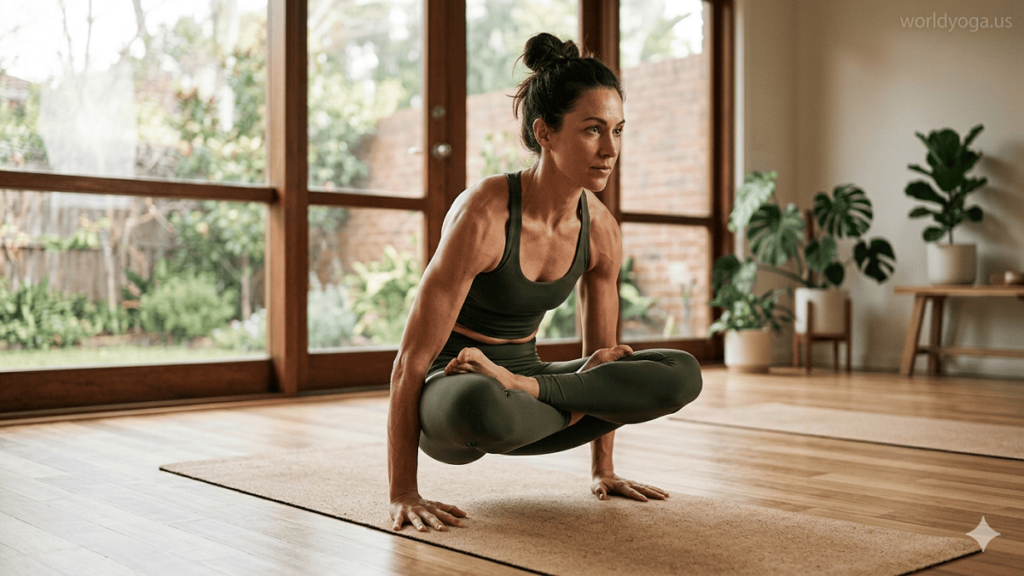
Tolasana, commonly known as Scale Pose, is an advanced seated arm balance in yoga that develops significant upper-body strength, core stability, and mental focus. The Sanskrit word “Tola” means “scale” or “balance,” and “Asana” means “pose,” reflecting the body’s lifted, balanced position resembling a weighing scale.
Overview
Tolasana is typically practiced in a seated lotus position (Padmasana) or half-lotus variation, where the practitioner lifts the entire body off the ground using arm strength alone. The hands are placed beside the hips, and the body is elevated while the legs remain crossed.
This posture requires strong engagement of the wrists, arms, shoulders, and abdominal muscles, along with flexibility in the hips to maintain the lotus position comfortably.
How It Is Performed (Basic Steps)
- Sit in Padmasana with a straight spine.
- Place palms firmly on the ground beside the hips or slightly forward.
- Engage the core and press strongly through the hands.
- Lift the hips and legs off the ground while keeping the lotus position intact.
- Hold the balance using controlled breathing and steady focus.
- Slowly lower the body back down with control.
Key Benefits
Tolasana provides a range of physical and mental benefits:
- Strengthens wrists, arms, shoulders, and chest
- Builds deep core strength and abdominal control
- Improves balance and body awareness
- Enhances concentration and mental discipline
- Opens hips when practiced in lotus position
Preparatory Poses
Before attempting Tolasana, practitioners should develop strength and flexibility through:
- Bakasana
- Plank Pose variations
- Core strengthening exercises
- Hip-opening poses such as Baddha Konasana
- Wrist conditioning drills
Common Mistakes
- Not engaging the core before lifting
- Relying only on arm strength instead of full-body integration
- Poor lotus alignment causing knee strain
- Collapsing shoulders during lift-off
- Holding breath instead of maintaining steady breathing
Precautions
Tolasana should be avoided or modified by individuals with:
- Wrist or shoulder injuries
- Knee or hip issues (especially related to lotus position)
- Weak core strength or lack of arm stability
Using blocks under the hands can help beginners gradually build strength.
Conclusion
Tolasana is a powerful arm balance that blends strength, flexibility, and control. It serves as an important progression posture in advanced yoga practice, preparing the body for more complex arm balances while enhancing overall stability and focus.
External References
- https://www.yogajournal.com/poses/scale-pose/
- https://www.verywellfit.com/scale-pose-tolasana-3567184
- https://www.gaia.com/yoga/poses/scale-pose
#Tolasana in India
What is Tolasana?
Tolasana, commonly known as Scale Pose, is an advanced yoga arm balance in which the practitioner lifts the entire body off the ground using arm and core strength while seated in a crossed-leg position.
The word “Tola” means scale or balance, and “Asana” means posture, so Tolasana literally translates to “Scale Pose,” representing the body being lifted like a weighing scale suspended evenly in balance.
What the Pose Involves
Tolasana is typically performed from a seated lotus position (Padmasana) or a simpler cross-legged variation. The hands are placed firmly on the floor beside the hips, and the practitioner presses down through the palms while engaging the core muscles. With controlled effort, the hips and legs lift completely off the ground, holding the body weight entirely on the arms.
Key Elements
- Strong wrist and arm engagement for support
- Deep core activation for lifting the body
- Hip flexibility (especially if practiced in lotus position)
- Balance and breath control to maintain stability
Purpose and Significance
Tolasana is considered an advanced posture that develops upper-body strength, abdominal control, and mental focus. It is often used as a progression pose in yoga sequences to prepare practitioners for more complex arm balances.
It also helps improve body awareness, concentration, and neuromuscular coordination, as it requires precise alignment and controlled lifting without momentum.
Preparatory Poses
Common preparatory poses include:
- Bakasana (to build arm balance strength)
- Plank Pose for core stability
- Hip-opening poses like Butterfly Pose
- Wrist strengthening exercises
Safety Note
Tolasana should be practiced carefully, especially by beginners, as it places significant pressure on the wrists and requires hip flexibility. People with knee, hip, or wrist injuries should modify or avoid it.
External References
- https://www.yogajournal.com/poses/scale-pose/
- https://www.verywellfit.com/scale-pose-tolasana-3567184
- https://www.gaia.com/yoga/poses/scale-pose
#Tolasana in Pune
How is Scales Pose performed step by step?
1. Start in a Seated Position
Begin in a comfortable seated posture, ideally Padmasana (Lotus Pose). If lotus is difficult, you can use a simpler cross-legged position as a modification.
Keep your spine upright, shoulders relaxed, and gaze forward.
2. Place the Hands on the Floor
Place your palms firmly on the ground beside your hips.
- Fingers should be spread wide for stability
- Hands should be slightly ahead of the hips for better leverage
- Press evenly through the entire palm, especially the base of the index finger and thumb
3. Engage the Core and Arms
Before lifting, activate your abdominal muscles strongly.
- Draw the navel inward
- Engage the obliques and lower abdomen
- Straighten and stabilize the arms without locking the elbows
This creates the internal support needed for lift-off.
4. Shift Weight Forward
Lean slightly forward to transfer weight into your hands.
This step is crucial because the lift depends on moving the center of gravity over the palms.
Avoid leaning too far back or you will lose balance.
5. Lift the Body Off the Ground
Press strongly through your palms and engage your core to lift:
- Hips
- Legs
- Entire seated base
The body should rise as a single unit while maintaining the leg position.
Breathing should remain steady and controlled.
6. Maintain the Balance
Once lifted:
- Keep the shoulders stable and slightly engaged
- Maintain core contraction
- Keep gaze steady forward
- Avoid collapsing into the wrists
Hold for a few seconds initially and gradually increase duration with practice.
7. Lower with Control
Slowly lower your body back down by bending the elbows slightly and releasing core engagement gently. Avoid dropping suddenly.
Return to a seated position and relax.
Key Alignment Tips
- Do not rely only on arm strength; use core engagement
- Keep elbows stable, not flared outward
- Maintain even pressure across both hands
- Avoid collapsing the chest forward
Preparatory Practice
Before attempting Scale Pose, build strength through:
- Bakasana
- Plank Pose variations
- Core strengthening exercises
- Wrist conditioning drills
Safety Note
Avoid or modify this pose if you have wrist, shoulder, knee, or hip injuries. Beginners should practice with a cross-legged position before attempting lotus-based lifting.
#Tolasana in Ahemadabad
What muscles and strength are required?
1. Upper Body Strength Requirements
Wrists and Forearms
The wrists bear the entire body weight in extension, making them a primary load-bearing structure. Strong forearm flexors and extensors are essential to stabilize pressure and prevent collapse or strain.
Shoulders
The shoulders must remain stable in a slightly protracted (forward-rounded but controlled) position. Deltoids and rotator cuff muscles work isometrically to support the lift and prevent sinking into the joints.
Arms (Triceps Dominance)
The triceps play a major role in holding the elbows extended or slightly bent while resisting collapse. Unlike pushing movements, this is a sustained isometric contraction.
2. Core Strength Requirements
Rectus Abdominis
This muscle is responsible for the upward lifting force of the lower body. It helps draw the pelvis upward toward the chest.
Obliques
The obliques stabilize the body in the crossed-leg position and prevent unwanted lateral tilting. They are especially important if balance shifts unevenly.
Transverse Abdominis
This deep stabilizer acts like a natural “weight belt,” maintaining internal pressure and spinal stability during the lift.
3. Hip and Lower Body Engagement
Hip Flexors
In Padmasana, the hip flexors must be flexible enough to maintain the crossed-leg position without strain. They also assist in keeping the legs tightly connected to the torso during lift.
Adductors (Inner Thighs)
These muscles help maintain leg positioning and prevent the knees from separating, especially in lotus variation.
4. Stabilizing Muscles
- Scapular stabilizers (serratus anterior, lower trapezius) maintain shoulder control
- Spinal erectors keep the torso upright before lift-off
- Hand intrinsic muscles help distribute pressure evenly across the palms
5. Type of Strength Required
Tolasana does not rely on explosive strength but rather:
- Isometric strength (holding the body static in air)
- Relative strength (lifting body weight without external load)
- Core-to-limb coordination (integrated full-body activation)
- Endurance strength (sustaining lift for several seconds)
6. Functional Strength Profile Summary
To perform Tolasana successfully, a practitioner needs:
- Strong wrist and shoulder stability for load-bearing
- Powerful core muscles for lift generation
- Controlled hip flexibility for leg positioning
- Full-body coordination under balance instability
7. Preparatory Strength Builders
- Bakasana (core + arm balance foundation)
- Plank variations (static core strength)
- Boat Pose (Navasana) for abdominal lifting strength
- Wrist conditioning exercises
#Tolasana in Hyderabad
What are the benefits of this arm balance?
1. Builds Upper Body Strength
One of the primary benefits of Scale Pose is the development of strong wrists, forearms, shoulders, and triceps. Since the body is fully lifted off the ground, these muscles work in an isometric manner to support sustained body weight. Over time, this improves endurance and functional pushing strength.
2. Strengthens Core Muscles Deeply
Tolasana heavily activates the abdominal muscles, especially the rectus abdominis and obliques. The core is responsible for initiating the lift and stabilizing the body in mid-air. This leads to improved abdominal control, better posture, and enhanced spinal support.
3. Improves Balance and Body Awareness
Holding the body in a suspended position requires precise neuromuscular coordination. Practitioners develop greater proprioception, meaning improved awareness of body position in space. This helps refine balance skills not only in yoga but in other physical activities as well.
4. Enhances Hip Flexibility
When practiced in Padmasana, Scale Pose improves hip mobility and flexibility. The posture encourages external rotation and opening of the hip joints, which can reduce stiffness caused by prolonged sitting.
5. Strengthens Mental Focus and Discipline
Because the pose requires controlled effort and balance, it naturally trains concentration and mental stability. Practitioners must coordinate breath, strength, and alignment simultaneously, which improves mindfulness and focus under physical challenge.
6. Develops Wrist Stability and Joint Endurance
The wrists bear the entire body weight in this posture, which strengthens connective tissues and improves joint resilience over time. This can be beneficial for progressing into other arm balances, provided it is practiced safely.
7. Prepares for Advanced Arm Balances
Tolasana acts as a progression pose for more complex arm balances such as Bakasana. It builds foundational strength and control required for dynamic lifting and balance transitions.
8. Improves Energy Control and Breath Awareness
Sustaining the lift requires steady breathing and controlled effort. This enhances breath-body coordination and helps practitioners manage energy efficiently during physically demanding postures.
9. Summary
Tolasana offers a complete training effect: it strengthens the upper body, builds deep core stability, improves hip flexibility, enhances balance, and develops mental focus. It is both a strength-building and awareness-enhancing posture that prepares the body for higher-level arm balances.
External References
- https://www.yogajournal.com/poses/scale-pose/
- https://www.verywellfit.com/scale-pose-tolasana-3567184
- https://www.gaia.com/yoga/poses/scale-pose
#Tolasana in Surat
What common mistakes should be avoided?
1. Relying Only on Arm Strength
A frequent mistake is trying to lift the body using only the arms. This leads to early fatigue and collapse.
Why it happens: Lack of core engagement.
Correction: Actively engage the abdominal muscles before pressing into the hands. The lift should come from the core, not just the arms.
2. Poor Core Activation
Without proper core engagement, the legs remain heavy and cannot lift.
Why it happens: Weak or inactive abdominal muscles.
Correction: Draw the navel inward and engage the lower abdomen and obliques before lifting.
3. Collapsing the Shoulders
Many practitioners allow the shoulders to sink toward the floor, which reduces stability and increases joint stress.
Why it happens: Weak scapular stabilizers.
Correction: Actively push the floor away and maintain lifted, stable shoulders.
4. Incorrect Hand Placement
Hands placed too far back or too narrow can destabilize the lift.
Why it happens: Lack of alignment awareness.
Correction: Place palms firmly beside the hips, slightly forward if needed, with fingers spread wide for balance.
5. Holding Breath
Breath-holding is very common during the lift phase, which reduces coordination and stability.
Why it happens: Physical effort and concentration.
Correction: Maintain steady, controlled breathing throughout the lift and hold.
6. Poor Lotus or Leg Positioning
In Padmasana variation, improper alignment can strain the knees.
Why it happens: Limited hip flexibility or forcing the lotus position.
Correction: Only enter lotus if hips are sufficiently open; otherwise use a simpler cross-legged position.
7. Locking or Hyperextending the Elbows
Some practitioners lock the elbows aggressively, creating joint strain.
Why it happens: Misunderstanding stability mechanics.
Correction: Keep a soft bend or controlled extension with muscular engagement, not joint locking.
8. Lifting Without Weight Shift
Attempting to lift without shifting the center of gravity forward results in failure.
Why it happens: Fear of falling forward.
Correction: Gradually shift weight into the hands until the body naturally becomes light.
9. Weak Wrist Preparation
Insufficient wrist conditioning can lead to discomfort or instability.
Why it happens: Lack of preparatory strengthening.
Correction: Strengthen wrists gradually before attempting full lift.
10. Summary
The most critical mistakes in Tolasana involve poor core engagement, incorrect weight distribution, shoulder collapse, and rushing the lift. Proper alignment and gradual progression are essential for safe practice.
External References
- https://www.yogajournal.com/poses/scale-pose/
- https://www.verywellfit.com/scale-pose-tolasana-3567184
- https://www.gaia.com/yoga/poses/scale-pose
#Tolasana in Kolkata
Case Study of Tolasana
1. Background and Objective
This case study examines the progression of an intermediate yoga practitioner attempting Scale Pose (Tolasana) over a structured 5-week training cycle. The objective was to develop full-body lift capability from a seated position while improving arm strength, core stability, and hip mobility.
The participant had prior experience with basic yoga postures and moderate core training but no prior mastery of arm balances.
2. Initial Assessment
At the start of the program, the practitioner demonstrated:
- Moderate wrist strength but low endurance under bodyweight load
- Weak core activation during lifting attempts
- Limited ability to maintain balance in seated lift transitions
- Difficulty coordinating breath with effort
- Hip stiffness affecting lotus position entry
Primary limitation: insufficient integrated core-to-upper-body coordination.
3. Training Protocol
Phase 1: Foundational Strength (Week 1–2)
- Plank holds and shoulder stability drills
- Core activation exercises (leg raises, hollow holds)
- Wrist conditioning routines
- Introduction to seated balance awareness
Phase 2: Mobility and Positioning (Week 2–3)
- Hip-opening practice (Malasana and butterfly stretch)
- Padmasana training for leg positioning
- Seated spinal alignment drills
- Controlled weight shifting in seated posture
Phase 3: Assisted Lift Training (Week 3–5)
- Partial lift-offs using fingertip support
- Block-assisted hand elevation for reduced load
- Core-driven micro-lifts (1–2 second holds)
- Breath synchronization with lift attempts
4. Observed Progress
By the end of week 5:
- Improved ability to engage core before lift
- Increased wrist endurance under load
- Successful short-duration lift-offs (2–4 seconds)
- Better shoulder stability and reduced collapse
- Improved coordination between breath and movement
However, full stable holds remained inconsistent due to core fatigue.
5. Key Challenges Identified
- Over-reliance on arm strength instead of core initiation
- Difficulty maintaining lotus compression during lift
- Fear of losing balance during weight transfer
- Early shoulder fatigue limiting hold duration
These challenges highlighted that Tolasana requires integrated strength rather than isolated muscle effort.
6. Outcome and Conclusion
The practitioner achieved partial mastery of Tolasana, with controlled lift-offs and improved stability but not yet sustained long holds. The case confirmed that progression depends on synchronized development of wrist strength, core activation, and hip mobility.
7. Key Insight
The most critical success factor in Scale Pose is not arm strength alone, but the ability to:
- Engage the core before lifting
- Maintain spinal stability under load
- Coordinate breath with upward force
8. Comparative Insight
Progress improved significantly when foundational work in Bakasana was introduced alongside core training, as it reinforced balance mechanics and weight transfer skills.
9. External References
- https://www.yogajournal.com/poses/scale-pose/
- https://www.verywellfit.com/scale-pose-tolasana-3567184
- https://www.gaia.com/yoga/poses/scale-pose/
#Tolasana in Chennai

White Paper of Tolasana
1. Abstract
This white paper presents a structured analysis of Tolasana (Scale Pose), an advanced yoga arm balance involving full-body suspension from a seated position. The study evaluates its biomechanical structure, physiological demands, neuromuscular requirements, risks, and training methodology. The objective is to understand how integrated strength, mobility, and motor control contribute to successful execution.
2. Introduction
Tolasana is a seated arm balance commonly performed in lotus or cross-legged position where the practitioner lifts the entire body off the ground using arm and core strength. Unlike dynamic movements, it is an isometric full-body lift requiring precise coordination between upper limbs, trunk stability, and hip positioning.
It is considered a benchmark posture in advanced yoga systems due to its demand for relative strength (bodyweight control) and neuromuscular synchronization.
3. Biomechanical Analysis
3.1 Load Distribution
Body weight is transferred through the hands into the wrists and forearms. The elbows act as stabilizing joints under isometric extension, while the shoulders provide structural support through scapular engagement.
3.2 Center of Mass Shift
Successful lift requires anterior and superior displacement of the center of mass. The practitioner must shift weight forward into the palms before initiating lift-off.
3.3 Kinetic Chain Activation
- Distal: wrist flexors and extensors stabilize ground contact
- Mid-chain: triceps and deltoids maintain arm extension
- Proximal: rectus abdominis and obliques generate lift force
- Lower body: hip flexors maintain leg structure in lotus or cross-legged form
4. Physiological Demands
Strength Requirements
- High isometric upper-body strength
- Core endurance for sustained elevation
- Wrist load tolerance under full body weight
Mobility Requirements
- Hip external rotation (especially in Padmasana)
- Thoracic and spinal alignment control
5. Neuromuscular Control
Tolasana is primarily a motor-control intensive posture. Key mechanisms include:
- Proprioceptive balance under unstable load
- Fine motor adjustments in wrist pressure distribution
- Core-to-limb coordination for lift initiation
- Breath regulation under exertion
6. Benefits Profile
Musculoskeletal Benefits
- Strengthens wrists, forearms, shoulders, and triceps
- Develops deep core stability and abdominal control
- Enhances hip flexibility in lotus variation
Neurological Benefits
- Improves balance perception and spatial awareness
- Enhances focus and sustained attention under load
- Develops motor planning for complex movement sequences
Functional Transfer
Improves bodyweight strength capacity useful in calisthenics, gymnastics, and athletic conditioning systems.
7. Risk Assessment
Common Risks
- Wrist strain due to improper load distribution
- Shoulder collapse from weak scapular control
- Knee strain if lotus is forced
- Core fatigue leading to sudden drop
Contraindications
- Wrist or shoulder injuries
- Hip or knee limitations
- Lack of core stability or beginner-level strength
8. Training Methodology
Phase 1: Foundational Strength
- Plank variations
- Core stabilization drills
- Wrist conditioning exercises
- Bakasana practice
Phase 2: Mobility Development
- Hip-opening sequences
- Seated spinal alignment training
- Controlled weight shifting drills
Phase 3: Integration Phase
- Assisted lift-offs
- Block-supported elevation
- Short-duration holds with breath control
9. Performance Metrics
Progress is evaluated through:
- Duration of sustained lift (seconds)
- Consistency of balance under fatigue
- Ability to maintain shoulder stability
- Control during entry and exit phases
10. Discussion
Tolasana is not purely a strength-based posture but a complex integration of strength, flexibility, and motor control. Performance success depends on coordination efficiency rather than isolated muscular power.
11. Conclusion
Tolasana represents a high-level integrated movement pattern that develops full-body coordination, isometric strength, and neuromuscular precision. It serves as both a training posture and a benchmark for advanced bodyweight control in yoga systems.
12. References
- https://www.yogajournal.com/poses/scale-pose/
- https://www.verywellfit.com/scale-pose-tolasana-3567184
- https://www.gaia.com/yoga/poses/scale-pose/
#Tolasana in Banglore
Industry Application of Tolasana
1. Overview
Tolasana is an advanced yoga arm balance that involves lifting the entire body off the ground while seated in a lotus or cross-legged position. Beyond traditional yoga practice, its biomechanics—full-body isometric lifting, core-driven stabilization, and wrist-loaded support—make it highly relevant across multiple modern industries, especially in fitness, sports science, rehabilitation principles, and movement training systems.
2. Fitness and Strength Training Industry
In modern fitness systems, Tolasana is used as a benchmark movement for relative strength (strength-to-bodyweight ratio).
Applications include:
- Assessment of advanced calisthenics readiness
- Bodyweight strength progression programming
- Core-to-upper-body integration training
- Isometric endurance development protocols
It is often included in advanced yoga fitness hybrids and bodyweight mastery programs.
3. Yoga Education and Teacher Training
In yoga certification programs, Tolasana is used to:
- Evaluate practitioner readiness for advanced arm balances
- Teach principles of weight transfer and lift mechanics
- Demonstrate integration of core and upper-body engagement
- Develop sequencing strategies for peak posture training
It is also used as a preparatory milestone for more complex arm balances.
4. Sports Science and Athletic Conditioning
The movement mechanics of Tolasana are valuable in athletic training systems.
Transferable applications:
- Upper-body closed-chain strength development
- Core stabilization under isometric load
- Enhanced neuromuscular coordination
- Improved body control during rotational or dynamic sports
Sports like gymnastics, martial arts, wrestling, and climbing benefit from similar movement patterns.
5. Physical Therapy and Rehabilitation Principles (Indirect Use)
While the full pose is not used clinically, its components are highly relevant in rehabilitation frameworks.
Applied principles include:
- Wrist strengthening under controlled load
- Scapular stabilization training
- Core activation for spinal support
- Gradual weight-bearing progression strategies
Therapists may extract modified versions rather than full execution.
6. Movement Arts and Performance Industry
In disciplines such as dance, circus arts, and acrobatic performance:
- Enhances floor-based control and transitions
- Builds static balance strength for choreography
- Improves aesthetic control in lifted poses
- Supports acro-yoga and hand-balancing sequences
It is especially valuable in performance environments requiring controlled body suspension.
7. Ergonomics and Human Movement Research
Tolasana’s biomechanics inform studies in:
- Load distribution across wrists under static pressure
- Core stability under asymmetrical seated lifting
- Postural alignment under closed kinetic chain stress
- Injury prevention strategies for repetitive upper-body loading
These insights help design safer movement guidelines for physically demanding occupations.
8. Human Performance and Motor Control Research
Researchers analyze similar postural structures to study:
- Proprioceptive adaptation under instability
- Motor learning in high-difficulty coordination tasks
- Neural efficiency in multi-joint isometric control
- Balance response under full-body load conditions
Tolasana acts as a practical model for studying integrated neuromuscular performance.
9. Limitations in Industry Application
Despite its usefulness, direct application is limited due to:
- High technical difficulty and injury risk
- Requirement of advanced flexibility and strength
- Need for guided progression in most populations
Therefore, industries primarily use scaled or derivative training methods.
10. Conclusion
Tolasana serves as a high-value movement model across fitness, sports science, rehabilitation principles, and performance arts. Its greatest contribution lies not in replication but in its underlying principles: integrated strength, controlled lift mechanics, and neuromuscular coordination under load.
11. References
- https://www.yogajournal.com/poses/scale-pose/
- https://www.verywellfit.com/scale-pose-tolasana-3567184
- https://www.gaia.com/yoga/poses/scale-pose/
#Tolasana in Mumbai
Ask FAQs
What is Tolasana (Scale Pose)?
Tolasana is an advanced yoga arm balance where the practitioner lifts the entire body off the ground while seated, using arm and core strength, often in a lotus or cross-legged position.
Is Tolasana suitable for beginners?
No, it is generally considered an advanced posture. Beginners should first develop strength through poses like Bakasana, plank variations, and core strengthening exercises before attempting it.
What are the main benefits of Tolasana?
It strengthens the wrists, arms, shoulders, and core muscles, improves balance and body awareness, enhances hip flexibility (especially in lotus variation), and builds mental focus and discipline.
What muscles are used in Scale Pose?
Tolasana primarily engages the wrists, forearms, triceps, shoulders, and abdominal muscles. The obliques and deep core muscles play a key role in lifting and stabilizing the body.
What are common mistakes to avoid?
Common mistakes include relying only on arm strength, poor core engagement, collapsing shoulders, incorrect hand placement, and holding the breath. These errors can reduce stability and increase injury risk.
Table of Contents
Disclaimer:
Tolasana is an advanced yoga posture that should be practiced with proper preparation and guidance. The information provided is for educational purposes only and is not a substitute for professional instruction. Individuals with wrist, shoulder, hip, or knee issues should avoid or modify this pose under expert supervision. Practice at your own risk