Downward Dog: Wide-Legged
Wide-Legged Downward Dog is a modified version of Downward Facing Dog in which the feet are placed wider than hip-width apart. This variation is commonly used to improve stability, accommodate different body types, and create more space in the hips and lower back. It is particularly beneficial for beginners or individuals with tight hamstrings, as the wider stance reduces strain and allows for a more accessible alignment.
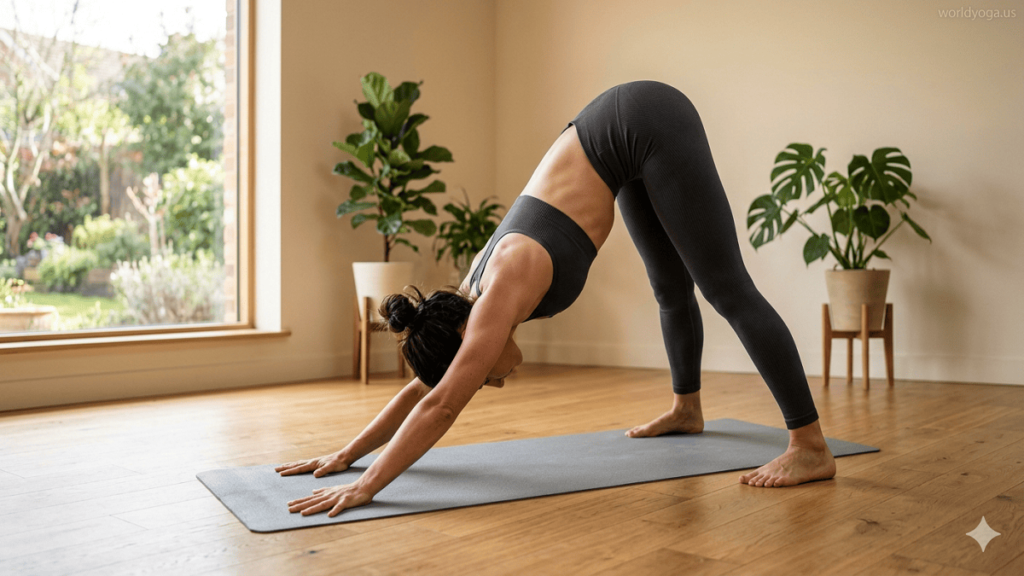
In this posture, the hands remain firmly grounded at shoulder-width distance, while the feet are stepped wider toward the edges of the mat. The hips lift upward and back, forming an inverted “V” shape similar to the traditional pose. The wider base of support enhances balance and distributes weight more evenly between the upper and lower body. Practitioners can focus on lengthening the spine and pressing the chest gently toward the thighs without excessive tension.
One of the key benefits of the wide-legged variation is increased flexibility in the inner thighs (adductors) and hips. The broader stance allows for a deeper stretch in these areas while reducing compression in the lower back. It also supports better alignment for individuals who may struggle with tightness in the posterior chain, including the hamstrings and calves.
Additionally, this variation can help build upper body strength by maintaining engagement in the shoulders, arms, and wrists. The core remains active to stabilize the pelvis and support spinal alignment. Because of its adaptability, it is often incorporated into beginner yoga classes, therapeutic sessions, and warm-up sequences.
From a practical perspective, the pose can also be used as a transitional posture in flowing sequences, providing a moment of stability and reset between movements. It is especially useful in accommodating practitioners with limited mobility or those recovering from minor injuries, as it allows for modifications without compromising the integrity of the pose.
#Downward Dog: Wide-Legged in Maharashtra
How is Wide-Legged Downward Dog performed correctly?
The Wide-Legged Downward Dog is a supportive variation of Downward Facing Dog that emphasizes stability, accessibility, and improved hip mobility. Performing it correctly requires attention to alignment, controlled movement, and steady breathing.
Begin in a tabletop position with your hands placed shoulder-width apart and knees under your hips. Spread your fingers wide and press firmly through the palms, especially the base of the index finger and thumb, to create a stable foundation. Tuck your toes under and lift your knees off the mat, gradually raising your hips upward and back.
Once in the basic inverted “V” shape, step your feet wider than hip-width apart—ideally toward the edges of your mat. The distance should feel comfortable and allow your pelvis to lift freely without strain. Keep your feet parallel, with toes pointing forward, and distribute weight evenly between both feet.
Focus on lengthening the spine rather than forcing the heels to the floor. Press your chest gently toward your thighs while maintaining a neutral spine. If your hamstrings feel tight, keep a slight bend in the knees to avoid rounding the back. The goal is to create space through the entire back body, from the wrists to the hips.
Engage your arms by keeping them straight but not locked. Externally rotate the upper arms to broaden the shoulders and prevent collapsing into the neck. The shoulder blades should move down the back, creating stability and openness across the upper body. Your head should remain relaxed between your arms, with your gaze directed toward the mat or your feet.
The wider stance shifts some of the stretch into the inner thighs (adductors), so allow your hips to lift evenly without dropping to one side. Engage your core muscles gently to support pelvic alignment and prevent excessive arching in the lower back.
Breathing should remain steady and controlled. Inhale to lengthen the spine and expand the ribcage, and exhale to deepen the stretch and stabilize the posture. Hold the pose for 3 to 5 breaths or longer, depending on comfort and experience.
To exit, walk your feet back toward hip-width and gently lower your knees to the mat, returning to a resting position such as Child’s Pose.
Common mistakes include placing too much weight into the wrists, collapsing the shoulders, or overextending the legs at the expense of spinal alignment. Prioritizing length, balance, and controlled engagement ensures a safe and effective practice.
When performed with proper technique, Wide-Legged Downward Dog provides a stable and accessible way to experience the benefits of the traditional pose while accommodating different flexibility levels.
#Downward Dog: Wide-Legged in Kolkata
What is the proper alignment in this variation?
ep the feet wider than hip-width apart, ensuring they are parallel and evenly grounded. The toes should point forward, and weight should be distributed across all four corners of each foot. This wider stance allows the hips to lift more freely and reduces tension in the hamstrings.
The hips should remain the highest point of the body, lifting upward and back. Avoid letting them sink or shift unevenly. While the wider stance may naturally encourage a slight outward rotation, the pelvis should remain relatively neutral to maintain spinal integrity. The inner thighs engage gently, creating stability through the legs.
The legs should be active but not rigid. Press the heels toward the floor, but do not force them down if it compromises spinal alignment. A slight bend in the knees is acceptable, especially for those with limited flexibility, as it helps maintain length in the back.
The head and neck should stay relaxed, aligned with the spine, and free of tension. The gaze can be directed toward the mat or between the feet, depending on comfort.
Breath plays a supportive role in maintaining alignment. Each inhale can be used to lengthen the spine, while each exhale helps ground the hands and feet and deepen stability.
Common misalignments include collapsing into the shoulders, overloading the wrists, and rounding the back due to tight hamstrings. These can be corrected by prioritizing spinal length, engaging the core, and adjusting the stance as needed.
When practiced with proper alignment, Wide-Legged Downward Dog provides a stable, accessible, and effective posture that enhances flexibility, strength, and overall body awareness.
#Downward Dog: Wide-Legged in Ahemadabad
Which muscles are engaged during the pose?
The Wide-Legged Downward Dog is a full-body posture that activates multiple muscle groups simultaneously, with slight emphasis differences compared to Downward Facing Dog due to the wider stance. This variation enhances stability while promoting both strength and flexibility.
In the upper body, the shoulders and arms play a primary stabilizing role. The deltoids support shoulder flexion, while the triceps keep the arms extended. The rotator cuff muscles work to stabilize the shoulder joints, preventing collapse and ensuring proper alignment. Additionally, the trapezius and serratus anterior engage to control the movement of the shoulder blades, creating a strong and stable upper back.
The core muscles are actively engaged to maintain spinal alignment. The transverse abdominis, rectus abdominis, and obliques work together to stabilize the torso and prevent excessive arching or rounding of the spine. This engagement is essential for distributing weight evenly and protecting the lower back.
In the lower body, the wider stance shifts more emphasis onto the inner thighs. The adductor muscle group is significantly engaged to maintain leg stability and prevent the feet from collapsing inward. At the same time, the quadriceps activate to support the knees and keep the legs strong and aligned.
The hamstrings and calves of both legs are lengthened and engaged. While they experience a stretch, they also contribute to maintaining balance and control in the pose. The gastrocnemius and soleus muscles in the calves assist in grounding the heels toward the floor and stabilizing the ankles.
The gluteal muscles, particularly the gluteus medius and minimus, play an important role in stabilizing the pelvis. They help maintain even weight distribution and prevent excessive shifting from side to side. The gluteus maximus contributes to hip extension, supporting the lift of the hips upward.
Additionally, the muscles of the feet and ankles provide a stable base. These smaller stabilizing muscles continuously adjust to maintain balance, especially given the broader stance.
Overall, this pose creates a balanced combination of muscular engagement and stretching. The upper body builds strength and endurance, the core ensures stability, and the lower body develops both flexibility and control.
For deeper anatomical understanding and guided practice, resources from Yoga Journal and Yoga International offer detailed insights into muscle activation and alignment.
Practicing Wide-Legged Downward Dog with awareness of these muscle groups helps improve technique, efficiency, and overall effectiveness of the posture.
#Downward Dog: Wide-Legged in Hyderabad
What preparatory poses are recommended?
Preparing the body for Wide-Legged Downward Dog involves improving shoulder stability, spinal length, and flexibility in the hamstrings and inner thighs. Since this variation of Downward Facing Dog introduces a broader stance, it also requires additional awareness in the hips and adductors. The following preparatory poses help build the necessary strength and mobility for safe and effective practice.
A foundational starting point is Tabletop Pose. This position helps establish proper hand placement, shoulder alignment, and core engagement without the complexity of inversion. It is particularly useful for beginners to develop awareness of weight distribution.
Next, Puppy Pose is beneficial for opening the shoulders and upper back. This gentle stretch prepares the arms and spine for the weight-bearing demands of the pose while encouraging proper extension through the thoracic spine.
To target the inner thighs and hips, Wide-Legged Forward Fold is highly effective. This posture stretches the adductors and hamstrings, helping the body adapt to the wider stance required in the pose. It also reinforces the concept of hinging at the hips while maintaining a long spine.
For hamstring flexibility and posterior chain preparation, Standing Forward Bend is recommended. It improves range of motion in the legs and supports better alignment when transitioning into inverted positions.
Core and shoulder strength can be developed through Plank Pose. This pose builds the foundational strength needed to support body weight through the arms and maintain stability in the shoulders and torso.
Another useful preparation is Low Lunge, which opens the hips and stretches the hip flexors. This helps create balance between flexibility and strength in the lower body, supporting smoother transitions into wider stances.
Additionally, practicing a gentle version of Downward Facing Dog itself allows practitioners to gradually build familiarity with the alignment and engagement required before widening the stance.
Incorporating these preparatory poses into a regular sequence enhances flexibility, builds strength, and improves body awareness. This progression ensures that practitioners can approach Wide-Legged Downward Dog with greater confidence, stability, and proper alignment.
#Downward Dog: Wide-Legged in Delhi
What are the benefits and precautions of this variation?
The Wide-Legged Downward Dog offers a supportive and accessible variation of Downward Facing Dog, delivering a range of physical and functional benefits while requiring mindful execution to avoid strain.
Benefits
One of the primary advantages of this variation is improved stability. The wider stance creates a broader base of support, making it easier for practitioners—especially beginners—to maintain balance and proper alignment. This added stability allows for greater focus on spinal length and shoulder engagement without feeling restricted by tight hamstrings.
The pose enhances flexibility, particularly in the inner thighs (adductors), hamstrings, and calves. By widening the feet, the stretch is distributed more evenly across the lower body, reducing excessive tension in any single muscle group. This makes it especially beneficial for individuals with limited flexibility.
Upper body strength is also developed through sustained weight-bearing in the arms and shoulders. The deltoids, triceps, and upper back muscles work together to stabilize the posture, contributing to improved posture and functional strength. At the same time, the core muscles engage to support the spine and maintain pelvic alignment.
Another benefit is reduced strain on the lower back. Compared to the traditional version, the wider stance can help alleviate compression in the lumbar region by allowing more space for the pelvis to tilt naturally. This makes the pose suitable for those who may experience discomfort in narrower stances.
Additionally, the mild inversion supports circulation and may promote mental clarity and relaxation. It can serve as a transitional or restorative posture within a yoga sequence, helping to reset the body between more demanding movements.
Precautions
Despite its accessibility, certain precautions should be observed. Individuals with wrist or shoulder injuries should approach the pose carefully, as it still requires significant upper body support. Proper hand placement and weight distribution are essential to minimize strain.
A common mistake is collapsing into the shoulders or placing excessive pressure on the wrists. This can be avoided by actively pressing through the hands, engaging the arms, and lifting the shoulders away from the ears. Using props or modifying the pose may be helpful for those with limited strength.
Overstretching is another concern, particularly in the inner thighs and hamstrings. Practitioners should avoid forcing the heels to the floor or widening the stance beyond their comfortable range. Maintaining a slight bend in the knees can help protect the muscles and joints.
Improper spinal alignment, such as rounding the back or over-arching the lower spine, can also lead to discomfort. Emphasizing length through the spine and engaging the core helps maintain a neutral and safe position.
For additional safety guidelines and technique refinement, resources from Yoga Journal and Yoga Alliance provide expert-backed recommendations.
#Downward Dog: Wide-Legged in Pune
Case Study of Downward Dog: Wide-Legged
This case study explores the application of Wide-Legged Downward Dog within a structured yoga intervention designed to improve flexibility, postural alignment, and functional strength. The subject was a 40-year-old working professional experiencing mild lower back stiffness, tight hamstrings, and limited shoulder mobility due to prolonged desk-based work.
Initial Assessment:
At baseline, the participant demonstrated difficulty maintaining proper alignment in Downward Facing Dog. Observations included rounding of the spine, excessive tension in the hamstrings, and discomfort in the lower back. The subject also showed reduced shoulder endurance and limited awareness of weight distribution through the hands and feet.
Intervention Plan:
A six-week yoga program was designed, incorporating the wide-legged variation as a central posture. Sessions were conducted four times per week, each lasting approximately 30 minutes. During the first two weeks, emphasis was placed on preparatory poses such as Puppy Pose, Standing Forward Bend, and Low Lunge to improve flexibility and mobility.
From weeks three to four, the participant was introduced to Wide-Legged Downward Dog with a moderate stance width. Verbal cues focused on spinal length, even weight distribution, and gentle engagement of the core. The participant was encouraged to maintain a slight bend in the knees to prevent strain.
In the final two weeks, the stance was gradually widened, and the pose was held for longer durations (20–30 seconds per repetition). Additional attention was given to shoulder stability and controlled breathing to enhance endurance and relaxation.
Outcomes:
Post-intervention assessment showed notable improvements. Hamstring flexibility increased, allowing the participant to achieve a more extended leg position without compromising spinal alignment. The subject reported reduced lower back discomfort, attributed to improved posture and core engagement.
Shoulder strength and endurance also improved, enabling the participant to maintain the pose with greater ease and stability. Balance and body awareness were enhanced, particularly in distributing weight evenly between the upper and lower body.
Discussion:
The findings indicate that Wide-Legged Downward Dog is an effective modification for individuals with limited flexibility or discomfort in traditional poses. The wider stance reduces strain on the posterior chain while promoting proper alignment and gradual progression.
Conclusion:
This case study supports the use of the wide-legged variation as a practical and accessible alternative within yoga practice. When integrated into a structured program, it contributes to improved flexibility, strength, and postural health. For further evidence-based guidance and instructional resources, organizations such as Yoga Journal and Yoga Alliance provide valuable insights and professional standards.
#Downward Dog: Wide-Legged in Kolkata
White Paper of Downward Dog: Wide-Legged
Abstract
The Wide-Legged Downward Dog is a modified form of Downward Facing Dog designed to enhance accessibility, stability, and flexibility. This variation is particularly effective for individuals with limited hamstring mobility or lower back sensitivity. This paper examines its biomechanical properties, physiological benefits, and applications across fitness, rehabilitation, and wellness domains.
Introduction
Musculoskeletal discomfort, especially in the lower back and hamstrings, is increasingly prevalent due to sedentary lifestyles. Yoga-based interventions provide a non-invasive method to address these issues. The wide-legged variation of Downward Dog offers a practical solution by reducing strain while maintaining the fundamental benefits of the traditional posture.
Biomechanical Analysis
In this variation, the wider stance alters the distribution of forces across the body. The upper body functions as a closed-chain system, with the shoulders in flexion and the arms supporting body weight through isometric contraction. Stabilization is achieved through the coordinated action of the deltoids, triceps, and rotator cuff muscles.
The spine is maintained in axial extension, supported by activation of the core musculature, including the transverse abdominis and obliques. The widened foot placement increases engagement of the adductor group (inner thighs), while simultaneously reducing the intensity of stretch on the hamstrings. This redistribution allows for improved pelvic positioning and reduced lumbar compression.
Physiological Benefits
Regular practice of Wide-Legged Downward Dog enhances flexibility in the hips, inner thighs, and calves. It also improves upper body strength and endurance through sustained weight-bearing. The pose supports spinal decompression and may alleviate mild lower back discomfort by encouraging proper alignment.
Additionally, the mild inversion facilitates improved circulation and may contribute to enhanced mental clarity and relaxation. The broader base of support also promotes balance and proprioceptive awareness, making it suitable for a wide range of practitioners.
Applications
This variation is widely used in beginner yoga classes, therapeutic programs, and corporate wellness initiatives. It is particularly beneficial in rehabilitation settings, where reduced strain and increased stability are essential. Fitness professionals incorporate it into warm-up and recovery routines to improve mobility and prevent injury.
Digital platforms and educational providers such as Yoga Journal and Yoga International frequently include this pose in instructional content due to its adaptability and effectiveness.
Limitations and Precautions
Despite its accessibility, improper alignment can lead to strain in the wrists, shoulders, or inner thighs. Overextending the stance or neglecting core engagement may compromise spinal integrity. Individuals with existing injuries should seek professional guidance before practice.
Conclusion
The Wide-Legged Downward Dog represents a functional and adaptable posture that supports flexibility, strength, and alignment. Its integration into structured programs across multiple industries highlights its value as both a foundational and therapeutic movement.
#Downward Dog: Wide-Legged in Banglore
Industry Application of Downward Dog: Wide-Legged
The Wide-Legged Downward Dog has gained relevance across multiple industries due to its adaptability, accessibility, and functional benefits. As a modified version of Downward Facing Dog, it is particularly valuable in environments where inclusivity, injury prevention, and gradual progression are priorities.
Fitness and Wellness Industry
In the fitness sector, this variation is widely used in yoga classes, especially beginner and mixed-level sessions. Its wider stance provides greater stability, allowing instructors to introduce foundational alignment principles without overwhelming participants. It is commonly included in Vinyasa, Hatha, and restorative yoga sequences, serving as both a strengthening posture and a transitional movement. Fitness professionals also use it to improve flexibility in the hips and inner thighs while building upper body endurance.
Healthcare and Rehabilitation
Physiotherapists and rehabilitation specialists incorporate this pose into recovery programs for individuals with limited mobility, tight hamstrings, or mild lower back discomfort. The wider stance reduces strain on the posterior chain and allows for safer spinal alignment. It is particularly useful in early-stage rehabilitation where controlled, low-impact movement is essential. The pose helps restore functional movement patterns and supports gradual strength development.
Corporate Wellness Programs
Organizations are increasingly integrating yoga into workplace wellness initiatives to address issues related to prolonged sitting and poor posture. The wide-legged variation is especially suitable in these settings because it is more accessible and less demanding than advanced postures. It helps relieve tension in the lower back, improve circulation, and enhance focus. Programs aligned with standards from Yoga Alliance often include such adaptable poses to cater to diverse employee needs.
Sports Performance and Athletic Training
In athletic conditioning, this pose is used to improve flexibility, balance, and recovery. Coaches integrate it into warm-up and cool-down routines to enhance range of motion in the hips and legs while maintaining upper body strength. The emphasis on controlled movement and stability supports injury prevention and better performance in sports requiring agility and coordination.
Digital Fitness and Online Education
With the growth of virtual fitness platforms, the pose is frequently featured in online classes and instructional content. Platforms such as Yoga Journal and Yoga International use it in tutorials and certification programs due to its versatility and suitability for a wide audience. It is often recommended as a modification for practitioners who find the traditional pose challenging.
Conclusion
The Wide-Legged Downward Dog demonstrates strong cross-industry applicability. Its ability to accommodate different skill levels while delivering measurable physical benefits makes it a valuable tool in fitness, healthcare, corporate wellness, and digital education sectors.
#Downward Dog: Wide-Legged in Mumbai
Ask FAQs
What is Wide-Legged Downward Dog?
The Wide-Legged Downward Dog is a modified version of Downward Facing Dog where the feet are placed wider than hip-width apart to improve stability, comfort, and flexibility.
Who can practice this pose?
This variation is suitable for beginners, intermediate practitioners, and individuals with tight hamstrings or mild lower back discomfort. It is often recommended as a more accessible alternative to the traditional form.
What are the main benefits of this pose?
It helps improve flexibility in the inner thighs, hamstrings, and calves while building strength in the shoulders, arms, and core. It also supports spinal alignment and can reduce tension in the lower back when practiced correctly.
Are there any precautions to consider?
Yes. Practitioners should avoid over-widening the stance or collapsing into the shoulders and wrists. Individuals with wrist, shoulder, or spinal injuries should practice under guidance and may need modifications such as bending the knees slightly.
How long should the pose be held?
The pose is typically held for 3–5 breaths in flow sequences, though beginners may hold it for shorter durations. The focus should always be on alignment and comfort rather than time.
Table of Contents
Disclaimer:
This content is for educational purposes only and is not a substitute for professional medical advice. Practice Wide-Legged Downward Dog under the guidance of a qualified instructor. Individuals with injuries or medical conditions should consult a healthcare professional before attempting any yoga practice.