Vishama Ashtavakrasana
Vishama Ashtavakrasana is an advanced arm-balancing yoga posture derived from classical Hatha Yoga traditions. The name comes from Sanskrit: “Vishama” meaning uneven or complex, and “Ashtavakra,” referring to the ancient sage Ashtavakra, whose body was said to be bent in eight places. “Asana” means posture. This pose is considered a deeper variation of Ashtavakrasana and demands significant strength, flexibility, balance, and body awareness.
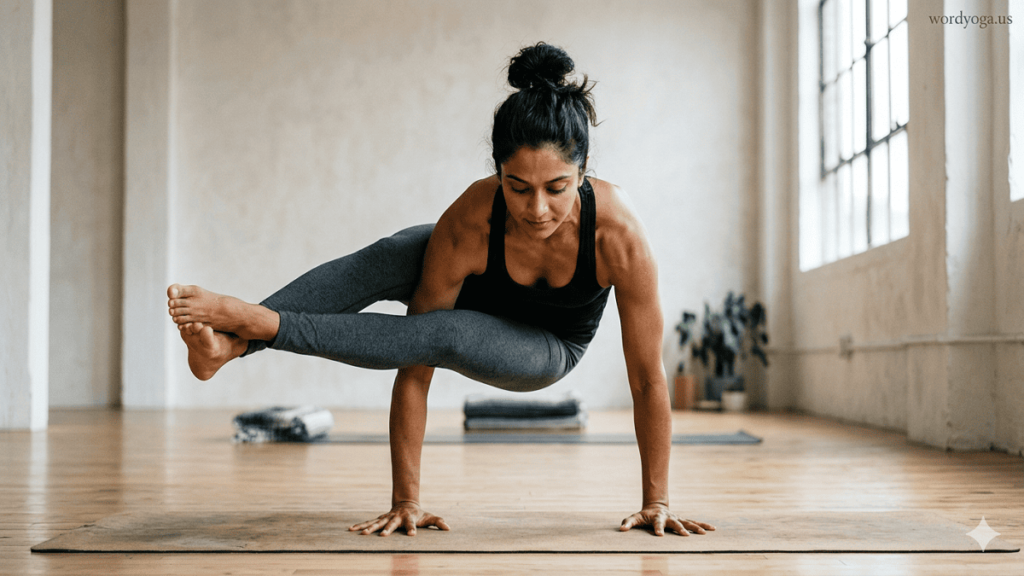
This posture is primarily an asymmetrical arm balance where the practitioner lifts the body off the ground using the arms while twisting the torso and crossing the legs over one arm. Vishama Ashtavakrasana intensifies the classical version by increasing the complexity of leg positioning and spinal rotation, making it suitable only for advanced practitioners.
To attempt this pose, one generally begins in a seated position with legs extended. The practitioner then bends one leg and threads it over the corresponding arm (usually the upper arm near the shoulder). The opposite leg is lifted and crossed over the other ankle, creating a locked structure. With palms firmly grounded, the practitioner shifts weight forward, engages the core, and gradually lifts both legs off the floor while maintaining a twist in the torso. Controlled breathing and strong engagement of the abdominal and arm muscles are essential to maintain stability.
The benefits of Vishama Ashtavakrasana are extensive. Physically, it strengthens the arms, shoulders, wrists, and core muscles. It improves spinal flexibility, enhances balance, and develops deep proprioceptive awareness. The twisting motion stimulates the abdominal organs, which may support digestion and detoxification. Mentally, the pose builds focus, patience, and resilience, as it requires calm concentration under physical challenge.
However, this posture is not recommended for beginners. Individuals with wrist injuries, shoulder instability, herniated discs, or high blood pressure should avoid or modify this pose. Proper preparation through foundational arm balances such as Bakasana (Crow Pose) and core-strengthening exercises is strongly advised before attempting Vishama Ashtavakrasana.
Progression into this pose should be gradual. Preparatory poses include Plank Pose, Side Plank, Chaturanga Dandasana, and hip-opening postures like Pigeon Pose. Regular practice of these helps build the required strength and mobility.
For further reference and structured guidance, you may explore the following resources:
https://www.yogajournal.com/poses/ashtavakrasana-eight-angle-pose/
https://www.verywellfit.com/ashtavakrasana-eight-angle-pose-3567150
https://www.ekhartyoga.com/resources/yoga-poses/ashtavakrasana
In summary, Vishama Ashtavakrasana is a highly advanced yoga posture that combines strength, balance, and deep twisting action. It is best approached with patience, consistent preparation, and mindful practice under the guidance of an experienced instructor.
#Vishama Ashtavakrasana in India
What is Vishama Ashtavakrasana?
Vishama Ashtavakrasana is an advanced arm-balancing yoga posture that originates from classical Hatha Yoga traditions and is considered a complex variation of the traditional Ashtavakrasana. The name is derived from Sanskrit: “Vishama” meaning uneven, difficult, or irregular; “Ashtavakra,” referring to the ancient sage Ashtavakra, who was traditionally described as being physically bent in eight places; and “Asana,” meaning posture. This variation increases the difficulty of the standard pose by adding greater asymmetry, deeper spinal rotation, and more demanding leg positioning.
The foundational posture, Ashtavakrasana, is already a challenging arm balance requiring core strength, wrist stability, shoulder engagement, and strong hip flexibility. Vishama Ashtavakrasana builds upon this by introducing additional complexity in how the legs are crossed and locked around the arms, often creating a more unstable center of gravity that demands heightened control and concentration.
In practice, Vishama Ashtavakrasana begins from a seated position with extended legs. The practitioner bends one leg and threads it over the upper arm, anchoring it near the shoulder. The second leg is then crossed in a modified configuration over or under the first leg depending on the variation being practiced. The hands are placed firmly on the ground beside the hips. By engaging the core muscles and leaning forward, the practitioner gradually lifts the body off the floor while maintaining the twist in the torso and the bind of the legs around the arm.
This posture requires a combination of strength, flexibility, and neuromuscular coordination. The arms and shoulders support most of the body weight, while the abdominal muscles stabilize the trunk and control the twisting motion. The hips must be open enough to allow the legs to wrap and lock without strain. Breath control plays a key role, as steady inhalation and exhalation help maintain balance and reduce tension.
The benefits of Vishama Ashtavakrasana are both physical and mental. Physically, it strengthens the wrists, arms, shoulders, and core muscles while enhancing hip flexibility and spinal mobility. It also stimulates abdominal organs, which may support digestion and internal massage of the viscera. Mentally, the posture develops focus, patience, and resilience, as it requires sustained concentration and calmness under physical challenge.
However, this is an advanced posture and should not be attempted without adequate preparation. Practitioners with wrist injuries, shoulder instability, or spinal conditions should avoid it. Preparatory poses such as Plank Pose, Chaturanga Dandasana, Side Plank, and hip openers like Pigeon Pose are strongly recommended to build the necessary strength and mobility.
For further reading and structured guidance, you may refer to:
https://www.yogajournal.com/poses/ashtavakrasana-eight-angle-pose/
https://www.ekhartyoga.com/resources/yoga-poses/ashtavakrasana
https://www.verywellfit.com/ashtavakrasana-eight-angle-pose-3567150
In summary, Vishama Ashtavakrasana is a highly advanced and intricate arm balance that challenges the practitioner’s strength, flexibility, and mental discipline beyond the standard Ashtavakrasana variation.
#Vishama Ashtavakrasana in Maharashtra
How is the pose performed correctly?
Vishama Ashtavakrasana is an advanced arm balance that requires a combination of strength, flexibility, and precise body coordination. It is typically practiced only after mastering foundational arm balances such as the standard Ashtavakrasana. The correct performance of the pose depends on controlled entry, secure binding of the legs, stable arm support, and mindful exit.
The pose begins in a seated position on a yoga mat with the legs extended forward. The spine should be upright and the core gently engaged. The practitioner then bends one knee and brings that leg toward the chest. The next step involves threading this leg over the corresponding upper arm, positioning the knee high near the shoulder. This creates the initial “hook” that anchors the lower body to the upper arm.
Once the first leg is secured, the second leg is positioned into the asymmetrical bind that characterizes Vishama Ashtavakrasana. Depending on the variation taught, the second leg may either cross tightly over the first ankle or wrap in a staggered configuration to deepen the asymmetry. This creates a locked structure that helps stabilize the body once lifted.
The hands are then placed firmly on the floor beside the hips, shoulder-width apart or slightly wider. Fingers are spread wide to distribute pressure evenly across the palms and wrists. The elbows should remain slightly bent but stable, avoiding hyperextension. At this stage, the practitioner leans forward, shifting the center of gravity over the wrists.
Core engagement is crucial. The abdominal muscles are drawn inward and upward to support spinal stability. With a controlled exhalation, the practitioner begins to lift the hips off the ground. The legs remain tightly bound around the arm, and the torso rotates slightly to accommodate the asymmetrical leg position. Both feet gradually lift off the mat as balance is achieved.
Breath control plays a central role in maintaining stability. Slow, steady breathing helps reduce muscular tension and prevents collapse in the shoulders or core. The gaze is typically directed slightly forward on the floor to maintain focus and alignment.
To exit the pose safely, the practitioner gently lowers the feet back to the ground with control, releasing the leg bind first and then returning to a seated position. It is important to avoid dropping the body abruptly, as this may strain the wrists or shoulders.
Correct execution of Vishama Ashtavakrasana depends heavily on preparatory conditioning. Poses such as Plank Pose, Chaturanga Dandasana, Side Plank, and hip-opening postures like Pigeon Pose are essential for building the required strength and mobility. Wrist warm-ups are also recommended to prevent strain.
Common mistakes include collapsing the chest, overloading the wrists, or attempting the lift without sufficient hip flexibility or core engagement. These errors can lead to instability and potential injury.
For additional technical guidance and visual breakdowns, you may refer to:
https://www.yogajournal.com/poses/ashtavakrasana-eight-angle-pose/
https://www.ekhartyoga.com/resources/yoga-poses/ashtavakrasana
https://www.verywellfit.com/ashtavakrasana-eight-angle-pose-3567150
In summary, correct performance of Vishama Ashtavakrasana requires a structured sequence of binding, weight transfer, core activation, and controlled lifting, all executed with precision and steady breath awareness.
#Vishama Ashtavakrasana in Ahemadabad
What are its benefits?
Vishama Ashtavakrasana is an advanced arm balance yoga posture that builds upon the classical Ashtavakrasana. Because it involves deep core engagement, asymmetrical binding of the legs, and full body weight support on the arms, it offers a wide range of physical, neurological, and mental benefits when practiced correctly and consistently.
From a physical perspective, one of the primary benefits of Vishama Ashtavakrasana is significant strengthening of the upper body. The wrists, forearms, elbows, shoulders, and chest muscles are all heavily engaged to support body weight. This leads to improved joint stability and muscular endurance in the upper limbs. The posture also strongly activates the core muscles, including the rectus abdominis, obliques, and deeper stabilizing muscles. This improves abdominal strength and enhances overall trunk control.
Another important benefit is improved hip mobility and flexibility. The leg-binding and twisting action require deep external rotation of the hips and coordinated engagement of the inner thighs. Over time, this can help release tightness in the hip flexors and groin area, especially for individuals who spend long hours sitting. Additionally, the spinal twist involved in the posture promotes improved spinal mobility and may help maintain functional range of motion in the back.
Vishama Ashtavakrasana also enhances balance and proprioception. Because the pose shifts the body’s center of gravity onto the hands while the legs are asymmetrically bound, the practitioner must constantly make micro-adjustments to remain stable. This improves neuromuscular coordination and body awareness, which can translate into better balance in everyday movement patterns.
From a physiological standpoint, the compression and twisting of the abdominal region may gently stimulate internal organs. This can support digestive efficiency by encouraging movement and circulation in the abdominal cavity. While such effects are often described in traditional yoga systems, they should be understood as supportive rather than medical treatments.
Mentally, this posture offers strong benefits in terms of focus and concentration. Maintaining the pose requires sustained attention, calm breathing, and the ability to stay composed under physical challenge. This trains the nervous system to remain steady in difficult situations, supporting stress management and emotional resilience. The effort required to enter and hold the pose also builds patience and discipline, as progress typically occurs gradually over time.
Practicing Vishama Ashtavakrasana can also improve confidence and mental determination. Successfully lifting into and holding the balance often provides a sense of accomplishment, reinforcing perseverance and self-trust in advanced physical practice.
However, it is important to note that the benefits of this pose are only accessible when practiced with proper preparation and alignment. Without adequate strength and flexibility, the pose may place excessive strain on the wrists, shoulders, or lower back.
For further reference on arm balance benefits and structured guidance, you may explore:
https://www.yogajournal.com/poses/ashtavakrasana-eight-angle-pose/
https://www.ekhartyoga.com/resources/yoga-poses/ashtavakrasana
https://www.verywellfit.com/ashtavakrasana-eight-angle-pose-3567150
In summary, Vishama Ashtavakrasana develops upper-body strength, core stability, hip flexibility, balance, and mental focus, making it a highly comprehensive posture for advanced yoga practitioners.
#Vishama Ashtavakrasana in Hyderabad
What are common mistakes?
Common mistakes in Vishama Ashtavakrasana usually arise from attempting the posture before sufficient preparation or from misplacing body weight during the transition into the arm balance. Because this pose is an advanced variation of Ashtavakrasana, even small alignment errors can significantly affect stability and increase the risk of strain, particularly in the wrists, shoulders, and lower back.
One of the most frequent mistakes is inadequate preparation of the hips and core. Practitioners often try to enter the pose without sufficient hip flexibility or abdominal strength. As a result, the legs cannot securely bind around the arm, causing instability and forcing excessive load onto the upper body. When the core is not properly engaged, the pelvis drops, and the spine collapses, making it difficult to lift the body safely off the ground.
Another common error is incorrect weight distribution in the hands. Many practitioners place too much pressure on the wrists instead of evenly distributing weight across the palms and fingers. This can lead to wrist discomfort or strain over time. Additionally, failing to actively press the fingers into the ground reduces control and makes balancing significantly more difficult.
A third mistake involves poor elbow positioning. Locking the elbows or allowing them to flare outward reduces structural stability. The elbows should remain slightly bent and engaged, creating a stable “shelf” for supporting body weight. When this engagement is missing, the upper body tends to collapse forward or sideways.
Improper leg binding is another key issue. In Vishama Ashtavakrasana, the asymmetrical crossing of the legs must be secure enough to anchor the body to the arm. If the legs are loosely placed or incorrectly positioned, they may slip during the lift, breaking balance and increasing the risk of falling. Many practitioners also rush this stage instead of carefully setting the bind before attempting to lift.
A related mistake is attempting to lift too quickly without controlled weight transfer. The transition from seated position to arm balance must be gradual, with the center of gravity slowly shifting forward. When practitioners try to “jump” into the pose instead of leaning with control, they often lose alignment and fail to engage the core properly.
Breath control is also commonly neglected. Holding the breath or breathing irregularly creates unnecessary tension in the body, which reduces balance and endurance. Steady, calm breathing is essential to maintain focus and stability throughout the posture.
Finally, lack of preparatory conditioning is a major underlying issue. Without building strength through poses like Plank, Chaturanga Dandasana, Side Plank, and hip openers, the body is not adequately prepared for the demands of this arm balance. Attempting the posture prematurely is one of the most significant causes of strain or failure.
Avoiding these mistakes requires patience, consistent practice, and attention to alignment rather than force. Proper progression ensures that strength, flexibility, and coordination develop safely over time.
For additional technical guidance, you may refer to:
https://www.yogajournal.com/poses/ashtavakrasana-eight-angle-pose/
https://www.ekhartyoga.com/resources/yoga-poses/ashtavakrasana
https://www.verywellfit.com/ashtavakrasana-eight-angle-pose-3567150
#Vishama Ashtavakrasana in Pune
Who should avoid this pose?
Vishama Ashtavakrasana is a highly advanced arm balance derived from the classical Ashtavakrasana, and it places significant load on the wrists, shoulders, core, and hips. Because of its intensity and technical demand, it is not suitable for everyone. Certain individuals should avoid this posture entirely or practice it only under strict supervision from an experienced yoga instructor.
People with wrist injuries should avoid this pose. The posture requires strong and sustained weight-bearing through the hands, which can aggravate conditions such as wrist sprains, carpal tunnel syndrome, tendonitis, or chronic wrist pain. Similarly, individuals with shoulder injuries, instability, or a history of dislocations should refrain from practicing it, as the shoulders must support and stabilize the entire body weight during the arm balance.
Those with lower back issues, such as herniated discs, sciatica, or chronic lumbar pain, should also avoid Vishama Ashtavakrasana. The deep twisting and forward weight shift involved in the pose can place stress on the spine, potentially worsening existing conditions if not carefully managed.
People with weak core strength or limited hip flexibility are also not ideal candidates for this posture. Since the pose relies heavily on abdominal engagement and hip opening to securely bind the legs around the arm, insufficient strength or mobility can lead to instability and increased risk of falling or straining the body.
Individuals with high blood pressure or cardiovascular conditions should exercise caution. Inversions and strong arm balances can temporarily increase intra-abdominal and thoracic pressure, which may not be advisable for those with uncontrolled hypertension or related health concerns.
Pregnant individuals should avoid this pose entirely. The compression of the abdomen, deep twisting, and high risk of imbalance make it unsafe during pregnancy. Similarly, people recovering from recent abdominal surgery should not attempt this posture until fully healed and medically cleared.
Beginners in yoga practice are generally not recommended to attempt Vishama Ashtavakrasana. Without prior experience in foundational poses and arm balances, the body lacks the necessary strength, coordination, and proprioceptive awareness required for safe execution.
Even experienced practitioners should approach this pose with caution if they are fatigued or lacking proper warm-up, as cold muscles and joints increase the risk of strain.
Safe progression is essential. Preparatory poses such as Plank Pose, Chaturanga Dandasana, Side Plank, and hip-opening postures like Pigeon Pose help build the required strength and mobility before attempting advanced arm balances.
For further reading on arm balance safety and contraindications, you may refer to:
https://www.yogajournal.com/poses/ashtavakrasana-eight-angle-pose/
https://www.ekhartyoga.com/resources/yoga-poses/ashtavakrasana
https://www.verywellfit.com/ashtavakrasana-eight-angle-pose-3567150
In summary, Vishama Ashtavakrasana should be avoided by individuals with wrist, shoulder, or spinal injuries, pregnant practitioners, those with cardiovascular concerns, and anyone without adequate strength, flexibility, or preparatory training.
#Vishama Ashtavakrasana in Kolkata
Case Study of Vishama Ashtavakrasana
Vishama Ashtavakrasana is an advanced asymmetrical arm balance derived from the classical Ashtavakrasana. It demands a combination of upper-body strength, core stability, hip flexibility, and precise neuromuscular coordination. The following case study examines three practitioners with different backgrounds to understand readiness, execution challenges, risks, and outcomes.
Case 1: Intermediate Practitioner Progressing Too Quickly
Profile:
A 28-year-old recreational yoga practitioner with 18 months of consistent practice. Strong interest in arm balances and inversion transitions.
Scenario:
The practitioner attempts Vishama Ashtavakrasana after learning standard arm balances like Crow Pose and Side Plank, but without mastering sustained core engagement or hip opening.
Observations:
During attempts, the practitioner can bind the legs partially but fails to maintain stable forward weight shift. The elbows collapse outward, and weight distribution is uneven across the palms.
Outcome:
The attempt results in wrist strain and loss of balance. The practitioner is advised to pause arm balance progression and return to foundational strength-building sequences.
Key Insight:
Premature entry into complex asymmetrical balances increases risk of joint overload, particularly in the wrists and shoulders.
Case 2: Experienced Yogi with Strong Foundation
Profile:
A 35-year-old yoga instructor with 8 years of practice, including consistent arm balance training and hip-opening work.
Scenario:
Attempts Vishama Ashtavakrasana as part of an advanced sequencing workshop.
Observations:
The practitioner successfully establishes leg binding, maintains strong scapular engagement, and gradually shifts center of gravity forward. Breath remains steady, enabling controlled lift and hold for several seconds.
Outcome:
Successful execution with minor instability during exit transition. No injury reported. The practitioner demonstrates improved proprioception and control over asymmetrical load distribution.
Key Insight:
Adequate preparation in core strength and shoulder stability significantly improves success rate and safety.
Case 3: Practitioner with Hip Tightness and Sedentary Lifestyle
Profile:
A 40-year-old office worker with limited hip mobility and weak core musculature.
Scenario:
Attempts the posture after online guidance without structured preparation.
Observations:
Inability to securely cross legs over the arm leads to instability. Excessive reliance on arm strength causes rapid fatigue and loss of alignment.
Outcome:
Pose is abandoned mid-attempt due to discomfort in wrists and hips. Practitioner shifts focus to preparatory poses such as Plank, Pigeon Pose, and mobility drills.
Key Insight:
Hip flexibility is a limiting factor in achieving secure leg binding, making progression essential before attempting full expression.
Conclusion
These cases demonstrate that Vishama Ashtavakrasana is highly dependent on progressive preparation and individualized readiness. Success is not determined solely by strength, but by integration of flexibility, alignment awareness, and controlled weight transfer.
For additional technical references on arm balance progression and safety principles, see:
https://www.yogajournal.com/poses/ashtavakrasana-eight-angle-pose/
https://www.ekhartyoga.com/resources/yoga-poses/ashtavakrasana
https://www.verywellfit.com/ashtavakrasana-eight-angle-pose-3567150
#Vishama Ashtavakrasana in Banglore

White Paper of Vishama Ashtavakrasana
1. Abstract
Vishama Ashtavakrasana is an advanced arm-balancing yoga posture derived from classical Hatha Yoga traditions and based on the foundational structure of Ashtavakrasana. This white paper examines its biomechanical structure, physiological demands, progression requirements, benefits, risks, and recommended training methodology. The pose is characterized by asymmetrical leg binding, spinal rotation, and full-body weight support through the upper limbs, making it one of the more complex arm balances in modern yoga practice.
2. Introduction
The posture originates from traditional yoga systems emphasizing strength, stability, and mind-body integration. Vishama Ashtavakrasana represents an intensified variation of Ashtavakrasana, introducing uneven limb positioning that increases neuromuscular demand. It is typically practiced in advanced yoga disciplines such as Vinyasa, Ashtanga, and contemporary arm balance training systems.
3. Biomechanical Analysis
The pose involves multiple joint systems working simultaneously:
- Upper body: Shoulder girdle depression, scapular protraction, and wrist extension under load
- Core: Rectus abdominis, obliques, and transverse abdominis provide stabilization
- Hips: Deep external rotation and flexion required for leg binding
- Spine: Controlled rotational torque with isometric stabilization
The asymmetry increases lateral instability, requiring continuous micro-adjustments to maintain equilibrium.
4. Physiological Demands
Vishama Ashtavakrasana places high demand on:
- Muscular endurance (especially wrists, deltoids, and core muscles)
- Proprioceptive control and neuromuscular coordination
- Breath regulation under physical load
- Joint integrity in wrists, elbows, and shoulders
Energy expenditure is moderate to high due to sustained isometric contraction.
5. Progression Framework
Safe entry into the posture requires structured progression:
Foundational Phase
- Plank Pose
- Chaturanga Dandasana
- Side Plank
Intermediate Phase
- Crow Pose
- Lolasana (arm balance conditioning)
- Hip-opening postures (Pigeon Pose, Bound Angle Pose)
Advanced Phase
- Standard Ashtavakrasana
- Assisted Vishama variations
- Full expression without support
6. Benefits
- Strengthens upper body musculature
- Enhances core stability and spinal control
- Improves hip mobility and flexibility
- Develops balance and proprioceptive awareness
- Builds mental focus and stress tolerance
7. Risk Profile and Contraindications
Common risks include wrist strain, shoulder overload, and lower back stress. Contraindications include:
- Wrist injuries or carpal tunnel syndrome
- Shoulder instability
- Lumbar disc conditions
- Pregnancy
- Insufficient core strength or beginner-level practice
8. Common Failure Points
- Inadequate leg binding stability
- Premature weight shift into hands
- Collapsed core engagement
- Uneven palm pressure distribution
- Breath holding during lift phase
9. Training Recommendations
- Emphasize progressive overload in arm support strength
- Integrate mobility work for hips and thoracic spine
- Use controlled transitions rather than momentum
- Prioritize breath-led movement patterns
- Practice under qualified supervision
10. Conclusion
Vishama Ashtavakrasana is a high-complexity yoga posture requiring integrated physical and neurological conditioning. While it offers significant strength and coordination benefits, it should only be attempted after mastering foundational arm balances and mobility prerequisites. Its practice represents an advanced stage of yogic physical discipline rather than a beginner or intermediate goal.
References
https://www.yogajournal.com/poses/ashtavakrasana-eight-angle-pose/
https://www.ekhartyoga.com/resources/yoga-poses/ashtavakrasana
https://www.verywellfit.com/ashtavakrasana-eight-angle-pose-3567150
#Vishama Ashtavakrasana in Chennnai
Industry Application of Vishama Ashtavakrasana
Vishama Ashtavakrasana, an advanced asymmetrical arm balance derived from classical Hatha Yoga and the foundational Ashtavakrasana, has growing relevance beyond traditional yoga practice. In modern professional domains, it is applied as a tool for physical conditioning, movement analysis, rehabilitation support (in modified form), athletic training, and wellness education. Its complexity makes it particularly valuable for studying human biomechanics, neuromuscular coordination, and strength integration.
1. Fitness and Strength Training Industry
In contemporary fitness systems, Vishama Ashtavakrasana is used as an advanced bodyweight training benchmark. It integrates isometric strength, core stability, and upper-body endurance. Personal trainers and calisthenics coaches incorporate progressions of this pose to develop functional strength, particularly in the wrists, shoulders, and deep abdominal muscles.
It is often used as a “peak skill” movement in advanced mobility programs, similar to gymnastic holds, helping athletes transition from linear strength training to multi-planar control.
2. Sports Performance and Athletic Conditioning
In sports science, the pose is studied for its demand on proprioception, balance, and kinetic chain coordination. Athletes in disciplines such as gymnastics, martial arts, rock climbing, and acrobatics benefit from training elements derived from this posture.
The asymmetrical loading pattern improves unilateral strength and teaches the body to stabilize under uneven force distribution, which is valuable in sports requiring rapid directional changes and body control under pressure.
3. Physiotherapy and Rehabilitation (Modified Use)
Although the full pose is not used directly in rehabilitation, its components are adapted in clinical movement therapy. Physiotherapists may use modified versions to:
- Improve wrist and shoulder stability
- Rebuild core engagement after injury
- Enhance hip mobility and controlled rotation
These adaptations are carefully scaled to avoid overload while restoring functional movement patterns.
4. Biomechanics and Movement Research
In academic and sports biomechanics, Vishama Ashtavakrasana is analyzed to understand load transfer across joints during closed-chain kinetic movements. Researchers examine:
- Scapular stabilization under compressive force
- Torque distribution in asymmetrical arm support
- Core activation patterns during static holds
Such studies contribute to broader understanding of human movement efficiency and injury prevention strategies.
5. Yoga Education and Teacher Training
In advanced yoga teacher training programs, the pose is used as a capstone skill to evaluate student readiness in arm balances. It helps instructors assess:
- Alignment awareness
- Breath control under stress
- Progressive sequencing ability
- Safety judgment in advanced postures
This makes it a key teaching tool for curriculum development in advanced yoga modules.
6. Wellness and Mind-Body Performance Industry
In corporate wellness and mental resilience programs, simplified progressions of the pose are used to build focus, stress tolerance, and cognitive control under physical challenge. The demand for sustained attention during instability makes it useful for mindfulness-based movement training.
Conclusion
Vishama Ashtavakrasana has significant interdisciplinary applications across fitness, sports science, rehabilitation (modified form), biomechanics research, and yoga education. While the full expression of the posture is reserved for advanced practitioners, its principles of asymmetrical load, core integration, and controlled balance make it a valuable model for understanding complex human movement systems.
References
https://www.yogajournal.com/poses/ashtavakrasana-eight-angle-pose/
https://www.ekhartyoga.com/resources/yoga-poses/ashtavakrasana
https://www.verywellfit.com/ashtavakrasana-eight-angle-pose-3567150
#Vishama Ashtavakrasana in Mumbai
Ask FAQs
What is Vishama Ashtavakrasana?
Vishama Ashtavakrasana is an advanced arm-balancing yoga posture derived from classical Hatha Yoga. It is a complex variation of the foundational Ashtavakrasana that involves asymmetrical leg binding, deep core engagement, spinal rotation, and full body weight support on the arms. It is considered a high-difficulty posture suitable only for experienced practitioners.
What level of yoga experience is required to practice it?
This posture is intended for advanced yoga practitioners who have already mastered foundational arm balances and possess strong core strength, hip flexibility, and wrist stability. Typically, students are expected to be comfortable with poses like Crow Pose, Side Plank, and standard Ashtavakrasana before attempting this variation.
What are the main benefits of Vishama Ashtavakrasana?
The pose strengthens the wrists, arms, shoulders, and core muscles while improving balance, coordination, and hip mobility. It also enhances body awareness and concentration due to the high level of focus required. Mentally, it helps develop patience, discipline, and stress control under physical challenge.
What are the common risks associated with this pose?
The main risks include wrist strain, shoulder overload, and lower back discomfort, especially if the pose is attempted without proper preparation. Poor alignment or insufficient strength can lead to instability and injury. Individuals with joint issues, spinal conditions, or limited core strength should avoid this posture or practice only under expert supervision.
How can beginners prepare for Vishama Ashtavakrasana?
Beginners should focus on building a strong foundation before attempting this pose. Recommended preparatory practices include Plank Pose, Chaturanga Dandasana, Side Plank, and hip-opening poses like Pigeon Pose. Gradual progression through basic arm balances is essential to safely develop the strength, flexibility, and control needed for advanced variations.
Table of Contents
Disclaimer:
Vishama Ashtavakrasana is an advanced yoga posture that requires proper training, strength, and flexibility. It should only be practiced under the guidance of a qualified yoga instructor. Individuals with wrist, shoulder, spine, or joint injuries, as well as pregnant practitioners, should avoid this pose or seek medical advice before attempting it. The information provided is for educational purposes only and is not a substitute for professional medical or fitness guidance.