Vishama Hasta Parshva Bakasana
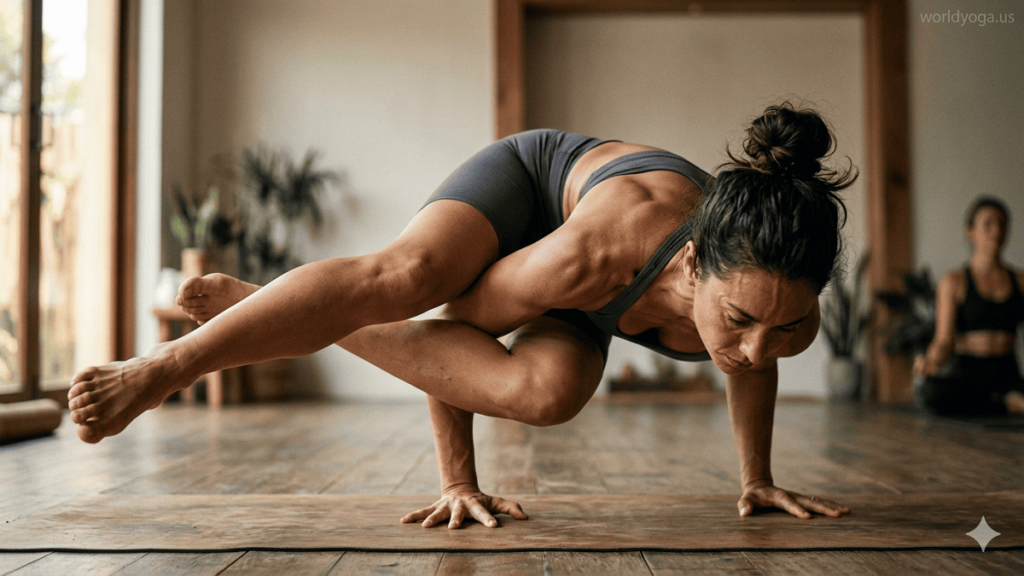
Vishama Hasta Parshva Bakasana is a Sanskrit yoga term referring to an advanced asymmetrical side crow arm balance variation. The name breaks down as follows: “Vishama” means uneven or asymmetrical, “Hasta” means hands, “Parshva” means side, and “Bakasana” refers to crow pose. Together, it describes a side crow pose performed with uneven hand loading, where one arm supports more body weight than the other, increasing difficulty and requiring refined balance control.
This posture is closely related to modern interpretations of Eka Pada Koundinyasana II, as both involve twisting, arm balancing, and leg extension variations. However, Vishama Hasta Parshva Bakasana Hasta Parshva Bakasana emphasizes asymmetry in the upper body support, making it more demanding on stabilizing muscles.
Key Characteristics
- Asymmetrical weight distribution between the hands
- Deep spinal twist combined with arm balance
- Core compression to lift and stabilize the body
- One or both legs positioned off the ground in a controlled extension or hook
- Strong reliance on shoulder and wrist stability
Physical Requirements
Practicing this pose requires:
- Advanced wrist and forearm strength
- Strong shoulders with scapular control
- Powerful core engagement, especially obliques
- Hip flexibility for twisting and leg positioning
- Excellent proprioception and balance awareness
Benefits
- Builds unilateral upper-body strength
- Strengthens deep core muscles and improves compression ability
- Enhances balance and coordination under instability
- Improves spinal rotation and mobility
- Develops mental focus and concentration
Common Challenges
- Collapsing into the weaker arm due to uneven load
- Losing balance from poor weight shift timing
- Insufficient core engagement leading to falls
- Over-rotation of the shoulders instead of spinal twist
- Wrist strain from improper alignment
Safety Notes
This is an advanced posture and should only be attempted after mastering foundational arm balances such as crow pose and basic side crane variations. Proper warm-up of wrists, shoulders, and core is essential to reduce injury risk.
Summary
Vishama Hasta Parshva Bakasana is a highly advanced asymmetrical arm balance that trains strength, coordination, and balance through uneven loading of the upper body. It is a progression of side crow mechanics and is often associated with modern arm balance systems derived from Eka Pada Koundinyasana II.
#Vishama Hasta Parshva Bakasana in Maharshtra
What is Vishama Hasta Parshva Bakasana?
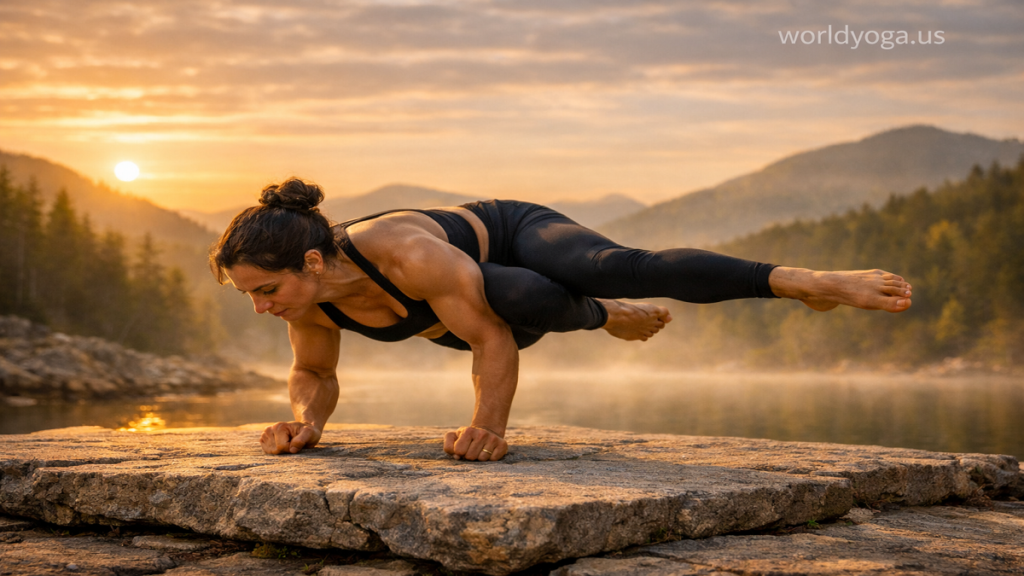
Vishama Hasta Parshva Bakasana is an advanced arm balance yoga posture that translates from Sanskrit as “uneven-handed side crow pose.” It is a variation of side crow in which the practitioner supports the body on both hands while intentionally placing uneven weight on the arms, creating a more challenging asymmetrical balance.
The pose is closely related to modern arm balances such as Eka Pada Koundinyasana II, which also combine twisting, arm support, and lifted leg positions. However, Vishama Hasta Parshva Bakasana Hasta Parshva Bakasana specifically emphasizes unequal load distribution between the hands, making stability and control significantly more demanding.
Core Concept
In this posture, the body is lifted off the ground using the arms as the main support while the torso is twisted to one side. One arm bears more weight than the other, and the legs are either hooked, extended, or partially supported depending on the variation. The asymmetry forces the body to constantly adjust balance through micro-engagement of the core and shoulders.
Key Elements of the Pose
- Side-body twist from the spine and torso
- Arm balance using both hands with uneven loading
- Core engagement to lift and stabilize the pelvis
- Active shoulder control to prevent collapse
- Controlled leg positioning for counterbalance
Purpose and Function
This pose is primarily used in advanced yoga practice to develop:
- Unilateral upper-body strength
- Deep core compression power
- Enhanced balance and proprioception
- Improved coordination between twist and lift mechanics
- Mental focus under unstable conditions
Difficulty Level
Vishama Hasta Parshva Bakasana is considered advanced to expert level. It requires strong preparation through foundational poses such as crow pose, side crow, and twisting strength work. Without proper conditioning, the pose can place excessive strain on the wrists, elbows, and shoulders.
Summary
Vishama Hasta Parshva Bakasana is a highly challenging asymmetrical arm balance that builds strength, stability, and control through uneven hand loading and deep twisting mechanics. It is a progression of side crow-style movements and is closely associated with advanced variations of Eka Pada Koundinyasana II.
#Vishama Hasta Parshva Bakasana in Surat
How is this uneven arm variation performed?
Step-by-Step Performance
1. Starting Position (Deep Squat Setup)
Begin in a low squat (Malasana) with feet slightly wider than hips. Place the palms on the floor shoulder-width apart. Spread the fingers wide and press firmly through the base of the hands to prepare for load-bearing.
Engage the core and lengthen the spine before twisting.
2. Entering the Twist
Rotate the torso to one side (for example, to the right). Bring the outer thigh or knee onto the upper arm (triceps area), similar to side crow alignment.
Deepen the twist from the mid-spine rather than just the shoulders. Keep the chest slightly lifted.
3. Establishing Uneven Hand Loading
Shift your weight forward and begin transferring more pressure into one hand (usually the hand closer to the twisted side or leg hook). The second hand remains grounded but carries less load.
This asymmetry is the defining feature of the pose.
4. Forward Lean and Lift
Slowly lean the chest forward until the shoulders move slightly ahead of the wrists. Bend the elbows to create a stable “shelf” for the legs.
Engage the core strongly and begin lifting the feet off the ground. Movement should be slow and controlled, not sudden.
5. Stabilizing the Balance
Once lifted, maintain balance by:
- Pressing more firmly through the dominant arm
- Engaging the obliques to control twist
- Keeping the gaze slightly forward
- Activating shoulder stabilizers to prevent collapse
The uneven load requires constant micro-adjustments in both hands.
6. Leg Positioning
Depending on variation:
- One leg may stay hooked on the arm
- The other may extend sideways or backward
- Both legs remain active to assist balance
Avoid letting the lower body become passive.
7. Controlled Exit
Slowly lower the feet back to the ground with control. Return to squat position and release the hands gently.
Rest the wrists in a neutral position before repeating.
Key Technical Focus
- Maintain spinal twist, not shoulder collapse
- Keep elbows slightly bent and active
- Do not dump weight into the wrists
- Control forward lean before lifting
- Engage core throughout the entire movement
Safety Reminder
This is an advanced pose. Practice only after mastering crow pose and basic side crow variations. Avoid if you have wrist, shoulder, Vishama Hasta Parshva Bakasana, or elbow issues.
#Vishama Hasta Parshva Bakasana in Kolkata
What strength and balance are needed?
1. Upper Body Strength Requirements
This pose places significant demand on the arms and shoulders, especially due to uneven loading.
Key requirements:
- Wrists: High tolerance for compression and extension under bodyweight
- Forearms: Strong stabilizing endurance for micro-adjustments
- Triceps: Support elbow stability and prevent collapse
- Shoulders (deltoids + rotator cuff): Maintain elevation and joint integrity
Because one arm carries more load, unilateral shoulder strength is essential to prevent imbalance or injury.
2. Core Strength and Compression Power
The core is the primary lifting engine of this posture.
Key requirements:
- Rectus abdominis: Lifts body off the ground
- Obliques: Control twist and prevent lateral collapse
- Transverse abdominis: Stabilizes spine under asymmetrical stress
- Hip flexors: Assist in holding legs off the ground
A strong “compression lift” is needed to bring the knees and torso together while maintaining elevation.
3. Balance and Proprioception
This pose is highly unstable due to uneven arm loading, making balance control critical.
Key requirements:
- Ability to shift weight subtly between hands without losing control
- Strong proprioception (awareness of body position in space)
- Fine-tuned coordination between upper body and core
- Stable gaze focus (drishti) to maintain orientation
Even small misalignments can cause loss of balance.
4. Shoulder and Scapular Stability
The shoulders act as stabilizers under uneven force.
Key requirements:
- Scapular protraction (pressing the floor away)
- Controlled shoulder elevation without collapsing
- Balanced engagement between both sides despite uneven load
- Rotator cuff activation for joint protection
Poor scapular control is one of the main reasons practitioners fail this pose.
5. Hip Mobility and Spinal Control
Although it is an arm balance, lower-body mobility plays a key role.
Key requirements:
- Hip rotation for leg placement on the arm
- Hamstring flexibility for leg extension variations
- Spinal rotation for entering and maintaining twist
Without mobility, the upper body compensates excessively, increasing strain.
6. Mental Focus and Nervous System Control
This pose is not purely physical; it requires strong neurological control.
- Calm breathing under instability
- Fear management during forward weight shift
- Precise timing of lift and stabilization
- Sustained concentration during micro-adjustments
Summary
Vishama Hasta Parshva Bakasana demands advanced unilateral upper-body strength, deep core compression power, high proprioceptive balance control, Vishama Hasta Parshva Bakasana, and strong shoulder stability. Its asymmetrical nature makes it significantly more challenging than standard arm balances and requires both physical conditioning and refined neuromuscular coordination for safe execution.
#Vishama Hasta Parshva Bakasana in Chennai
What are the key benefits of this pose?
1. Builds Advanced Upper Body Strength
One of the primary benefits is the development of strong, functional upper-body power.
- Strengthens wrists under load-bearing extension
- Builds triceps and forearm endurance
- Improves shoulder stability and joint resilience
- Enhances unilateral strength due to uneven arm loading
The asymmetry forces each arm to adapt differently, improving overall strength balance.
2. Strengthens Deep Core Muscles
This pose heavily engages the entire core system, especially through twisting and lifting.
- Activates rectus abdominis for body lift
- Strengthens obliques for rotational control
- Engages transverse abdominis for spinal stability
- Improves hip flexor coordination for leg lift
The combination of twist and lift creates strong “core compression strength.”
3. Improves Balance and Body Awareness
Because the load is uneven, the nervous system must constantly adjust.
- Enhances proprioception (body awareness in space)
- Improves micro-adjustments in hands and shoulders
- Develops stability under unstable conditions
- Strengthens coordination between upper and lower body
This leads to better overall balance control in movement practice.
4. Increases Spinal Mobility and Hip Flexibility
The twisting nature of the pose improves mobility in key areas.
- Deepens spinal rotation
- Opens hips and groin region
- Improves hamstring flexibility in extended variations
- Enhances rotational movement capacity
This makes it valuable for improving functional flexibility.
5. Enhances Mental Focus and Concentration
The difficulty of the pose demands strong mental discipline.
- Builds concentration under physical stress
- Develops patience through progressive learning
- Improves breath control during effort
- Reduces fear response in unstable positions
Maintaining balance requires calm awareness and steady focus.
6. Prepares for Advanced Arm Balance Progressions
This pose serves as a stepping stone toward more complex arm balances.
- Trains asymmetrical load management
- Builds endurance for longer holds
- Develops coordination for advanced transitions
- Strengthens foundational arm balance mechanics
Summary
Vishama Hasta Parshva Bakasana provides advanced upper-body strength, deep core conditioning, improved balance, enhanced mobility, Vishama Hasta Parshva Bakasana, and strong mental focus. Its uneven loading structure makes it especially effective for developing real-world functional strength and refined neuromuscular control in advanced yoga practice.
#Vishama Hasta Parshva Bakasana in Ahemadabad
What mistakes should be avoided?
1. Collapsing Into the Wrists
One of the most frequent errors is dumping weight into the hands without active support.
Problem:
- Wrists bend excessively under pressure
- Passive sinking instead of active pressing
- Increased risk of wrist strain or pain
Correction:
- Spread fingers wide and press evenly through all knuckles
- Actively “push the floor away”
- Engage forearms to support load distribution
2. Losing Shoulder Stability
Shoulders often collapse or become uneven due to asymmetrical loading.
Problem:
- Shoulder drops toward the floor
- Elbows flare outward
- Rotator cuff engagement is weak
Correction:
- Protract shoulders (round upper back slightly)
- Keep elbows controlled and aligned
- Maintain strong scapular activation
3. Incorrect Weight Shift Timing
Many practitioners attempt the lift too early or too late.
Problem:
- Lifting before enough forward lean causes falling backward
- Over-leaning without lift causes collapse forward
Correction:
- Shift weight gradually until shoulders pass wrists
- Engage core before lifting feet
- Move slowly with controlled transition
4. Weak Core Engagement
The core must actively support the lift; otherwise the arms overcompensate.
Problem:
- Legs feel heavy and drop quickly
- Lower back collapses
- Unable to maintain balance
Correction:
- Draw belly strongly toward the spine
- Engage obliques during twist
- Practice compression drills (knees-to-chest holds)
5. Over-Rotating From the Shoulders Instead of Spine
Twist misalignment reduces efficiency and stability.
Problem:
- Rotation comes from shoulders only
- Hips and spine remain disconnected
- Uneven pressure increases instability
Correction:
- Initiate twist from mid-spine
- Keep hips active and lifted
- Maintain full-body integration in the twist
6. Holding the Breath
Breath control is often overlooked but critical.
Problem:
- Breath is held during effort
- Tension increases and stability decreases
Correction:
- Maintain steady nasal breathing
- Exhale during lift phase
- Use breath to stabilize transitions
7. Rushing the Pose
Speed often leads to loss of control in advanced arm balances.
Problem:
- Jumping into lift without setup
- Skipping alignment steps
- Losing balance mid-transition
Correction:
- Build the pose slowly step by step
- Prioritize control over height or duration
- Repeat setup drills before full attempt
Summary
Avoiding mistakes such as wrist collapse, poor shoulder engagement, mistimed weight shifts, weak core activation, incorrect twisting, breath holding, and rushing the movement is essential in Vishama Hasta Parshva Bakasana. Correct alignment and controlled progression ensure safer practice and more stable performance in this advanced asymmetrical arm balance.
#Vishama Hasta Parshva Bakasana in Hyderabad
Case Study of Vishama Hasta Parshva Bakasana
1. Subject Profile
- Age: 28–35 years
- Experience: 3–5 years consistent yoga practice
- Baseline skills: Crow Pose (stable 20–30 seconds), Side Crow (10–15 seconds), moderate twisting ability
- Limitations: Limited unilateral shoulder strength and moderate wrist endurance imbalance
The practitioner aimed to achieve controlled asymmetrical arm balance stability.
2. Objective
The primary goals were:
- Develop unilateral upper-body strength
- Improve core compression under rotational load
- Enhance proprioception in unstable balance conditions
- Achieve controlled lift in uneven arm loading situations
3. Training Progression
Phase 1: Foundational Conditioning (2–4 weeks)
Focus:
- Plank variations and chaturanga control
- Crow pose holds for endurance
- Wrist strengthening drills
Outcome:
- Improved baseline wrist tolerance
- Better scapular stability awareness
- Initial core activation consistency
Phase 2: Twisting and Arm Balance Integration (3–5 weeks)
Focus:
- Side crow preparation drills
- Seated spinal rotation exercises
- Knee-to-tricep balance holds
Outcome:
- Increased spinal mobility
- Improved leg-to-arm connection
- Better coordination in twisted positions
Phase 3: Asymmetrical Load Introduction (3–4 weeks)
Focus:
- Gradual weight shifting into one arm
- Assisted uneven balance using props
- Short holds (2–5 seconds) of uneven support
Outcome:
- Noticeable improvement in unilateral shoulder endurance
- Early development of balance correction reflexes
- Mild wrist fatigue in dominant loading side
Phase 4: Full Pose Execution
Focus:
- Independent Vishama Hasta Parshva Bakasana holds
- Controlled entry and exit practice
- Breath coordination during lift
Outcome:
- Stable holds of 5–10 seconds achieved
- Improved mid-air correction ability
- Reduced fear response during forward shift
4. Key Observations
Strength Adaptations
- Dominant arm developed higher load tolerance
- Obliques became primary stabilizers
- Shoulder stabilizers adapted to asymmetrical stress
Balance Adaptations
- Faster micro-adjustments in hand pressure
- Improved spatial awareness during instability
- Better coordination between twist and lift phases
Challenges Identified
- Early wrist overload in dominant arm
- Difficulty maintaining even breath under peak effort
- Occasional shoulder misalignment during fatigue
5. Risk Factors
- Uneven wrist strain due to load imbalance
- Shoulder instability if scapular engagement is weak
- Loss of balance during premature lift attempts
Mitigation included slower progression, shorter holds, and emphasis on alignment drills.
6. Outcome Summary
After approximately 8–12 weeks of structured progression:
- Practitioner achieved controlled asymmetrical arm balance holds
- Significant improvement in unilateral strength and coordination
- Enhanced confidence in advanced arm balancing sequences
- Better integration of core and shoulder stability under instability
7. Conclusion
This case demonstrates that Vishama Hasta Parshva Bakasana is not simply a strength pose but a neuromuscular adaptation process requiring gradual exposure to asymmetrical loading. When trained progressively, it enhances unilateral strength, balance control, and core integration, making it a valuable advanced progression in modern arm balance yoga practice.
References
- https://www.yogajournal.com/poses/side-crow-pose/
- https://www.ekhartyoga.com/resources/yoga-poses/side-crow-pose
- https://www.yogapedia.com/definition/6390/eka-pada-koundinyasana-ii
#Vishama Hasta Parshva Bakasana in Banglore
White Paper of Vishama Hasta Parshva Bakasana
Abstract
Vishama Hasta Parshva Bakasana is an advanced asymmetrical arm balance derived from side crow mechanics and closely related to Eka Pada Koundinyasana II. It is characterized by uneven weight distribution across the hands during a twisted, lifted balance. This white paper examines its biomechanical demands, neuromuscular adaptations, training methodology, risk profile, and functional applications in movement-based disciplines.
1. Introduction
Modern yoga evolution has produced increasingly complex arm balances that challenge both strength and neuromotor coordination. Vishama Hasta Parshva Bakasana represents a progression beyond symmetrical loading patterns by introducing deliberate asymmetry in upper-limb weight distribution. This creates a high instability environment requiring refined control of force, alignment, and balance.
2. Biomechanical Structure
The pose operates through a closed kinetic chain involving the upper limbs, core, and hips.
- Upper limbs: One arm bears greater compressive load through wrist, elbow, and shoulder joints
- Scapulae: Must maintain protraction and stability under uneven force
- Core musculature: Obliques and transverse abdominis manage rotational torque
- Lower body: Hip flexors and adductors assist in lift and stabilization
The asymmetry introduces rotational shear forces that require continuous micro-corrections to prevent collapse.
3. Neuromuscular Adaptation
Consistent training produces measurable functional adaptations:
- Increased unilateral motor unit recruitment in shoulder stabilizers
- Enhanced proprioceptive feedback in wrist and hand structures
- Improved inter-limb coordination under uneven loading
- Strengthened core compression and anti-rotation control
These adaptations extend beyond yoga into general movement efficiency.
4. Training Methodology
A structured progression model is essential for safe development:
- Foundational strength (planks, chaturanga, crow pose)
- Twisting preparation (side crow mechanics and spinal rotation drills)
- Assisted asymmetrical loading (props or partial weight shifts)
- Independent uneven-arm balance execution
Emphasis must remain on control, alignment, and gradual load increase rather than duration.
5. Risk Assessment
Due to its asymmetrical nature, this pose presents elevated injury risks:
- Wrist overload due to uneven compression
- Shoulder impingement from poor scapular stabilization
- Core fatigue leading to sudden structural collapse
- Loss of balance causing joint strain or falls
Risk mitigation includes progressive loading, proper warm-ups, and controlled exit strategies.
6. Discussion
Vishama Hasta Parshva Bakasana functions as both a strength and neuromotor training tool. Unlike symmetrical arm balances, it challenges the body to stabilize under unpredictable force distribution. This makes it highly relevant for advanced movement practitioners, athletes, and yoga educators focused on functional strength development.
7. Applications
The pose has relevance across multiple domains:
- Yoga training: Advanced arm balance sequencing
- Sports conditioning: Shoulder stability and core control
- Movement science: Study of asymmetrical load adaptation
- Rehabilitation (advanced stage): Controlled unilateral strengthening
8. Conclusion
Vishama Hasta Parshva Bakasana represents a high-level evolution in arm balance practice. It integrates strength, balance, and neuromuscular control under asymmetrical conditions. When practiced systematically, it enhances unilateral stability, core compression strength, and dynamic balance control. Further research is encouraged to quantify long-term biomechanical adaptations.
References
- https://www.yogajournal.com/poses/side-crow-pose/
- https://www.ekhartyoga.com/resources/yoga-poses/side-crow-pose/
- https://www.yogapedia.com/definition/6390/eka-pada-koundinyasana-ii
#Vishama Hasta Parshva Bakasana in Pune
Industry Application of Vishama Hasta Parshva Bakasana
1. Fitness and Strength Training Industry
In modern fitness systems, this pose is used as a bodyweight strength and stability drill.
Applications:
- Development of unilateral upper-body strength without equipment
- Advanced calisthenics and functional movement training
- Shoulder stability training under asymmetrical load
- Core compression conditioning for athletic performance
Industry Value:
It provides a scalable model for training real-world strength patterns where load is rarely symmetrical.
2. Sports Performance and Athletic Conditioning
Athletes benefit from the pose’s ability to improve dynamic control under instability.
Applications:
- Shoulder stabilization for gymnastics, climbing, and martial arts
- Core anti-rotation strength for throwing and striking sports
- Improved proprioception during rapid directional changes
- Injury prevention through controlled uneven loading
Industry Value:
It enhances neuromuscular responsiveness, which is critical in high-performance sports environments.
3. Physical Therapy and Rehabilitation (Advanced Stage)
In controlled clinical or therapeutic environments, modified versions may be used.
Applications:
- Gradual restoration of wrist and shoulder load tolerance
- Post-injury neuromuscular re-education (unilateral focus)
- Controlled core stabilization training
- Progressive return-to-weight-bearing protocols
Industry Value:
It supports functional recovery by retraining movement patterns rather than isolated muscles.
4. Movement Science and Biomechanics Research
Researchers analyze this pose to study asymmetrical force behavior in the human body.
Applications:
- Study of uneven load distribution in closed-chain systems
- Analysis of scapular stability under rotational stress
- Proprioceptive response mapping under instability
- Injury risk modeling for upper-limb weight-bearing positions
Industry Value:
It acts as a real-world model for understanding complex human balance mechanics.
5. Yoga Education and Teacher Training
In advanced yoga pedagogy, it is used as a peak posture for skill integration.
Applications:
- Teaching progressive arm balance sequencing
- Demonstrating safe entry into asymmetrical poses
- Training instructors in alignment correction techniques
- Structuring advanced vinyasa flow classes
Industry Value:
It serves as a benchmark for evaluating advanced practitioner readiness.
6. Performing Arts and Dance Conditioning
In performance disciplines, similar mechanics are used for creative movement training.
Applications:
- Floor-based choreography requiring upper-body support
- Controlled off-axis balance for expressive movement
- Strength training for acrobatic transitions
- Dynamic stability in contemporary dance forms
Industry Value:
It enhances expressive physical control in artistic movement systems.
Conclusion
Vishama Hasta Parshva Bakasana extends beyond yoga into multiple applied industries. Its core principles—asymmetrical load management, core compression strength, and neuromuscular balance control—make it valuable for fitness, sports science, rehabilitation, biomechanics research, education, and performing arts. It functions as a high-complexity movement model for studying and training human stability under uneven force conditions.
#Vishama Hasta Parshva Bakasana in Mumbai
Ask FAQs
What is Vishama Hasta Parshva Bakasana?
Vishama Hasta Parshva Bakasana is an advanced asymmetrical arm balance yoga posture. It involves supporting the body on both hands while twisting the torso and shifting more weight onto one arm. It is closely related to Eka Pada Koundinyasana II but emphasizes uneven hand loading for increased difficulty.
Who should practice this pose?
This pose is suitable only for advanced yoga practitioners who have strong experience in arm balances such as Crow Pose and Side Crane Pose. Beginners or individuals with wrist, shoulder, or elbow injuries should avoid it due to high physical demand and joint stress.
What are the main benefits of this pose?
Key benefits include:
Increased unilateral upper-body strength
Stronger core compression and oblique engagement
Improved balance and body awareness
Enhanced shoulder and wrist stability
Better coordination under unstable conditions
What makes this pose difficult?
The main difficulty comes from:
Uneven weight distribution between the arms
Deep twisting of the spine and torso
Requirement for strong core lift and control
High demand on wrist and shoulder stability
Need for precise balance and timing during lift
What are common mistakes to avoid?
Common mistakes include:
Collapsing into the wrists instead of actively pressing
Poor shoulder engagement leading to instability
Lifting too early without proper weight shift
Weak core activation causing loss of balance
Holding the breath during effort, increasing tension
Table of Contents
Disclaimer: Vishama Hasta Parshva Bakasana is an advanced yoga arm balance that requires significant strength, balance, and body control. It should only be practiced after proper preparation and under the guidance of a qualified yoga instructor. Individuals with wrist, shoulder, elbow, or spinal injuries should avoid this pose. This information is for educational purposes only and is not a substitute for professional medical or fitness advice.