Uneven One-Legged Crane 1
The Uneven One-Legged Crane Pose is an advanced arm balance variation derived from the foundational Crow Pose (Bakasana). In traditional yoga terminology, it is closely related to Eka Pada Bakasana, where “eka pada” means one leg. The “uneven” aspect typically refers to the asymmetrical extension of one leg while the other remains supported on the upper arms, requiring greater core control, shoulder stability, and balance precision.
Execution and Technique
To begin, come into a low squat (Malasana), placing the palms firmly on the mat shoulder-width apart. Engage the fingers for grip and lean forward so the knees rest high on the triceps. In the base Crow Pose, both feet lift off the ground while the body balances on the arms.
For the uneven variation, once stable in Crow, slowly extend One-Legged Crane backward and upward while keeping the other knee firmly supported on the arm. The extension should be controlled, not forced, with the hips squared as much as mobility allows. The gaze remains slightly forward, not down, to help maintain equilibrium.
Key Alignment Principles
- Strong engagement of the core (especially lower abdominals)
- Scapular stability through protraction of the shoulder blades
- Even weight distribution across both palms
- Controlled hip rotation to prevent collapse on One-Legged Crane side
Benefits
This pose strengthens the upper body significantly, including the wrists, shoulders, triceps, and chest. It also builds deep core strength and enhances proprioception (body awareness). Practitioners often notice improved focus and mental discipline due to the high demand for balance. Additionally, the pose opens the hips and challenges spinal alignment control.
Common Mistakes
A frequent error is collapsing into one shoulder or overloading One-Legged Crane wrist, which can lead to strain. Another is lifting the extended leg too quickly without establishing a stable base in Crow Pose first. Holding the breath is also common; however, steady breathing is essential for maintaining balance.
Precautions
This is an advanced posture and should be avoided or modified by individuals with wrist injuries, shoulder instability, or severe lower back issues. Beginners should master basic Crow Pose and core strengthening exercises before attempting this variation.
Progression Tips
Practicing plank variations, knee-to-triceps drills, and core compression exercises can build the required strength. Using a yoga block under the feet during initial attempts can also help reduce fear of falling forward.
For deeper study, reputable yoga education platforms such as Yoga Journal, ACE Fitness, and established yoga training schools provide detailed breakdowns and safety insights on arm balances and progressive transitions.
#Uneven One-Legged Crane 1 in India
What is Uneven One-Legged Crane Pose I?
Uneven One-Legged Crane Pose I is an advanced arm balance variation of the traditional yoga posture known as Crow Pose (Bakasana) and its one-legged form Eka Pada Bakasana. It is not a strictly standardized classical name in ancient texts, but rather a modern descriptive term used in contemporary yoga teaching to indicate a more asymmetrical and challenging variation of one-legged crane.
What the Pose Is
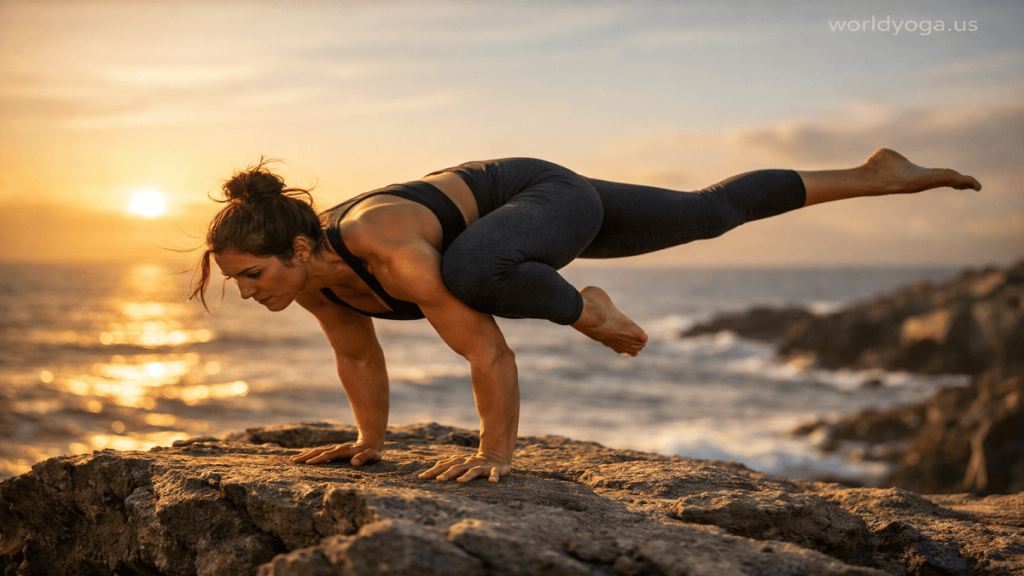
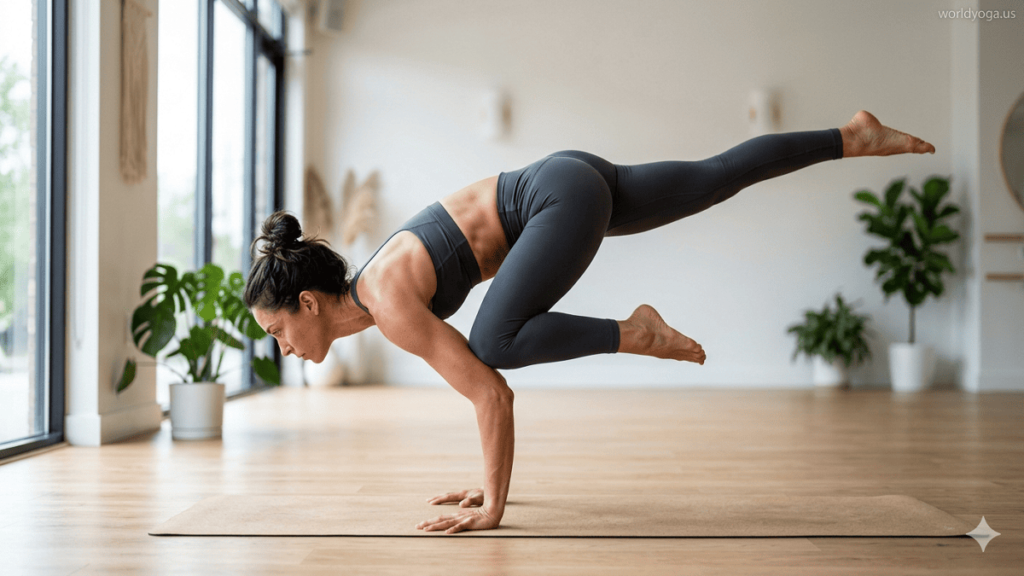
In this posture, the practitioner balances on the hands while One-Legged Crane knee is securely placed on the upper arm (triceps area), similar to Crow Pose. The difference is that instead of keeping both legs tucked, One-Legged Crane leg is extended backward or upward in space, creating an uneven distribution of weight and requiring significantly greater core control and shoulder stability.
The “Uneven” aspect refers to the asymmetry created when:
- One leg remains supported on the arm (bent position)
- The other leg is extended freely behind the body
This makes the posture more unstable than standard Crow Pose or even basic One-Legged Crow, demanding refined balance and body awareness.
Key Characteristics
- Arm balance supported entirely by the hands
- One knee pressing into the arm for stability
- One leg extended backward or upward
- Strong engagement of core muscles to prevent tipping
- Forward gaze to maintain equilibrium
Purpose and Benefits
This pose is primarily practiced for strength, control, and focus rather than flexibility alone. It helps develop:
- Upper body strength (wrists, shoulders, triceps)
- Deep core activation
- Balance and proprioception
- Mental concentration under physical instability
It is also often used as a transitional arm balance in advanced yoga flows.
Preparation Requirements
Before attempting this pose, practitioners should be comfortable with:
- Crow Pose (Bakasana)
- Side Crow (Parsva Bakasana)
- Basic arm balances and plank strength
- Core compression exercises
Without this foundation, the risk of wrist strain or imbalance increases significantly.
Safety Notes
Because of the high load on the wrists and shoulders, proper alignment is critical. Practitioners should avoid collapsing into One-Legged Crane shoulder or rushing the leg extension. Using yoga blocks or practicing near a wall is common in early training stages.
Further Learning
You can explore foundational arm balances and progressions here:
- https://www.yogajournal.com/poses/bakasana/
- https://www.verywellfit.com/crow-pose-bakasana-3567074
- https://en.wikipedia.org/wiki/Bakasana
In summary, Uneven One-Legged Crane Pose I is an advanced asymmetrical arm balance that builds strength, coordination, and focus, and is typically approached only after mastering basic crane and crow variations.
#Uneven One-Legged Crane 1 in Mahrashtra
How is this variation performed step by step?
Step-by-Step Execution
1. Warm-Up and Preparation
Begin with a proper warm-up focused on wrists, shoulders, and core activation. Common preparatory poses include:
- Plank Pose
- Chaturanga Dandasana (low push-up)
- Malasana (yogic squat)
- Knee-to-triceps drills
These help condition the body for weight-bearing on the hands.
2. Start in a Squat Position
Come into a deep squat (Malasana):
- Feet slightly wider than hips
- Heels may lift if flexibility is limited
- Palms placed firmly on the mat shoulder-width apart
- Fingers spread wide for stability and grip
Engage your core before shifting weight forward.
3. Place Knees on Upper Arms
Lean forward slowly:
- Place One-Legged Crane knee high on the back of one upper arm (triceps)
- Then place the second knee on the other upper arm
- Hug both knees inward toward the midline
At this stage, your body should feel compact and controlled.
4. Shift Weight Forward
Gradually transfer weight into your hands:
- Bend elbows slightly like a shelf
- Lean forward until your feet feel light
- Keep gaze forward, not downward, to prevent tipping
This is the transition into basic Crow Pose stability.
5. Lift Feet into Crow Pose Base
Once balanced:
- Lift both feet off the ground
- Keep knees supported on upper arms
- Engage core deeply to prevent collapse
Hold briefly to establish control.
6. Begin the “Uneven” Extension
Now transition into the variation:
- Slowly extend One-Legged Crane leg backward and slightly upward
- Keep the opposite knee firmly pressing into the arm
- Maintain strong abdominal engagement to prevent rotation
Do not rush this step; movement should be gradual and controlled.
7. Stabilize the Pose
Once the leg is extended:
- Keep shoulders protracted (pushing floor away)
- Engage glutes and core for alignment
- Maintain steady breathing
The body should feel like a controlled diagonal line with asymmetry.
8. Exit Safely
To come out:
- Slowly lower the extended leg first
- Return both feet to the ground softly
- Rest in Child’s Pose to release wrist tension
Key Technical Tips
- Weight must stay centered between both palms
- Avoid collapsing into the supporting shoulder
- Core engagement is more important than leg height
- Practice on a soft surface or yoga mat
Useful References
- https://www.yogajournal.com/poses/bakasana/
- https://www.verywellfit.com/crow-pose-bakasana-3567074
- https://www.yogapedia.com/definition/6422/eka-pada-bakasana
#Uneven One-Legged Crane 1 in Banglore
What strength and balance are required?
1. Upper Body Strength Requirements
At the foundation of this pose is arm and shoulder strength, because the entire body weight is supported on the hands.
Wrists and Forearms
Strong wrists are essential for load-bearing. The wrists must tolerate sustained extension while micro-adjusting for balance. Forearm strength helps control subtle shifts in pressure between the fingers and palms.
Shoulders and Scapular Control
The shoulders must be capable of scapular protraction (pushing the floor away). One-Legged Crane, This creates a stable “platform” for the knees to rest on the upper arms. Weak shoulders often lead to collapsing inward, which destabilizes the pose.
Key strength areas:
- Deltoids (especially anterior shoulder)
- Serratus anterior (critical for stability)
- Triceps (for elbow support and control)
2. Core Strength Requirements
The core is the primary balancing engine in this posture.
Deep Core Engagement
The rectus abdominis, transverse abdominis, and obliques work together to:
- Lift the body off the ground
- Prevent tipping forward
- Maintain spinal alignment during leg extension
Anti-Rotation Strength
Because one leg extends while the other remains bent, the body naturally wants to twist. The obliques must resist this rotation, making anti-rotation strength crucial.
Without a strong core, the extended leg will cause imbalance and collapse.
3. Hip and Lower Body Control
While not a flexibility-heavy pose, hip control is important:
- Hip flexors stabilize the bent-leg position
- Glutes help control the extended leg
- Adductors keep knees hugged into the arms
The extended leg requires controlled activation rather than passive lifting.
4. Balance and Proprioception
Balance in this pose is not static—it is dynamic micro-adjustment.
Key Balance Skills Required:
- Forward weight shifting without over-leaning
- Finger pressure modulation (index finger and thumb are critical)
- Continuous core correction to prevent tipping
- Spatial awareness of leg asymmetry
This is where proprioception (body awareness in space) becomes essential. Practitioners must constantly “feel” alignment rather than rely on visual correction.
5. Mental Focus and Control
Although not a physical muscle, mental stability is a major requirement:
- Calm breathing prevents shaking and instability
- Focus reduces overcorrection movements
- Confidence prevents premature exit from the pose
Fear of falling forward often limits progression more than physical weakness.
6. Benchmark Strength Indicators
You are generally ready to attempt this pose if you can:
- Hold Crow Pose steadily for 20–30 seconds
- Maintain Plank Pose for 60+ seconds
- Perform controlled knee-to-triceps lifts
- Balance weight shifts without collapsing shoulders
Reference Resources
- https://www.yogajournal.com/poses/bakasana/
- https://www.verywellfit.com/crow-pose-bakasana-3567074
- https://www.acefitness.org/resources/everyone/blog/
#Uneven One-Legged Crane 1 in Kolkata
What are the benefits of this pose?
1. Upper Body Strength Development
One-Legged Crane of the primary benefits of this pose is significant strengthening of the upper extremities.
- Wrists and forearms are conditioned to support full body weight, improving load tolerance and joint resilience.
- Shoulders (especially the deltoids and stabilizing rotator cuff muscles) develop greater endurance and control.
- Triceps and chest muscles engage isometrically to maintain stability and prevent collapse.
Because the pose involves balancing in a forward-leaning position, it builds functional pushing strength that supports other arm balances and inversions.
2. Core Strength and Stability
This pose is highly effective for developing deep core engagement.
- The rectus abdominis helps lift the body off the ground.
- The transverse abdominis stabilizes internal pressure and supports spinal alignment.
- The obliques work intensely due to the uneven leg extension, resisting rotational forces.
The asymmetry forces the core to work harder than in symmetrical arm balances, making it particularly effective for building anti-rotation strength.
3. Improved Balance and Proprioception
The uneven leg extension introduces instability, which enhances neuromuscular coordination and spatial awareness.
Practitioners learn to:
- Adjust finger pressure dynamically for micro-balance corrections
- Distribute weight evenly across both hands despite asymmetry
- Maintain equilibrium while the center of gravity shifts
This improves overall balance skills that carry over into other yoga postures and functional movement patterns.
4. Hip Mobility and Control
Although not primarily a flexibility pose, it improves hip joint awareness and control.
- The bent-leg position strengthens hip flexor engagement.
- The extended leg trains glute activation and controlled hip extension.
- The pose encourages balanced mobility between both sides of the body.
This helps reduce muscular imbalances caused by daily sedentary posture patterns.
5. Mental Focus and Stress Regulation
Arm balances like this require intense concentration, which has cognitive benefits:
- Enhances mind-body connection
- Encourages present-moment focus
- Builds tolerance for controlled physical stress
Many practitioners also report improved confidence in handling challenging movement situations due to repeated exposure to controlled instability.
6. Functional Movement Benefits
The strength and coordination developed in this pose translate into:
- Better control in athletic movements requiring upper-body support
- Improved shoulder stability during pushing or lifting actions
- Enhanced coordination between upper and lower body chains
Further Reading
- https://www.yogajournal.com/poses/bakasana/
- https://www.verywellfit.com/crow-pose-bakasana-3567074
- https://www.acefitness.org/resources/everyone/blog/
#Uneven One-Legged Crane 1 in Delhi
What common mistakes should be avoided?
1. Placing Too Much Weight on the Wrists
A very common mistake is collapsing forward and dumping excessive load into the wrists.
- This happens when practitioners lean too far without engaging the core.
- It can lead to wrist pain or strain over time.
Correction:
Distribute pressure evenly through the palms, especially the index finger and thumb. Actively “grip” the floor and keep the weight slightly forward in the fingers rather than collapsing into the heel of the hand.
2. Not Engaging the Core Properly
Many practitioners rely too heavily on arm strength and forget that the core is the primary lifting mechanism.
- Without core engagement, the body feels heavy and unstable.
- The extended leg causes the torso to tilt or rotate.
Correction:
Before lifting the feet, actively draw the navel inward and upward. Think of compressing the abdomen toward the spine to create lift and stability.
3. Collapsing the Shoulders
Another frequent issue is allowing the shoulders to sink or cave inward.
- This reduces structural support for the knees on the upper arms.
- It increases pressure on the joints instead of distributing load through muscles.
Correction:
Actively push the floor away to create scapular protraction. The upper back should feel broad and engaged, not compressed.
4. Rushing the Leg Extension
In the uneven variation, practitioners often try to extend the leg too quickly.
- This disrupts balance immediately.
- It shifts the center of gravity before stability is established.
Correction:
First stabilize in Crow Pose. Then extend the leg slowly and deliberately, maintaining core tension throughout the movement.
5. Letting the Knees Slide Off the Arms
If the knees are not properly placed, they may slide down the triceps.
- This removes the structural “shelf” needed for balance.
- It leads to sudden falls or loss of control.
Correction:
Hug the knees tightly into the upper arms before lifting. Think of “gripping” the arms with the thighs.
6. Poor Gaze Direction
Looking too far down or back can disrupt balance.
- Downward gaze often causes over-leaning.
- Looking backward reduces forward control.
Correction:
Maintain a steady gaze slightly forward of the fingertips to stabilize the center of gravity.
7. Holding the Breath
Many practitioners unconsciously stop breathing due to effort and concentration.
- This increases tension and reduces stability.
- It can cause early fatigue.
Correction:
Maintain slow, steady breathing to support balance and muscle control.
Further Reading
- https://www.yogajournal.com/poses/bakasana/
- https://www.verywellfit.com/crow-pose-bakasana-3567074
- https://www.yogapedia.com/definition/6422/eka-pada-bakasana
#Uneven One-Legged Crane 1 in Ahemadabad
Case Study of Uneven One-Legged Crane 1
1. Background and Objective
This case study examines the progression of an intermediate yoga practitioner transitioning into the Uneven One-Legged Crane Pose I, an advanced arm balance derived from Crow Pose (Bakasana). The practitioner aimed to develop upper-body strength, core stability, and asymmetrical balance control while improving focus and body awareness in dynamic arm balances.
The subject had approximately 18 months of consistent yoga practice, with a stable 30-second Crow Pose hold and basic arm balance familiarity, but limited experience in asymmetrical extensions.
2. Initial Assessment
At the beginning of training, the practitioner demonstrated:
- Adequate wrist tolerance but early fatigue under prolonged load
- Moderate shoulder stability with occasional collapse in forward-leaning positions
- Strong rectus abdominis engagement but weak oblique control (especially under rotation)
- Difficulty maintaining balance when One-Legged Crane leg was lifted independently
The main limitation identified was loss of core control during asymmetrical extension, leading to imbalance and premature exit from the pose.
3. Training Approach
The progression strategy focused on three phases:
Phase 1: Foundation Strengthening
- Plank holds (45–60 seconds)
- Knee-to-triceps drills
- Crow Pose stabilization (20–30 seconds)
- Wrist conditioning exercises
Phase 2: Controlled Balance Introduction
- Partial weight shifts forward in Crow Pose
- One-foot lifts with toe taps for control
- Resistance-based core anti-rotation exercises
Phase 3: Full Pose Integration
- Slow extension of one leg from stable Crow Pose
- Focus on scapular protraction and finger pressure control
- Breath regulation during hold phases
4. Observed Progress
After 6 weeks of structured practice, significant improvements were recorded:
- Core Stability: Marked increase in oblique engagement reduced rotational collapse during leg extension.
- Shoulder Control: Improved scapular strength allowed sustained forward lean without joint strain.
- Balance Precision: Ability to hold uneven extension for 5–8 seconds without foot contact.
- Mental Focus: Reduced hesitation and improved confidence during lift-off phase.
However, minor instability persisted during longer holds, particularly under fatigue.
5. Key Challenges Identified
- Delayed activation of deep core muscles during transition phase
- Over-reliance on arm strength instead of integrated body engagement
- Slight asymmetry in hip alignment during extended leg lift
- Occasional breath holding under effort
6. Outcome and Conclusion
By the end of the study period, the practitioner achieved consistent entry into Uneven One-Legged Crane Pose I with controlled extension and safe exit. Full stabilization beyond 8–10 seconds remained an ongoing development goal.
The case highlights that success in this pose depends less on raw strength and more on progressive neuromuscular coordination, core integration, and controlled weight shifting.
7. Practical Insights
- Mastery of Crow Pose is essential before attempting asymmetrical variations.
- Core anti-rotation training is critical for success.
- Small incremental progressions reduce injury risk and improve retention.
- Breath control significantly enhances balance stability.
References
- https://www.yogajournal.com/poses/bakasana/
- https://www.verywellfit.com/crow-pose-bakasana-3567074
- https://www.acefitness.org/resources/everyone/blog/
#Uneven One-Legged Crane 1 in Hyderaad
White Paper of Uneven One-Legged Crane 1
1. Executive Summary
The Uneven One-Legged Crane Pose I is an advanced yoga arm balance derived from Crow Pose (Bakasana) and One-Legged Crane (Eka Pada Bakasana). It introduces asymmetrical lower-limb extension while maintaining full body weight support through the upper extremities, significantly increasing neuromuscular demand.
This white paper examines the pose from a biomechanical, physiological, training, and safety perspective, highlighting its requirements, benefits, risks, and application in modern yoga practice.
2. Definition and Classification
This posture is classified as:
- Category: Advanced arm balance
- Primary systems engaged: Upper limb kinetic chain, core stabilizers, hip control system
- Movement type: Closed-chain upper-body balance with unilateral lower-limb extension
The “Uneven” descriptor refers to the asymmetrical distribution of load and extension, where one leg remains supported while the other extends freely in space.
3. Biomechanical Analysis
The pose creates a complex interaction of forces:
- Center of gravity shift: Forward and slightly lateral due to leg extension
- Load distribution: Concentrated in wrists, metacarpals, and elbow flexors
- Shoulder mechanics: Requires sustained scapular protraction for structural integrity
- Core engagement: High anti-rotation demand on obliques and transverse abdominis
F=maF = m aF=ma
This relationship illustrates that increased mass displacement (extended leg) increases required stabilizing force to maintain equilibrium.
4. Physiological Requirements
Upper Body System
- High isometric endurance in triceps and deltoids
- Wrist load tolerance under full-body compression
- Serratus anterior activation for scapular stability
Core System
- Deep abdominal engagement for lift generation
- Oblique dominance for rotational resistance
- Spinal stabilization under forward flexion load
Lower Body System
- Hip flexor engagement in bent-leg support
- Gluteal activation for extended-leg control
5. Performance Benefits
Regular practice contributes to:
- Increased upper-body strength and endurance
- Enhanced core anti-rotation capacity
- Improved proprioceptive awareness and balance precision
- Development of neuromuscular coordination under asymmetrical load
- Greater mental focus and stress regulation under instability
6. Risk and Safety Considerations
Primary risks include:
- Wrist overload due to improper weight distribution
- Shoulder collapse from insufficient scapular engagement
- Loss of balance due to premature leg extension
- Core disengagement leading to sudden forward fall
Mitigation strategies:
- Progressive training through Crow Pose mastery
- Use of controlled transitions and supports (blocks/wall)
- Emphasis on scapular and core activation before lift-off
7. Training Progression Model
A structured approach includes:
- Foundational strength (plank, chaturanga, wrist conditioning)
- Static Crow Pose stabilization
- Controlled weight shifting drills
- Partial leg lift integration
- Full uneven extension practice
8. Application in Modern Yoga Systems
The pose is commonly used in:
- Advanced Hatha yoga sequences
- Contemporary Vinyasa flow progressions
- Arm balance training modules
- Movement therapy for coordination development
It serves as a bridge posture between basic arm balances and advanced inversion transitions.
9. Conclusion
The Uneven One-Legged Crane Pose I represents a high-complexity, full-body integration posture requiring synchronized strength, stability, and cognitive control. Its value lies not only in physical conditioning but also in enhancing motor control, balance intelligence, and focused awareness under instability.
References
- https://www.yogajournal.com/poses/bakasana/
- https://www.verywellfit.com/crow-pose-bakasana-3567074
- https://www.acefitness.org/resources/everyone/blog/
- https://en.wikipedia.org/wiki/Bakasana
#Uneven One-Legged Crane 1 in Pune
Industry Application of Uneven One-Legged Crane 1
The Uneven One-Legged Crane Pose I (an advanced variation of Eka Pada Bakasana) is increasingly relevant beyond traditional yoga practice. While it originates in classical arm balance training, its underlying mechanics—asymmetrical load bearing, dynamic stability, and neuromuscular control—make it valuable across several modern industries including fitness training, sports performance, rehabilitation, biomechanics research, and performing arts conditioning.
1. Fitness and Strength Training Industry
In contemporary fitness systems, this pose is used as an advanced functional bodyweight training drill. It is particularly valuable in calisthenics and mobility-based strength programs.
- Enhances closed-chain upper-body strength (hands in fixed position supporting full body weight)
- Develops anti-rotation core strength, useful for athletic movement stability
- Improves joint resilience in wrists, elbows, and shoulders
Fitness trainers often integrate progressions of this pose into bodyweight skill circuits, where it acts as a benchmark for advanced balance control and relative strength.
2. Sports Performance and Athletic Conditioning
Athletes in sports requiring explosive stability and body control benefit indirectly from training inspired by this posture.
- Gymnasts use similar mechanics for aerial control and landing stability
- Martial artists develop improved balance during single-leg transitions and evasive movements
- Climbers and obstacle racers gain enhanced grip endurance and shoulder stability
The asymmetrical extension element mimics real-world athletic conditions where the body rarely operates in perfect symmetry, making it useful for sport-specific proprioceptive training.
3. Physiotherapy and Rehabilitation Research
In rehabilitation contexts, simplified progressions of this pose are used under supervision to assess and rebuild:
- Wrist load tolerance after injury
- Shoulder stabilization post-rehabilitation
- Core reactivation following spinal or abdominal weakness
Therapists do not typically use the full expression of the pose clinically, but its movement patterns are adapted into controlled therapeutic exercises to improve neuromuscular coordination and joint stability.
4. Biomechanics and Movement Science
In biomechanics research, this pose is a useful model for studying:
- Asymmetrical load distribution across upper limbs
- Center of gravity displacement under unilateral extension
- Scapular control under closed-chain kinetic stress
τ=r×F\tau = r \times Fτ=r×F
This torque relationship is relevant when analyzing rotational stress on the shoulder joint during uneven leg extension.
Researchers use such models to better understand injury prevention, joint loading patterns, and stability thresholds in human movement systems.
5. Performing Arts and Dance Training
In contemporary dance and movement arts, variations of arm balances like this are used to develop:
- Upper-body support strength for floor transitions
- Fluid asymmetrical movement vocabulary
- Enhanced spatial awareness during improvisation
The pose contributes to aesthetic control under instability, which is essential in modern choreography that blends strength and expressive motion.
6. Mind-Body and Wellness Industry
In yoga studios and wellness programs, the pose is used not only for physical conditioning but also for:
- Cognitive focus training
- Breath control under physical stress
- Confidence building in advanced movement practice
It is often positioned as a peak pose in advanced vinyasa sequencing, symbolizing mastery of both strength and awareness.
Conclusion
The Uneven One-Legged Crane Pose I functions as more than a yoga posture—it is a multidisciplinary movement model. Its applications span fitness, sports science, rehabilitation, biomechanics, and performing arts, making it a valuable reference point for understanding human balance, strength integration, and asymmetrical control under load.
#Uneven One-Legged Crane 1 in Mumbai
Ask FAQs
What is Uneven One-Legged Crane Pose I?
It is an advanced arm balance variation of Crow Pose (Bakasana) where the practitioner balances on the hands with one knee supported on the upper arm while the other leg is extended asymmetrically. It requires strong core control, shoulder stability, and refined balance.
Who can practice this pose?
This pose is suitable for advanced yoga practitioners who already have stability in Crow Pose or One-Legged Crane Pose. Beginners are advised to build foundational strength first, especially in the wrists, shoulders, and core, before attempting it.
What are the main benefits of this pose?
The pose strengthens the wrists, arms, shoulders, and core muscles, while also improving balance, coordination, and mental focus. It enhances proprioception (body awareness) and builds control in asymmetrical movement patterns.
What are the most common mistakes in this pose?
Common mistakes include:
Putting too much weight on the wrists
Collapsing the shoulders inward
Extending the leg too quickly before balance is established
Not engaging the core properly
Holding the breath during effort
These errors often lead to instability or loss of balance.
How can I safely progress toward this pose?
You can prepare safely by:
Practicing Plank Pose and Chaturanga for upper-body strength
Mastering Crow Pose with steady balance
Doing knee-to-triceps drills for control
Strengthening the core with anti-rotation exercises
Practicing slow, controlled weight shifts before lifting both feet
Consistent progression and controlled practice are key to safely achieving this pose.
Table of Contents
Disclaimer: The Uneven One-Legged Crane Pose I is an advanced yoga posture. It should be practiced only after proper preparation and under the guidance of a qualified instructor. Individuals with wrist, shoulder, or balance-related injuries should avoid or modify this pose. Always practice with care and listen to your body to prevent injury.