
Baddha Hasta Malasana
Malasana is a foundational deep squatting posture in yoga that improves hip mobility, ankle flexibility, and lower-body strength. A variation of this posture is Baddha Hasta Malasana, where the arms and hands are bound or positioned in a specific integrated manner to deepen stability, alignment, and internal awareness.
What is Baddha Hasta Malasana?
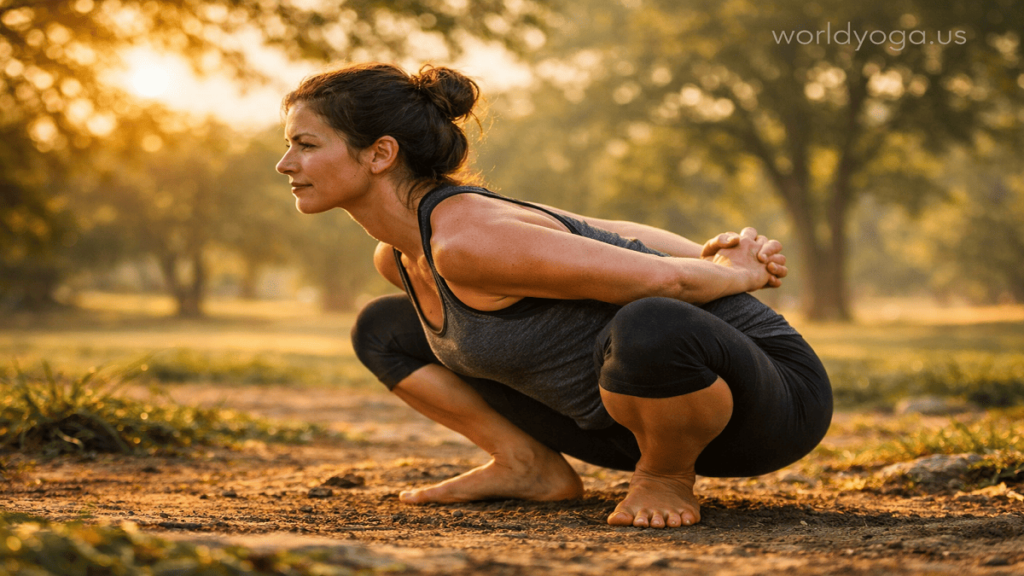
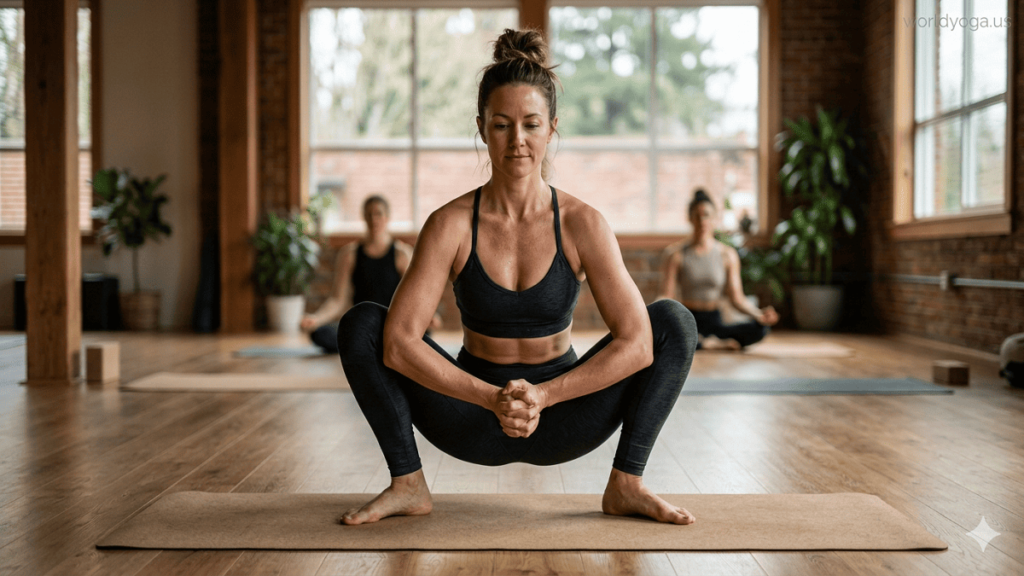
Baddha Hasta Malasana is a bound-hand variation of Malasana where the practitioner holds a deep squat while interlacing or binding the hands in front of or around the body. The term “Baddha Hasta” refers to “bound hands,” which creates a controlled engagement of the upper body while the lower body remains in a deep squat.
This variation enhances structural awareness by integrating the upper and lower body into a single stable posture.
How to Perform Baddha Hasta Malasana Correctly
- Begin in a standing position with feet slightly wider than hip-width apart.
- Turn the toes slightly outward for stability.
- Slowly lower into a deep squat, keeping the heels grounded or supported.
- Press the knees outward gently using the inner arms or elbows.
- Bring the hands into a bind—either interlacing fingers behind the back, holding opposite elbows in front, or wrapping arms around the shins depending on flexibility.
- Maintain a long spine, chest open, and steady breath.
- Hold the posture for 20–60 seconds with controlled breathing.
Key Alignment Points
- Heels grounded or supported to maintain balance
- Knees aligned with toes and gently pressed outward
- Spine elongated without excessive rounding
- Hips lowered evenly between the feet
- Shoulders relaxed even in bound position
- Core lightly engaged for stability
Yoga Journal emphasizes that proper alignment in Malasana variations is essential for safe hip opening and joint protection (https://www.yogajournal.com/poses/garland-pose/).
Benefits of Baddha Hasta Malasana
1. Enhanced Hip Opening
Deep squat positioning combined with binding increases stretch in the adductors, glutes, and hip rotators.
2. Improved Lower-Body Strength
Quadriceps, hamstrings, and calves work isometrically to maintain stability in the squat.
3. Better Postural Awareness
Upper-body binding improves shoulder stability and encourages spinal alignment.
4. Increased Joint Mobility
Regular practice improves ankle dorsiflexion, knee stability, and hip flexibility.
5. Mind-Body Integration
The bound position enhances proprioception and encourages focused breathing and awareness.
Precautions
- Avoid if experiencing knee injuries or severe hip impingement
- Use support under heels if flexibility is limited
- Do not force the bind if shoulder mobility is restricted
- Maintain neutral spine to prevent lower-back strain
Conclusion
Baddha Hasta Malasana is an advanced variation of Malasana that combines deep lower-body squatting with upper-body binding to enhance stability, mobility, and alignment awareness. When practiced with proper technique, it strengthens the lower body, improves hip flexibility, and promotes integrated full-body control.
#Baddha Hasta Malasana in India
How is Baddha Hasta Malasana performed correctly?
Malasana is a deep squatting posture that requires stability, hip mobility, and controlled alignment. In the Baddha Hasta Malasana variation, the addition of bound or structured hand positioning increases upper-body engagement and improves postural awareness. Correct execution depends on coordinated alignment of the feet, knees, hips, spine, and shoulders.
1. Starting Position and Foot Alignment
Begin standing with feet slightly wider than hip-width apart. Turn the toes outward at a natural angle (not forced). Slowly lower the body into a deep squat by bending the knees and pushing the hips downward.
The heels should ideally remain grounded. If flexibility is limited, a folded mat or small support under the heels can help maintain balance without compromising alignment.
2. Knee Alignment and Hip Position
As you descend, actively guide the knees outward in line with the toes. This prevents inward collapse and opens the hips safely. The hips should drop straight down between the feet rather than shifting backward.
The pelvis remains neutral—neither excessively tucked nor overly arched. This ensures spinal stability and balanced load distribution.
Yoga Journal highlights that proper knee-to-toe alignment in Malasana is essential for safe hip opening and joint protection (https://www.yogajournal.com/poses/garland-pose/).
3. Spine and Upper Body Alignment
The spine should remain long and upright. Avoid rounding the lower back or collapsing the chest. The chest stays open, and shoulders remain relaxed away from the ears.
The head follows the natural line of the spine, with gaze forward or slightly downward for balance.
4. Baddha Hasta (Bound Hand Positioning)
Once stable in the squat:
- Option 1: Interlace fingers behind the back and gently draw shoulders back for chest opening
- Option 2: Hold opposite elbows in front of the body for a stable bind
- Option 3: Wrap arms lightly around the shins if mobility allows
The bind should support posture, not create tension. The goal is integration of upper and lower body control.
5. Core Engagement and Stability
The core muscles remain gently active to stabilize the spine and pelvis. This prevents collapse into the lower back and supports balance in the deep squat position.
Breathing should remain steady and diaphragmatic throughout the posture.
6. Breath Coordination
Inhale deeply through the nose as you prepare and lower into the squat. Exhale slowly as you settle into the position. Maintain smooth, controlled breathing to support relaxation and stability.
7. Common Mistakes to Avoid
- Heels lifting off the ground without support
- Knees collapsing inward
- Rounding the lower back excessively
- Forcing the hand bind beyond comfort
- Holding breath during the posture
Conclusion
Correct execution of Baddha Hasta Malasana requires grounded feet, outward knee alignment, a neutral spine, and controlled upper-body binding. When performed with proper technique, it enhances hip mobility, improves postural control, strengthens stabilizing muscles, and promotes full-body integration through mindful movement and breath.
#Baddha Hasta Malasana in Maharashtra
What is the proper alignment in this bound hand squat variation?
Malasana in its Baddha Hasta variation combines a deep squat with a bound or structured hand position, making alignment even more important than in the basic posture. The goal is to maintain a stable lower body base while integrating the upper body without collapsing the spine or overstressing the joints.
1. Foot and Heel Alignment
The feet are placed slightly wider than hip-width apart with toes turned outward at a natural angle. The heels should stay grounded to provide a stable base. Weight must be evenly distributed across the entire foot—heel, big toe mound, and little toe mound.
If the heels lift, a folded mat or wedge support can be used to maintain proper alignment without forcing flexibility.
2. Knee Position and Tracking
The knees should track directly in line with the toes and gently move outward. This outward action creates space in the hips and prevents inward collapse (valgus alignment), which can stress the knee joints.
The knees should not drift forward excessively or collapse inward. Instead, they should remain stable and open, supported by hip engagement.
3. Hip and Pelvic Alignment
The hips should lower straight down between the heels rather than pushing backward. The pelvis remains in a neutral position, avoiding excessive tilting forward or backward.
This alignment allows even distribution of load across the hip joints and supports spinal stability.
4. Spinal Alignment
The spine should remain long, upright, and naturally extended. Avoid rounding the lower or upper back. The chest stays open, and the shoulder blades gently draw back and down.
The head remains aligned with the spine, avoiding excessive forward tilt or neck strain.
5. Baddha Hasta (Bound Hand Position) Alignment
The bound hand position should support posture, not distort it:
- If hands are interlaced behind the back, the shoulders should remain relaxed and not forced backward.
- If holding opposite elbows in front, the arms should hang naturally without collapsing the chest.
- If wrapping arms around the legs, the grip should be gentle and not compress the knees inward.
The key principle is upper-body integration without spinal distortion.
6. Core Engagement
A gentle engagement of the core (transverse abdominis and lower abdominals) helps stabilize the pelvis and spine. This prevents collapsing into the lower back during the deep squat.
7. Shoulder and Upper Back Position
The shoulders should remain relaxed away from the ears. Even in a bound position, the upper back should stay open without excessive rounding or tension.
Conclusion
Proper alignment in Baddha Hasta Malasana depends on a stable grounded base, outward knee tracking, neutral pelvic positioning, a long spine, and a supportive—not restrictive—hand bind. When these alignment principles are maintained, the posture becomes safe, effective, and beneficial for improving hip mobility, lower-body strength, and full-body postural integration.
#Baddha Hasta Malasana in Ahemadabad
Which muscles are engaged during the pose?
1. Quadriceps (Front Thigh Muscles)
The quadriceps are heavily engaged to control knee flexion in the deep squat. They work isometrically to support body weight and maintain stability in the lowered position. This sustained activation builds endurance and improves functional lower-body strength.
2. Gluteal Muscles (Gluteus Maximus and Medius)
The glutes play a key role in hip stability and external rotation. The gluteus medius helps keep the knees aligned outward, while the gluteus maximus supports hip control and prevents collapse during deep squatting.
3. Adductor Group (Inner Thigh Muscles)
The adductors are lengthened under controlled tension as the knees press outward. This improves hip mobility and flexibility while also contributing to controlled stabilization of the pelvis.
4. Hamstrings
The hamstrings assist in stabilizing the pelvis and controlling the depth of the squat. They help regulate hip positioning and support the posterior chain during sustained holds.
5. Calf Muscles (Gastrocnemius and Soleus)
The calves maintain ankle stability and support balance, especially when the heels are grounded. They are engaged isometrically to prevent instability in the lower leg.
6. Core Muscles (Abdominals and Deep Stabilizers)
The rectus abdominis, transverse abdominis, and obliques work to stabilize the spine and pelvis. This prevents excessive rounding and maintains structural integrity in the deep squat position.
7. Spinal Extensors (Erector Spinae)
The erector spinae muscles support upright posture and help maintain spinal alignment. They counterbalance forward flexion forces and keep the torso elongated.
8. Shoulder and Upper Back Muscles
Because of the Baddha Hasta (bound hand) component, the upper body is actively engaged:
- Deltoids: stabilize shoulder positioning
- Trapezius (mid and lower fibers): support scapular control
- Rhomboids: assist in maintaining upper back posture
- Forearm muscles: activate during arm binding or elbow holds
9. Hip Stabilizers
Deep stabilizing muscles such as the piriformis and small external rotators are engaged to maintain knee alignment and pelvic control. These muscles are essential for safe squat mechanics.
Conclusion
Baddha Hasta Malasana is a highly integrated movement that engages the quadriceps, glutes, adductors, hamstrings, calves, core muscles, spinal extensors, and upper-body stabilizers. This coordinated activation improves lower-body strength, hip mobility, postural control, and full-body neuromuscular coordination, making it an effective functional movement for both mobility and strength development.
#Baddha Hasta Malasana in Hyderabad
What preparatory poses are recommended?
Malasana with the Baddha Hasta (bound hand) variation requires a combination of hip mobility, ankle flexibility, core stability, and shoulder opening. Proper preparation ensures safe alignment in both the deep squat and upper-body binding components, reducing strain on the knees, hips, and shoulders.
1. Hip Opening Preparations
Since deep hip flexion and external rotation are central to this posture, hip-opening poses are essential.
- Bound Angle Pose (Baddha Konasana): Opens the inner thighs and groin, improving external hip rotation.
- Low Lunge (Anjaneyasana): Stretches hip flexors and prepares the pelvis for deeper squatting.
- Pigeon Pose (Eka Pada Rajakapotasana): Releases deep gluteal tension and improves hip joint mobility.
These poses gradually increase range of motion in the hips, making the squat more accessible.
2. Ankle Mobility and Calf Flexibility
Ankle flexibility is crucial for maintaining grounded heels in Malasana.
- Downward-Facing Dog (Adho Mukha Svanasana): Stretches calves and Achilles tendon, improving dorsiflexion.
- Heel-Elevated Squat Holds: Builds gradual adaptation for deeper squat positioning if flexibility is limited.
Improved ankle mobility helps stabilize the entire squat foundation.
3. Knee Strength and Stability Work
Strong and stable knees are required for safe deep squatting.
- Chair Pose (Utkatasana): Strengthens quadriceps and supports knee stability.
- Supported Wall Squats: Reinforces proper knee tracking and alignment control.
These movements prepare the joints for load-bearing flexion.
4. Core Activation and Spinal Preparation
Core strength supports spinal integrity in both squat and bound positions.
- Cat-Cow Pose (Marjaryasana–Bitilasana): Improves spinal mobility and breath coordination.
- Plank Pose (Phalakasana): Strengthens core stabilizers for better control in deep squat positions.
5. Shoulder and Upper Body Preparation (for Baddha Hasta)
Because this variation includes binding or arm positioning, shoulder mobility is important.
- Cow Face Arms (Gomukhasana Arms): Improves shoulder flexibility and internal rotation.
- Shoulder Rolls and Chest Openers: Release upper-back tension and improve posture.
- Eagle Arms (Garudasana Arms): Enhances scapular mobility and arm binding readiness.
Yoga Journal emphasizes that shoulder openness is key for safe upper-body binding in yoga postures (https://www.yogajournal.com/poses/garland-pose/).
6. Breath Awareness Preparation
Controlled breathing supports stability in deep squats.
- Diaphragmatic Breathing (Seated or Supine): Trains deep abdominal engagement.
- Slow Nasal Breathing Practice: Prepares nervous system for stability and relaxation in the posture.
Conclusion
Effective preparation for Baddha Hasta Malasana requires a balanced sequence of hip openers, ankle mobility work, knee strengthening, core activation, shoulder flexibility training, and breath awareness. When practiced consistently, these preparatory poses make the final posture safer, more stable, and more accessible while improving overall movement efficiency and joint health.
#Baddha Hasta Malasana in Banglore
What are the benefits and precautions of Baddha Hasta Malasana?
Malasana in its Baddha Hasta (bound hand) variation combines deep lower-body squatting with structured upper-body engagement. This creates a more integrated full-body posture that enhances strength, mobility, and postural awareness, but also requires careful attention to alignment and joint safety.
Benefits of Baddha Hasta Malasana
1. Deep Hip Opening and Mobility
The wide-knee squat position strongly activates the hip external rotators and stretches the inner thighs (adductors). Over time, this improves hip flexibility and reduces stiffness caused by prolonged sitting.
2. Strengthening of Lower-Body Muscles
The quadriceps, glutes, hamstrings, and calves work isometrically to support the deep squat. This builds endurance and functional strength used in daily movements like sitting, lifting, and bending.
3. Improved Postural Awareness
The Baddha Hasta arm position enhances upper-body engagement, encouraging better shoulder alignment and spinal awareness. This integration helps develop balanced posture control.
4. Enhanced Joint Stability
The posture improves stability in the knees, hips, and ankles by training coordinated load distribution in a closed kinetic chain movement pattern.
5. Better Body Awareness and Focus
The combination of deep squatting and arm binding increases proprioception, helping practitioners become more aware of body positioning and alignment.
Yoga Journal highlights that Malasana-based postures support hip mobility and functional joint health, especially in individuals with sedentary lifestyles (https://www.yogajournal.com/poses/garland-pose/).
Precautions of Baddha Hasta Malasana
1. Knee Strain or Injury Risk
Individuals with knee pain, ligament issues, or arthritis should avoid deep squatting or use support such as blocks or cushions. Knees must always track in line with toes.
2. Hip or Groin Tightness
Forcing depth in tight hips may cause discomfort or impingement. The squat depth should be reduced if pain is present.
3. Shoulder or Arm Limitations
The bound hand variation may strain the shoulders if flexibility is limited. The bind should never be forced or painful.
4. Lower Back Sensitivity
Excessive rounding of the spine can stress the lumbar region. A long, neutral spine must be maintained throughout the posture.
5. Balance and Stability Concerns
Beginners may find the deep squat unstable. Support from a wall or yoga block can improve safety and control.
Conclusion
Baddha Hasta Malasana offers significant benefits for hip mobility, lower-body strength, joint stability, and postural awareness. However, it requires careful alignment and appropriate modifications to prevent strain on the knees, hips, shoulders, and lower back. When practiced mindfully, it becomes a powerful integrated posture for functional movement and full-body coordination.
#Baddha Hasta Malasana in Pune
Case Study of Baddha Hasta Malasana
This case study examines the application of Malasana in its Baddha Hasta (bound hand) variation within a structured mobility and movement re-education program. The focus is on improving lower-body flexibility, upper-body integration, and overall postural control in a sedentary adult population.
1. Subject Profile
A 36-year-old administrative professional presented with:
- Reduced hip mobility due to prolonged sitting
- Limited ankle dorsiflexion
- Mild shoulder stiffness from desk work
- Occasional lower back tightness
- Poor squat depth and balance control
The intervention aimed to restore functional squatting ability and improve full-body coordination through progressive training.
2. Intervention Protocol
The program was implemented over 8 weeks, with sessions conducted 4–5 times per week for 15–25 minutes.
Structure of Practice:
- Warm-up phase: Cat-Cow movement, ankle rolls, and shoulder mobilization
- Squat progression: Supported squat → full Malasana → Baddha Hasta Malasana
- Bound hand integration: Gradual introduction of arm positions (elbows hold → interlaced fingers → full bind)
- Hold duration: 30–60 seconds per repetition
- Breath control: Slow nasal breathing throughout posture
3. Observations During Training
Weeks 1–2:
- Difficulty maintaining heel contact with the floor
- Limited squat depth due to hip and ankle stiffness
- Shoulder tightness restricted full binding
Weeks 3–5:
- Improved knee alignment and hip external rotation
- Increased tolerance in deep squat hold
- Reduced shoulder tension during bound arm positions
Weeks 6–8:
- Stable full-depth squat achieved with heel grounding
- Comfortable execution of Baddha Hasta variations
- Improved balance and postural control
Yoga Journal notes that Malasana-based postures significantly improve hip mobility and joint function when practiced consistently (https://www.yogajournal.com/poses/garland-pose/).
4. Outcomes
Mobility Improvements:
- Noticeable increase in hip external rotation range
- Improved ankle dorsiflexion allowing deeper squat access
Strength and Stability:
- Enhanced quadriceps and glute endurance
- Better knee alignment control under load
Upper-Body Integration:
- Reduced shoulder stiffness
- Improved scapular awareness and posture control
Functional Improvements:
- Easier transition between sitting and squatting movements
- Improved balance during bodyweight activities
5. Discussion
The Baddha Hasta Malasana variation proved effective in integrating lower-body mobility with upper-body binding patterns. The progression from supported squat to full bind allowed gradual neuromuscular adaptation without excessive joint strain.
Key contributing factors to success included:
- Progressive loading of squat depth
- Incremental shoulder mobility work
- Consistent alignment correction
- Controlled breathing throughout movement
6. Limitations and Considerations
- Shoulder mobility limitations slowed early progression
- Knee discomfort required occasional reduction in squat depth
- Consistency was critical for measurable improvement
- Individual flexibility levels influenced adaptation speed
7. Conclusion
Baddha Hasta Malasana is an effective integrated movement for improving hip mobility, lower-body strength, shoulder flexibility, and full-body postural coordination. When introduced progressively and practiced with proper alignment, it serves as a valuable functional training tool for correcting sedentary movement restrictions and enhancing overall body control.
#Baddha Hasta Malasana in Kolkata
White Paper of Baddha Hasta Malasana
1. Executive Summary
Malasana in its Baddha Hasta (bound hand) variation is a functional movement that integrates deep hip flexion, knee flexion, ankle dorsiflexion, and upper-body binding mechanics. This white paper evaluates its biomechanical structure, neuromuscular demands, therapeutic applications, and suitability in mobility training, rehabilitation, and functional fitness systems. The posture functions as a closed-chain kinetic exercise that enhances lower-body strength while improving upper-body postural integration.
2. Introduction
Modern sedentary lifestyles have significantly reduced natural squatting ability, leading to restricted hip mobility, weakened posterior chain activation, and poor postural control. Baddha Hasta Malasana addresses these limitations by combining a deep squat pattern with structured upper-body engagement through binding or arm positioning.
Yoga Journal identifies Malasana as a key posture for improving hip mobility, joint function, and lower-body flexibility, making it a foundational movement in yoga-based mobility systems (https://www.yogajournal.com/poses/garland-pose/).
3. Biomechanical Framework
3.1 Lower-Body Mechanics
The posture involves:
- Deep hip flexion and external rotation
- Knee flexion under controlled load
- Ankle dorsiflexion with heel grounding
Primary muscles engaged include quadriceps, gluteus maximus, gluteus medius, adductors, hamstrings, and calf complex. The movement enhances closed-chain stability and joint loading efficiency.
3.2 Upper-Body Binding Mechanics
The Baddha Hasta component introduces:
- Shoulder flexion or extension depending on bind type
- Scapular stabilization via rhomboids and trapezius
- Forearm and grip activation during arm positioning
This upper-body integration enhances postural awareness and neuromuscular coordination.
3.3 Spinal Alignment
The spine remains in a neutral elongated position with controlled axial loading. Core musculature stabilizes the pelvis, preventing lumbar collapse during deep flexion.
4. Neuromuscular Activation Profile
The posture activates multiple muscle systems simultaneously:
- Lower-body stabilizers: quadriceps, glutes, calves
- Hip control muscles: adductors, deep rotators
- Core stabilizers: transverse abdominis, obliques, multifidus
- Upper-body stabilizers: deltoids, trapezius, rhomboids, forearm flexors
This integrated activation improves motor control efficiency and proprioceptive awareness.
5. Therapeutic Applications
5.1 Mobility Restoration
- Enhances hip external rotation
- Improves ankle dorsiflexion
- Reduces stiffness from prolonged sitting
5.2 Postural Re-education
- Improves spinal alignment awareness
- Strengthens scapular stabilization
- Enhances whole-body coordination
5.3 Functional Strength Development
- Builds isometric lower-body endurance
- Improves load-bearing capacity in squat positions
- Strengthens posterior chain engagement
6. Clinical Considerations and Risk Factors
Despite its benefits, controlled application is necessary:
- Knee valgus collapse may increase joint stress
- Excessive spinal rounding may strain lumbar structures
- Shoulder mobility limitations may restrict safe binding
- Limited ankle flexibility may shift load unevenly to knees
Modifications such as block support, reduced squat depth, or simplified arm positioning are recommended for beginners or clinical populations.
7. Implementation Framework
A progressive training model is recommended:
- Phase 1: Supported squat holds (no bind)
- Phase 2: Full Malasana with controlled alignment
- Phase 3: Introduction of basic Baddha Hasta positioning
- Phase 4: Full integration with breath control and extended holds
Recommended dosage:
- Frequency: 3–5 sessions per week
- Duration: 10–25 minutes per session
8. Conclusion
Baddha Hasta Malasana is a comprehensive functional movement that integrates lower-body mobility, upper-body binding mechanics, and core stabilization into a single posture. When applied progressively and with correct alignment principles, it improves joint mobility, enhances neuromuscular coordination, and supports functional movement re-education. Its adaptability makes it suitable for fitness training, rehabilitation programs, and yoga-based therapeutic systems.
#Baddha Hasta Malasana in Delhi
Induistry Application of Baddha Hasta Malasana
Malasana in its Baddha Hasta (bound hand) variation is increasingly used across multiple industries due to its combination of deep lower-body loading, hip mobility development, and upper-body postural integration. It is valued as a functional movement pattern that supports strength, flexibility, and neuromuscular coordination in both preventive and corrective training systems.
1. Fitness and Functional Training Industry
In fitness programming, Baddha Hasta Malasana is used as a compound mobility-strength exercise. Trainers include it in:
- Functional movement circuits
- Lower-body mobility training sessions
- Bodyweight strength conditioning programs
It helps improve squat depth, hip external rotation, and lower-body endurance while also promoting shoulder stability through the bound-hand component. This makes it useful for improving overall movement quality and athletic readiness.
2. Physiotherapy and Rehabilitation Sector
In rehabilitation environments, this variation is adapted as a progressive mobility and re-education tool. It is commonly used for:
- Restoring hip and ankle mobility after inactivity or minor injury
- Improving knee alignment control in closed-chain movements
- Rebuilding functional squatting ability in sedentary patients
Therapists often modify the posture using props such as blocks or wall support to reduce joint stress while maintaining movement integrity.
3. Corporate Wellness Programs
With prolonged sitting being a major workplace issue, corporate wellness programs use simplified versions of this squat to reduce musculoskeletal strain. Benefits include:
- Reduction in lower back and hip stiffness
- Improved circulation in lower limbs
- Short movement breaks to counter sedentary posture stress
These micro-mobility sessions help improve employee comfort and productivity.
4. Sports and Athletic Performance Training
Athletes use deep squat variations like Baddha Hasta Malasana to enhance:
- Hip mobility for explosive movements
- Knee stability under load
- Posterior chain engagement for sprinting and jumping
The upper-body binding adds scapular stability, which is useful in sports requiring full-body coordination such as martial arts, wrestling, and functional strength sports.
5. Yoga and Mind-Body Training Industry
In yoga systems, this posture is used to develop full-body awareness, breath control, and structural integration. It is often included in:
- Mobility-focused yoga sequences
- Alignment and posture correction classes
- Deep hip-opening practices
Yoga Journal highlights Malasana as a foundational posture for hip opening and functional joint health, making it widely applicable in yoga education (https://www.yogajournal.com/poses/garland-pose/).
6. Ergonomics and Movement Education
In ergonomics training, this movement is used to teach safe squatting mechanics and body alignment principles. It reinforces:
- Proper hip hinge and squat mechanics
- Knee tracking awareness
- Balanced load distribution through the feet
This makes it useful in workplace safety education and physical literacy programs.
Conclusion
Baddha Hasta Malasana is a versatile functional movement applied across fitness, rehabilitation, corporate wellness, sports performance, yoga education, and ergonomics industries. Its ability to combine mobility, strength, and postural integration makes it a valuable tool for improving movement quality, preventing injury, and restoring functional squatting ability in modern sedentary populations.
#Baddha Hasta Malasana in Mumbai
Ask FAQs
What is Baddha Hasta Malasana?
Malasana in its Baddha Hasta variation is a deep squatting posture combined with a bound or structured hand position. It integrates lower-body mobility work with upper-body engagement to improve stability, alignment, and overall body control.
What are the main benefits of this pose?
It improves hip flexibility, strengthens the quadriceps, glutes, and calves, and enhances shoulder stability through the bound hand position. It also promotes better posture, joint mobility, and full-body coordination.
Is Baddha Hasta Malasana suitable for beginners?
Yes, but beginners should start with a basic squat or supported Malasana before attempting the bound hand variation. Using props like blocks or a wall can help maintain balance and reduce strain while building flexibility gradually.
What are the common mistakes to avoid?
Common mistakes include letting the knees collapse inward, lifting the heels without control, rounding the lower back excessively, and forcing the hand bind beyond comfort. Proper alignment and gradual progression are essential for safety.
Who should avoid this pose?
Individuals with knee injuries, severe hip limitations, shoulder mobility restrictions, or lower back pain should modify or avoid this posture. Pregnant individuals or those with balance issues should practice under professional guidance or use supported variations.
Table of Contents
Disclaimer: This content is for educational purposes only and is not a substitute for professional medical advice, diagnosis, or treatment. Practice Baddha Hasta Malasana within your comfort level and avoid any pain or strain. Individuals with injuries, mobility limitations, or medical conditions should consult a qualified healthcare professional or certified yoga instructor before attempting this pose.