Boat Pose: Grabbing onto Feet/Toes
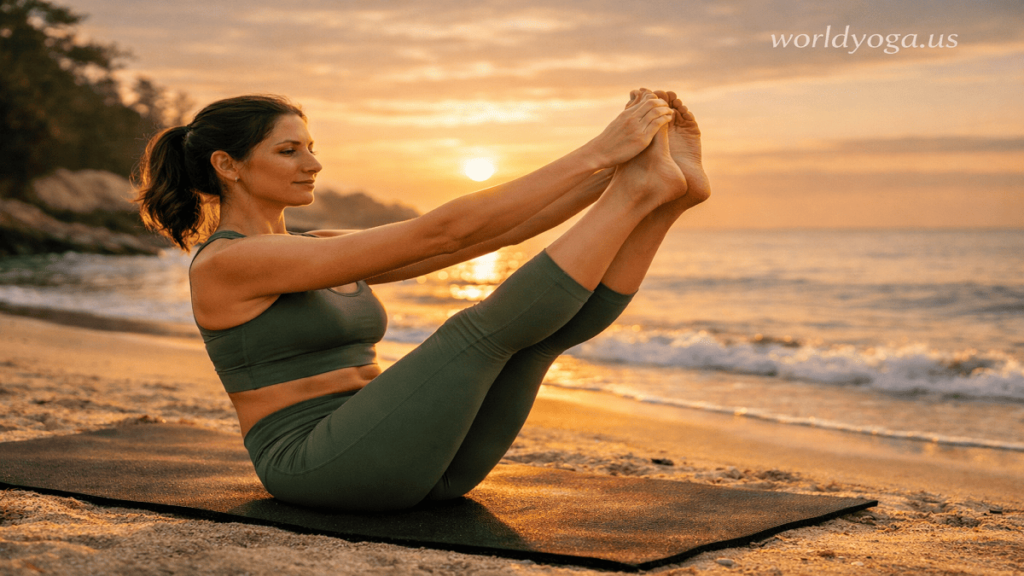
Navasana with hands holding the feet or toes is an advanced variation that combines core stability, balance, spinal control, and hamstring flexibility. In this variation, the practitioner balances on the sit bones while extending the legs upward and reaching the hands to grasp the feet or big toes, creating a deeper and more controlled “V” shape.
This posture increases the intensity of traditional Boat Pose by adding flexibility and upper-body engagement while maintaining strong abdominal activation.
How the pose is performed
Begin seated on a yoga mat with legs extended forward. Engage the core and lean the torso slightly back while keeping the spine long and chest lifted.
Lift both legs off the floor and gradually straighten them upward. Once balanced, reach the hands toward the feet or big toes. Depending on flexibility and control, the practitioner may:
- Hold the backs of the thighs
- Hold the ankles
- Grasp the feet
- Or catch the big toes with yogic toe lock
The final posture should maintain balance on the sit bones without collapsing into the lower back.
Proper alignment principles
Correct alignment is essential for stability and safety:
- Spine remains elongated and lifted
- Chest stays open, not collapsed
- Core remains strongly engaged throughout
- Legs stay active and extended
- Shoulders remain relaxed away from ears
- Weight balances evenly on the sit bones
The primary goal is maintaining spinal integrity rather than pulling the legs excessively close to the torso.
Muscles engaged
This variation activates multiple muscle groups simultaneously:
Core muscles
- Rectus abdominis
- Transverse abdominis
- Internal and external obliques
Hip and leg muscles
- Iliopsoas (hip flexors)
- Quadriceps
- Hamstrings (lengthened under tension)
Upper body stabilizers
- Deltoids
- Rhomboids
- Erector spinae for spinal support
Because the arms connect to the feet, the posture requires coordinated engagement across the entire kinetic chain.
Benefits of this variation
Practicing this advanced variation may:
- Build deep core strength and endurance
- Improve balance and neuromuscular coordination
- Increase hamstring flexibility and posterior chain mobility
- Enhance spinal awareness and posture control
- Develop concentration and breath regulation under effort
Precautions
This variation should be practiced carefully:
- Avoid if experiencing lower back pain or hip injury
- Do not force hamstring flexibility
- Avoid rounding the spine to reach the feet
- Use bent-knee modifications if flexibility is limited
- Maintain steady breathing throughout the hold
Practitioners with tight hamstrings should prioritize spinal length before attempting full toe grasping.
Conclusion
Boat Pose while grabbing the feet or toes is an advanced progression of Navasana that integrates strength, flexibility, Boat Pose and balance into one posture. When practiced with proper alignment and gradual progression, it becomes an effective tool for developing full-body control and advanced core stability.
References
- Yoga Journal – Boat Pose Variations Guide
- Yoga Basics – Navasana Techniques
- NCBI – Core Stability and Functional Movement Research
#Boat Pose: Grabbing onto Feet/Toes in India
How is Boat Pose while grabbing the feet or toes performed correctly?
Navasana while holding the feet or toes is an advanced balancing variation that combines core strength, spinal stability, Boat Pose and hamstring flexibility. Correct execution depends on maintaining a strong, lifted spine while balancing steadily on the sit bones.
Step-by-step technique
1. Start in a seated position
Sit on a yoga mat with both legs extended forward in a comfortable seated position. Ground evenly through the sit bones and lengthen the spine upward.
2. Engage the core
Activate the abdominal muscles by gently drawing the navel inward. This creates lumbar support before lifting the legs.
3. Lean back slightly
Tilt the torso backward from the hips while keeping the chest lifted and spine long. Avoid collapsing or rounding the lower back.
4. Lift the legs
Raise both feet off the floor and gradually extend the legs upward. Depending on flexibility and strength, the legs may form a wide or narrow “V” shape.
5. Reach for the feet or toes
Once balance is established, extend the arms toward the legs and hold:
- The backs of the thighs (beginner progression)
- Ankles or feet
- Or the big toes using a yogic toe grip
The grip should support balance without pulling the spine into rounding.
6. Stabilize the final posture
Maintain balance on the sit bones while:
- Keeping the spine elongated
- Chest open
- Core engaged
- Legs active and extended
- Shoulders relaxed away from the ears
Breathing should remain slow and controlled throughout the hold.
Proper alignment principles
Correct alignment is essential for safety and effectiveness:
- Spine remains neutral and lifted
- Weight balances evenly on the sit bones
- Chest stays open, not collapsed inward
- Legs remain active instead of passive
- Neck stays neutral and relaxed
- Core supports the posture continuously
The posture should feel stable rather than forced.
Breathing guidance
Use steady nasal breathing during the pose. Avoid breath-holding, Boat Pose as this increases tension and reduces balance control. Controlled breathing improves endurance and helps maintain focus.
Common mistakes to avoid
Rounding the lower back
This is the most common mistake and places stress on the lumbar spine.
Pulling excessively with the arms
The hands should assist balance, not force flexibility.
Locking the knees aggressively
Legs should stay active but not hyperextended.
Collapsing the chest
Dropping the chest reduces spinal integrity and core activation.
Holding tension in shoulders and neck
The upper body should remain relaxed while the core performs the primary work.
Key focus for safe practice
The main objective is:
spinal length + core control + balanced flexibility
It is better to hold the thighs or ankles with correct alignment than to force a toe grip with poor posture.
Conclusion
Boat Pose while grabbing the feet or toes is an advanced progression requiring integrated strength, flexibility, and balance. When practiced with controlled alignment and gradual progression, it develops powerful core endurance, Boat Pose improved body awareness, and refined postural control.
#Boat Pose: Grabbing onto Feet/Toes in Maharashtra
What is the proper alignment in this Navasana variation?
Navasana while holding the feet or toes is an advanced variation that requires a precise balance between spinal stability, Boat Pose core activation, and hamstring flexibility. Proper alignment is essential because the added arm-to-leg connection can easily pull the body into poor posture if stability is lost.
1. Pelvis and sit bones (foundation of balance)
The body should balance directly on the sit bones, not rolled backward onto the tailbone or sacrum. The pelvis maintains a slightly neutral or gently forward-tilted position to support spinal length.
A stable pelvic base is the key to maintaining the entire posture safely.
2. Spine (primary alignment axis)
The spine should remain long, lifted, and neutral throughout the pose. The chest stays open while the torso lengthens upward instead of collapsing toward the legs.
The most important principle is:
lift the spine before deepening the leg extension or toe grip.
Avoid rounding the lower back to reach the feet.
3. Core engagement
The deep abdominal muscles remain continuously active to stabilize the lumbar spine and maintain balance. The core should feel firm but controlled, preventing the body from collapsing backward.
The abdominal engagement supports:
- Pelvic stability
- Upright posture
- Controlled breathing
- Leg elevation
4. Legs and knees
The legs remain active and extended rather than passive. Quadriceps engage to support knee extension, while the inner thighs remain gently active to maintain alignment.
Knees should stay straight but not aggressively locked or hyperextended.
5. Arms and grip
The arms extend naturally toward the feet or toes without pulling excessively. The grip should support balance and alignment rather than force flexibility.
Depending on mobility, practitioners may hold:
- Thighs
- Ankles
- Feet
- Or big toes
The shoulders remain relaxed and broad throughout the posture.
6. Chest and shoulders
The chest should stay open and lifted. Shoulder blades remain stable on the back without collapsing inward or lifting toward the ears.
The upper body should feel spacious, not compressed.
7. Head and neck
The neck remains neutral and aligned with the spine. The gaze is forward or slightly upward, avoiding strain in the cervical spine.
Key alignment principles
Correct posture can be summarized as:
- Balance on sit bones
- Long neutral spine
- Active core support
- Open chest and relaxed shoulders
- Straight, engaged legs
- Gentle grip without forcing flexibility
Common alignment mistakes
Rounding the spine
Often caused by tight hamstrings or trying to grab the toes too aggressively.
Collapsing backward
Occurs when core engagement is insufficient.
Pulling with the arms
The posture should originate from core stability, not arm tension.
Shoulder tension
Over-gripping the feet often creates neck and shoulder strain.
Final note
In this advanced Navasana variation, proper alignment matters more than achieving a deep leg extension or toe hold. The posture should feel stable, lifted, and controlled rather than forced.
References
- Yoga Journal – Boat Pose Alignment Guide
- Yoga Basics – Navasana Variations
- NCBI – Postural Stability and Core Research
#Boat Pose: Grabbing onto Feet/Toes in Ahemadabad
Which muscles are engaged during the pose?
Navasana while holding the feet or toes is a full-body isometric posture that combines core activation, hip flexor strength, spinal stabilization, and flexibility control. Because the arms connect directly to the legs, the body functions as an integrated kinetic chain where multiple muscle groups work simultaneously to maintain balance and alignment.
Primary core muscles engaged
1. Rectus abdominis
This muscle is heavily activated to maintain trunk flexion and prevent the torso from collapsing backward. It is responsible for the strong abdominal contraction associated with the “V” shape of the posture.
2. Transverse abdominis
The deepest abdominal muscle layer stabilizes the lumbar spine and pelvis. It acts like a supportive corset, helping maintain balance and reducing lower back strain during the hold.
3. Internal and external obliques
The obliques stabilize the torso and prevent rotational imbalance. They help maintain symmetry while balancing on the sit bones and support controlled breathing under tension.
Hip and leg muscles engaged
4. Iliopsoas (hip flexors)
The hip flexors play a major role in lifting and sustaining the legs in the elevated position. Because the legs are extended upward, these muscles work intensely throughout the pose.
5. Quadriceps
The quadriceps actively maintain knee extension and stabilize the legs. They help keep the legs straight and controlled rather than collapsing or bending.
6. Hamstrings
Although lengthened in this posture, the hamstrings remain lightly active to stabilize the legs and control tension during extension.
Spinal and postural stabilizers
7. Erector spinae
These muscles along the spine help maintain an upright torso and prevent excessive rounding of the back. They create balance between spinal extension and abdominal engagement.
8. Multifidus and deep stabilizers
Small stabilizing muscles around the lumbar spine and pelvis provide fine-tuned postural control and balance support.
Upper body muscles engaged
9. Deltoids and arm stabilizers
The shoulders and arms remain active while reaching toward or holding the feet or toes. They assist in maintaining posture without excessive pulling.
10. Rhomboids and trapezius
These upper back muscles stabilize the shoulder blades and help maintain an open chest position.
Functional muscle interaction
This variation creates:
- Isometric core contraction
- Dynamic flexibility control
- Integrated upper and lower body stabilization
- Continuous balance adjustment through deep stabilizers
The posture demands coordination rather than isolated muscular effort.
Main training effect
Regular practice may improve:
- Core endurance and stability
- Hip flexor strength
- Spinal posture control
- Balance and coordination
- Flexibility under muscular tension
Final note
The pose is most effective when the muscles work together in a controlled and balanced manner. Excessive pulling or collapsing into flexibility reduces proper muscular engagement and increases strain risk.
References
- Yoga Journal – Boat Pose Anatomy and Alignment
- Yoga Basics – Navasana Muscle Activation Guide
- NCBI – Core Stability and Postural Control Research
#Boat Pose: Grabbing onto Feet/Toes in Hyderabad
What preparatory poses help improve balance and flexibility for this variation?
Navasana while holding the feet or toes is an advanced variation that requires a combination of core strength, balance, spinal control, and hamstring flexibility. Proper preparation helps the body safely develop the mobility and stability needed for this posture without excessive strain.
Below are the most effective preparatory poses.
1. Ardha Navasana (Half Boat Pose)
Ardha Navasana
This is the primary preparatory posture because it builds foundational core strength and balance awareness. Practicing with bent knees allows better spinal alignment while gradually strengthening the abdominal muscles and hip flexors required for the full variation.
2. Dandasana (Staff Pose)
Dandasana
Dandasana teaches proper seated alignment and pelvic positioning. It helps practitioners learn how to sit upright on the sit bones while maintaining a long spine—essential for balanced Boat Pose variations.
3. Paschimottanasana (Seated Forward Fold)
Paschimottanasana
This posture improves hamstring and calf flexibility, reducing the tendency to round the lower back during leg extension. Increased posterior chain flexibility allows a safer and more controlled toe grip in advanced Navasana.
4. Supta Padangusthasana (Reclined Hand-to-Big-Toe Pose)
Supta Padangusthasana
This pose develops active hamstring flexibility while teaching controlled leg extension. It also improves awareness of pelvic stability during leg movement.
5. Phalakasana (Plank Pose)
Phalakasana
Plank strengthens the deep core stabilizers, shoulders, and spinal support muscles. This improves the ability to maintain stability and balance when holding the feet or toes in Boat Pose.
6. Setu Bandhasana (Bridge Pose)
Setu Bandhasana
Bridge Pose strengthens the posterior chain, including the glutes and spinal stabilizers. Balanced strength between the front and back body is important for maintaining an upright spine during advanced Boat Pose.
7. Baddha Konasana (Butterfly Pose)
Baddha Konasana
This hip-opening posture improves mobility in the inner thighs and pelvis, helping the practitioner sit more comfortably and balance efficiently on the sit bones.
Key preparation goals
These preparatory poses collectively develop:
- Deep core stability
- Hamstring flexibility
- Hip mobility
- Pelvic control
- Spinal alignment awareness
- Balance coordination
Recommended progression
A safe progression may look like:
- Dandasana → seated alignment
- Plank → core stabilization
- Half Boat Pose → balance and abdominal endurance
- Hamstring flexibility poses → leg extension readiness
- Supported toe-holding variations → final integration
Final note
The ability to hold the feet or toes safely in Boat Pose depends more on balanced strength and controlled flexibility than on forcing range of motion. Progressive preparation improves both performance and injury prevention.
References
- Yoga Journal – Boat Pose Preparation and Variations
- Yoga Basics – Navasana Foundations
- NCBI – Flexibility and Core Stability Research
#Boat Pose: Grabbing onto Feet/Toes in Delhi
What are the benefits and precautions of practicing this pose?
Navasana while holding the feet or toes is an advanced variation that combines core stability, balance, flexibility, and postural control. Because the posture requires simultaneous engagement of the abdomen, hips, spine, and legs, it offers multiple physical and functional benefits when practiced correctly. However, due to its intensity, proper precautions are essential to avoid strain or injury.
Benefits of the pose
1. Strengthens the entire core
This variation strongly activates the rectus abdominis, transverse abdominis, and obliques. The deep abdominal engagement improves spinal support and overall trunk stability.
2. Improves balance and body coordination
Balancing on the sit bones while holding the feet or toes develops neuromuscular control and full-body coordination. The posture trains the body to maintain stability under tension.
3. Enhances hamstring flexibility
The extended leg position gently lengthens the hamstrings and posterior chain. Over time, this may improve mobility and reduce stiffness in the legs and hips.
4. Develops hip flexor strength
The iliopsoas and surrounding hip flexor muscles work continuously to maintain leg elevation. This supports better lower-body control and functional movement efficiency.
5. Encourages postural awareness
Maintaining a long spine and lifted chest improves awareness of spinal alignment and seated posture habits, which can benefit daily movement and ergonomic sitting patterns.
6. Builds mental focus and endurance
Because the pose requires concentration and controlled breathing, it improves mental discipline and the ability to stay calm under physical challenge.
Precautions and safety considerations
1. Avoid rounding the lower back
The most common risk is collapsing into lumbar flexion while trying to reach the feet or toes. This places excessive pressure on the lower spine.
2. Do not force flexibility
Practitioners with tight hamstrings should avoid pulling aggressively on the feet. It is safer to hold the thighs or ankles while maintaining spinal integrity.
3. Lower back conditions
Individuals with lower back pain, disc issues, or spinal instability should approach this pose cautiously or avoid it unless guided by a qualified professional.
4. Hip flexor overuse
Excessive reliance on the hip flexors instead of the core may create strain in the front of the hips or groin area.
5. Neck and shoulder tension
Over-gripping the feet or lifting the shoulders toward the ears can create unnecessary tension in the neck and upper back.
6. Breathing restrictions
Holding the breath during effort increases tension and decreases stability. Smooth nasal breathing should be maintained throughout the pose.
Key safety principle
The posture should prioritize:
- Spinal length
- Controlled core engagement
- Balanced flexibility
- Comfortable breathing
It is better to practice a modified variation with proper alignment than to force a full toe hold with poor posture.
Final note
Boat Pose while grabbing the feet or toes is a powerful progression that develops integrated strength, flexibility, and balance. When practiced gradually and with proper alignment, it becomes an effective tool for improving core endurance, posture, and overall body control.
References
- Yoga Journal – Boat Pose Variations and Alignment
- Yoga Basics – Navasana Practice Guide
- NCBI – Core Stability and Movement Research
#Boat Pose: Grabbing onto Feet/Toes in Pune
Case Study of Boat Pose: Grabbing onto Feet/Toes
This case study evaluates the physical and functional outcomes of practicing Navasana while holding the feet or toes, an advanced variation integrating core strength, balance, spinal control, and hamstring flexibility.
1. Subject Profile and Initial Assessment
The subject was a 29-year-old yoga practitioner with intermediate experience in core-focused postures but limited hamstring flexibility and inconsistent balance during advanced Navasana variations.
Initial assessment revealed:
- Difficulty maintaining straight-leg Boat Pose beyond 15 seconds
- Mild lower back rounding during toe-reaching attempts
- Tight hamstrings restricting full leg extension
- Shoulder tension caused by over-gripping
- Moderate instability while balancing on sit bones
The primary objective was to safely progress toward a stable toe-holding variation with improved alignment and endurance.
2. Intervention Protocol
A structured 6-week progression program was designed with emphasis on flexibility, core stability, and postural mechanics.
Weekly practice components included:
- Ardha Navasana for foundational core conditioning
- Dandasana for seated spinal alignment awareness
- Hamstring mobility work (Paschimottanasana and Supta Padangusthasana)
- Progressive grip training (thighs → ankles → feet → toes)
- Controlled breathing exercises during balance holds
Training frequency:
- 5 sessions weekly
- 20–30 minutes per session
The approach prioritized spinal integrity over achieving a deep toe grip.
3. Progression and Observations
Week 1–2
The subject demonstrated adequate core strength but poor flexibility integration. Attempts to hold the toes caused spinal rounding and shoulder tension. Modifications using ankle holds were introduced.
Week 3
Improved pelvic stability and awareness of spinal extension were observed. Hamstring flexibility increased slightly, allowing partial toe reach while maintaining a longer spine.
Week 4
Balance improved significantly. The practitioner maintained stable sit-bone balance for 20 seconds while holding the feet. Breathing became more controlled during effort.
Week 5
Full toe grip was achieved intermittently without collapsing the chest. Reduced neck tension and smoother transitions into the posture were noted.
Week 6
Final assessment showed a stable 30-second hold with proper alignment, controlled breathing, and consistent spinal integrity while holding the toes.
4. Outcomes
The intervention produced measurable improvements:
- Increased deep core endurance and trunk stability
- Improved hamstring flexibility and active leg extension
- Better balance and neuromuscular coordination
- Reduced lower back compensation patterns
- Improved breath control under isometric load
- Enhanced postural awareness and movement efficiency
5. Discussion
This case demonstrates that advanced Navasana variations require integration of strength and flexibility rather than isolated muscular effort.
Key factors contributing to successful progression included:
- Gradual grip progression instead of forcing toe access
- Prioritizing spinal alignment over flexibility depth
- Combining mobility training with core conditioning
- Consistent breath regulation during balance holds
The primary limiting factor at baseline was hamstring restriction affecting pelvic positioning.
6. Conclusion
Boat Pose while grabbing the feet or toes is an effective advanced yoga posture for developing integrated core strength, balance, and flexibility when introduced progressively.
The study confirms that successful execution depends on:
- Controlled spinal alignment
- Gradual flexibility adaptation
- Deep core engagement
- Coordinated breathing mechanics
Key Insight
The posture is most effective when flexibility supports stability—not when flexibility compromises spinal control.
References
- Yoga Journal – Boat Pose Variations and Alignment
- Yoga Basics – Navasana Technique Guide
- NCBI – Core Stability and Functional Movement Research
#Boat Pose: Grabbing onto Feet/Toes in Banglore
White Paper of Boat Pose: Grabbing onto Feet/Toes
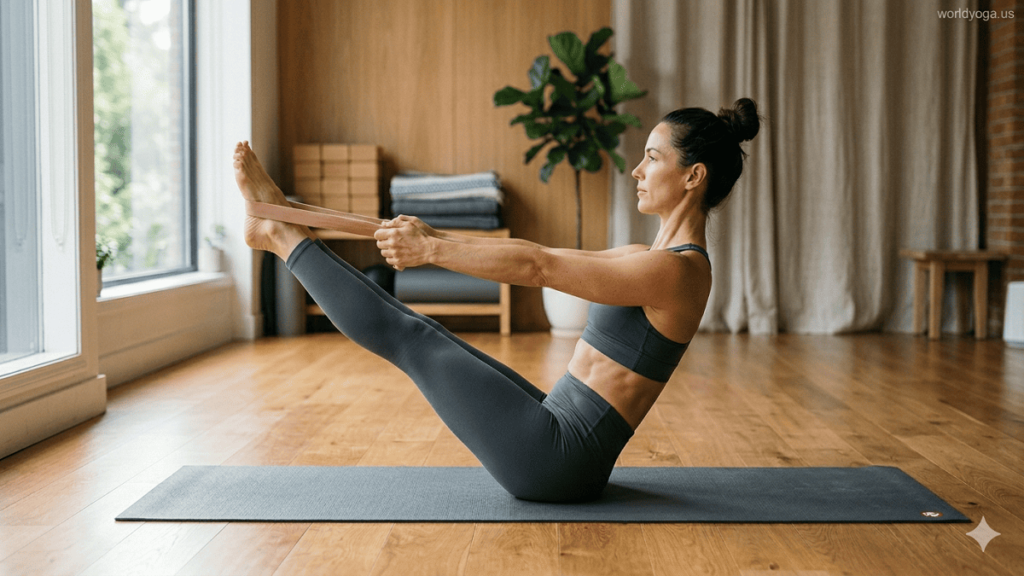
This white paper examines the advanced variation of Navasana in which the practitioner holds the feet or toes while balancing on the sit bones. The posture integrates core stabilization, spinal alignment, balance control, and flexibility under load, making it relevant in yoga practice, functional movement systems, and athletic conditioning.
1. Introduction
Boat Pose is a foundational yoga posture used to develop abdominal strength and postural control. The toe-holding variation significantly increases the complexity of the posture by combining:
- Isometric core contraction
- Active hamstring flexibility
- Balance stabilization
- Upper and lower body integration
This variation transforms the posture from a simple core hold into a coordinated full-body neuromuscular challenge.
2. Biomechanical Structure
In this variation, the body forms a stabilized “V” shape balanced on the sit bones while the hands connect to the feet or toes.
Key biomechanical features include:
- Sustained hip flexion with extended knees
- Isometric trunk stabilization
- Dynamic flexibility control of the posterior chain
- Upper-limb-assisted balance stabilization
The arm-to-leg connection increases leverage demands on the spine and pelvis, requiring precise alignment control.
3. Muscle Activation Profile
Primary muscles engaged
- Rectus abdominis: trunk stabilization and flexion control
- Transverse abdominis: deep lumbar support
- Internal and external obliques: rotational and lateral stabilization
- Iliopsoas: sustained hip flexion and leg support
Secondary muscles engaged
- Quadriceps: knee extension maintenance
- Hamstrings: tension-controlled leg stabilization
- Erector spinae: spinal extension support
- Rhomboids and trapezius: scapular stabilization
- Deltoids and forearm muscles: grip and arm support
The posture demands integrated muscular coordination rather than isolated contraction patterns.
4. Physiological Effects
Consistent practice may contribute to:
- Increased core endurance and postural resilience
- Improved balance and proprioception
- Enhanced hamstring flexibility under active tension
- Improved hip flexor strength and control
- Greater neuromuscular efficiency during static stabilization
- Improved breathing control under isometric effort
These adaptations support both functional movement and advanced yoga performance.
5. Functional Applications
5.1 Advanced Yoga Training
Used in higher-level Vinyasa and Hatha yoga sequencing to develop integrated strength and flexibility.
5.2 Athletic Conditioning
Useful for athletes requiring strong trunk stabilization and balance coordination, including dancers, gymnasts, martial artists, and runners.
5.3 Movement Education
Applied in anatomy-focused training to teach relationships between spinal alignment, pelvic control, and flexibility.
5.4 Core Stability Development
Integrated into bodyweight conditioning systems emphasizing controlled isometric loading.
6. Safety and Risk Assessment
Primary risks
- Lumbar spine strain from spinal rounding
- Hamstring overstretching due to forced toe gripping
- Hip flexor overuse and anterior hip discomfort
- Neck and shoulder tension from excessive pulling
Contraindications
- Acute lower back injury
- Sciatic nerve irritation
- Severe hamstring limitation
- Hip impingement or instability
Recommended safety strategies
- Begin with bent-knee variations
- Progress gradually from thigh hold to toe hold
- Prioritize spinal length over flexibility depth
- Maintain continuous breathing throughout practice
7. Limitations
- Requires baseline core strength and flexibility
- High technical demand for safe execution
- Performance quality decreases significantly under fatigue
- Not appropriate for beginners without preparatory progression
8. Conclusion
Boat Pose while grabbing the feet or toes is an advanced integrated posture that develops core stability, balance, and flexibility simultaneously. Its effectiveness depends on coordinated neuromuscular control, progressive adaptation, and precise alignment mechanics.
When practiced correctly, the variation serves as a valuable tool for improving postural strength, movement efficiency, and full-body coordination.
Key Insight
The posture succeeds through the balance of:
strength + flexibility + alignment + controlled breathing
References
- Yoga Journal – Boat Pose Variations and Alignment
- Yoga Basics – Navasana Practice Guide
- NCBI – Core Stability and Functional Movement Research
#Boat Pose: Grabbing onto Feet/Toes in Kolkata
Industry Application of Boat Pose: Grabbing onto Feet/Toes
The advanced variation of Navasana involving holding the feet or toes is widely applied across the yoga, fitness, rehabilitation, and performance industries. Its combination of core stabilization, balance control, flexibility, and neuromuscular coordination makes it valuable for both physical conditioning and movement education.
1. Yoga and Wellness Industry
In yoga studios and advanced training programs, this variation is commonly used to:
- Develop integrated core strength
- Improve flexibility and balance simultaneously
- Teach advanced alignment principles
- Enhance concentration and breath control
It is frequently included in advanced Hatha and Vinyasa sequencing where practitioners transition from foundational Navasana variations into more complex balance postures.
2. Fitness and Functional Training Industry
Fitness professionals use this variation as a bodyweight core-conditioning exercise because it combines:
- Isometric abdominal activation
- Hip flexor endurance
- Dynamic flexibility control
It is often integrated into:
- Functional fitness circuits
- Pilates-inspired conditioning systems
- Mobility and core endurance workouts
The posture is valued for training multiple movement systems simultaneously without external equipment.
3. Athletic Performance and Sports Conditioning
Athletes in sports requiring high levels of balance and trunk control use this variation to improve:
- Neuromuscular coordination
- Core-to-limb force transfer
- Stability during dynamic movement
It is especially relevant in:
- Gymnastics
- Martial arts
- Dance training
- Rowing and running programs
The posture develops body awareness and controlled tension management under load.
4. Rehabilitation and Movement Therapy
In controlled therapeutic settings, modified versions are used to:
- Restore postural stability
- Improve pelvic control
- Rebuild deep core activation after injury
Movement therapists often adapt the variation using bent knees or support straps to reduce strain while preserving balance training principles.
5. Yoga Teacher Training and Anatomy Education
Yoga educators use this variation as a practical teaching model for:
- Spinal alignment under load
- Relationship between flexibility and stability
- Sit-bone balance mechanics
- Integrated muscle activation patterns
It is frequently analyzed in anatomy modules because it clearly demonstrates how flexibility limitations affect posture quality.
6. Corporate Wellness and Ergonomics
Although the full variation is advanced, simplified progressions inspired by the posture are used in workplace wellness programs to improve:
- Core engagement awareness
- Sitting posture mechanics
- Lower back support strategies
These applications help counteract prolonged sedentary work habits.
7. Mind-Body and Performance Psychology Programs
The posture is also used in performance-focused wellness systems because it trains:
- Concentration under physical challenge
- Breath control during muscular tension
- Mental resilience and focus stability
This makes it relevant in executive coaching, athletic psychology, and mindfulness-based performance training.
Conclusion
Boat Pose while grabbing the feet or toes has broad applications across yoga, fitness, sports performance, rehabilitation, and movement education industries. Its value lies in its ability to simultaneously develop:
- Core stability
- Flexibility under control
- Balance coordination
- Postural awareness
- Mental focus
When applied progressively and with proper alignment principles, it becomes an effective multidimensional training tool for both physical and cognitive performance development.
References
- Yoga Journal – Boat Pose Variations Guide
- Yoga Basics – Advanced Navasana Techniques
- NCBI – Core Stability and Functional Movement Research
#Boat Pose: Grabbing onto Feet/Toes in Mumbai
Ask FAQs
What is Boat Pose while grabbing the feet or toes?
It is an advanced variation of Boat Pose where the practitioner balances on the sit bones while lifting the legs and holding the feet or big toes. The posture creates a controlled “V” shape that challenges core stability, balance, and flexibility simultaneously.
Which muscles are most engaged in this variation?
The pose strongly activates the rectus abdominis, transverse abdominis, obliques, hip flexors, and spinal stabilizers. The quadriceps and hamstrings also work to maintain leg extension and stability.
Is this variation suitable for beginners?
This variation is generally recommended for intermediate or advanced practitioners. Beginners should first develop core strength and hamstring flexibility through preparatory poses such as Ardha Navasana and Dandasana before attempting toe holds.
What are the main benefits of this pose?
The posture helps improve deep core strength, balance, flexibility, posture awareness, and neuromuscular coordination. It also enhances concentration and breath control during physical effort.
What is the most common mistake in this pose?
The most common mistake is rounding the lower back while trying to grab the feet or toes. This often happens when flexibility is forced instead of maintaining proper spinal alignment and core engagement.
Table of Contents
Disclaimer: This content is for educational and informational purposes only and is not intended as medical advice. Boat Pose while grabbing the feet or toes is an advanced yoga variation that should be practiced with proper guidance and alignment. Individuals with back, hip, hamstring, or joint conditions should consult a qualified healthcare professional or certified yoga instructor before practicing this pose.