
Fighting Warrior Pose
The Fighting Warrior Pose is a powerful, stance-based posture commonly associated with martial arts conditioning, yoga-inspired strength training, and functional movement systems. It represents a grounded and dynamic position that combines stability, focus, and controlled muscular engagement. The pose is designed to develop lower-body strength, enhance balance, and build mental concentration through a structured and intentional body alignment.
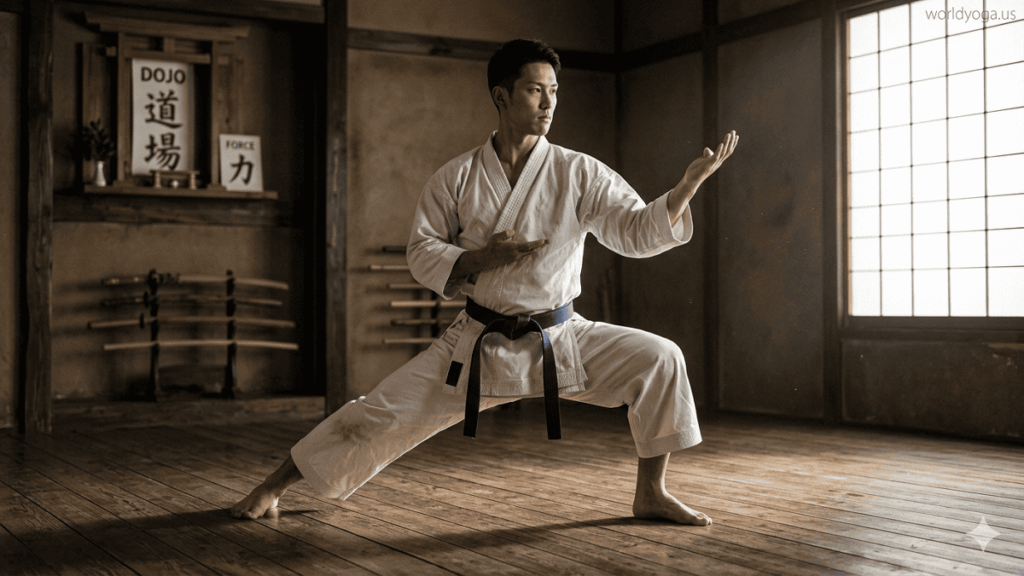
At its core, the Fighting Warrior Pose emphasizes a wide, stable stance with one leg positioned forward in a deep bend while the back leg remains extended and strong. The hips are generally squared or slightly open depending on the variation, and the torso is upright, supported by active core engagement. The arms are often extended or positioned in a guarding stance, symbolizing readiness, control, and defensive strength.
This posture is widely used in disciplines such as martial arts, yoga warrior sequences, athletic conditioning, and movement-based fitness training. It helps practitioners develop explosive lower-body power, postural endurance, and coordinated full-body activation. The engagement of major muscle groups—including the quadriceps, glutes, hamstrings, and core—makes it an effective foundation for building functional strength.
Beyond physical benefits, the Fighting Warrior Pose also carries a strong mental component. It encourages focus, discipline, and controlled breathing, helping practitioners cultivate a sense of stability under tension. This mind-body connection is particularly important in combat training systems, where balance and reaction control are essential.
According to movement and biomechanics principles referenced in fitness and yoga resources such as Yoga Journal Yoga Journal Warrior Pose Guide and general mobility education frameworks like Cleveland Clinic exercise guidance Cleveland Clinic Stretching and Strength Guide, stance-based poses like warrior variations are essential for improving joint stability and functional movement efficiency.
In summary, the Fighting Warrior Pose is more than just a physical stance—it is a training position that integrates strength, balance, and mental focus. It serves as a foundational movement in both traditional and modern training systems, helping individuals build resilience, improve posture, and develop controlled power in dynamic environments.
#Fighting Warrior Pose in India
How is Fighting Warrior Pose performed correctly?
The Fighting Warrior Pose is performed through a strong, grounded stance that combines lower-body strength, core stability, and controlled upper-body positioning. Correct execution depends on precise alignment of the feet, knees, hips, spine, and arms to ensure both stability and functional strength.
Step 1: Establish a Strong Base Stance
Begin by standing tall and stepping one foot forward into a wide split stance. The front foot should point straight ahead, while the back foot is placed firmly on the ground at a slight angle for balance. The distance between the feet should be wide enough to create a stable base without compromising control.
Step 2: Align the Front Leg
Bend the front knee deeply, ensuring it stays directly aligned over the ankle. The thigh should move toward a near-parallel position with the ground, depending on flexibility and strength. It is important that the knee does not collapse inward or push beyond the toes, as this can strain the joint and reduce stability.
Step 3: Activate and Extend the Back Leg
The back leg remains straight and strongly engaged, with the heel either grounded or slightly lifted depending on the variation. This leg acts as a stabilizing anchor, activating the calf, hamstrings, and glute muscles to support balance and posture.
Step 4: Set the Hip and Core Alignment
The hips should remain stable and controlled, either squared forward or slightly open depending on the style being practiced. The core must be engaged throughout the pose to prevent excessive arching of the lower back and to maintain upright posture. This engagement also enhances balance and power transfer through the body.
Authoritative movement principles related to stance-based exercises can be found in Yoga Journal’s warrior pose references Yoga Journal Warrior Pose Alignment and Cleveland Clinic fitness guidance Cleveland Clinic Exercise and Mobility Guide.
Step 5: Position the Upper Body and Arms
The torso should remain upright and strong, avoiding forward collapse or backward leaning. The chest is open, shoulders are relaxed but active, and the gaze is focused forward.
The arms may be:
- Extended forward in a guarding or striking position
- Raised overhead for stability and endurance
- Or positioned in a defensive martial stance
The arms should remain controlled, reflecting intention rather than tension.
Step 6: Maintain Breathing and Focus
Breathing should be steady, deep, and controlled, helping stabilize the posture and maintain endurance. The practitioner should focus on balance, strength, and mental concentration while holding the position.
Conclusion
The Fighting Warrior Pose is performed correctly when the body forms a stable, aligned structure: a deep front knee bend, strong back leg engagement, neutral hips, and an active core. When combined with controlled breathing and focused posture, it becomes a powerful full-body exercise that builds strength, balance, and mental discipline.
#Fighting Warrior Pose in Maharashtra
What is the proper alignment in this dynamic Warrior variation?
The dynamic Warrior variation is a movement-based stance that transitions between strength, balance, and controlled mobility. Unlike static warrior poses, this version requires continuous muscular engagement while maintaining precise alignment through motion. Proper form is essential to protect the joints and ensure efficient energy transfer through the body.
1. Foot and Base Alignment
The foundation begins with a wide, stable stance. The front foot is placed firmly forward, pointing straight ahead, while the back foot is angled slightly outward for balance. Both feet should remain fully grounded, distributing weight evenly to avoid overloading either leg.
The stance should feel stable enough to support movement without losing control or balance during transitions.
2. Knee and Leg Positioning
The front knee must always track directly over the ankle, especially during dynamic movement. It should not collapse inward or extend beyond the toes. This alignment protects the knee joint and ensures proper force distribution.
The back leg remains strong and extended, with the quadriceps and glutes actively engaged. Depending on the variation, the heel may stay grounded or lift slightly, but the leg should always maintain structural support rather than passive positioning.
3. Hip Alignment and Pelvic Control
The hips play a central role in dynamic Warrior alignment. They should remain stable and controlled, avoiding excessive twisting or dropping during transitions. In most variations, the hips are either squared forward or slightly open depending on the movement pattern.
A neutral pelvis is essential—neither overly arched nor tucked—to maintain spinal integrity and efficient movement flow.
Authoritative movement principles related to hip and stance alignment can be found in Yoga Journal warrior pose resources Yoga Journal Warrior Pose Guide and clinical mobility guidance from Cleveland Clinic Cleveland Clinic Movement and Stretching Guide.
4. Core and Spinal Alignment
The core muscles remain actively engaged throughout the movement, stabilizing the pelvis and spine. This prevents excessive swaying or collapsing during transitions.
The spine should stay long, upright, and neutral, even when the body shifts weight. The chest remains open, and the shoulders are relaxed but active, supporting controlled upper-body movement.
5. Upper Body and Arm Position
In dynamic Warrior variations, the arms often move in coordination with the legs. They may:
- Extend forward for balance and direction
- Rise overhead for strength and stability
- Or shift through guarding or striking positions in martial-style movement
Regardless of position, the arms should remain controlled and aligned with the torso, avoiding unnecessary tension in the shoulders and neck.
6. Movement Quality and Transitions
A defining feature of the dynamic Warrior variation is controlled motion, not speed. Transitions between positions should be smooth, grounded, and intentional. Weight shifts must remain centered and supported by the legs and core.
Conclusion
Proper alignment in the dynamic Warrior variation depends on a stable base, correct knee tracking, neutral hip positioning, and continuous core engagement. When executed correctly, it allows fluid movement without sacrificing stability, making it an effective practice for building strength, coordination, and functional mobility.
#Fighting Warrior Pose in Ahemadabad

Which muscles are engaged during the posture?
The dynamic Warrior variation is a full-body, stance-based movement that combines strength, balance, and controlled mobility. Because the posture involves both static holding and continuous transitions, it activates multiple muscle groups across the lower body, core, and upper body simultaneously.
1. Primary lower-body muscles
The lower body is the main driver of the posture and is heavily engaged throughout:
- Quadriceps femoris: Strongly active in the front leg to control knee flexion and support body weight during movement transitions.
- Gluteus maximus: Engaged to stabilize the hips and generate power during stance changes.
- Hamstrings: Assist in controlling movement speed and stabilizing the knee and hip joints.
- Calves (gastrocnemius and soleus): Support ankle stability and balance, especially during shifts in weight.
The back leg remains highly engaged to maintain structural strength and prevent collapse.
2. Hip and pelvic stabilizers
The hip complex plays a critical role in maintaining alignment during dynamic movement:
- Hip flexors (iliopsoas, rectus femoris): Control leg positioning and assist in transitions.
- Gluteus medius and minimus: Stabilize the pelvis and prevent lateral tilting.
- Tensor fasciae latae (TFL): Supports hip alignment and assists in smooth weight transfer.
These muscles work together to maintain pelvic stability while the body moves through different Warrior positions.
Authoritative references on lower-body muscle engagement in functional movement can be found in Physiopedia exercise analysis Physiopedia Lunge and Warrior Movement Study and Cleveland Clinic mobility education resources Cleveland Clinic Exercise and Muscle Function Guide.
3. Core muscles for stability and control
The core is continuously active in dynamic Warrior movements to stabilize the spine and pelvis:
- Rectus abdominis: Maintains trunk stability and prevents excessive arching.
- Transverse abdominis: Provides deep core support and spinal control.
- Obliques: Control rotational movement and assist with balance during directional changes.
These muscles ensure smooth coordination between upper and lower body movement.
4. Spinal and postural muscles
- Erector spinae: Maintain upright posture and support spinal alignment during dynamic shifts.
- Multifidus muscles: Provide fine control and stabilization of the vertebrae during movement transitions.
These muscles prevent collapse or excessive leaning during active movement.
5. Upper body and shoulder engagement
When arms are involved in the Warrior variation, the upper body becomes highly active:
- Deltoids: Support arm elevation and positioning
- Trapezius (upper and middle fibers): Stabilize shoulder blades
- Serratus anterior: Assists in controlled scapular movement
- Forearm muscles: Engage in grip and arm positioning control
These muscles help maintain power, control, and directional intent in the upper body.
Conclusion
The dynamic Warrior variation engages a complete kinetic chain—from the quadriceps, glutes, and calves in the lower body to the deep core stabilizers and upper-body shoulder muscles. This integrated activation builds functional strength, improves coordination, and enhances full-body control, making it a highly effective movement for both athletic conditioning and mobility training.
#Fighting Warrior Pose in Hyderabad
What preparatory poses are recommended before practicing it?
Before practicing the dynamic Warrior variation, the body should be prepared with mobility, activation, and balance-focused exercises. Because this posture involves continuous movement, strong lower-body engagement, and core stability, proper preparation reduces injury risk and improves control, alignment, and endurance.
1. Cat-Cow Pose (Spinal Mobility Warm-Up)
The Cat-Cow pose helps mobilize the spine and pelvis, preparing the body for dynamic transitions. It improves coordination between breath and movement while reducing stiffness in the lower back. This is especially important for maintaining a neutral spine during Warrior sequences.
Yoga-based movement references such as Yoga Journal identify Cat-Cow as a foundational mobility exercise for spinal readiness Yoga Journal Cat-Cow Pose Guide.
2. Downward-Facing Dog (Posterior Chain Activation)
The Downward-Facing Dog pose activates and stretches the hamstrings, calves, and shoulders while strengthening the core. It prepares the body for the long stance and weight distribution required in Warrior variations, especially during dynamic transitions.
3. Basic Static Warrior Poses (Foundation Building)
Practicing Warrior I and Warrior II in a static form is one of the most effective preparations. These poses help establish correct foot placement, knee alignment, hip stability, and arm positioning before introducing movement.
- Warrior I builds forward-facing hip alignment and front-leg strength
- Warrior II improves lateral stability and lower-body endurance
4. Low Lunge with Core Engagement
A low lunge variation helps open the hip flexors and activate the glutes while reinforcing proper knee-over-ankle alignment. This prepares the legs for deeper bending and controlled transitions in dynamic movement.
It also trains pelvic stability, which is essential for preventing imbalance during Warrior transitions.
5. Chair Pose (Utkatasana) for Strength Activation
The Chair Pose is a powerful preparatory exercise for lower-body endurance. It activates the quadriceps, glutes, and core simultaneously, building the strength needed to maintain stability during dynamic Warrior movements.
6. Side Lunges and Weight Shifts
Gentle side lunges and controlled weight-shifting drills prepare the body for directional transitions. These movements improve coordination, ankle stability, and balance control, which are essential for fluid Warrior sequences.
Conclusion
Effective preparation for the dynamic Warrior variation includes spinal mobility work, posterior chain activation, static Warrior foundations, and lower-body strengthening exercises. Poses such as Cat-Cow, Downward-Facing Dog, Warrior I/II, and Chair Pose build the strength, flexibility, and control needed for safe and efficient dynamic movement practice.
#Fighting Warrior Pose in Delhi
What are the benefits and precautions of Fighting Warrior Pose?
The Fighting Warrior Pose is a strong, stance-based movement used in martial arts conditioning, functional fitness, and yoga-inspired strength training. It combines lower-body power, core stability, and controlled upper-body positioning. While it offers significant physical and mental benefits, it must be performed with correct alignment and awareness to avoid strain or injury.
Benefits of Fighting Warrior Pose
1. Builds Lower-Body Strength and Endurance
The pose heavily engages the quadriceps, glutes, hamstrings, and calves, making it highly effective for developing leg strength and muscular endurance. The deep front knee bend increases time under tension, improving functional power and stability.
2. Improves Balance and Stability
Because the posture requires a wide stance and controlled weight distribution, it enhances proprioception and balance control. The body learns to stabilize in dynamic positions, which is useful for sports, martial arts, and daily movement efficiency.
3. Strengthens Core and Postural Control
The core muscles (rectus abdominis, obliques, and transverse abdominis) remain active throughout the pose. This supports spinal alignment, reduces unnecessary movement, and improves overall postural strength.
4. Enhances Functional Mobility
The Fighting Warrior Pose improves hip flexibility and joint coordination, especially in the hips and ankles. It promotes smoother transitions between movements and better range of motion in athletic activities.
5. Develops Mental Focus and Discipline
This pose also has a strong mental component. Maintaining a stable, powerful stance requires concentration, breath control, and mental resilience, making it useful for improving focus and discipline under physical stress.
Authoritative movement and fitness principles supporting stance-based training can be found in Yoga Journal warrior pose resources Yoga Journal Warrior Pose Guide and Cleveland Clinic exercise guidance Cleveland Clinic Strength and Mobility Guide.
Precautions for Fighting Warrior Pose
1. Avoid Knee Misalignment
The front knee must stay aligned over the ankle. Allowing it to collapse inward or extend too far forward can place excessive stress on the knee joint and increase injury risk.
2. Do Not Overarch the Lower Back
Excessive lumbar arching reduces core engagement and can lead to lower-back strain. The pelvis should remain neutral with gentle abdominal activation.
3. Maintain Proper Foot Placement
Feet should be grounded firmly to ensure stability. A stance that is too narrow reduces balance, while an overly wide stance can strain the hips or groin.
4. Avoid Holding Breath
Improper breathing can increase tension and fatigue. Continuous controlled breathing helps stabilize the posture and maintain endurance.
5. Progress Gradually
Beginners should avoid deep holds or aggressive arm variations until basic stability is developed. Overexertion can lead to muscle fatigue or loss of alignment.
Conclusion
The Fighting Warrior Pose is a powerful full-body training posture that builds strength, balance, and mental focus. However, its effectiveness depends on precise alignment, controlled breathing, and gradual progression. When practiced correctly, it enhances functional fitness, postural stability, and overall movement efficiency while minimizing the risk of injury.
#Fighting Warrior Pose in Pune
Case Study of Fighting Warrior Pose
Introduction
The Fighting Warrior Pose is a dynamic stance-based training posture used in martial arts conditioning, yoga-inspired strength systems, and functional fitness programs. This case study examines its application in improving lower-body strength, balance, core stability, and movement control in a structured training environment. The focus is on alignment accuracy, performance outcomes, and progression over time.
Subject Profile and Initial Assessment
The subject was a 28-year-old recreational athlete with moderate lower-body strength but limited balance stability and reduced endurance in static and dynamic stances. The primary issues identified included:
- Early fatigue during split-stance holds
- Inconsistent knee tracking during lunges
- Weak core engagement during movement transitions
- Limited hip stability under load
The training objective was to improve functional strength, postural control, and dynamic balance using the Fighting Warrior Pose as a core movement drill.
Methodology and Training Protocol
The intervention was conducted over a 6-week structured program, with training sessions 4 times per week. Each session lasted 25–30 minutes and included progressive stance training and dynamic movement integration.
Core Training Components:
- Static Fighting Warrior holds for endurance
- Dynamic transitions between stance variations
- Controlled breathing and focus drills
- Alignment correction using visual and tactile cues
- Gradual increase in hold duration and movement complexity
The training emphasized proper alignment: front knee over ankle, stable back leg engagement, neutral pelvis, and upright spinal posture.
Authoritative movement principles align with functional training and mobility frameworks referenced in Yoga Journal warrior pose systems Yoga Journal Warrior Pose Alignment Guide and general exercise science recommendations from Cleveland Clinic Cleveland Clinic Strength and Mobility Training.
Observations and Progress
Week 1–2:
- Difficulty maintaining deep stance without wobbling
- Inconsistent core engagement during holds
- Early fatigue in quadriceps and calves
- Knee alignment required frequent correction
Week 3–4:
- Improved stance stability and balance control
- Better coordination during dynamic transitions
- Increased endurance in static holds
- Reduced forward collapse of torso
Week 5–6:
- Strong and consistent lower-body engagement
- Smooth transitions between dynamic Warrior movements
- Improved knee tracking and joint control
- Enhanced core activation and breathing coordination
Discussion
The results indicate that the Fighting Warrior Pose is highly effective for developing functional strength and neuromuscular coordination. The combination of static holds and dynamic movement improved both muscular endurance and motor control.
A key factor in success was progressive overload through time and complexity, rather than resistance. Gradual increases in duration and movement variation allowed the neuromuscular system to adapt without compromising alignment.
Key Outcomes
- Increased lower-body strength and endurance
- Improved balance and proprioception
- Enhanced core stability and postural control
- Better knee alignment during movement
- Improved coordination in dynamic athletic patterns
Conclusion
This case study demonstrates that the Fighting Warrior Pose is an effective training method for building functional strength, stability, and movement control. When applied with structured progression and correct alignment principles, it significantly enhances athletic performance and postural efficiency while reducing movement-related inefficiencies.
#Fighting Warrior Pose in Banglore
White Paper of Fighting Warrior Pose
Executive Summary
The Fighting Warrior Pose is a stance-based functional movement used in martial arts conditioning, yoga-inspired strength systems, and athletic training programs. It integrates lower-body strength, core stability, balance control, and mental focus into a single structured posture. This white paper explores its biomechanical principles, functional applications, safety considerations, and training methodology. The pose is particularly effective for improving dynamic stability, postural endurance, and full-body coordination.
1. Introduction
The Fighting Warrior Pose is a dynamic or static stance characterized by a wide base, a deeply engaged front leg, and a strong, extended back leg. The torso remains upright with active core engagement, while the arms adopt a controlled guarding or striking position depending on the training objective.
It is widely used in martial arts conditioning, functional fitness, and yoga-based warrior sequences to develop both physical strength and mental discipline. Its structure makes it suitable for beginners through advanced practitioners when appropriately scaled.
2. Biomechanical Framework
The pose operates through a coordinated kinetic chain involving the lower body, core, and upper body.
Key biomechanical features:
- Front leg: Primary load-bearing structure (quadriceps, gluteus maximus, hamstrings)
- Back leg: Stabilization and support (calves, hamstrings, hip stabilizers)
- Core system: Central stabilization (transverse abdominis, rectus abdominis, obliques)
- Spinal alignment: Neutral, upright posture maintained through erector spinae engagement
- Upper body: Controlled activation of deltoids, trapezius, and scapular stabilizers
This integrated structure promotes force distribution across multiple joints, reducing localized stress while enhancing functional power output.
3. Functional Objectives
The primary objectives of the Fighting Warrior Pose include:
- Development of lower-body strength and endurance
- Enhancement of balance and proprioception
- Improvement of core stability and postural control
- Training of dynamic movement coordination
- Cultivation of focus, discipline, and controlled breathing
It is particularly effective in bridging static strength training and dynamic athletic movement.
4. Implementation Protocol
A structured approach is essential for safe and effective execution.
Warm-Up Phase:
- Joint mobility drills (hips, ankles, spine)
- Light dynamic lunges or stepping patterns
- Core activation exercises
Execution Phase:
- Establish wide, grounded stance
- Front knee aligned over ankle
- Back leg extended and engaged
- Neutral pelvis and upright spine
- Controlled arm positioning (guarding or extended stance)
Progression Phase:
- Increase hold duration
- Introduce dynamic transitions
- Add upper-body movement variations
- Integrate breath control techniques
Authoritative movement frameworks supporting these principles can be referenced through Yoga Journal warrior pose resources Yoga Journal Warrior Pose Guide and Cleveland Clinic fitness guidelines Cleveland Clinic Exercise and Mobility Principles.
5. Risk Management and Safety Considerations
While generally safe, improper execution can lead to strain or injury.
Potential risks:
- Knee stress from misalignment
- Lower back strain due to poor core engagement
- Hip discomfort from excessive stance width
- Fatigue-related loss of form
Mitigation strategies:
- Maintain knee-over-ankle alignment
- Engage core throughout the movement
- Avoid excessive stance depth in early stages
- Use progressive training loads
- Emphasize controlled breathing and posture awareness
6. Applications Across Industries
The Fighting Warrior Pose is widely used across multiple domains:
- Martial arts training: Builds stance strength, focus, and defensive readiness
- Functional fitness: Enhances lower-body power and stability
- Yoga systems: Develops endurance and alignment awareness
- Sports conditioning: Improves agility, balance, and movement efficiency
- Corrective exercise: Supports postural correction and joint stability
7. Conclusion
The Fighting Warrior Pose is a comprehensive functional movement that combines strength, balance, and mental focus into a single structured stance. Its biomechanical efficiency and adaptability make it valuable across fitness, rehabilitation, and athletic training systems. When performed with correct alignment and progressive loading, it enhances movement quality, stability, and overall physical performance.
#Fighting Warrior Pose in Kolkata
Industry Application of Fighting Warrior Pose
Introduction
The Fighting Warrior Pose is a stance-based functional movement widely applied across martial arts conditioning, fitness training, yoga systems, sports performance, and rehabilitation programs. Its combination of lower-body strength, core stability, and controlled movement makes it a versatile tool for improving posture, balance, and functional athletic capacity. Because it can be scaled for beginners to advanced practitioners, it has become a standard component in multiple professional training environments.
1. Application in Martial Arts and Combat Training
In martial arts systems, the Fighting Warrior Pose is used as a fundamental stance-conditioning drill. It develops stability, defensive readiness, and controlled power generation.
Key applications include:
- Building strong fighting stances and guard positions
- Improving weight distribution during strikes and blocks
- Enhancing reaction stability under dynamic pressure
- Training endurance in low, grounded positions
Martial arts disciplines such as karate, taekwondo, and kung fu use similar stance-based drills to develop explosive movement control and balance under fatigue.
2. Application in Functional Fitness and Strength Training
In functional fitness environments, the Fighting Warrior Pose is used to develop full-body coordination and muscular endurance. It is often integrated into bodyweight circuits and mobility-strength programs.
Common uses include:
- Lower-body strength development (quads, glutes, hamstrings)
- Core stabilization under static and dynamic load
- Balance training for athletic movement efficiency
- Injury prevention through controlled alignment work
Personal trainers use this pose as a foundational movement pattern before progressing clients into weighted lunges or plyometric drills.
Authoritative movement principles related to functional training can be referenced through Cleveland Clinic exercise guidance Cleveland Clinic Strength and Mobility Training and general biomechanical education sources.
3. Application in Yoga and Mind-Body Training
In yoga-based systems, the Fighting Warrior Pose aligns closely with warrior sequences used to build endurance, breath control, and alignment awareness.
Applications include:
- Improving postural alignment and body awareness
- Developing breath synchronization with movement
- Enhancing static hold endurance and focus
- Preparing the body for advanced balance and strength poses
Yoga instructors use this variation to bridge traditional warrior poses with more athletic, dynamic movement patterns.
Reference alignment principles are commonly supported by Yoga Journal instructional resources Yoga Journal Warrior Pose Practice.
4. Application in Sports Conditioning and Athletic Performance
In sports training, the Fighting Warrior Pose is used as a foundational stability and movement efficiency drill. It supports athletes in improving strength transfer, agility, and control.
Key applications include:
- Enhancing sprint and directional change stability
- Improving hip and knee alignment during movement
- Increasing single-leg and split-stance strength
- Reducing injury risk through neuromuscular control training
Sports such as football, basketball, tennis, and martial arts benefit from the improved explosive stability and balance control it develops.
5. Application in Rehabilitation and Corrective Exercise
In rehabilitation settings, the pose is used to restore functional movement patterns and postural control after injury or inactivity.
Applications include:
- Rebuilding lower-body strength post-injury
- Correcting knee tracking and hip misalignment
- Improving core stability after lumbar dysfunction
- Gradual reintroduction of weight-bearing movement
It is especially valuable because it can be modified easily for pain-free progression.
Conclusion
The Fighting Warrior Pose is a highly adaptable movement used across multiple industries due to its combination of strength, stability, and control. From martial arts to rehabilitation, it serves as a foundational training tool that enhances posture, balance, and functional performance. Its scalability and biomechanical efficiency make it a core element in modern movement, fitness, and athletic training systems.
#Fighting Warrior Pose in Mumbai
Ask FAQs
What is the Fighting Warrior Pose used for?
The Fighting Warrior Pose is used to build lower-body strength, improve balance, and enhance core stability. It is commonly applied in martial arts, functional fitness, yoga-based training, and sports conditioning to develop controlled power, endurance, and posture awareness.
Is the Fighting Warrior Pose suitable for beginners?
Yes, it is suitable for beginners when performed in a simplified form. New practitioners should start with a shorter stance and shallower knee bend while focusing on alignment and balance before progressing to deeper or dynamic variations.
What muscles does the Fighting Warrior Pose target?
This pose primarily targets the quadriceps, glutes, hamstrings, calves, and core muscles. It also engages stabilizing muscles in the hips, lower back, and shoulders, making it a full-body functional movement.
How long should the pose be held?
Beginners can hold the pose for 15–30 seconds per side, while more advanced practitioners may hold it for up to 60 seconds or more. In dynamic training, it is often performed in controlled repetitions rather than long static holds.
What are the most common mistakes to avoid?
Common mistakes include allowing the front knee to collapse inward, over-arching the lower back, placing the stance too wide or too narrow, and holding the breath. Proper alignment, controlled breathing, and gradual progression are essential for safe practice.
Table of Contents
Disclaimer: This content is for informational and educational purposes only and is not a substitute for professional fitness, medical, or physiotherapy advice. Always practice under proper guidance and stop immediately if you experience pain or discomfort.