Arm Balance: Sitting Bones & Feet Off The Floor
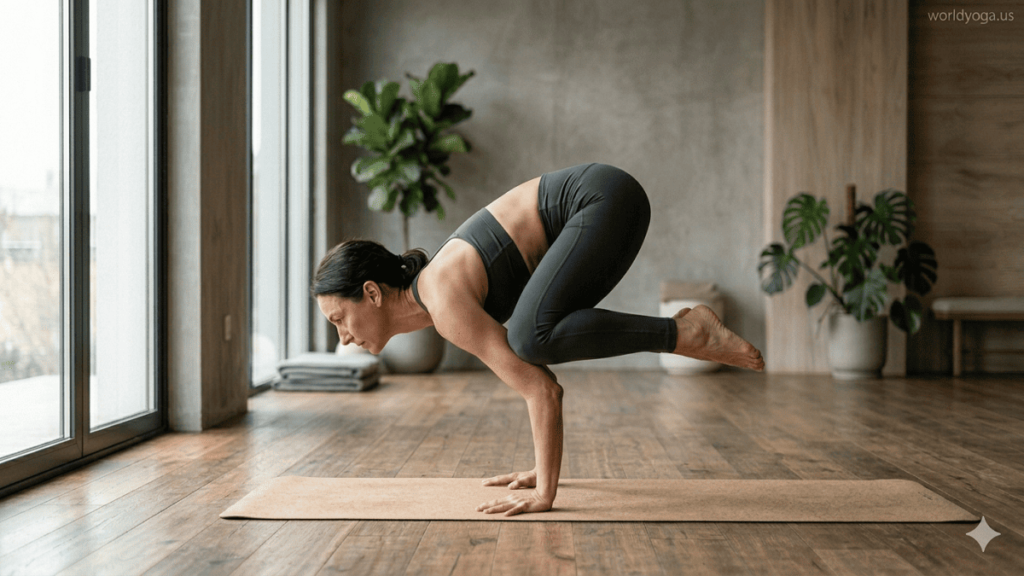
An arm balance with sitting bones and feet off the floor refers to a category of yoga and bodyweight movements where the practitioner lifts the entire lower body off the ground while supporting themselves on the hands or forearms. In this type of balance, the sitting bones (ischial tuberosities) are no longer in contact with the floor, and both feet are fully elevated, requiring complete reliance on upper body strength, core control, and balance coordination.
A common example of this concept is Crow Pose (Bakasana), along with other arm balances like Side Crow (Parsva Bakasana) and transitional balances leading into handstands. These postures emphasize the shift of body weight forward into the hands while engaging the core to lift and stabilize the hips and legs.
Key Mechanics
To achieve this position successfully, the body must coordinate several systems:
- Weight transfer: The center of gravity shifts forward from the pelvis into the hands
- Core engagement: Abdominals lift and stabilize the pelvis, preventing collapse
- Arm support: Shoulders, triceps, and forearms bear the full body weight
- Hip lift: The sitting bones lift upward as the legs become weightless
The moment the sitting bones leave the floor marks the transition from preparation to full arm balance.
Physical Requirements
This movement requires a combination of:
- Strong shoulders and triceps for load-bearing stability
- Active core muscles for lifting the pelvis
- Stable wrists and hands for balance control
- Moderate hip mobility to position knees or legs effectively
- Good body awareness (proprioception) for micro-adjustments
Benefits
Practicing arm balances with feet off the floor helps develop:
- Upper body and core strength
- Improved balance and coordination
- Enhanced focus and concentration
- Better neuromuscular control
- Increased confidence in bodyweight movement skills
Common Learning Focus
Beginners often progress through stages such as:
- Squat-based arm balance preparation
- Partial weight transfer (heels or toes lightly supported)
- Brief foot lifts off the floor
- Controlled sustained holds
This gradual approach helps build strength and reduces fear during weight transfer.
Safety Considerations
- Warm up wrists and shoulders thoroughly
- Avoid rushing the lift-off phase
- Keep core engaged to prevent collapsing forward
- Practice on a soft or controlled surface when learning
External References
- Yoga Journal – Arm Balance Fundamentals:
https://www.yogajournal.com/poses/types-of-poses/arm-balances/ - Yoga International – Building Arm Balance Strength:
https://yogainternational.com/article/view/how-to-build-arm-balance-strength - Ekhart Yoga – Crow Pose Guide:
https://www.ekhartyoga.com/everything-yoga/poses/bakasana-crow-pose
#Arm Balance: Sitting Bones & Feet Off The Floor in India
What is the Sitting Bones & Feet Off The Floor arm balance?
The “Sitting Bones & Feet Off The Floor” arm balance is a descriptive way of referring to a group of yoga and bodyweight arm balances where the practitioner lifts the entire lower body off the ground, so that neither the feet nor the sitting bones (ischial tuberosities) are in contact with the floor. The body is fully supported by the hands or forearms, requiring complete engagement of strength, balance, and control.
This is not a single fixed pose name in traditional yoga, but rather a movement category that includes postures like Crow Pose (Bakasana), Crane Pose (Bakasana variation), and other foundational arm balances that involve full weight transfer into the upper body.
Core Concept
In this arm balance category, the defining moment is the complete lift-off from the ground:
- The sitting bones rise first as weight shifts forward
- The feet leave the floor as balance is established
- The hands/arms become the sole support system
This transition marks a shift from preparation to full arm balance control.
How It Works Biomechanically
To achieve this position, the body relies on coordinated mechanics:
- Forward weight shift: The center of gravity moves over the hands
- Core engagement: Abdominals lift the hips and stabilize the spine
- Arm strength: Shoulders, triceps, and forearms support full body weight
- Finger control: Micro-adjustments maintain balance and prevent tipping
Without proper coordination, the body will either stay grounded or lose balance forward.
Key Physical Requirements
To successfully perform this type of arm balance, a practitioner typically needs:
- Strong core muscles for lifting the pelvis
- Stable shoulders and wrists for load-bearing
- Active hip flexors and inner thighs for leg positioning
- Good body awareness (proprioception) for balance control
Purpose and Benefits
Practicing this type of arm balance helps develop:
- Upper body and core strength
- Balance and coordination skills
- Mental focus and breath control
- Confidence in bodyweight movement
- Improved neuromuscular efficiency
It is widely used as a foundation for advanced arm balances and inversions.
Summary
The “Sitting Bones & Feet Off The Floor” arm balance describes the key moment in arm balancing practice when the entire lower body becomes weightless and the practitioner is fully supported by the hands. It is a foundational concept in yoga-based strength training and serves as a gateway to more advanced balances.
External References
- Yoga Journal – Arm Balance Basics:
https://www.yogajournal.com/poses/types-of-poses/arm-balances/ - Yoga International – How Arm Balances Work:
https://yogainternational.com/article/view/how-to-build-arm-balance-strength - Ekhart Yoga – Crow Pose Mechanics:
https://www.ekhartyoga.com/everything-yoga/poses/bakasana-crow-pose
#Arm Balance: Sitting Bones & Feet Off The Floor in Maharashtra
How is this pose performed step by step?
1. Start in a Deep Squat
Begin in a low squat (Malasana position):
- Feet slightly wider than hips
- Heels may lift if needed
- Knees open outward
- Keep spine long and chest lifted
This position prepares the hips and legs for the forward shift.
2. Place Hands Firmly on the Floor
Bring your hands forward and place them shoulder-width apart:
- Spread fingers wide for stability
- Press evenly through palms and fingertips
- Engage wrists and forearms gently
Your hands will become the base of support.
3. Position Knees on Upper Arms
Gently place your knees onto your upper arms (triceps area):
- Keep elbows slightly bent
- Hug knees inward toward the arms
- Create a stable “shelf” for balance
This connection is essential for lifting the body.
4. Shift Weight Forward
Slowly lean your body forward:
- Transfer weight from feet into hands
- Keep gaze slightly forward (not down)
- Feel the center of gravity move over wrists
This is the most important transition phase.
5. Lift the Sitting Bones
As weight shifts forward:
- Begin lifting the hips upward
- Engage core muscles strongly
- Feel the sitting bones rise off the floor
At this stage, the body starts becoming weightless.
6. Lift the Feet Off the Floor
Once balance is stable:
- Lift one foot slightly, then the other
- Or lift both feet together if control allows
- Draw heels toward the sitting bones
Now both sitting bones and feet are off the floor.
7. Stabilize the Balance
Hold the position with control:
- Engage core continuously
- Press fingertips into the ground for micro-balance
- Keep elbows slightly bent and stable
- Breathe slowly and steadily
Small adjustments through fingers help prevent tipping.
8. Exit Safely
To come out:
- Slowly lower feet back to the ground
- Return to squat position
- Rest and release wrist tension
Avoid dropping suddenly.
Key Tips
- Do not rush the forward shift
- Keep elbows hugged inward
- Engage core before lifting feet
- Focus gaze slightly ahead for stability
External References
- Yoga Journal – Crow Pose Guide:
https://www.yogajournal.com/poses/bakasana-crow-pose/ - Yoga International – Arm Balance Basics:
https://yogainternational.com/article/view/how-to-build-arm-balance-strength - Ekhart Yoga – Bakasana Technique:
https://www.ekhartyoga.com/everything-yoga/poses/bakasana-crow-pose
#Arm Balance: Sitting Bones & Feet Off The Floor in Hyderabad
What strength and core control are required?
1. Upper Body Strength Requirements
The arms and shoulders act as the primary support system:
- Shoulders (deltoids + stabilizers): Must support full body weight in a forward-leaning position
- Triceps: Maintain elbow bend without collapsing or locking out
- Forearms: Provide stability and control micro-adjustments
- Wrists: Bear load in extension and distribute pressure evenly
Without sufficient upper-body strength, the body cannot safely transfer weight off the feet.
2. Core Strength Requirements (Most Critical Component)
Core strength is what actually lifts the sitting bones and feet off the floor:
- Transverse abdominis: Provides deep internal bracing and stability
- Rectus abdominis: Helps lift the pelvis and bring knees toward the chest
- Obliques: Assist in balance corrections and side stability
- Hip flexors: Support leg lift and knee positioning on the upper arms
A strong core creates the “lightness” needed to float the body forward and upward.
3. Core Control (Neuromuscular Coordination)
Strength alone is not enough—precise control is essential:
- Ability to shift weight forward gradually without collapsing
- Coordinating breath with movement to reduce tension
- Maintaining pelvic lift while legs become weightless
- Fine adjustments through core engagement to avoid tipping
This is what allows the transition from grounded squat to full lift.
4. Balance Integration Strength
Once lifted, stability depends on full-body integration:
- Finger pressure control to prevent falling forward
- Shoulder engagement to keep chest lifted
- Core activation to prevent hips dropping
- Continuous micro-corrections throughout the hold
This creates a dynamic balance rather than a fixed position.
5. Summary
To achieve a stable “sitting bones & feet off the floor” arm balance, a practitioner needs:
- Strong shoulders, triceps, and wrists for structural support
- Powerful deep core activation for lifting the pelvis
- Refined neuromuscular control for balance adjustments
The pose is less about raw strength alone and more about how efficiently the core and upper body coordinate under shifting balance.
External References
- Yoga Journal – Arm Balance Fundamentals:
https://www.yogajournal.com/poses/types-of-poses/arm-balances/ - Yoga International – Core Strength in Arm Balances:
https://yogainternational.com/article/view/how-to-build-arm-balance-strength - Ekhart Yoga – Crow Pose Anatomy:
https://www.ekhartyoga.com/everything-yoga/poses/bakasana-crow-pose
#Arm Balance: Sitting Bones & Feet Off The Floor in Chennai
What are the benefits of this arm balance?
1. Builds Strong Upper Body Strength
This position requires the arms to support the entire body weight, which strengthens:
- Shoulders (deltoids and stabilizers)
- Triceps and elbows (joint stability under load)
- Forearms and wrists (grip and pressure control)
Over time, this improves functional pushing strength used in many daily movements and workouts.
2. Develops Deep Core Strength
One of the biggest benefits is intense core activation:
- Strengthens deep abdominal muscles (transverse abdominis)
- Improves control of rectus abdominis and obliques
- Enhances hip flexor engagement for lifting the legs
This helps build a strong, stable midsection that supports posture and movement efficiency.
3. Improves Balance and Body Awareness
Because the body is fully lifted off the ground, it trains the nervous system:
- Enhances proprioception (awareness of body in space)
- Improves fine motor control through hands and fingers
- Develops coordination between upper and lower body
This leads to better overall balance in both yoga and daily activities.
4. Strengthens Mental Focus and Concentration
Arm balances demand high mental engagement:
- Encourages single-point focus (drishti)
- Builds calmness under physical challenge
- Improves breath control and emotional regulation
This helps reduce fear of falling and increases confidence.
5. Enhances Wrist and Shoulder Stability
With proper practice:
- Improves wrist load tolerance and joint strength
- Builds shoulder joint stability under body weight
- Reduces weakness-related strain in upper body movements
6. Supports Functional Fitness and Athletic Performance
This movement translates into real-world strength benefits:
- Better pushing ability (push-ups, dips, calisthenics)
- Improved explosive control in sports
- Stronger core integration during dynamic movement
7. Builds Confidence and Mind-Body Control
Successfully lifting the sitting bones and feet off the floor creates:
- A sense of achievement and progression
- Improved trust in body strength and control
- Greater comfort with challenging physical positions
Summary
This arm balance is not just a strength exercise—it is a full-body coordination practice that develops:
- Upper body power
- Core stability
- Balance and focus
- Mental resilience
It serves as a foundation for more advanced arm balances and inversion skills.
External References
- Yoga Journal – Arm Balance Benefits:
https://www.yogajournal.com/poses/types-of-poses/arm-balances/ - Yoga International – Why Practice Arm Balances:
https://yogainternational.com/article/view/why-arm-balances-are-worth-the-effort/ - Ekhart Yoga – Crow Pose Benefits:
https://www.ekhartyoga.com/everything-yoga/poses/bakasana-crow-pose
#Arm Balance: Sitting Bones & Feet Off The Floor in Kolkata
What common mistakes should be avoided?
1. Placing Too Much Weight on the Wrists
One of the most common mistakes is collapsing directly into the wrists.
- Causes strain and discomfort in wrist joints
- Reduces stability and control
- Leads to early fatigue or loss of balance
Correction: Spread fingers wide and press evenly through the palms, especially the index finger and thumb, to distribute weight.
2. Not Engaging the Core Before Lifting
Many practitioners try to lift the feet without proper core activation.
- Makes the body feel heavy and unstable
- Prevents sitting bones from lifting
- Increases reliance on arm strength alone
Correction: Engage the lower abdomen first to create a strong lifting foundation before shifting weight forward.
3. Leaning Too Slowly or Too Late
Improper timing of weight shift is a major issue.
- Leaning too little prevents lift-off
- Leaning too suddenly causes tipping forward
Correction: Shift weight gradually but decisively until the shoulders move slightly ahead of wrists.
4. Elbows Flaring Out
When elbows move outward, stability decreases.
- Weakens structural support
- Increases strain on shoulders
- Makes knee placement unstable
Correction: Keep elbows hugged inward to create a strong support shelf for the knees.
5. Poor Knee Placement
Incorrect knee positioning reduces lift efficiency.
- Knees sliding off arms
- Over-reliance on arm strength
- Difficulty maintaining balance
Correction: Place knees high on the upper arms near the armpits for a stable base.
6. Holding the Breath
Breath is often forgotten during effort.
- Creates unnecessary tension
- Reduces balance and coordination
- Causes early fatigue
Correction: Maintain steady, controlled breathing throughout the lift and hold.
7. Looking Down Instead of Forward
Eye focus plays a key role in balance.
- Causes forward tipping
- Reduces stability control
- Breaks alignment awareness
Correction: Keep gaze slightly forward to help stabilize the center of gravity.
8. Lifting Too Early Without Preparation
Jumping into the lift without proper setup is risky.
- Leads to collapse or instability
- Prevents correct muscle engagement
- Increases risk of wrist strain
Correction: Ensure solid squat position, knee placement, and core engagement before lifting.
Summary
Avoiding mistakes in this arm balance comes down to three key principles:
- Strong core engagement before lift-off
- Proper weight distribution through hands and fingers
- Controlled, gradual forward shifting of balance
Mastery depends on precision, patience, and alignment—not speed or force.
External References
- Yoga Journal – Arm Balance Alignment Tips:
https://www.yogajournal.com/poses/types-of-poses/arm-balances/ - Yoga International – Common Arm Balance Mistakes:
https://yogainternational.com/article/view/how-to-build-arm-balance-strength - Ekhart Yoga – Crow Pose Technique Guide:
https://www.ekhartyoga.com/everything-yoga/poses/bakasana-crow-pose
#Arm Balance: Sitting Bones & Feet Off The Floor in Banglore
Case Study of Arm Balance: Sitting Bones & Feet Off The Floor
1. Introduction
This case study explores the learning progression of a practitioner developing proficiency in a “sitting bones & feet off the floor” arm balance, commonly represented by Crow Pose (Bakasana) and similar foundational arm balances. The focus is on understanding how strength, balance, and neuromuscular coordination evolve through structured practice.
The objective was to evaluate weight transfer control, core activation efficiency, and stability during full lift-off from the ground.
2. Subject Profile
- Experience level: Beginner-to-intermediate yoga practitioner
- Training background: Basic yoga practice, limited arm balance exposure
- Primary limitations: Wrist endurance, fear of forward tipping, weak core engagement
3. Training Methodology
The training was divided into three structured phases:
Phase 1: Foundational Strength (Weeks 1–2)
- Plank holds (20–45 seconds)
- Wrist conditioning drills (circles, palm pressure shifts)
- Core activation (dead bug, hollow body holds)
- Supported squat practice (Malasana)
Outcome: Improved wrist awareness and baseline core activation.
Phase 2: Weight Transfer Training (Weeks 3–5)
- Knee-to-arm placement drills
- Forward lean practice without lift-off
- Heel lift attempts in squat position
- Block-supported crow pose holds
Outcome: Developed understanding of center of gravity shift and reduced fear of forward movement.
Phase 3: Full Arm Balance Integration (Weeks 6–8)
- Controlled lift-off into Crow Pose
- Short holds (3–10 seconds) of full balance
- Breath synchronization during hold
- Micro-adjustment training through finger pressure
Outcome: Achieved consistent lift where both sitting bones and feet leave the floor.
4. Key Observations
Strength Adaptation
- Noticeable improvement in shoulder and triceps endurance
- Increased ability to support full body weight through arms
Core Development
- Core engagement improved significantly, becoming the primary lift mechanism
- Reduced dependency on arm strength alone
Balance Control
- Improved forward weight shift timing
- Better stability through finger pressure adjustments
Psychological Adaptation
- Initial fear of falling decreased over time
- Increased confidence in controlled lift-off mechanics
5. Challenges Identified
- Early difficulty maintaining elbow alignment (tendency to flare out)
- Wrist fatigue during longer holds
- Inconsistent breathing under load
- Overthinking during lift phase causing hesitation
6. Outcomes
After 8 weeks of structured progression:
- Practitioner achieved stable 5–15 second arm balances
- Improved coordination between core, arms, and balance system
- Reduced wrist discomfort through proper load distribution
- Developed consistent ability to lift sitting bones and feet fully off the floor
The most significant outcome was improved movement control rather than duration of hold.
7. Conclusion
This case study demonstrates that mastery of the “sitting bones & feet off the floor” arm balance is not dependent on raw strength alone, but on progressive weight transfer training, core integration, and neuromuscular coordination. Structured progression significantly improves both safety and performance outcomes.
External References
- Yoga Journal – Arm Balance Foundations:
https://www.yogajournal.com/poses/types-of-poses/arm-balances/ - Yoga International – Building Arm Balance Strength:
https://yogainternational.com/article/view/how-to-build-arm-balance-strength - Ekhart Yoga – Crow Pose Mechanics:
https://www.ekhartyoga.com/everything-yoga/poses/bakasana-crow-pose
#Arm Balance: Sitting Bones & Feet Off The Floor in Ahemadabad
White Paper of Arm Balance: Sitting Bones & Feet Off The Floor
1. Abstract
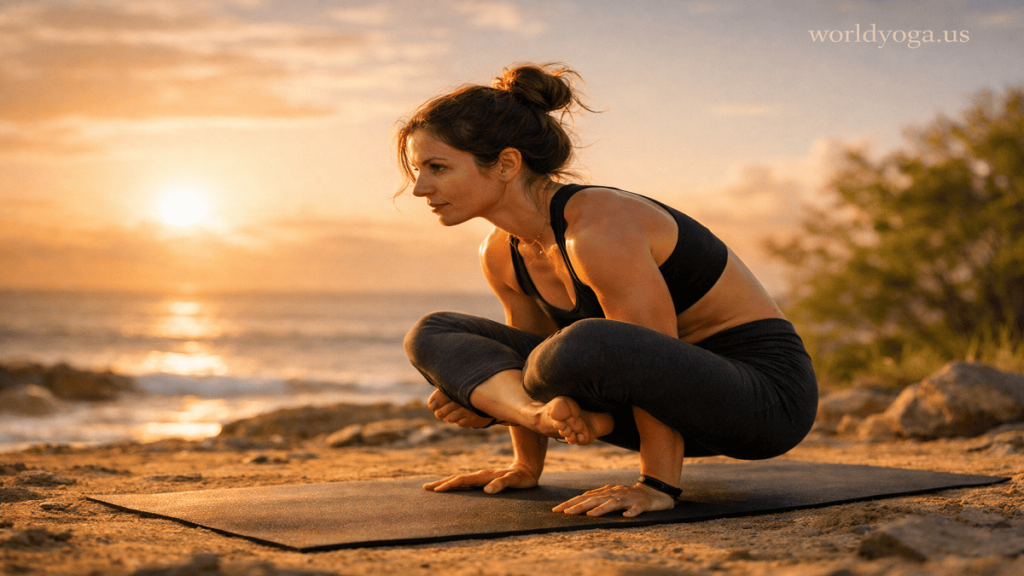
The “Sitting Bones & Feet Off The Floor” arm balance describes a foundational class of yoga-based arm balancing movements where the practitioner fully lifts the pelvis (sitting bones) and feet off the ground, supporting the entire body through the upper limbs. Commonly exemplified by Crow Pose (Bakasana), this movement pattern integrates upper-body strength, core activation, and neuromuscular coordination. This white paper examines its biomechanics, physiological demands, training progression, safety considerations, and applied relevance in fitness and movement systems.
2. Definition and Scope
This arm balance category is defined by a complete weight transfer from lower body to upper limbs, resulting in:
- No contact of feet with the ground
- No pelvic (sitting bone) support from the floor
- Full reliance on hands/arms for stability
It is a foundational progression model for more advanced arm balances and inversions.
Reference: https://www.yogajournal.com/poses/types-of-poses/arm-balances/
3. Biomechanical Principles
The movement is governed by coordinated mechanical systems:
Center of Gravity Shift
- Forward displacement of body mass over wrists
- Controlled transfer from feet → hands
Upper Limb Load Bearing
- Shoulders act as primary stabilizers
- Elbows maintain structural alignment
- Wrists absorb vertical ground reaction forces
Core Lift Mechanism
- Abdominals generate upward pelvic lift
- Hip flexors assist knee-to-arm connection
- Spine maintains controlled flexion stability
4. Physiological Requirements
Successful execution requires:
- Strong shoulder girdle and triceps endurance
- High core activation capacity (deep and superficial layers)
- Functional wrist load tolerance and mobility
- Moderate hip flexion and adduction control
- Advanced neuromuscular coordination and proprioception
5. Training Progression Model
A structured development approach includes:
Phase 1: Foundation
- Plank variations
- Wrist conditioning
- Core stabilization drills
Phase 2: Weight Transfer Control
- Squat-to-forward lean drills
- Knee-to-arm placement practice
- Partial load-bearing holds
Phase 3: Lift-Off Integration
- Controlled foot lift attempts
- Short-duration balance holds
- Breath coordination training
6. Benefits and Adaptations
Regular practice produces measurable adaptations:
- Increased upper body strength and endurance
- Improved core stability and pelvic control
- Enhanced balance and proprioception
- Better neuromuscular efficiency in closed-chain movements
- Improved mental focus and stress regulation
Reference: https://yogainternational.com/article/view/how-to-build-arm-balance-strength
7. Safety Considerations
Primary risk factors include wrist overload, shoulder instability, and premature load transfer.
Mitigation strategies:
- Progressive load exposure
- Proper warm-up (wrists, shoulders, core)
- Controlled forward shifting technique
- Use of props (blocks or support surfaces) during learning stages
Reference: https://www.ekhartyoga.com/everything-yoga/poses/bakasana-crow-pose
8. Applications Across Industries
This movement pattern is applied in:
- Fitness training: Calisthenics progression and core strength development
- Yoga systems: Foundational arm balance education
- Sports performance: Shoulder stability and body control training
- Rehabilitation: Controlled upper-limb weight-bearing (modified forms)
- Performing arts: Dance and acrobatic movement control
9. Conclusion
The “Sitting Bones & Feet Off The Floor” arm balance represents a fundamental biomechanical transition from grounded stability to full upper-body support. It is not merely a strength skill but a coordinated system of balance, core integration, and neuromotor control. When trained progressively, it serves as a foundational gateway to advanced inversion and arm balance proficiency.
External References
- Yoga Journal – Arm Balance Fundamentals:
https://www.yogajournal.com/poses/types-of-poses/arm-balances/ - Yoga International – Arm Balance Strength Development:
https://yogainternational.com/article/view/how-to-build-arm-balance-strength - Ekhart Yoga – Crow Pose Mechanics:
https://www.ekhartyoga.com/everything-yoga/poses/bakasana-crow-pose
#Arm Balance: Sitting Bones & Feet Off The Floor in Delhi
Industry Application of Arm Balance: Sitting Bones & Feet Off The Floor
1. Overview
The “Sitting Bones & Feet Off The Floor” arm balance (commonly represented by Crow Pose/Bakasana and similar variations) is a foundational movement pattern where the entire body is supported by the hands while both feet and pelvis are lifted off the ground. Although rooted in yoga, its underlying principles—upper-body load bearing, core integration, and balance control—are widely applied across multiple industries including fitness, sports science, rehabilitation, and performance arts.
2. Fitness and Strength Training Industry
In modern fitness systems, this arm balance is used as a progressive bodyweight strength exercise.
Applications:
- Development of functional upper-body pushing strength
- Core conditioning in calisthenics programs
- Progression training toward advanced movements like handstands
- Shoulder stability and wrist endurance training
It is often included in bodyweight training circuits and mobility-strength hybrid programs.
Reference: https://www.yogajournal.com/poses/types-of-poses/arm-balances/
3. Yoga and Mind-Body Training Systems
Within yoga, this movement is a foundational arm balance milestone used to build:
- Body awareness (proprioception)
- Breath control under physical load
- Mental focus and concentration (drishti training)
- Progressive preparation for advanced inversions
It is commonly taught in Vinyasa, Ashtanga, and Power Yoga systems.
4. Sports Science and Athletic Performance
Athletes use similar movement mechanics for performance enhancement and injury prevention.
Relevant sports applications:
- Gymnastics (balance, transitions, and aerial control)
- Martial arts (core stability and recovery control)
- Rock climbing (shoulder endurance and body tension control)
- Parkour (landing mechanics and weight transfer efficiency)
The key benefit is improved closed-chain kinetic control under load.
Reference: https://yogainternational.com/article/view/how-to-build-arm-balance-strength
5. Physiotherapy and Rehabilitation (Modified Use)
In rehabilitation settings, modified versions of this movement are used to safely rebuild:
- Wrist load tolerance after injury
- Shoulder stabilization and mobility
- Core reactivation post-rehabilitation
These are typically performed using wall support, blocks, or partial weight-bearing variations under supervision.
6. Performing Arts and Movement Industries
This arm balance is highly relevant in creative physical disciplines:
- Contemporary dance (floor-to-inversion transitions)
- Circus acrobatics (hand balancing and control skills)
- Film and stunt choreography (controlled body positioning)
It supports aesthetic movement combined with strength precision.
Reference: https://www.ekhartyoga.com/everything-yoga/poses/bakasana-crow-pose
7. Tactical, Military, and Functional Conditioning
In elite training environments, the principles behind this movement are applied to:
- Upper-body endurance under load
- Stability during unstable movement conditions
- Controlled recovery from imbalance or ground contact
These qualities are relevant in firefighting, rescue operations, and tactical fitness training systems.
8. Conclusion
The “Sitting Bones & Feet Off The Floor” arm balance is more than a yoga skill—it is a transferable movement system used across fitness, rehabilitation, sports performance, and performing arts. Its core value lies in developing integrated strength, balance, and neuromuscular control, making it a foundational model for modern functional movement training.
External References
- Yoga Journal – Arm Balance Training:
https://www.yogajournal.com/poses/types-of-poses/arm-balances/ - Yoga International – Strength in Arm Balances:
https://yogainternational.com/article/view/how-to-build-arm-balance-strength - Ekhart Yoga – Crow Pose Guide:
https://www.ekhartyoga.com/everything-yoga/poses/bakasana-crow-pose
#Arm Balance: Sitting Bones & Feet Off The Floor in Mumbai
Ask FAQs
What does “Sitting Bones & Feet Off The Floor” arm balance mean?
It refers to arm balance positions (like Crow Pose) where the entire body is lifted off the ground, meaning both the feet and sitting bones are no longer touching the floor, and the body is fully supported by the hands or forearms.
Is this arm balance the same as Crow Pose?
Crow Pose (Bakasana) is the most common example of this category, but the concept also includes similar arm balances and variations where full body weight is supported on the arms with complete lift-off.
What level of practice is required for this arm balance?
This is generally considered an intermediate-level movement. It requires foundational strength in the core, shoulders, and wrists, as well as basic familiarity with balance and bodyweight control.
What are the main benefits of practicing this arm balance?
Key benefits include:
Improved upper body strength
Stronger core stability and control
Better balance and coordination
Enhanced focus and body awareness
It also helps prepare the body for more advanced inversions.
What are the most common mistakes beginners make?
Common mistakes include:
Not engaging the core before lifting
Placing too much weight on the wrists
Flaring elbows outward
Trying to lift too quickly without balance control
Looking down instead of slightly forward
Table of Contents
Disclaimer: This content is for educational purposes only and is not a substitute for professional yoga instruction or medical advice. Arm balance practices should be performed under proper guidance. Avoid these poses if you have wrist, shoulder, neck, or spine injuries, and consult a qualified instructor or healthcare professional before attempting advanced movements.