Utthita Dwi Pada Vṛishchikasana
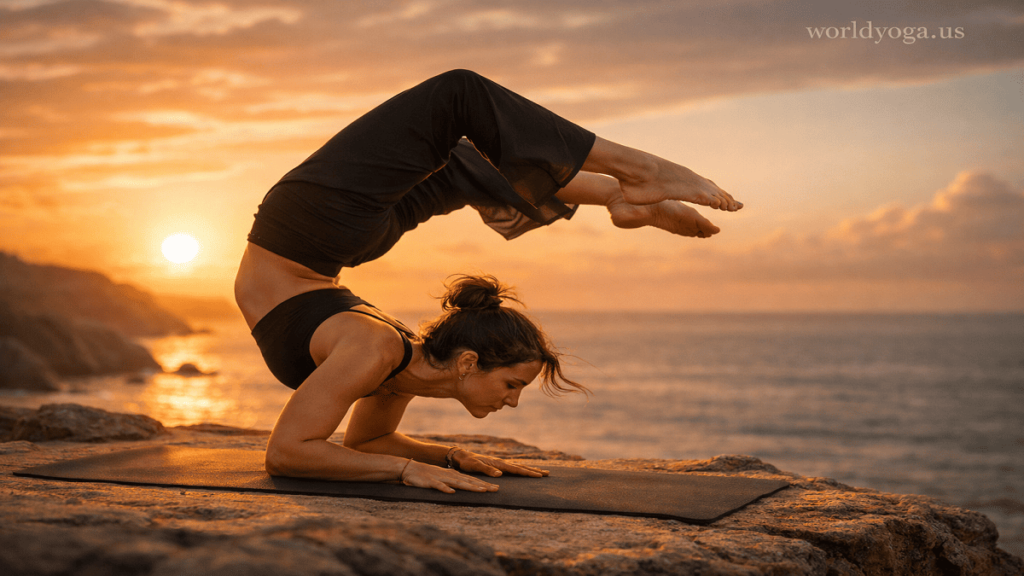
Utthita Dwi Pada Vṛishchikasana is an advanced arm balance and backbend posture in yoga where the practitioner supports the entire body on the forearms or hands while both legs are lifted overhead in a deep, controlled scorpion-like arch. The Sanskrit name translates to “Extended Two-Legged Scorpion Pose,” reflecting the lifted, curved shape of the body resembling a scorpion’s tail.
Meaning and Classification
This pose belongs to the category of advanced arm balances and inversion-backbend hybrids. It combines elements of strength, flexibility, balance, and spinal extension. It is typically practiced in advanced yoga styles such as Ashtanga, Power Yoga, and advanced Vinyasa flow systems.
Technique Overview
The posture begins from a stable forearm or hand balance base, similar to a forearm stand (Pincha Mayurasana) or handstand foundation. From this inverted position, Vṛishchikasana , the practitioner gradually:
- Engages the core to stabilize the torso
- Opens the chest and shoulders into extension
- Bends the knees while lifting both legs overhead
- Creates a controlled backbend through the spine
The final shape requires precise balance between strength and flexibility, especially in the shoulders, spine, and hip flexors.
Physical Requirements
To safely attempt this posture, practitioners typically need:
- Strong shoulders, arms, and upper back for weight-bearing
- Advanced core control for inversion stability
- High spinal and hip flexibility for deep backbending
- Good balance and proprioception for controlled inversion
Benefits
Regular practice (under guidance) may support:
- Increased upper body and core strength
- Improved spinal flexibility and mobility
- Enhanced balance, focus, and body awareness
- Development of advanced inversion control skills
Precautions
This is an advanced-level pose and should not be attempted without proper preparation. Key precautions include:
- Avoid if you have wrist, shoulder, neck, Vṛishchikasana or spinal injuries
- Always warm up thoroughly with backbends and shoulder openers
- Practice near a wall or with expert supervision
- Progress gradually through simpler inversions first
External References
- Yoga Journal – Inversions and Arm Balance Practice:
https://www.yogajournal.com/poses/types-of-poses/inversions/ - Yoga International – Advanced Arm Balance Training:
https://yogainternational.com/article/view/how-to-build-arm-balance-strength - Ekhart Yoga – Forearm Stand Foundations:
https://www.ekhartyoga.com/everything-yoga/poses/pincha-mayurasana-forearm-balance
#Utthita Dwi Pada Vrishtasana in India
What is Utthita Dwi Pada Vṛishchikasana ?
Utthita Dwi Pada Vṛishchikasana (Extended Two-Legged Scorpion Pose) is an advanced yoga inversion combined with a deep backbend and arm balance. In this posture, Vṛishchikasana the practitioner balances the entire body either on the forearms or hands while both legs are lifted overhead and curved toward the head in a scorpion-like shape.
The Sanskrit name can be broken down as:
- Utthita = extended
- Dwi Pada = two legs
- Vṛishchika = scorpion
- Asana = posture
So, the name describes a fully extended, two-legged scorpion-shaped pose performed in balance.
Core Characteristics of the Pose
This posture combines three major elements:
- Inversion: The body is upside down, Vṛishchikasana with the head below the heart
- Arm balance: The entire body weight is supported on the arms or forearms
- Deep backbend: The spine is strongly extended to allow the legs to arc overhead
It is often considered a progression from poses like Forearm Stand (Pincha Mayurasana) or advanced handstand variations.
Physical Requirements
To perform this pose safely, a practitioner generally needs:
- Strong shoulders, arms, and upper back for support
- High core strength for stability in inversion
- Advanced spinal flexibility for deep backbending
- Open hip flexors and quadriceps to allow leg extension overhead
- Excellent balance and body control
Purpose and Benefits
When practiced correctly and progressively, this pose may help:
- Build upper body and core strength
- Improve spinal mobility and flexibility
- Enhance balance, focus, and mental control
- Develop advanced inversion stability and coordination
It also demands strong concentration, making it a powerful practice for improving mind-body awareness.
Important Note
This is an advanced-level posture and should not be attempted without proper preparation. Practitioners are advised to:
- Master basic inversions first (like Dolphin Pose or Forearm Stand)
- Warm up thoroughly with shoulder openers and backbends
- Practice under the guidance of an experienced yoga teacher
- Avoid if there are injuries in the neck, spine, shoulders, or wrists
External References
- Yoga Journal – Inversions Overview:
https://www.yogajournal.com/poses/types-of-poses/inversions/ - Yoga International – Arm Balance Progressions:
https://yogainternational.com/article/view/how-to-build-arm-balance-strength - Ekhart Yoga – Forearm Stand Foundations:
https://www.ekhartyoga.com/everything-yoga/poses/pincha-mayurasana-forearm-balance
#Utthita Dwi Pada Vrishtasana in Maharashtra
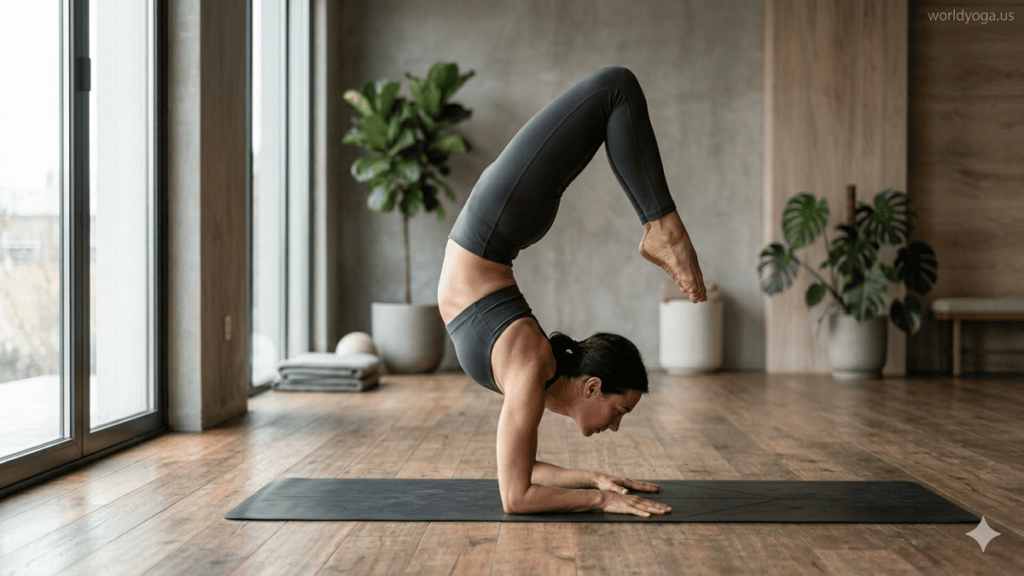
How is this arm balance performed step by step?
1. Prepare the Body
Begin with a proper warm-up focusing on:
- Shoulder openers (e.g., Dolphin Pose holds)
- Backbends (e.g., Cobra or Bridge Pose)
- Core activation exercises (planks, hollow holds)
Place your forearms on the mat, Vṛishchikasana elbows shoulder-width apart. Interlock fingers or keep palms flat, depending on stability preference.
2. Enter Forearm Balance Base
Kick up or lift into a stable forearm stand position:
- Stack shoulders directly over elbows
- Engage core to prevent arching collapse
- Keep legs extended upward initially for balance
This forms the foundation of the pose.
3. Establish Stability
Once balanced:
- Press forearms firmly into the mat
- Engage shoulders by lifting away from the floor
- Keep core tight to avoid excessive sway
- Maintain steady breathing
Hold this position before progressing further.
4. Begin Backbend Transition
Slowly initiate spinal extension:
- Start arching the upper back gently
- Open the chest forward
- Begin bending the knees slightly
- Allow controlled movement rather than forcing flexibility
This is where the scorpion shape begins to form.
5. Lower the Feet Toward Head
Gradually deepen the backbend:
- Bend both knees more deeply
- Guide feet toward the head in a controlled arc
- Keep weight centered over elbows/forearms
- Avoid collapsing into the lower back
The movement should feel smooth, not forced.
6. Final Position (Full Expression)
In the completed pose:
- Both legs are bent and extended overhead
- Spine is deeply arched in a scorpion shape
- Chest is open and slightly forward
- Balance is maintained through forearm strength and core control
Hold only as long as stability and breath remain steady.
7. Exit Safely
To come out:
- Slowly straighten the legs upward first
- Return to a stable forearm stand
- Gently lower feet back to the mat
- Rest in Child’s Pose to release pressure
Key Tips for Safety
- Do not rush the backbend transition
- Keep core engaged at all times
- Avoid collapsing into the lower back or shoulders
- Practice near a wall for support if needed
External References
- Yoga Journal – Inversions Practice Guide:
https://www.yogajournal.com/poses/types-of-poses/inversions/ - Yoga International – Forearm Balance Progressions:
https://yogainternational.com/article/view/how-to-build-arm-balance-strength - Ekhart Yoga – Pincha Mayurasana Basics:
https://www.ekhartyoga.com/everything-yoga/poses/pincha-mayurasana-forearm-balance
#Utthita Dwi Pada Vrishtasana in Pune
What strength and flexibility are required?
1. Upper Body Strength Requirements
This pose places the entire body weight on the arms or forearms, so upper-body strength is critical:
- Shoulder strength and stability: Must support full inversion while controlling balance over elbows or hands
- Forearm and wrist endurance: Needed to maintain steady grounding and prevent collapse
- Triceps strength: Helps stabilize elbow positioning in forearm balance
- Upper back (scapular control): Prevents sinking into shoulders and supports lift through the spine
Without strong shoulder and forearm engagement, the pose becomes unsafe and unstable.
2. Core Strength Requirements
The core is the central control system of this pose:
- Deep abdominal muscles (transverse abdominis): Maintain inversion stability
- Rectus abdominis: Controls lifting and prevents over-arching collapse
- Obliques: Assist in balance adjustments and alignment control
- Lower back support muscles: Help manage spinal extension safely
A strong core prevents excessive pressure on the lower spine during the deep backbend phase.
3. Flexibility Requirements
Flexibility is equally important, especially in the spine and hips:
- Spinal flexibility (thoracic + lumbar): Required for deep scorpion-like arch
- Shoulder flexibility: Needed for overhead extension in inversion
- Hip flexor flexibility: Allows legs to bend and travel toward the head
- Quadriceps flexibility: Supports controlled knee bending in the final shape
- Chest and rib cage openness: Enables safe backbend expansion
Without sufficient flexibility, the pose cannot reach full expression safely.
4. Balance and Control Requirements
Beyond strength and flexibility, Vṛishchikasana, neuromuscular control is essential:
- Proprioception: Awareness of body position while inverted
- Fine motor control: Small adjustments through forearms or hands
- Breath control: Maintains calmness and stability under load
- Focus (drishti): Prevents disorientation during inversion
5. Summary
To perform Utthita Dwi Pada Vṛishchikasana safely, a practitioner needs:
- Strong shoulders, forearms, and core for structural support
- High spinal and hip flexibility for deep backbending
- Excellent balance, control, and body awareness
It is a pose where strength creates stability and flexibility enables shape, and both must develop together progressively.
External References
- Yoga Journal – Inversions and Advanced Poses:
https://www.yogajournal.com/poses/types-of-poses/inversions/ - Yoga International – Building Arm Balance Strength:
https://yogainternational.com/article/view/how-to-build-arm-balance-strength - Ekhart Yoga – Forearm Stand Foundations:
https://www.ekhartyoga.com/everything-yoga/poses/pincha-mayurasana-forearm-balance
#Utthita Dwi Pada Vrishtasana in Chennai
What are the benefits of this pose?
1. Builds Exceptional Upper Body Strength
This pose places the entire body weight on the arms or forearms, which significantly strengthens:
- Shoulders and deltoids (primary support in inversion)
- Forearms and wrists (load-bearing stability)
- Upper back muscles (scapular control and posture alignment)
- Triceps (elbow stability and endurance)
Over time, it improves overall upper-body resilience and control.
2. Develops Core Stability and Control
The inverted backbend requires continuous core engagement:
- Strengthens deep abdominal muscles (transverse abdominis)
- Improves control of spinal alignment during inversion
- Enhances coordination between upper and lower body movement
A strong core is essential to prevent collapse into the lower back during the deep arch.
3. Increases Spinal Flexibility and Mobility
One of the most significant benefits is improved spinal function:
- Deepens thoracic and lumbar extension
- Increases flexibility in the entire posterior chain
- Enhances overall spinal mobility and decompression
This contributes to better posture and reduced stiffness when practiced safely.
4. Enhances Balance and Body Awareness
Because the pose is performed upside down, it trains the nervous system intensively:
- Improves proprioception (awareness of body in space)
- Develops fine motor control for micro-adjustments
- Strengthens neuromuscular coordination under instability
This translates into better balance in other physical activities.
5. Opens Shoulders and Chest
The deep backbend naturally expands the upper body:
- Opens the chest and rib cage
- Improves shoulder mobility and flexibility
- Encourages better breathing capacity and lung expansion
This can support improved posture and upper-body alignment.
6. Builds Mental Focus and Emotional Control
This pose is physically intense and requires strong concentration:
- Enhances focus and mindfulness under pressure
- Develops breath control in challenging positions
- Builds confidence and emotional resilience
It teaches calmness in unstable or demanding situations.
7. Improves Advanced Movement Skills
Practicing this pose supports progression into:
- Advanced inversions (handstand variations)
- Backbend-arm balance transitions
- Controlled acrobatic and athletic movements
It acts as a bridge pose between strength-based and flexibility-based skills.
External References
- Yoga Journal – Inversion Benefits:
https://www.yogajournal.com/poses/types-of-poses/inversions/ - Yoga International – Arm Balance Strength Development:
https://yogainternational.com/article/view/how-to-build-arm-balance-strength - Ekhart Yoga – Forearm Stand Guide:
https://www.ekhartyoga.com/everything-yoga/poses/pincha-mayurasana-forearm-balance
#Utthita Dwi Pada Vrishtasana in Banglore
What common mistakes should be avoided?
1. Collapsing Into the Shoulders
One of the most serious mistakes is sinking into the shoulder joints.
- This reduces stability
- Increases risk of shoulder strain or injury
- Breaks proper spinal alignment
Correction: Actively push the floor away and keep shoulders lifted and engaged throughout the pose.
2. Overarching the Lower Back
Many practitioners force the backbend from the lumbar spine instead of distributing it evenly.
- Creates compression in the lower back
- Reduces control and increases discomfort
- Leads to instability in inversion
Correction: Focus on opening the upper back (thoracic spine) and engage the core to support the lumbar region.
3. Weak Core Engagement
Without a strong core, the body becomes unstable in inversion.
- Causes excessive wobbling or collapse
- Shifts pressure into shoulders and spine
- Makes controlled leg movement difficult
Correction: Keep abdominal muscles actively engaged throughout the pose.
4. Forcing the Leg Drop Too Quickly
Trying to bring both legs into the scorpion shape too early is a common error.
- Leads to loss of balance
- Causes sudden strain in spine and shoulders
- Prevents controlled alignment development
Correction: Progress gradually—first stabilize inversion, then slowly deepen the backbend.
5. Poor Elbow or Forearm Alignment
Incorrect base positioning reduces stability.
- Elbows too wide weaken support structure
- Uneven forearm pressure destabilizes balance
Correction: Keep elbows shoulder-width apart and press evenly through both forearms.
6. Holding the Breath
Many practitioners unconsciously stop breathing during effort.
- Increases muscle tension
- Reduces balance control
- Causes early fatigue
Correction: Maintain slow, steady breathing to support stability and focus.
7. Skipping Progression Work
Attempting this pose without preparation is a major risk.
- Leads to poor control and unsafe alignment
- Increases chance of wrist, shoulder, or spine strain
Correction: Build foundation with Dolphin Pose, Forearm Stand, and backbend training before attempting.
8. Lack of Focus and Body Awareness
Distraction during inversion affects balance significantly.
- Causes misalignment mid-pose
- Reduces ability to correct micro-movements
Correction: Use a steady gaze (drishti) and maintain strong mental focus.
Summary
Avoiding mistakes in this pose comes down to:
- Strong shoulder engagement without collapse
- Controlled spinal extension (not forced bending)
- Gradual progression and core activation
- Steady breathing and focused awareness
Mastery depends more on precision and control than extreme flexibility or force.
External References
- Yoga Journal – Inversion Safety Tips:
https://www.yogajournal.com/poses/types-of-poses/inversions/ - Yoga International – Arm Balance Alignment Guide:
https://yogainternational.com/article/view/how-to-build-arm-balance-strength - Ekhart Yoga – Forearm Stand Technique:
https://www.ekhartyoga.com/everything-yoga/poses/pincha-mayurasana-forearm-balance
#Utthita Dwi Pada Vrishtasana in Ahemadabad
Case Study of Utthita Dwi Pada Vṛishchikasana
1. Introduction
This case study examines the progressive training, adaptation, and performance outcomes of an advanced yoga practitioner learning Utthita Dwi Pada Vṛishchikasana, a complex inversion combining forearm balance, deep spinal extension, and bilateral leg positioning. The objective was to evaluate physical readiness, skill acquisition timeline, and biomechanical adaptation required for safe execution of the pose.
2. Subject Profile
- Practitioner level: Advanced (2+ years consistent yoga practice)
- Background: Strong foundation in Forearm Stand (Pincha Mayurasana) and backbends (Wheel Pose, King Cobra)
- Primary limitation: Limited thoracic spine flexibility and moderate shoulder endurance under inversion
3. Training Methodology
The training protocol was divided into four progressive phases:
Phase 1: Foundational Strength (Weeks 1–3)
- Dolphin Pose holds (30–60 seconds)
- Core stabilization drills (plank variations, hollow holds)
- Shoulder mobility work (wall slides, scapular push-ups)
- Passive backbend conditioning
Outcome: Improved shoulder stability and baseline core engagement.
Phase 2: Inversion Stability (Weeks 4–6)
- Forearm Stand (Pincha Mayurasana) wall-assisted
- Kick-up drills with controlled alignment
- Breath regulation under inversion
Outcome: Ability to hold stable inversion for 20–40 seconds with wall support.
Phase 3: Backbend Integration (Weeks 7–9)
- Gradual thoracic extension work in inversion
- Knee bending drills in forearm stand
- Assisted scorpion shape formation using wall feedback
Outcome: Initial controlled leg descent achieved with partial balance maintenance.
Phase 4: Full Expression (Weeks 10–12)
- Independent forearm balance attempts
- Slow bilateral leg transition into scorpion shape
- Refinement of breath control and micro-adjustments
Outcome: Short-duration holds (5–10 seconds) of full pose achieved.
4. Key Observations
Strength Adaptation
- Significant improvement in shoulder endurance and scapular stability
- Core activation became automatic during inversion entry
Flexibility Adaptation
- Noticeable increase in thoracic spine extension capacity
- Improved hip flexor openness for leg positioning
Neuromuscular Control
- Enhanced proprioception during inversion transitions
- Better balance correction using forearm pressure shifts
5. Challenges Identified
- Initial difficulty preventing lumbar over-compression
- Tendency to rush leg transition phase
- Fatigue in shoulders during extended holds
- Fear response during deep inversion backbending
6. Outcomes
After 12 weeks:
- Achieved controlled entry into full pose with short holds
- Improved upper-body strength and spinal mobility
- Enhanced balance awareness in advanced inversions
- Developed safer progression habits for complex arm balances
The most significant result was not duration of hold, but improved control, alignment awareness, and injury prevention mechanics.
7. Conclusion
This case study demonstrates that Utthita Dwi Pada Vṛishchikasana requires systematic progression rather than direct execution attempts. Success depends on integrating shoulder strength, core stability, spinal flexibility, and psychological control. The pose serves as a benchmark for advanced inversion proficiency rather than an isolated physical achievement.
External References
- Yoga Journal – Inversion Training Principles:
https://www.yogajournal.com/poses/types-of-poses/inversions/ - Yoga International – Arm Balance Progressions:
https://yogainternational.com/article/view/how-to-build-arm-balance-strength - Ekhart Yoga – Forearm Balance Foundations:
https://www.ekhartyoga.com/everything-yoga/poses/pincha-mayurasana-forearm-balance
#Utthita Dwi Pada Vrishtasana in Hyderabad
White Paper of Utthita Dwi Pada Vṛishchikasana
1. Abstract
Utthita Dwi Pada Vṛishchikasana is an advanced yoga inversion combining forearm or hand balance with deep spinal extension and bilateral leg positioning. The pose integrates upper-body strength, core stability, spinal flexibility, and neuromuscular control. This white paper explores its biomechanical demands, physiological adaptations, training methodology, safety considerations, and applied relevance in movement science and performance training.
2. Definition and Classification
Utthita Dwi Pada Vṛishchikasana is classified as an advanced inversion–backbend arm balance hybrid. The practitioner supports body weight on the forearms (or hands) while performing a controlled scorpion-like spinal arch with both legs extended overhead.
It is typically derived from:
- Forearm Stand (Pincha Mayurasana)
- Scorpion Pose progressions
- Advanced backbend systems in yoga
3. Biomechanical Analysis
This pose requires coordinated multi-joint engagement:
Upper Body Load System
- Shoulder girdle acts as primary stabilizer
- Forearms/wrists maintain ground reaction force distribution
- Scapular elevation and protraction prevent collapse
Core Integration
- Deep abdominal engagement stabilizes inversion
- Prevents lumbar hyperextension collapse
- Coordinates lower-limb positioning
Spinal Mechanics
- Thoracic extension is primary driver of backbend
- Lumbar spine acts as secondary controlled segment
- Cervical alignment maintained in neutral or slight extension
Lower Limb Positioning
- Hip flexion and knee bend enable scorpion shape
- Requires eccentric control of hip flexors and quadriceps
4. Physiological Requirements
To safely perform the pose, practitioners require:
- High shoulder strength and endurance
- Strong core stabilization capacity
- Advanced thoracic and hip flexibility
- Functional wrist load tolerance
- Developed proprioceptive control in inversion
5. Training Methodology
A structured progression model is recommended:
Phase 1: Foundational Conditioning
- Dolphin Pose holds
- Plank and hollow body drills
- Shoulder mobility work
Phase 2: Inversion Stability
- Forearm Stand (wall-supported)
- Balance control and alignment training
Phase 3: Backbend Integration
- Scapular control in inversion
- Controlled spinal extension drills
- Assisted leg bending mechanics
Phase 4: Full Expression
- Independent inversion holds
- Gradual bilateral leg transition
- Breath-controlled stabilization
6. Benefits and Adaptations
Regular progressive practice may result in:
- Increased upper body and shoulder strength
- Enhanced spinal mobility and extension capacity
- Improved core control under inversion load
- Strengthened neuromuscular coordination and balance
- Greater mental focus and stress regulation
Reference: https://www.yogajournal.com/poses/types-of-poses/inversions/
7. Risk and Safety Considerations
Key risk factors include:
- Shoulder joint compression from poor alignment
- Lumbar spine overextension
- Wrist strain under improper load distribution
- Loss of balance in unsupported inversion
Mitigation strategies:
- Progressive training only
- Use of wall support during early stages
- Proper warm-up of shoulders and spine
- Supervised practice for advanced attempts
Reference: https://yogainternational.com/article/view/how-to-build-arm-balance-strength
8. Applications in Modern Movement Systems
This pose has relevance beyond yoga:
- Sports training: Enhances overhead stability and core control
- Calisthenics: Develops advanced inversion strength
- Rehabilitation (modified forms): Controlled shoulder and spinal loading
- Performing arts: Used in acrobatic and dance-based movement systems
9. Conclusion
Utthita Dwi Pada Vṛishchikasana represents a high-level integration of strength, flexibility, and neuromotor control. It should be approached as a progressive system rather than a single achievement. When trained correctly, it serves as a benchmark for advanced inversion mastery and full-body coordination efficiency.
External References
- Yoga Journal – Inversion Systems:
https://www.yogajournal.com/poses/types-of-poses/inversions/ - Yoga International – Arm Balance Development:
https://yogainternational.com/article/view/how-to-build-arm-balance-strength - Ekhart Yoga – Forearm Stand Foundations:
https://www.ekhartyoga.com/everything-yoga/poses/pincha-mayurasana-forearm-balance
#Utthita Dwi Pada Vrishtasana in Delhi
Industry Application of Utthita Dwi Pada Vṛishchikasana
1. Overview
Utthita Dwi Pada Vṛishchikasana is an advanced inversion–backbend arm balance that requires extreme coordination of strength, flexibility, balance, and neuromuscular control. While it originates in advanced yoga practice, its underlying biomechanics—overhead stability, core integration, and controlled inversion—have valuable applications across multiple modern industries including fitness, sports science, rehabilitation, performing arts, and elite training systems.
2. Fitness and Strength Training Industry
In contemporary fitness systems, this pose is used as a high-level bodyweight skill progression, particularly in advanced calisthenics and functional training.
Applications include:
- Development of overhead shoulder stability under load
- Advanced core conditioning and anti-extension training
- Progression training toward handstand and freestanding inversion skills
- Mobility-strength integration programs
It is often used as a benchmark movement for athletes who have mastered basic inversions.
Reference: https://www.yogajournal.com/poses/types-of-poses/inversions/
3. Yoga and Mind-Body Wellness Industry
In yoga systems, this pose is considered part of advanced asana progression training.
Applications include:
- Teaching advanced body awareness and proprioception
- Developing breath control under physical stress
- Training spinal mobility and controlled backbending
- Enhancing focus, patience, and mental discipline
It is typically included only in advanced workshops or teacher training modules.
4. Sports Science and Athletic Performance
The biomechanical principles of this pose are valuable for athletes requiring overhead control and dynamic stability.
Relevant sports applications:
- Gymnastics (inversion control and aerial transitions)
- Diving and acrobatics (body alignment in rotation)
- Martial arts (core stability during inversion recovery)
- Climbing (shoulder endurance and body tension control)
The pose enhances kinesthetic awareness and injury-resistant shoulder mechanics.
Reference: https://yogainternational.com/article/view/how-to-build-arm-balance-strength
5. Physiotherapy and Rehabilitation (Modified Application)
In clinical settings, modified versions are used carefully for rehabilitation purposes:
- Gradual shoulder load-bearing rehabilitation
- Controlled spinal extension training
- Core reactivation after injury (low-intensity variations)
Therapists typically use wall-supported or partial inversion versions to ensure safety and control.
6. Performing Arts and Movement Industries
This pose and its mechanics are widely applied in:
- Contemporary dance (floor-to-inversion transitions)
- Circus arts (aerial and hand balancing acts)
- Film stunts and choreography (controlled inversion movement)
It supports aesthetic control combined with strength and precision.
7. Military, Tactical, and High-Performance Training
Although not practiced as a pose, its principles are applied in elite conditioning systems:
- Shoulder resilience under load-bearing stress
- Core stabilization in unstable environments
- Controlled recovery from inverted or off-balance positions
These are valuable in firefighting, rescue operations, and tactical fitness training.
8. Conclusion
Utthita Dwi Pada Vṛishchikasana is more than a yoga posture—it is a high-performance movement model. Its principles of inversion strength, spinal control, and neuromuscular coordination are transferable across fitness, rehabilitation, athletics, and performance industries. It serves as a benchmark for elite-level body control and integrated movement efficiency.
External References
- Yoga Journal – Inversion Training:
https://www.yogajournal.com/poses/types-of-poses/inversions/ - Yoga International – Arm Balance Development:
https://yogainternational.com/article/view/how-to-build-arm-balance-strength - Ekhart Yoga – Forearm Balance Guide:
https://www.ekhartyoga.com/everything-yoga/poses/pincha-mayurasana-forearm-balance
#Utthita Dwi Pada Vrishtasana in Mumbai
Ask FAQs
What is Utthita Dwi Pada Vṛishchikasana?
Utthita Dwi Pada Vṛishchikasana (Extended Two-Legged Scorpion Pose) is an advanced yoga inversion that combines an arm balance with a deep backbend. The body is supported on the forearms or hands while both legs curve overhead in a scorpion-like shape.
Is this pose suitable for beginners?
No, this is an advanced-level pose. Beginners should first master foundational movements such as Dolphin Pose, Forearm Stand (Pincha Mayurasana), and basic backbends before attempting it. Proper guidance is strongly recommended.
What are the main benefits of this pose?
This pose helps develop:
Upper body strength (shoulders, arms, forearms)
Core stability and control
Spinal flexibility and mobility
Balance, focus, and body awareness
It also improves neuromuscular coordination and inversion control.
What muscles are most involved in this pose?
Key muscle groups include:
Shoulders and upper back for support
Core muscles for stability in inversion
Hip flexors and quadriceps for leg positioning
Spinal muscles for controlled backbending
What precautions should be taken before practicing it?
Important safety guidelines include:
Avoid if you have wrist, shoulder, spine, or neck injuries
Always warm up thoroughly (shoulders, core, and back)
Practice under expert supervision
Use wall support during early progression stages
Table of Contents
Disclaimer: This content is for educational and informational purposes only and does not replace professional yoga instruction or medical advice. Advanced poses like Utthita Dwi Pada Vṛishchikasana should be practiced only under the guidance of a qualified instructor. Avoid practice if you have any injuries or medical conditions affecting the wrists, shoulders, spine, or neck.