BACKBEND: HEADSTAND 5 ARM POSITION

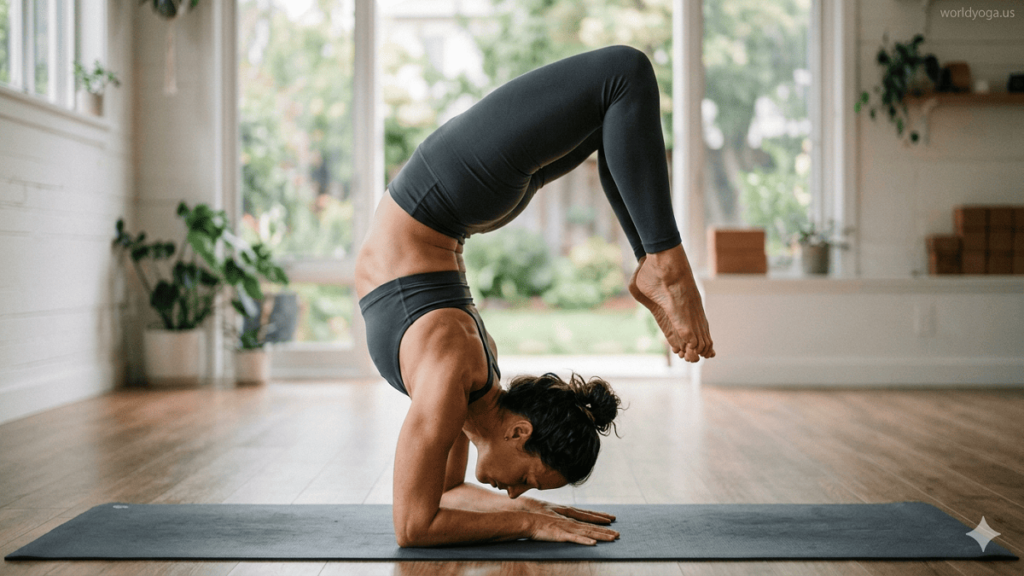
Urdhva Dhanurasana in Shirshasana. An advanced yoga practitioner in a dramatic studio setting appears mid-transition between headstand and wheel pose under warm cinematic lighting, with a subtle “worldyoga.us” watermark in the top right.
BACKBEND: HEADSTAND 5 ARM POSITION, Urdhva Dhanurasana in Shirshasana 1

Urdhva Dhanurasana in Shirshasana 1

This advanced exploration of Urdhva Dhanurasana in Shirshasana 1 examines one of the most complex and unconventional intersections in modern yoga practice. It breaks down seven powerful insights into how inversion (headstand mechanics) and deep spinal extension (wheel pose dynamics) interact from a biomechanical, neurological, and structural perspective. The content highlights the extraordinary demands placed on the cervical spine, shoulders, core stabilizers, and spinal extensors when attempting or studying this variation.
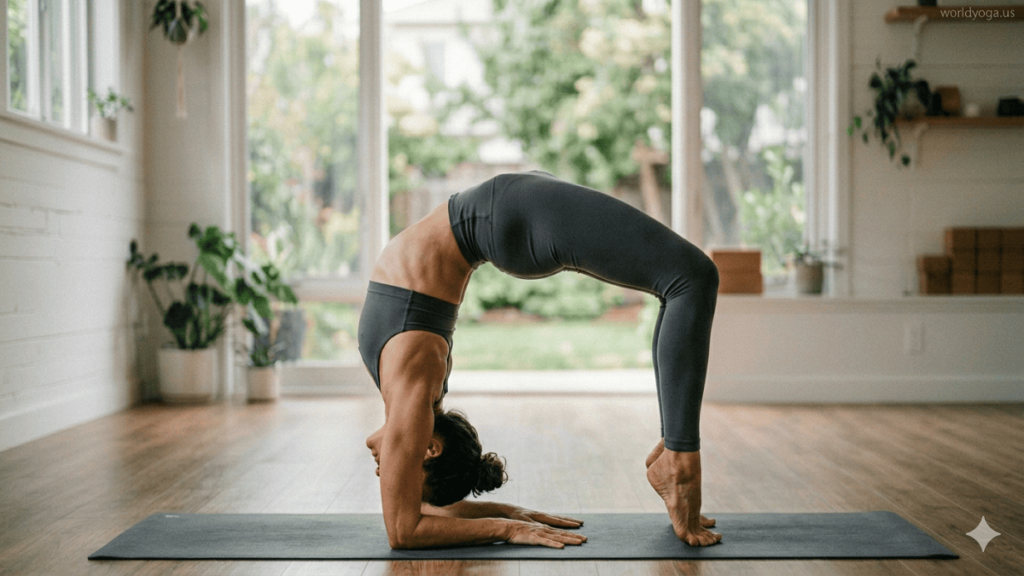
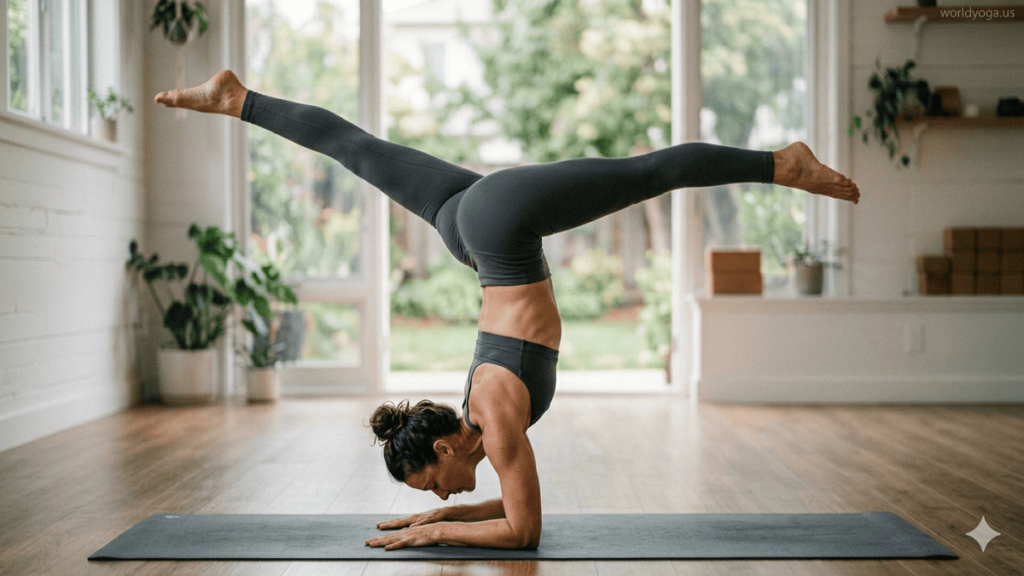
Upward Bow Pose in Headstand. An advanced yogi performing an inverted headstand variation with a deep backbend in a minimal indoor yoga studio, demonstrating strength, balance, and spinal control.
BACKBEND: HEADSTAND 5 ARM POSITION, Upward Bow Pose in Headstand 1

Upward Bow Pose in Headstand 1

Upward Bow Pose in Headstand 1 is an advanced yoga variation that combines the strength of Headstand (Sirsasana) with the deep spinal extension of Wheel Pose (Urdhva Dhanurasana). This powerful inversion demands exceptional shoulder stability, core engagement, and spinal control while maintaining precise balance. Practitioners develop full-body coordination, neuromuscular awareness, and controlled flexibility through gradual progression. It is considered a high-level movement practice requiring preparation through foundational inversions and backbends.

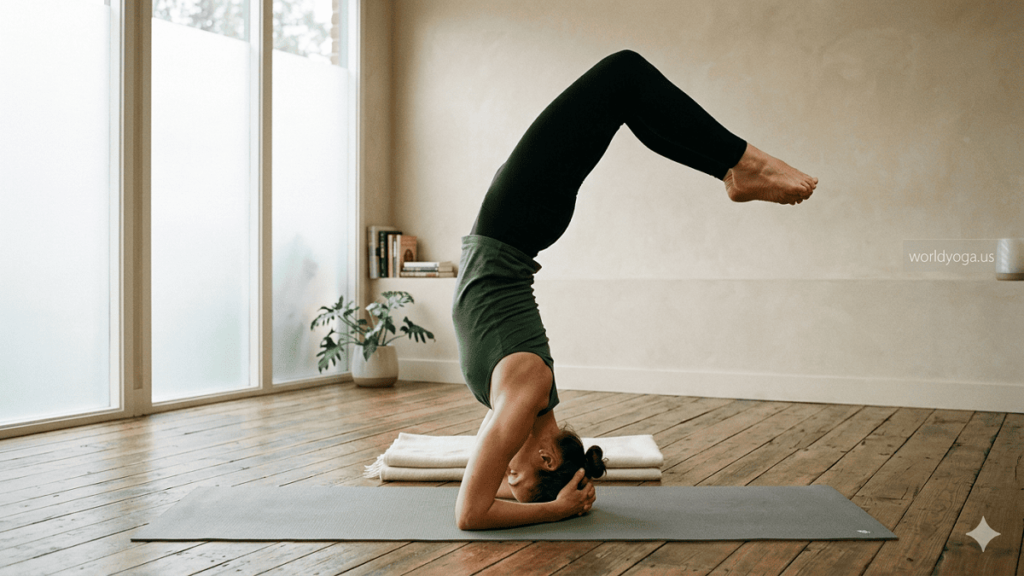
A yoga practitioner holding a One-Legged Inverted Staff Pose in a forearm headstand with one leg extended upward, showing strong alignment and stability in a studio setting with “worldyoga.us” watermark in the top right.
BACKBEND: HEADSTAND 5 ARM POSITION, One-Legged Inverted Staff Pose

One-Legged Inverted Staff Pose

The One-Legged Inverted Staff Pose is an advanced inversion that combines vertical spinal alignment, unilateral leg extension, and high-level shoulder and core stability under gravitational load. One leg is extended upward in a straight line while the rest of the body maintains a rigid, stacked “staff-like” structure. This pose develops elite shoulder endurance, deep core compression strength, pelvic control, and refined balance awareness. It also enhances neuromuscular coordination by challenging the body to maintain stability under asymmetrical conditions. Widely used in advanced yoga and movement training systems, this posture emphasizes precision, control, and safe progression through strong foundational strength and alignment discipline.

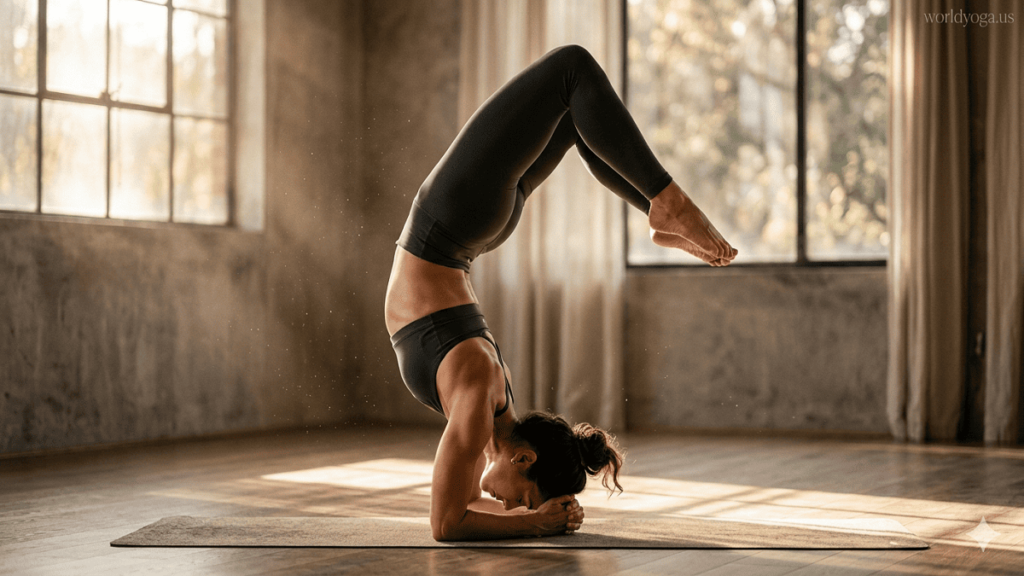
An advanced yoga practitioner performing a backbend headstand with bent knees and forearm support in a softly lit studio, with “worldyoga.us” watermark in the top right.
BACKBEND: HEADSTAND 5 ARM POSITION, BACKBEND: HEADSTAND 1 ARM POSITION—KNEE/KNEES BENT

BACKBEND: HEADSTAND 1 ARM POSITION—KNEE/KNEES BENT

The Backbend Headstand (Arm Position 1, Bent Knees) is an advanced inversion-based movement that combines controlled headstand balance, shoulder-loaded stability, and gentle thoracic spinal extension. It incorporates bent-knee positioning to reduce leverage and improve control while introducing subtle asymmetry through Arm Position 1. This variation is designed to develop deep core compression strength, scapular stability, inversion awareness, and precise spinal alignment without placing excessive stress on the neck or lower back.

Advanced yogi performing Backbend Headstand Arm Position 5 in a yoga studio with controlled inversion and spinal backbend.
BACKBEND: HEADSTAND 5 ARM POSITION

BACKBEND: HEADSTAND 5 ARM POSITION

The Backbend Headstand Arm Position 5 is an advanced yoga inversion variation of Sirsasana that combines controlled spinal extension with reduced arm support. This posture challenges balance, strength, and neuromuscular coordination by requiring the practitioner to maintain stability while transitioning into a subtle backbend in an inverted position. This topic explores the correct technique, biomechanics, and alignment principles necessary to safely perform the variation. It emphasizes the importance of a strong foundation in standard headstand practice and shoulder-supported inversions such as Pincha Mayurasana before attempting this advanced progression.

Scroll to Top