
Extended Lizard Tail Lunge Pose
The Extended Lizard Tail Lunge Pose is an advanced variation of the traditional Lizard Pose, widely used in yoga-inspired mobility training, functional fitness, and deep hip-opening sequences. This posture intensifies the classical lunge by extending one leg back in a straight, active line while deeply opening the hips and lengthening the front-leg hamstrings. It is designed to improve lower-body flexibility, enhance joint mobility, and build integrated core stability under deep stretch conditions.
In this variation, the practitioner begins from a high lunge or low lunge position and gradually lowers into a deeper stance. The front foot is placed firmly outside the hand on the same side, Extended Lizard Tail Lunge Pose creating a wide angle at the hip joint. The front knee is bent and aligned carefully over the ankle, ensuring joint safety and stability. The back leg is extended fully behind the body, with the heel lifted and the leg actively engaged. Unlike the standard lizard pose, the “tail extension” emphasizes full-length activation of the posterior chain, particularly the glutes, hamstrings, and calf muscles of the back leg.
This posture significantly targets hip flexibility. The hip flexors of the back leg, including the iliopsoas and rectus femoris, are deeply stretched, helping reduce tightness caused by prolonged sitting. At the same time, the adductor muscles of the front leg are lengthened, improving overall hip joint range of motion. The dual action of stretch and activation makes this pose highly effective for restoring balanced lower-body mobility.
From a biomechanical perspective, the Extended Lizard Tail Lunge requires strong core engagement. The transverse abdominis and obliques stabilize the torso, preventing collapse into the lower back. The spinal erectors maintain a long neutral spine, Extended Lizard Tail Lunge Pose especially when transitioning deeper into the pose. Shoulder stability also becomes important if the practitioner supports the upper body on the hands or forearms.
This pose also enhances neuromuscular coordination. Because it combines deep stretching with active muscle engagement, Extended Lizard Tail Lunge Pose the nervous system must continuously adjust to maintain balance and alignment. This improves proprioception and overall body awareness, especially in the hips and pelvis.
Breath control is essential for safe execution. Inhalation supports spinal lengthening and prepares the body for deeper movement, Extended Lizard Tail Lunge Pose while exhalation allows gradual release into the stretch without forcing the joints. This breath-led approach reduces tension and prevents overstretching.
The Extended Lizard Tail Lunge Pose is commonly used in advanced yoga flows, athletic mobility training, and rehabilitation programs focused on hip dysfunction and lower-body stiffness. However, Extended Lizard Tail Lunge Pose due to its intensity, it should be approached progressively with proper warm-up sequences.
For further reference on lunge mechanics and hip mobility training, you may explore:
Yoga Journal – Hip Opening Yoga Poses
Cleveland Clinic – Yoga for Flexibility and Mobility
Physiopedia – Hip Joint Mobility and Stability
In summary, the Extended Lizard Tail Lunge Pose is a powerful combination of deep hip opening, posterior chain activation, and core stabilization, Extended Lizard Tail Lunge Pose making it a highly effective tool for improving flexibility, strength balance, and functional movement efficiency.
#Extended Lizard Tail Lunge Pose in India
How is Extended Lizard Tail Lunge Pose performed correctly?
The Extended Lizard Tail Lunge Pose is an advanced hip-opening and posterior chain activation variation of the traditional Lizard Pose. It combines deep lunge mechanics with a strong back-leg extension, requiring precise alignment, controlled mobility, Extended Lizard Tail Lunge Pose and steady breath coordination to ensure both safety and effectiveness.
To begin correctly, start in a high lunge position. Step one foot forward between the hands, placing the front foot slightly outside the corresponding hand to create space for a deep hip opening. The front knee should be bent and aligned directly over the ankle, Extended Lizard Tail Lunge Pose never collapsing inward or extending beyond the toes. This alignment protects the knee joint while establishing a stable foundation.
From this lunge base, begin lowering the body carefully. Depending on flexibility, the hands may remain on the floor, yoga blocks, or forearms. The spine should stay long and neutral, avoiding rounding in the lower back. The chest gradually moves forward and slightly down, Extended Lizard Tail Lunge Pose maintaining space between the shoulders and ears.
The defining feature of this variation is the extended “tail” position of the back leg. Instead of dropping the knee, the back leg remains fully straight and active. The heel stays lifted, and the ball of the foot presses firmly into the ground. The quadriceps engage to maintain knee extension, Extended Lizard Tail Lunge Pose while the gluteus maximus helps stabilize hip extension. This active engagement prevents the back leg from becoming passive and increases the intensity of the stretch.
Proper pelvic alignment is essential. The hips should remain as square as mobility allows, avoiding excessive external rotation. A neutral pelvis helps balance the deep stretch occurring in the hip flexors of the back leg while protecting the lower back from compression.
As the body settles deeper into the pose, the hip flexors of the back leg (iliopsoas and rectus femoris) experience a strong lengthening sensation. At the same time, the inner thigh and hamstring of the front leg are engaged to stabilize the wide stance. This dual engagement creates a balanced stretch-strength relationship across both sides of the body.
Core activation plays a critical role in maintaining stability. The transverse abdominis and obliques gently engage to support the spine and prevent collapse into the lower back. The spinal erectors help maintain a long, extended posture rather than allowing rounding or sinking into the shoulders.
The upper body remains relaxed but active. Shoulders should stay away from the ears, Extended Lizard Tail Lunge Pose and the neck should remain long and neutral. The gaze can be directed slightly forward or down, depending on comfort and balance needs.
Breathing is essential for correct execution. Inhale to lengthen the spine and create space in the hips. Exhale slowly to deepen the stretch without forcing the range of motion. This breath control ensures that the nervous system remains calm and prevents overstretching.
This pose should be approached gradually, especially for beginners. Using blocks under the hands or keeping a smaller range of motion helps maintain alignment while building flexibility and strength over time.
For additional guidance on lunge mechanics and hip mobility practices, you may refer to:
Yoga Journal – Hip Opening Pose Guide
Cleveland Clinic – Flexibility and Mobility Training
Physiopedia – Hip Mobility and Stability Concepts
In summary, correct execution depends on a stable front-leg lunge, an actively extended back leg, a neutral and controlled spine, and breath-led gradual deepening of the hip opening without compromising alignment or joint safety.
#Extended Lizard Tail Lunge Pose in Maharashtra
What is the proper alignment in this deep lizard lunge variation?
The Extended Lizard Tail Lunge Pose is a deep hip-opening variation that combines a wide lunge base with an actively extended back leg. Proper alignment is essential to protect the knees, hips, and lower back while ensuring the stretch is distributed safely across the hip flexors, hamstrings, and core stabilizers.
1. Foot and Lower Body Foundation
Begin by placing the front foot outside the corresponding hand to create a stable, wide lunge base. The front foot should be fully grounded, with weight distributed evenly across the heel, ball of the foot, and outer edge. The front knee must stay aligned directly above the ankle to avoid joint strain and should track in the same direction as the toes.
The back leg is fully extended and lifted off the floor. The heel remains elevated, and the ball of the foot presses firmly into the ground. The knee stays straight but not locked, allowing active muscular engagement. The quadriceps are engaged to maintain extension, while the calf muscles stabilize the ankle.
2. Hip and Pelvic Alignment
The hips should remain as square as mobility allows, facing forward rather than opening excessively to the side. A neutral pelvis is critical—avoid both anterior tilt (arching the lower back) and posterior tuck (rounding the spine). This neutral positioning ensures that the hip flexors of the back leg are safely lengthened while maintaining spinal integrity.
The gluteus maximus of the back leg remains active to support hip extension, while the gluteus medius helps stabilize the pelvis and prevent side-to-side collapse.
3. Spinal Alignment
The spine should remain long, extended, and neutral throughout the posture. Movement into the deeper lunge is driven by the hips, not by rounding the back. The chest stays open, and the spine lengthens forward rather than collapsing downward.
The cervical spine (neck) remains in line with the rest of the spine. The gaze can be directed slightly forward or downward to maintain balance and reduce neck strain.
4. Upper Body and Shoulder Position
The shoulders should remain relaxed and drawn away from the ears. If the hands are on the floor or blocks, they should be placed directly under the shoulders for support. The arms act as stabilizers rather than weight-bearing collapse points.
The scapulae (shoulder blades) remain gently engaged and stable, preventing sinking into the chest or upper back rounding.
5. Core Engagement
The core plays a central role in maintaining alignment. The transverse abdominis activates to stabilize the spine, while the obliques assist in preventing rotational collapse. This core engagement ensures that the forward fold component does not compromise lumbar stability.
6. Lower-Limb Muscle Balance
- Front leg: Hamstrings stabilize and control the hip hinge, quadriceps maintain knee alignment
- Back leg: Hip flexors are deeply stretched while quadriceps maintain extension and control
- Calves: Assist in ankle stability and grounding of the back foot
Summary
Proper alignment in the Extended Lizard Tail Lunge Pose is built on five key principles:
- Stable, wide front-foot placement with knee-over-ankle alignment
- Actively extended back leg with engaged quadriceps and lifted heel
- Neutral pelvis with controlled hip squaring
- Long, hip-driven spinal extension (no rounding)
- Continuous core and shoulder stabilization
For further reference on hip-opening alignment and functional lunge mechanics:
Yoga Journal – Hip Opening Yoga Poses
Cleveland Clinic – Yoga and Flexibility Training
Physiopedia – Hip Mobility and Stability Concepts
#Extended Lizard Tail Lunge Pose in Ahemadabad
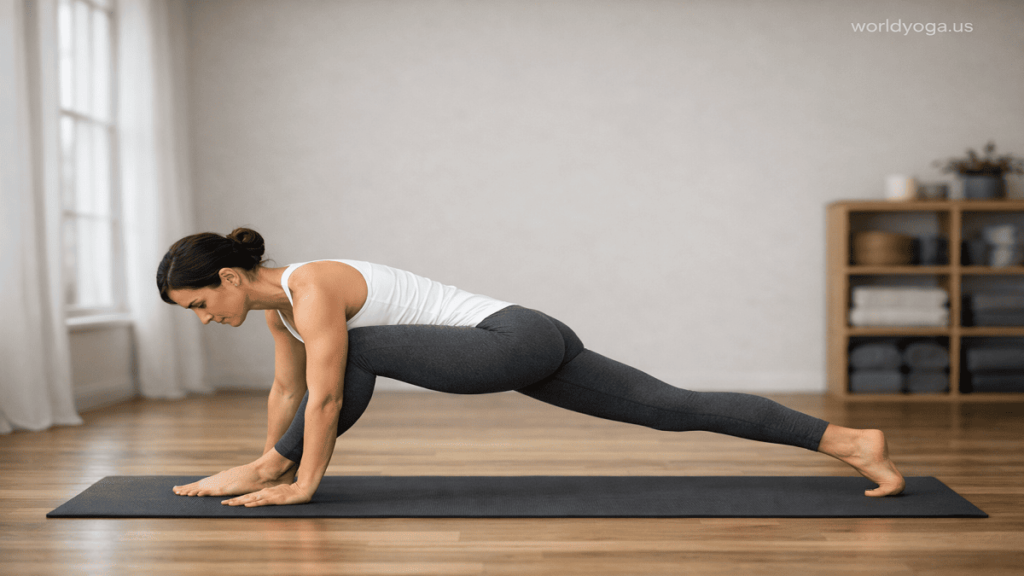
Which muscles and joints are engaged during the posture?
The Extended Lizard Tail Lunge Pose is a high-intensity mobility and strength posture that integrates deep hip opening with active lower-limb stabilization. Because it combines a wide lunge with an extended back leg and forward-leaning torso, it recruits multiple muscle groups across the lower body, core, and stabilizing joints in a coordinated chain.
1. Hip Joints (Primary Mobility Focus)
The hip joints are the central articulation points in this posture.
- The front hip joint is placed in deep flexion as the torso folds forward, allowing the glutes and hamstrings to stabilize the movement.
- The back hip joint is in strong extension, creating a deep stretch through the hip flexors (iliopsoas and rectus femoris).
This dual action—flexion in front and extension in back—makes the hips highly active in both mobility and stabilization roles.
2. Knee Joints (Stability and Control)
- Front knee joint: Bent under load, stabilized by the quadriceps (vastus medialis, lateralis, intermedius, and rectus femoris). It must track properly over the ankle to avoid ligament strain.
- Back knee joint: Fully extended but not locked, supported by the quadriceps to maintain straight-leg alignment.
The knees function as stabilizers rather than primary movers, absorbing shifts in weight and balance.
3. Ankle Joints (Grounding and Balance)
- Front ankle: Works in dorsiflexion and stability, helping control forward weight transfer.
- Back ankle: Engaged in plantar flexion, with the ball of the foot grounded and heel lifted, requiring active stabilization from the calf muscles.
The ankle joints continuously adjust to maintain equilibrium and prevent collapse.
4. Major Muscle Groups Engaged
Hip Flexors (Back Leg – Primary Stretch Zone)
- Iliopsoas
- Rectus femoris
These muscles undergo deep eccentric lengthening, making this one of the most intense hip-opening components of the posture.
Hamstrings (Front Leg – Control and Stabilization)
- Biceps femoris
- Semitendinosus
- Semimembranosus
They work eccentrically to control the forward fold and maintain hip hinge integrity.
Quadriceps (Both Legs – Stability and Extension)
- Vastus medialis
- Vastus lateralis
- Vastus intermedius
- Rectus femoris
They stabilize both knees and maintain structural alignment during the lunge.
Gluteal Muscles (Hip Stability and Control)
- Gluteus maximus: Supports hip extension in back leg
- Gluteus medius: Stabilizes pelvis and prevents side collapse
Calf Muscles (Ankle Stability)
- Gastrocnemius
- Soleus
These muscles stabilize the lifted heel and help control balance during forward shifting.
Core Musculature (Spinal Protection System)
- Transverse abdominis
- Obliques
- Rectus abdominis
- Multifidus (deep spinal stabilizer)
The core prevents excessive lumbar flexion and maintains controlled spinal alignment during forward folding.
5. Joints Summary
The primary joints engaged include:
- Hip joints: Deep flexion and extension (key mobility driver)
- Knee joints: Stabilization under load
- Ankle joints: Balance and grounding control
- Spinal joints: Controlled articulation and stabilization
- Shoulder girdle (secondary): Supports posture if hands are grounded
Summary
The Extended Lizard Tail Lunge Pose is a full kinetic-chain movement involving:
- Deep hip flexor stretch and hamstring control
- Strong knee and ankle stabilization
- High core engagement for spinal safety
- Integrated balance and neuromuscular coordination
This makes it an advanced functional posture that simultaneously develops flexibility, strength, and joint control.
For reference on joint mechanics and lower-body movement systems:
Physiopedia – Lower Limb Biomechanics
Cleveland Clinic – Hip and Leg Anatomy Overview
Yoga Journal – Hip Opening and Alignment Guides
#Extended Lizard Tail Lunge Pose in Hyderabad
What preparatory poses are recommended before practicing it?
The Extended Lizard Tail Lunge Pose is an advanced hip-opening and posterior-chain activation posture that demands strong hamstring control, deep hip flexor flexibility, and core stability. Preparing the body with progressive foundational poses is essential to reduce strain on the hips, knees, and lower back while improving range of motion and neuromuscular control.
1. Tadasana (Mountain Pose) – Alignment Foundation
Tadasana establishes the baseline for safe practice by training neutral pelvis positioning, even weight distribution through the feet, and spinal elongation. This helps the practitioner understand correct stacking of joints before moving into deeper lunge variations. It also activates intrinsic foot muscles required for balance in asymmetrical poses.
2. Anjaneyasana (Low Lunge) – Hip Flexor Opening
Low Lunge is one of the most important preparatory poses for this variation. It gently stretches the iliopsoas and rectus femoris of the back leg while allowing the front leg to build stability. This prepares the hips for the deeper extension required in the Extended Lizard Tail Lunge.
3. High Lunge (Crescent Lunge) – Strength and Stability Base
High Lunge builds the structural strength needed for the pose. It strengthens the quadriceps, glutes, and core while training balance in a split stance. Practicing this helps condition the back leg for active extension without collapsing the knee or hip.
4. Downward-Facing Dog (Adho Mukha Svanasana) – Posterior Chain Activation
Downward Dog prepares both hamstrings and calves while reinforcing spinal length. It also strengthens shoulder stability and teaches controlled weight distribution between upper and lower body, which is useful for transitioning into deeper lunge positions.
5. Lizard Pose (Utthan Pristhasana) – Direct Hip Preparation
Standard Lizard Pose is the closest foundational preparation. It opens the hips deeply, stretches the groin and hip flexors, and introduces weight-bearing in a wide lunge position. Practicing this helps the body adapt to deeper hip opening before adding the extended back leg.
6. Half Splits Pose (Ardha Hanumanasana) – Hamstring Conditioning
Half Splits specifically targets the front leg hamstrings. It trains controlled eccentric lengthening, which is essential for safely handling forward folding pressure in the Extended Lizard variation.
7. Plank Pose – Core Stability Training
Plank strengthens the transverse abdominis, obliques, and spinal stabilizers. This is critical for maintaining a neutral spine during deep forward folding and preventing collapse into the lower back.
8. Runner’s Lunge Flow – Dynamic Integration
Slow transitions between High Lunge and Low Lunge help integrate mobility and stability. This dynamic movement prepares the nervous system for controlled shifting between hip extension and flexion.
Summary
Safe preparation for the Extended Lizard Tail Lunge Pose should include:
- Alignment training (Tadasana)
- Hip flexor opening (Low Lunge, Lizard Pose)
- Strength building (High Lunge, Plank)
- Hamstring flexibility (Half Splits, Downward Dog)
- Movement integration (Lunge transitions)
For further reference on hip mobility and lunge preparation sequences:
Yoga Journal – Hip Opening Sequences
Cleveland Clinic – Flexibility and Mobility Training
Physiopedia – Lower Body Movement Preparation
#Extended Lizard Tail Lunge Pose in Delhi
What are the benefits and precautions of Extended Lizard Tail Lunge Pose?
The Extended Lizard Tail Lunge Pose is an advanced hip-opening and posterior chain activation posture that combines a deep lunge with an actively extended back leg. It creates a strong demand on flexibility, strength, and neuromuscular control, making it highly effective but also technically challenging. Proper understanding of its benefits and precautions is essential for safe and effective practice.
Benefits of the Posture
1. Deep Hip Flexor Opening
This pose provides an intense stretch to the hip flexors of the back leg, particularly the iliopsoas and rectus femoris. Regular practice can help reduce tightness caused by prolonged sitting and improve overall hip mobility.
2. Improved Hamstring Flexibility and Control
The front leg hamstrings are engaged in controlled eccentric lengthening during the deep lunge and forward shift. This improves flexibility while maintaining muscular strength, which is important for functional movement and injury prevention.
3. Strong Lower-Body Strength Development
The quadriceps, glutes, and calves work continuously to stabilize both legs in a split stance. The back leg remains active rather than passive, helping develop endurance and strength in the posterior chain.
4. Core Stability and Spinal Control
The transverse abdominis, obliques, and spinal stabilizers engage to maintain a neutral spine during deep hip opening and forward weight transfer. This improves postural control and reduces strain on the lower back.
5. Enhanced Balance and Proprioception
Because the posture requires asymmetrical loading and continuous micro-adjustments, it improves neuromuscular coordination and body awareness, especially in the hips, knees, and ankles.
6. Increased Functional Mobility
The combination of stretch and activation improves movement efficiency in daily activities such as walking, running, and bending, making it valuable for athletic and functional training programs.
Precautions and Safety Considerations
1. Risk of Hip or Groin Overstretching
Forcing the hips too deep into the pose can strain the adductor muscles or hip flexors. The movement should always be gradual and controlled.
2. Lower Back Strain Risk
Excessive spinal rounding or collapsing into the lower back can create lumbar compression. Maintaining a long, neutral spine is essential.
3. Knee Joint Stress
The front knee must stay aligned above the ankle. Allowing it to collapse inward or extend too far forward can place unnecessary stress on ligaments and cartilage.
4. Hamstring Overload
The front leg hamstrings are under eccentric tension. Overstretching or bouncing into the pose may lead to strain or micro-tears.
5. Instability in Beginners
Because the back leg is fully extended and lifted, beginners may experience balance challenges. Using props such as blocks or keeping a reduced range of motion is recommended.
6. Shoulder and Wrist Pressure (If Hands are Grounded)
When supporting weight through the hands, improper alignment can strain wrists and shoulders. Proper stacking under the shoulders is necessary.
Summary
The Extended Lizard Tail Lunge Pose offers significant benefits, including:
- Deep hip flexor release
- Hamstring flexibility with strength retention
- Strong lower-body and core engagement
- Improved balance and proprioception
However, it requires careful attention to:
- Controlled depth of stretch
- Neutral spine alignment
- Knee and hip joint safety
- Gradual progression and proper warm-up
For further reference on mobility safety and hip-opening practices:
Yoga Journal – Hip Opening Safety and Practice
Cleveland Clinic – Yoga Benefits and Injury Prevention
Physiopedia – Hip Mobility and Stability Training
#Extended Lizard Tail Lunge Pose in Pune
Case Study of Extended Lizard Tail Lunge Pose
1. Introduction
This case study evaluates the effects of the Extended Lizard Tail Lunge Pose, an advanced hip-opening and posterior-chain activation variation of the traditional Lizard Pose. The posture combines deep lunge mechanics with an actively extended back leg, placing simultaneous demands on flexibility, strength, balance, and neuromuscular control. The objective is to assess improvements in hip mobility, hamstring flexibility, and core stability over a structured training period.
2. Participant Profile and Method
The participant was a 32-year-old recreational fitness practitioner with intermediate experience in yoga and mobility training. The individual reported chronic hip tightness due to prolonged sitting and occasional stiffness in the lower back.
The intervention program lasted six weeks, with four sessions per week. Each session included preparatory poses such as Low Lunge, High Lunge, and Downward-Facing Dog, followed by progressive practice of the Extended Lizard Tail Lunge Pose. Initial sessions focused on partial range of motion with hands supported on blocks, gradually progressing to deeper holds of 20–40 seconds without support.
3. Implementation Protocol
The progression was structured as follows:
- Week 1–2: Introduction to standard Lizard Pose with controlled hip opening
- Week 3: Addition of back-leg extension with light support
- Week 4: Increased depth of hip flexion and active engagement of back leg
- Week 5–6: Full expression of Extended Lizard Tail Lunge with stable holds and breath control
Breath synchronization was emphasized throughout: inhalation for spinal lengthening and preparation, exhalation for gradual deepening of the stretch.
4. Observations and Outcomes
Hip Mobility Improvement
Significant improvement was observed in hip flexor flexibility, particularly in the iliopsoas and rectus femoris. The participant reported reduced stiffness during daily walking and stair climbing.
Hamstring and Lower-Body Flexibility
The front leg hamstrings showed increased tolerance to eccentric stretch, allowing deeper forward positioning without discomfort.
Core Stability Enhancement
Improved activation of the transverse abdominis and obliques resulted in better spinal control and reduced lower back strain during forward movement.
Balance and Neuromuscular Control
The participant demonstrated improved stability in split-stance positions, with fewer corrective movements in the ankle and hip joints.
5. Discussion
The findings support the effectiveness of integrated lunge-based mobility training for improving lower-body function. The combination of deep hip flexor stretching and active posterior-chain engagement creates a balanced stimulus for both flexibility and strength development.
Research in movement science indicates that controlled hip-opening exercises improve functional mobility and reduce musculoskeletal discomfort. Physiopedia highlights the importance of progressive mobility training for joint stability and neuromuscular coordination Physiopedia – Hip Mobility and Stability. Similarly, Cleveland Clinic notes that structured yoga-based movement enhances flexibility and reduces stiffness associated with sedentary lifestyles Cleveland Clinic – Yoga Benefits. Foundational alignment principles align with standard yoga sequencing practices documented in Yoga Journal resources Yoga Journal – Yoga Pose Library.
6. Conclusion
The Extended Lizard Tail Lunge Pose demonstrates strong potential as a functional mobility and strength-building posture when practiced progressively. Over the six-week program, the participant experienced measurable improvements in hip flexibility, hamstring control, core stability, and balance coordination.
When integrated with proper preparation and alignment principles, this posture serves as an effective tool for enhancing lower-body function and overall movement efficiency in both fitness and yoga-based training systems.
#Extended Lizard Tail Lunge Pose in Banglore

White Paper of Extended Lizard Tail Lunge Pose
1. Abstract
The Extended Lizard Tail Lunge Pose is an advanced movement pattern derived from Lizard Pose variations, characterized by a deep front-leg lunge combined with an actively extended back leg. It integrates hip flexor lengthening, hamstring control, and core stabilization under load-bearing conditions. This white paper analyzes its biomechanical structure, muscular engagement, functional applications, and safety considerations across rehabilitation, athletic conditioning, and yoga-based movement systems.
2. Background and Functional Context
Modern movement science emphasizes integrated mobility patterns that combine strength, flexibility, and neuromuscular coordination. The Extended Lizard Tail Lunge Pose fits within this framework as a hybrid posture that challenges both anterior and posterior kinetic chains simultaneously.
Unlike passive stretching models, this posture requires active engagement of stabilizing muscles while maintaining deep hip opening, making it relevant for functional rehabilitation and performance training.
For foundational yoga-based movement principles:
Yoga Journal – Hip Opening Poses
3. Biomechanical Structure and Muscle Activation
Lower-Body Kinetic Chain
- Front leg: Quadriceps stabilize the knee; hamstrings control eccentric hip hinge
- Back leg: Gluteus maximus supports hip extension; quadriceps maintain knee extension
- Calves: Assist in ankle stability and balance control
Hip Flexor Complex (Primary Stretch Zone)
The iliopsoas and rectus femoris in the back leg undergo deep eccentric lengthening. This contributes to improved hip extension capacity and reduced anterior pelvic stiffness, particularly beneficial for individuals with sedentary movement patterns.
Hamstring and Adductor Engagement
The front leg hamstrings regulate controlled forward folding through eccentric contraction. The adductor muscles assist in stabilizing the wide stance, preventing lateral collapse.
Core Stabilization System
The transverse abdominis, obliques, rectus abdominis, and multifidus muscles provide spinal stability during deep hip flexion and forward shifting of the center of gravity. This prevents lumbar overextension or collapse.
For anatomical movement reference:
Physiopedia – Lower Limb Biomechanics
4. Functional Objectives
The Extended Lizard Tail Lunge Pose is designed to achieve:
- Deep hip flexor flexibility enhancement
- Eccentric hamstring strength development
- Core stability under asymmetrical load
- Improved pelvic alignment and control
- Enhanced proprioception and neuromuscular coordination
These objectives align with modern functional training and rehabilitation models.
5. Clinical and Performance Applications
Rehabilitation
Used for restoring hip mobility, improving gait mechanics, and addressing lower back stiffness caused by prolonged sitting or muscular imbalance.
Athletic Conditioning
Applied in sports requiring explosive lower-body mechanics such as sprinting, martial arts, and field sports. It improves stride length, hip extension power, and movement efficiency.
Yoga Therapy
Integrated into therapeutic sequencing to enhance flexibility, reduce muscular tension, and improve breath-body coordination.
Clinical support for yoga-based movement benefits:
Cleveland Clinic – Yoga and Mobility Benefits
6. Safety and Risk Considerations
Due to its intensity, this posture requires structured progression and careful alignment control:
- Avoid excessive lumbar flexion during forward fold
- Maintain active engagement in the back leg to prevent joint collapse
- Prevent front knee from moving beyond ankle alignment
- Avoid forcing hip depth beyond individual mobility limits
- Use props (blocks or support) during early stages
Progressive loading is essential to prevent hip and hamstring strain.
7. Conclusion
The Extended Lizard Tail Lunge Pose is a highly effective integrated movement pattern that combines strength, flexibility, and neuromuscular control. Its dual demand on hip flexion and extension makes it valuable across rehabilitation, sports performance, and yoga-based training systems.
When practiced with proper alignment and progressive conditioning, it enhances hip mobility, hamstring control, core stability, and overall functional movement efficiency, making it a versatile tool in modern physical training methodologies.
8. References
- Yoga Journal – Pose Library and Sequencing
- Physiopedia – Hip and Lower Limb Mechanics
- Cleveland Clinic – Yoga for Flexibility and Health
#Extended Lizard Tail Lunge Pose in Kolkata
Industry Application of Extended Lizard Tail Lunge Pose
Introduction
The Extended Lizard Tail Lunge Pose is an advanced functional movement that integrates deep hip flexor stretching, hamstring eccentric control, and full-body stabilization. Because it combines mobility and strength in a single pattern, it has wide applications across rehabilitation, sports performance, fitness training, yoga therapy, and occupational wellness systems. Its adaptability makes it a valuable tool in both clinical and performance-based environments.
1. Physiotherapy and Rehabilitation Industry
In physiotherapy, this posture is applied as a progressive mobility and neuromuscular re-education exercise. It is particularly effective for:
- Hip flexor tightness caused by prolonged sitting
- Hamstring stiffness and reduced posterior chain mobility
- Mild lower back dysfunction related to poor hip mechanics
- Gait pattern correction and functional movement restoration
Therapists often introduce modified versions using blocks or forearm support to ensure safe loading. The emphasis is on restoring hip extension capacity while maintaining spinal neutrality.
Evidence supports structured mobility training for joint stability and recovery outcomes Physiopedia – Hip Mobility and Stability.
2. Sports Performance and Athletic Conditioning
In sports science, the Extended Lizard Tail Lunge is used as a dynamic flexibility-strength integration drill. It is relevant for athletes who require explosive lower-body mechanics, such as:
- Sprinting and track athletes
- Football and soccer players
- Martial arts and combat sports
- Tennis and racket sports
The posture improves stride mechanics by enhancing hip extension and eccentric hamstring control. It also develops unilateral stability, which is critical for cutting, jumping, and directional changes.
Athletic trainers often include it in warm-ups, mobility circuits, and injury-prevention protocols.
3. Yoga Therapy and Mind–Body Wellness Industry
Within yoga therapy, this pose is used for deep hip release and nervous system regulation. It supports:
- Stress-related muscular tension release
- Sedentary lifestyle compensation
- Lower back stiffness reduction
- Breath-awareness and body-mind coordination
The combination of deep stretch and controlled breathing encourages parasympathetic activation, supporting relaxation and recovery.
Clinical insights support yoga-based movement for flexibility and stress reduction Cleveland Clinic – Yoga Benefits.
4. Fitness, Functional Training, and Pilates Industry
In fitness programming, this posture is classified as a multi-dimensional mobility and strength exercise. It is used in:
- Functional mobility flows
- Lower-body strength circuits
- Core stabilization training
- Injury-prevention and recovery workouts
Pilates and functional trainers value this movement for its ability to integrate deep core activation with controlled limb movement, improving posture and movement efficiency.
5. Corporate Wellness and Occupational Health
In workplace wellness programs, simplified versions of this pose are used to counteract the effects of prolonged sitting. Benefits include:
- Hip flexor release from sedentary posture
- Improved spinal mobility
- Reduced muscular stiffness
- Enhanced circulation and focus
Short guided sessions during work breaks help improve employee comfort and reduce musculoskeletal complaints.
Conclusion
The Extended Lizard Tail Lunge Pose has strong cross-industry relevance due to its integrated approach to mobility, strength, and stability. Its key value lies in its adaptability across clinical, athletic, and wellness environments.
Core industry benefits include:
- Rehabilitation of hip and lower-back dysfunction
- Enhanced athletic performance and movement efficiency
- Stress reduction and mobility restoration in yoga therapy
- Functional strength development in fitness training
- Workplace posture correction and mobility enhancement
For reference on movement science and application frameworks:
Physiopedia – Functional Movement Training
Cleveland Clinic – Yoga and Mobility Health
Yoga Journal – Hip Opening and Sequencing
#Extended Lizard Tail Lunge Pose in Mumbai
Ask FAQs
What is the Extended Lizard Tail Lunge Pose?
It is an advanced yoga-inspired lunge variation where the front leg is deeply bent in a wide stance while the back leg remains fully extended and active. It combines deep hip opening, hamstring control, and core stabilization in a single functional movement pattern.
Who can practice this pose safely?
This pose is best suited for intermediate to advanced practitioners with prior experience in lunges, hip-opening poses, and hamstring flexibility work. Beginners should first build strength and mobility through basic lunge and lizard pose variations before attempting it.
What are the main benefits of this pose?
The pose improves hip flexor flexibility, strengthens the glutes and quadriceps, enhances hamstring control, and builds core stability. It also improves balance, posture, and overall lower-body mobility, making it useful for both fitness and functional training.
What precautions should be taken?
Avoid forcing depth in the hips or rounding the lower back. The front knee must stay aligned over the ankle, and the back leg should remain active without locking the knee. Individuals with hip, knee, or lower-back injuries should practice under supervision or avoid deep variations.
How long should the pose be held?
Beginners should hold the pose for 15–30 seconds per side, focusing on alignment and breath control. Advanced practitioners may extend the hold up to 60 seconds depending on comfort, stability, and mobility level.
Table of Contents
Beginners should hold the pose for 15–30 seconds per side, focusing on alignment and breath control. Advanced practitioners may extend the hold up to 60 seconds depending on comfort, stability, and mobility level.