
Lunge: Back Knee Off the Floor, Back Leg Straight-Forward Bends
The Lunge with the back knee lifted off the floor and the back leg kept straight, combined with forward bending movements, is an advanced dynamic variation of the classic lunge posture commonly used in yoga, mobility training, and functional fitness. This variation intensifies lower-body engagement while simultaneously challenging balance, flexibility, and core stability through controlled forward flexion.
In this posture, the practitioner begins in a high lunge position with the front knee bent at approximately 90 degrees and aligned directly over the ankle. The back leg remains fully extended and active, with the heel lifted and the leg engaged through the quadriceps and gluteal muscles. Unlike a low lunge, the back knee does not touch the ground, which significantly increases the demand on stabilizing muscles and improves endurance in the posterior chain.
The addition of forward bending introduces a deeper level of complexity. As the torso inclines forward over the front thigh, the spine lengthens while maintaining a neutral alignment. This forward fold must be performed with control, avoiding rounding of the lower back. The movement engages the hamstrings of the front leg, deepens hip flexor activation in the back leg, and requires strong core engagement to maintain spinal integrity.
From a biomechanical perspective, this variation enhances functional strength and mobility. The quadriceps of the front leg work isometrically to stabilize the knee joint, while the gluteus maximus and medius in the back leg maintain hip extension and balance. The calf muscles assist in stabilizing the ankle joint, especially as weight shifts forward during the bend. The core musculature—including the transverse abdominis and obliques—plays a crucial role in preventing excessive spinal flexion and maintaining postural control.
This posture also significantly improves proprioception and neuromuscular coordination. The unilateral load distribution forces the body to make continuous micro-adjustments to maintain equilibrium, especially during forward bending transitions. Over time, this leads to improved balance control, better posture awareness, and increased lower-body resilience.
Breath coordination is essential for safe execution. Inhalation is used to lengthen the spine and prepare for movement, while exhalation supports the forward bend and deepens stability. This breath-movement synchronization enhances focus and reduces unnecessary muscular tension.
The pose is commonly integrated into yoga flows, athletic conditioning programs, and rehabilitation protocols aimed at improving hip flexibility, hamstring mobility, and core strength. However, it requires caution due to the intensity placed on the knees, hamstrings, and lower back. Proper warm-up and progressive training are strongly recommended.
For further reference on lunge mechanics and functional mobility training, you may explore:
Cleveland Clinic – Lower Body Strength and Mobility
Physiopedia – Lunges and Functional Movement
Yoga Journal – Yoga Lunge Variations
In summary, this advanced lunge variation with forward bending develops strength, flexibility, balance, and neuromuscular control, making it a powerful tool for both athletic performance and mindful movement practice when performed with proper alignment and breath awareness.
#Lunge: Back Knee Off the Floor, Back Leg Straight-Forward Bends in India
How is Lunge with back knee lifted and back leg straight performed correctly in forward bends?
The Lunge with the back knee lifted and the back leg kept straight, combined with forward bending, is an advanced movement pattern that requires precise alignment, controlled mobility, and coordinated breath work. It is commonly used in yoga-based flows and functional training to develop lower-body strength, hip flexibility, and core stability while challenging balance under dynamic spinal movement.
To begin correctly, step one foot forward into a high lunge position. The front foot should be placed firmly on the ground with the knee bent at approximately a 90-degree angle, directly aligned above the ankle. The toes should point forward, and the weight should be distributed evenly across the heel and forefoot to maintain stability. The back leg remains fully extended, with the heel lifted and the ball of the foot pressing into the ground. The back knee stays off the floor throughout the movement, which increases muscular engagement and balance demand.
Proper alignment of the pelvis is essential. The hips should face forward in a squared position rather than rotating outward. The pelvis remains neutral, avoiding excessive tilting. This alignment ensures that both hip flexors and gluteal muscles work efficiently without unnecessary strain on the lower back.
Once the base lunge is stable, the forward bend begins. Inhale deeply to lengthen the spine, creating space between each vertebra. As you exhale, hinge forward from the hips rather than rounding the back. The torso gradually moves toward the front thigh while maintaining a long, neutral spine. The goal is to bring the chest closer to the front leg without collapsing the shoulders or rounding the lumbar region.
The back leg remains actively engaged and straight throughout the forward bend. The quadriceps are activated to stabilize the knee, while the gluteal muscles maintain hip extension. The heel continues to lift, and the calf muscles provide additional support for balance. This engagement prevents the back leg from becoming passive, which is crucial for maintaining structural integrity.
The core plays a central role in controlling the forward movement. The transverse abdominis and obliques stabilize the trunk, preventing excessive spinal flexion and ensuring smooth movement from the hips. This core engagement also supports balance as the center of gravity shifts forward.
The shoulders remain relaxed, and the neck stays long in line with the spine. The gaze can be directed toward the floor slightly ahead of the front foot to maintain equilibrium. Arms may rest on the front thigh, extend forward, or reach toward the ground depending on flexibility and control level.
Breathing should remain steady and synchronized. Inhale to prepare and lengthen, exhale to deepen the forward fold slightly without forcing the range of motion. Controlled breathing helps maintain stability and reduces muscular tension.
This movement should be practiced gradually, especially for beginners, as it places significant demand on the hamstrings, hip flexors, and lower back. Using blocks or partial range of motion can help maintain correct alignment during early practice stages.
For additional guidance on lunge mechanics and movement safety, you may refer to:
Yoga Journal – Lunge Pose Variations
Physiopedia – Functional Lunge Movement Patterns
Cleveland Clinic – Lower Body Mobility and Strength
In summary, correct execution depends on three key principles: a stable high lunge foundation, a hip-driven forward fold with a neutral spine, and continuous engagement of the back leg and core to maintain balance and alignment throughout the movement.
#Lunge: Back Knee Off the Floor, Back Leg Straight-Forward Bends in Maharashtra
What is the proper alignment in this high lunge forward fold variation?
The High Lunge Forward Fold variation with the back knee lifted and the back leg fully straight is an advanced alignment-based movement that combines strength, flexibility, and balance under dynamic forward flexion. Proper alignment is essential to protect the knees, lower back, and hamstrings while ensuring efficient muscular engagement across both legs and the core.
The foundation begins with the feet. The front foot is placed firmly on the mat with the toes pointing forward. The front knee is bent to approximately a right angle and must remain stacked directly above the ankle, never collapsing inward or drifting past the toes. Weight distribution should be balanced between the heel and the ball of the front foot to maintain stability and avoid excessive strain on the knee joint.
The back leg is fully extended and active throughout the posture. The heel remains lifted, and the ball of the back foot presses into the ground. The back knee does not touch the floor, which increases the demand on the quadriceps, hamstrings, and calf muscles. The back leg should feel strong and engaged rather than passive, as it plays a key role in maintaining balance and hip stability.
Pelvic alignment is critical. The hips should remain squared toward the front of the mat as much as mobility allows. The pelvis stays in a neutral position, avoiding anterior or posterior tilt. This ensures that the hip flexors of the back leg are lengthened while the gluteal muscles remain active for stabilization.
Spinal alignment is the central control point during the forward fold phase. The spine should remain long and neutral, extending from the tailbone through the crown of the head. The movement into the forward bend must originate from the hip hinge rather than spinal rounding. The chest moves toward the front thigh while maintaining length through the back.
As the torso folds forward, the core musculature becomes highly active. The transverse abdominis stabilizes the abdominal wall, while the obliques assist in maintaining balance against rotational forces. This prevents collapse into the lower back and supports controlled movement.
Shoulder alignment remains relaxed and neutral. The shoulders should stay away from the ears, with the shoulder blades gently drawing down and back. Arms may rest on the front thigh, extend forward, or reach toward the floor depending on flexibility, but they should not disrupt spinal neutrality.
The neck remains aligned with the spine, avoiding excessive extension or flexion. The gaze is directed slightly forward or downward to maintain balance and prevent strain.
In the forward fold, the key alignment principle is controlled hinging from the hips while maintaining active engagement in both legs. The back leg must remain straight and energized, while the front leg stabilizes the descent of the torso.
Breath coordination supports alignment integrity. Inhalation lengthens the spine and prepares the hinge, while exhalation deepens the fold slightly without compromising form. This prevents forceful stretching and encourages safe range-of-motion development.
For further reference on alignment principles in lunge-based movement patterns, you may explore:
Yoga Journal – Lunge Pose Alignment Guide
Cleveland Clinic – Lower Body Strength and Posture
Physiopedia – Functional Movement and Stability Training
In summary, proper alignment in this variation depends on a stable front knee-over-ankle position, an actively extended back leg, a neutral squared pelvis, and a hip-driven forward fold supported by continuous core engagement and spinal length.
#Lunge: Back Knee Off the Floor, Back Leg Straight-Forward Bends in Ahemadabad
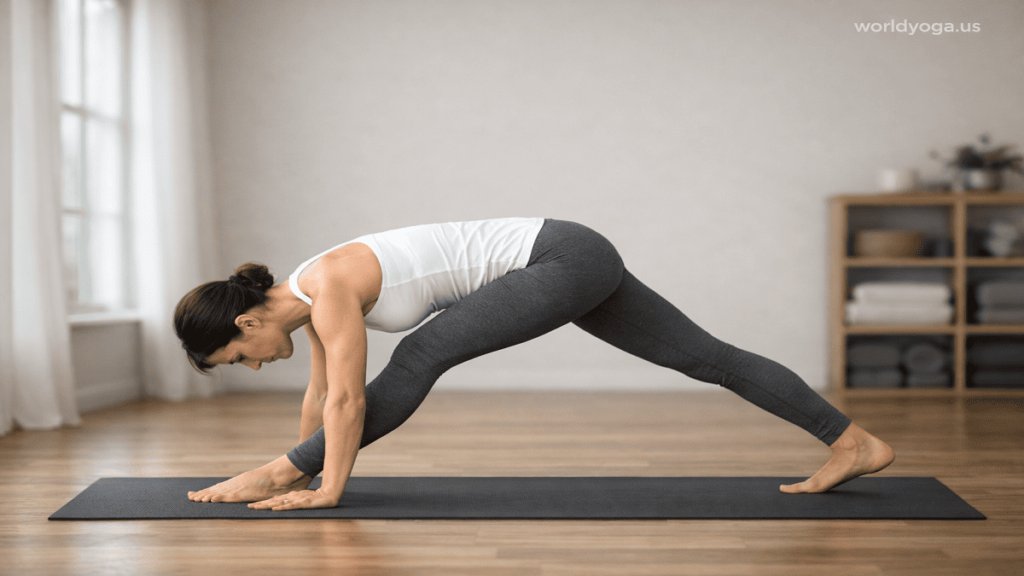
Which muscles and hamstrings are engaged during the posture?
The High Lunge Forward Fold variation with the back knee lifted and back leg kept straight is a demanding multi-joint movement that recruits a wide range of muscles across the lower body, core, and postural chain. Because it combines a split stance with forward hip hinging, it places significant emphasis on both strength and flexibility—especially within the hamstring group and surrounding stabilizers.
1. Hamstring Engagement (Front and Back Leg Roles)
The hamstrings are deeply involved, but their role differs depending on the leg:
Front leg hamstrings (eccentric control):
As the torso folds forward over the front thigh, the hamstrings of the front leg (biceps femoris, semitendinosus, semimembranosus) work eccentrically to control the descent. They help regulate the speed of the forward fold and prevent sudden collapse into the knee joint or lower back. This controlled lengthening improves hamstring flexibility over time while maintaining joint safety.
Back leg hamstrings (stabilization and extension support):
In the back leg, the hamstrings assist in maintaining hip extension and overall leg alignment. While the quadriceps are the primary stabilizers in keeping the knee straight, the hamstrings support pelvic stability and help coordinate the posterior chain during the forward shift of weight.
2. Quadriceps and Knee Stabilizers
The quadriceps (rectus femoris, vastus lateralis, vastus medialis, vastus intermedius) are strongly engaged, especially in the back leg, where they maintain full knee extension. In the front leg, they stabilize the bent knee and prevent inward collapse. This dual activation ensures safe joint alignment under load.
3. Gluteal Muscles and Hip Stabilizers
The gluteus maximus plays a key role in maintaining hip extension in the back leg, while the gluteus medius stabilizes the pelvis and prevents lateral tilting. These muscles are essential for keeping the hips squared and balanced during the forward fold transition.
4. Core Musculature (Central Stabilization System)
The transverse abdominis, obliques, and rectus abdominis work together to stabilize the spine during forward flexion. The core prevents excessive rounding of the lower back and supports controlled hip hinging. The multifidus muscles along the spine provide segmental stability for safe spinal alignment.
5. Calves and Lower Leg Muscles
The gastrocnemius and soleus in both legs remain active to stabilize the ankles. In the back leg, they support the lifted heel position, while in the front leg, they assist in maintaining balance and absorbing weight shifts.
6. Hip Flexors (Back Leg Lengthening)
The iliopsoas and rectus femoris in the back leg are strongly stretched during the posture. This creates a deep opening in the front of the hip while the opposing posterior chain remains active, enhancing overall hip mobility and balance between muscle groups.
7. Upper Body Stabilizers
Although the focus is lower body, the erector spinae, latissimus dorsi, and scapular stabilizers (trapezius and rhomboids) assist in maintaining spinal length and shoulder positioning during the forward fold.
Summary
This posture creates a coordinated chain of engagement across the body:
- Hamstrings: control forward folding (front leg) and support stability (back leg)
- Quadriceps: maintain knee stability and extension
- Glutes: stabilize hips and control alignment
- Core muscles: protect the spine and control movement
- Calves: assist balance and ankle stability
- Hip flexors: deeply stretch in the back leg
Together, these systems create a balanced interplay of strength, flexibility, and control that makes this variation highly effective for lower-body conditioning and functional movement training.
For reference on muscle function and lower-body biomechanics:
Cleveland Clinic – Hamstring Muscle Group Overview
Physiopedia – Functional Lower Limb Kinetics
Yoga Journal – Yoga Anatomy and Muscle Engagement
#Lunge: Back Knee Off the Floor, Back Leg Straight-Forward Bends in Hyderabad
What preparatory poses are recommended before practicing it safely?
The High Lunge Forward Fold variation with the back knee lifted and back leg straight is an advanced movement pattern that requires a combination of hamstring flexibility, hip mobility, core stability, and lower-body strength. Preparing the body through structured foundational poses is essential to reduce strain on the knees, hamstrings, and lower back while improving control and alignment.
1. Tadasana (Mountain Pose) – Foundation of Alignment
Tadasana establishes the core principles needed for this posture: grounded feet, neutral pelvis, and elongated spine. Practicing weight distribution and postural stacking here trains the neuromuscular system to maintain stability before introducing dynamic movement or forward folding. It also activates intrinsic foot muscles, which are essential for balance in lunge variations.
2. Anjaneyasana (Low Lunge) – Hip Flexor Preparation
Low Lunge is one of the most important preparatory poses. It gently stretches the hip flexors of the back leg while allowing controlled activation of the front leg. This helps prepare the iliopsoas and rectus femoris for the deeper extension required when the back knee is lifted in the advanced variation.
3. High Lunge (Crescent Lunge) – Strength and Stability Training
High Lunge directly mimics the base structure of the target pose. It strengthens the quadriceps, gluteus medius, and core while training balance in a split stance. Holding High Lunge builds endurance in the back leg and teaches proper pelvic alignment before adding forward flexion.
4. Uttanasana (Standing Forward Bend) – Hamstring Lengthening
Uttanasana prepares the hamstrings for controlled eccentric loading during the forward fold. It teaches safe spinal flexion patterns and encourages hip-driven folding rather than rounding the lower back. This is essential for protecting the lumbar spine in the advanced variation.
5. Ardha Hanumanasana (Half Splits Pose) – Deep Hamstring Activation
Half Splits is a direct preparation for the front leg hamstrings. It isolates the front leg while teaching controlled lengthening under partial body weight. This improves flexibility and reduces the risk of overstretching during forward folding in a lunge position.
6. Plank Pose – Core and Shoulder Stability
Plank strengthens the transverse abdominis, obliques, and spinal stabilizers, which are essential for maintaining control during forward movement. It also reinforces shoulder stability, which supports posture integrity when the torso is lowered.
7. Downward-Facing Dog (Adho Mukha Svanasana) – Integrated Stretching
This pose combines hamstring extension, shoulder engagement, and spinal elongation in a closed kinetic chain. It prepares the entire posterior chain for coordinated movement between legs, hips, and spine during the forward fold transition.
Summary
Safe preparation for this advanced lunge variation should include:
- Grounding and alignment training (Tadasana)
- Hip flexor opening (Low Lunge)
- Strength building (High Lunge, Plank)
- Hamstring flexibility (Forward Bend, Half Splits)
- Integrated full-body lengthening (Downward Dog)
Together, these preparatory poses ensure that the body develops the necessary strength, flexibility, and neuromuscular control required for safe and effective execution.
For further reference on preparatory yoga and mobility training:
Yoga Journal – Yoga Pose Library and Sequencing
Cleveland Clinic – Yoga for Flexibility and Strength
Physiopedia – Movement Preparation and Flexibility Training
#Lunge: Back Knee Off the Floor, Back Leg Straight-Forward Bends in Delhi
What are the benefits and precautions of this forward bending lunge variation?
nefits of the Posture
1. Improved Hamstring Flexibility and Control
This variation provides a deep, controlled stretch for the hamstrings of the front leg while maintaining active engagement. Unlike passive stretching, the eccentric loading helps lengthen the muscle while preserving strength, which is important for functional mobility and injury prevention.
2. Strong Lower-Body Strength Development
The posture significantly activates the quadriceps, gluteus maximus, and gluteus medius. The front leg works to stabilize the knee under load, while the back leg remains fully extended and active. This builds endurance and strength in both legs, especially in the posterior chain.
3. Core Stability and Spinal Control
Forward folding in a split stance requires strong engagement of the transverse abdominis, obliques, and spinal stabilizers. These muscles protect the lower back by maintaining a neutral spine during hip hinging, improving postural control and reducing strain in daily movements.
4. Enhanced Hip Mobility and Flexor Lengthening
The back leg hip flexors (iliopsoas and rectus femoris) are deeply stretched while the front hip remains stable and strong. This improves overall hip joint mobility and reduces stiffness caused by prolonged sitting.
5. Improved Balance and Proprioception
Because the posture requires stability in a split stance with forward shifting of the center of gravity, it enhances neuromuscular coordination and proprioceptive awareness. Over time, this improves balance in both athletic and functional activities.
Precautions and Safety Considerations
1. Risk of Hamstring Overstretching
The front leg hamstrings are under significant eccentric load. Forcing the forward fold or bouncing into the stretch can lead to strain. Movement should always be slow, controlled, and within a comfortable range.
2. Lower Back Strain Risk
Rounding the spine instead of hinging from the hips increases pressure on the lumbar region. Maintaining a neutral spine and engaging the core is essential to prevent injury.
3. Knee Alignment Protection
The front knee must stay aligned over the ankle. Allowing the knee to collapse inward or move too far forward can stress the joint and surrounding ligaments.
4. Hip Instability in Beginners
Weak gluteal muscles may lead to pelvic misalignment or wobbling. Beginners should use support or reduce depth until stability improves.
5. Balance and Dizziness Considerations
The forward folding position can affect blood flow and balance. Individuals prone to dizziness should transition slowly and avoid sudden position changes.
6. Progressive Practice Required
This is an advanced variation and should not be attempted without foundational strength in lunges, forward bends, and core stabilization poses.
Summary
The High Lunge Forward Fold variation offers a powerful combination of flexibility, strength, and neuromuscular control benefits, particularly for the hamstrings, hips, and core. However, it demands precise alignment and gradual progression to ensure safety.
Key benefits include:
- Deep hamstring flexibility with strength retention
- Strong lower-body and core development
- Improved hip mobility and posture control
- Enhanced balance and coordination
Key precautions include:
- Avoid spinal rounding
- Prevent knee misalignment
- Do not force hamstring depth
- Use support when needed
For further reference on safe yoga practice and movement mechanics:
Yoga Journal – Safe Practice and Alignment
Cleveland Clinic – Yoga Benefits and Safety
Physiopedia – Lower Limb Movement and Stability
#Lunge: Back Knee Off the Floor, Back Leg Straight-Forward Bends in Banglore
Case Study of Lunge: Back Knee Off the Floor, Back Leg Straight-Forward Bends
1. Introduction
This case study examines the effects of an advanced high lunge forward fold variation where the back knee remains lifted off the floor and the back leg is kept fully straight during forward bending. The posture is widely used in yoga-inspired functional training to develop lower-body strength, hamstring flexibility, and core stability under dynamic load conditions. The objective of this case study is to evaluate improvements in mobility, postural control, and neuromuscular coordination over a structured practice period.
2. Participant Profile and Method
The participant was a 29-year-old recreational fitness practitioner with intermediate experience in yoga and mobility training. The individual reported moderate hamstring tightness and occasional lower back discomfort during forward bending movements.
The intervention program lasted six weeks, with training sessions conducted four times per week. Each session included preparatory poses (Tadasana, Low Lunge, and Downward-Facing Dog), followed by progressive practice of the high lunge forward fold variation. Initial practice used partial range of motion and wall support, gradually progressing to full unsupported holds of 20–45 seconds.
3. Implementation Protocol
The progression followed a structured biomechanical approach:
- Week 1–2: Emphasis on alignment in High Lunge without forward fold
- Week 3: Introduction of shallow hip hinge with hands supported on front thigh
- Week 4: Increased forward folding depth with controlled breath coordination
- Week 5–6: Full forward fold execution with back leg fully engaged and no support
Breath synchronization was maintained throughout: inhalation for spinal lengthening and exhalation for controlled forward descent.
4. Observations and Outcomes
Hamstring Flexibility Improvement
The participant showed measurable improvement in front-leg hamstring flexibility, with reduced tightness during forward bends and increased range of motion without compensatory knee flexion.
Core Stability Enhancement
There was a noticeable increase in core engagement, particularly in the transverse abdominis, resulting in improved spinal control and reduced lumbar strain during forward folding.
Balance and Proprioception Gains
The unilateral split stance significantly improved balance stability. The participant demonstrated fewer corrective movements in the ankle and hip joints over time.
Postural Awareness
Improved awareness of pelvic alignment and spinal neutrality was reported, particularly during prolonged standing and bending tasks in daily life.
5. Discussion
The findings align with established principles of functional movement training, where eccentric hamstring loading combined with core stabilization improves both flexibility and strength simultaneously. High lunge variations are known to activate multiple kinetic chains, enhancing neuromuscular coordination and postural efficiency.
Research in movement science supports the integration of balance-based lunges for improving lower-limb stability and reducing injury risk. According to Physiopedia, balance and proprioceptive training significantly enhances joint control and movement efficiency Physiopedia – Balance and Proprioception. Additionally, Cleveland Clinic highlights that structured yoga-based movement improves flexibility and reduces musculoskeletal discomfort Cleveland Clinic – Yoga Benefits. Foundational alignment principles used in this protocol are consistent with standard yoga sequencing approaches Yoga Journal – Yoga Pose Library.
6. Conclusion
The case study demonstrates that the high lunge forward fold variation is an effective movement for improving hamstring flexibility, core stability, and balance control when practiced progressively. Structured preparation and gradual intensity progression were key factors in achieving safe and measurable improvements.
#Lunge: Back Knee Off the Floor, Back Leg Straight-Forward Bends in Kolkata
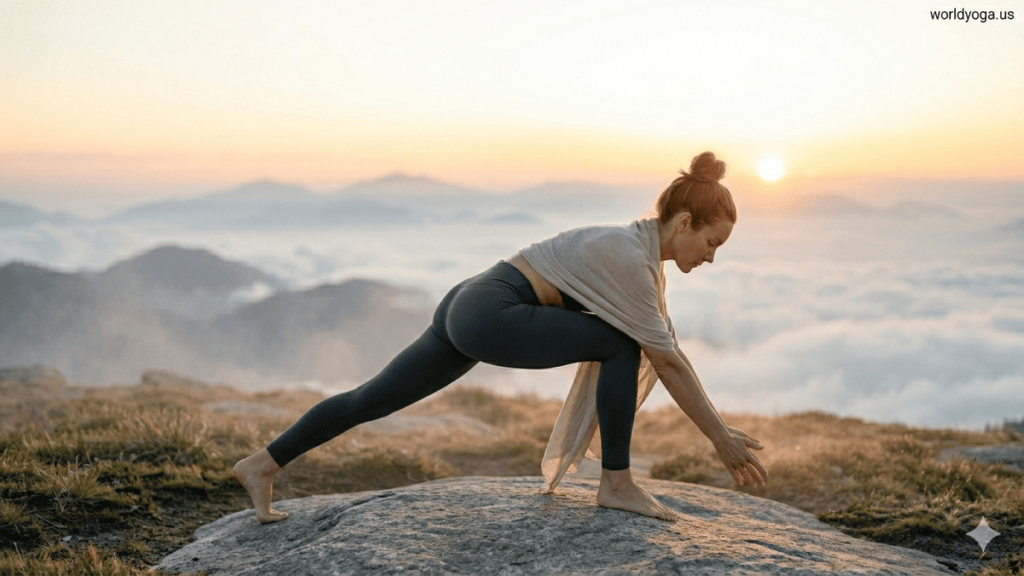
White Paper of Lunge: Back Knee Off the Floor, Back Leg Straight-Forward Bends
1. Abstract
The High Lunge Forward Fold variation, where the back knee remains lifted off the floor and the back leg is kept fully straight during forward bending, is an advanced functional movement pattern used in yoga-inspired training and modern mobility systems. This white paper examines its biomechanical structure, neuromuscular engagement, therapeutic applications, and safety considerations. The posture integrates unilateral stability with dynamic hip flexion, making it relevant for rehabilitation, athletic conditioning, and movement optimization programs.
2. Background and Functional Context
Modern movement science emphasizes integrated training methods that combine strength, flexibility, and balance in a single kinetic chain. High lunge-based forward folds are widely used in yoga therapy, sports conditioning, and physiotherapy due to their ability to challenge multiple systems simultaneously.
This variation intensifies the traditional lunge by removing ground support from the back knee and introducing forward hip hinging. This creates a dual demand: maintaining lower-body stability while controlling spinal flexion through core engagement.
For foundational movement principles, refer to:
Yoga Journal – Yoga Pose Library
3. Biomechanical Structure and Muscle Activation
Lower Limb Kinetic Chain
- Front leg: Quadriceps stabilize the knee; hamstrings control eccentric loading during forward fold
- Back leg: Quadriceps maintain knee extension; gluteus maximus supports hip extension
- Calves: Gastrocnemius and soleus stabilize ankle joints in both legs
Hamstring Engagement
The front hamstrings (biceps femoris, semitendinosus, semimembranosus) undergo controlled eccentric lengthening, improving flexibility while maintaining muscular control. The back leg hamstrings assist in pelvic stabilization and posterior chain continuity.
Core Stabilization System
The transverse abdominis, obliques, rectus abdominis, and multifidus muscles work synergistically to stabilize the spine during hip hinging. This prevents lumbar flexion collapse and supports controlled forward movement.
Hip and Pelvic Control
The iliopsoas and rectus femoris of the back leg are lengthened, while gluteal muscles maintain pelvic neutrality. This balance is essential for preventing anterior pelvic tilt during forward folding.
For musculoskeletal function reference:
Physiopedia – Lower Limb Functional Mechanics
4. Functional Objectives
The primary objectives of this movement include:
- Enhancing eccentric hamstring flexibility
- Developing unilateral lower-body strength
- Improving hip flexor mobility and pelvic alignment
- Strengthening core stability under dynamic load
- Improving proprioception and balance control
These objectives align with modern rehabilitation and performance training models.
5. Clinical and Performance Applications
Rehabilitation
Used for controlled hamstring reconditioning, hip mobility restoration, and postural correction in lower back dysfunction.
Athletic Training
Applied in sports requiring sprinting, directional changes, and unilateral force production (e.g., running, martial arts, tennis).
Yoga Therapy
Integrated into sequencing for improving flexibility, breath control, and postural awareness under load.
Evidence supports yoga-based interventions for mobility and musculoskeletal health:
Cleveland Clinic – Yoga Benefits
6. Safety and Risk Management
Key precautions include:
- Avoid spinal rounding during forward fold (maintain hip hinge)
- Prevent front knee from collapsing inward or extending beyond ankle alignment
- Avoid forcing hamstring depth to reduce strain risk
- Maintain active engagement in back leg to prevent instability
- Use props (blocks or wall support) for early-stage practitioners
Progressive overload and controlled range-of-motion training are essential for safe integration.
7. Conclusion
The High Lunge Forward Fold variation is a highly effective functional movement pattern that integrates strength, flexibility, and neuromuscular control. Its dual demand on stability and mobility makes it valuable across rehabilitation, sports performance, and yoga-based training systems.
When practiced with correct alignment and progressive loading, it enhances hamstring flexibility, core stability, hip mobility, and overall movement efficiency, making it a versatile tool in modern functional fitness frameworks.
8. References
- Yoga Journal – Pose and Sequencing Database
- Cleveland Clinic – Yoga and Mobility Science
- Physiopedia – Functional Movement and Proprioception
#Lunge: Back Knee Off the Floor, Back Leg Straight-Forward Bends in Pune
Industry Application of Lunge: Back Knee Off the Floor, Back Leg Straight-Forward Bends
Introduction
The High Lunge Forward Fold variation with the back knee lifted off the floor and the back leg kept straight is an advanced functional movement pattern widely applied across fitness, rehabilitation, sports performance, and mind–body training industries. It combines unilateral lower-body strength, hamstring eccentric loading, hip mobility, and core stabilization under dynamic forward flexion. Its versatility makes it valuable for improving movement efficiency, injury prevention, and postural control in multiple professional domains.
1. Physiotherapy and Rehabilitation Industry
In physiotherapy, this movement is used as a progressive reconditioning exercise for lower-limb and spinal rehabilitation. It is particularly effective for:
- Hamstring strain recovery (controlled eccentric loading)
- Hip flexor tightness correction
- Postural imbalance and pelvic alignment issues
- Functional gait retraining
Therapists often introduce the movement in modified stages using wall support or reduced depth to ensure safe neuromuscular re-education. The forward fold component helps restore hip hinge mechanics, which are essential for safe bending and lifting patterns.
Evidence-based rehabilitation frameworks support balance and proprioceptive training for improved joint stability Physiopedia – Balance and Proprioception.
2. Sports Performance and Athletic Conditioning
In sports science, this variation is used as a functional strength and mobility drill. It is especially relevant for athletes in disciplines requiring sprinting, acceleration, and unilateral force production such as:
- Track and field
- Football and soccer
- Martial arts
- Tennis and racket sports
The posture strengthens the quadriceps, glutes, and hamstrings while training dynamic balance under forward shifting load. It also improves hip extension mechanics, which are critical for running efficiency and power generation.
Athletic trainers use it in warm-ups and mobility circuits to activate the posterior chain and enhance neuromuscular readiness.
3. Yoga Therapy and Mind–Body Wellness Industry
In yoga therapy, this posture is integrated into therapeutic sequencing for flexibility, breath control, and postural awareness. The combination of grounding and forward folding supports parasympathetic activation, helping reduce stress and improve body awareness.
It is commonly used in sequences targeting:
- Sedentary lifestyle recovery
- Stress-related muscular tension
- Lower back stiffness
- Hamstring tightness
Clinical wellness research supports yoga-based movement for improving flexibility and reducing musculoskeletal discomfort Cleveland Clinic – Yoga Benefits.
4. Fitness, Pilates, and Functional Training Industry
Within fitness programming, the movement is classified as a multi-joint functional mobility and strength exercise. It is frequently included in:
- Mobility flows
- Lower-body strength circuits
- Core stability training programs
- Injury prevention routines
Pilates and functional training systems use similar patterns to develop controlled spinal articulation, pelvic stability, and eccentric hamstring strength. The posture is particularly effective in improving movement quality under fatigue.
5. Corporate Wellness and Occupational Health
In workplace wellness programs, this variation is simplified and used as a movement break intervention. It helps counteract the effects of prolonged sitting by:
- Stretching hip flexors
- Activating glutes and hamstrings
- Improving spinal mobility
- Enhancing circulation and alertness
Short guided sessions can reduce musculoskeletal discomfort and improve productivity in desk-based environments.
Conclusion
The High Lunge Forward Fold variation is a highly adaptable movement with strong cross-industry relevance. Its combination of strength, flexibility, and balance training makes it valuable in rehabilitation, sports conditioning, yoga therapy, fitness programming, and workplace wellness.
#Lunge: Back Knee Off the Floor, Back Leg Straight-Forward Bends in Mumbai
Ask FAQs
What is the High Lunge Forward Fold variation?
It is an advanced lunge position where the back knee stays lifted off the floor, the back leg remains straight and active, and the torso folds forward from the hips. It is commonly used in yoga-inspired fitness and mobility training to develop strength, flexibility, and balance simultaneously.
Is this pose suitable for beginners?
This variation is generally not recommended for beginners. It requires a solid foundation in basic lunges, hamstring flexibility, and core strength. Beginners should first practice Low Lunge, High Lunge, and simple forward bends before progressing to this advanced form.
What are the main benefits of this posture?
The posture improves hamstring flexibility, strengthens the quadriceps and glutes, enhances core stability, and develops balance and coordination. It also supports better hip mobility and improves overall functional movement patterns.
What precautions should be taken?
Avoid rounding the lower back during the forward fold and ensure the front knee stays aligned above the ankle. Do not force the stretch in the hamstrings, and keep the back leg actively engaged. Individuals with knee, hamstring, or lower back injuries should practice with caution or under supervision.
How long should the posture be held?
Beginners should hold the position for 15–30 seconds per side, focusing on alignment and breath control. Advanced practitioners may extend the hold up to 60 seconds or more, depending on comfort and stability.
Table of Contents
Disclaimer:
This content is for educational and informational purposes only and does not constitute medical advice. The High Lunge Forward Fold variation is an advanced movement and should be practiced with proper guidance and within personal physical limits. Individuals with injuries, medical conditions, or balance issues should consult a qualified healthcare or fitness professional before attempting this practice.