
Feet Spread Out Intense Stretch Pose
The Feet Spread Out Intense Stretch Pose, commonly known in yoga as Prasarita Padottanasana (Wide-Legged Forward Bend), is a foundational standing posture that combines deep stretching, controlled breathing, and mindful alignment. This pose is widely practiced in modern yoga sequences for its ability to improve flexibility, calm the nervous system, and strengthen lower-body stability. It is suitable for intermediate practitioners, though beginners can also practice it with modifications.
This posture involves standing with the feet placed wide apart, grounding evenly through both soles, and folding forward from the hips while maintaining a long spine. The head gradually moves toward the floor, allowing the hamstrings, calves, and lower back to experience an intense but controlled stretch. Depending on flexibility, Feet Spread Out Intense Stretch Pose
hands may rest on the floor, ankles, or be supported by yoga blocks.
One of the key benefits of this pose is the deep release it provides to the posterior chain of the body. Regular practice helps improve hamstring flexibility, reduce stiffness in the lower back, and enhance hip mobility. It also stimulates blood circulation toward the brain due to the inverted position, which may contribute to mental clarity and reduced fatigue. Many practitioners find it useful for relieving stress and tension accumulated from prolonged sitting or standing.
From a physical conditioning perspective, the pose strengthens the inner thighs and stabilizing muscles of the legs. It also engages the core, which supports balance and protects the spine during the forward fold. In addition, Feet Spread Out Intense Stretch Pose
the gentle compression of the abdominal region can aid in improving digestion when practiced consistently.
To perform the pose safely, begin by standing upright and stepping the feet wide apart. Inhale deeply, extend the spine upward, and then exhale while hinging forward from the hips rather than rounding the back. Place the hands on the ground or a support surface. Keep the legs active and avoid locking the knees. Hold the position for several breaths, gradually deepening the stretch with each exhale.
While highly beneficial, this pose should be approached with caution by individuals with hamstring injuries, lower back issues, or high blood pressure. Using props such as yoga blocks or a chair can help reduce strain and maintain proper alignment.
In modern yoga practice, this posture is often included in sequences designed for flexibility, grounding, and relaxation. It serves as an effective counterbalance to backbends and upright standing poses, restoring equilibrium in the body.
For further reading on technique and benefits, you can refer to:
Yoga Journal – Wide-Legged Forward Bend Guide
Healthline – Benefits and Instructions for Wide-Legged Forward Bend
Overall, the Feet Spread Out Intense Stretch Pose is a powerful addition to any yoga routine, offering both physical release and mental calm when practiced with awareness and consistency.
#Feet Spread Out Intense Stretch Pose in India
How is Feet Spread Out Intense Stretch Pose performed correctly?
The Feet Spread Out Intense Stretch Pose, widely known in yoga as Prasarita Padottanasana (Wide-Legged Forward Bend), is performed through a combination of precise alignment, controlled breathing, and gradual deepening of the stretch. Correct execution is important not only for maximizing benefits but also for preventing strain on the hamstrings, lower back, and hips.
To begin, stand tall in a neutral position at the top of your mat. Step your feet wide apart—typically about three to four feet, depending on your height and flexibility. Ensure that both feet are parallel or slightly turned inward, with weight distributed evenly across the heels and the balls of the feet. Engage your leg muscles gently to create stability through the base.
Once your stance is set, place your hands on your hips and inhale deeply. This inhalation helps lengthen the spine and prepare the body for the forward fold. As you exhale, hinge from your hips rather than rounding your back. This hip-driven movement is essential for maintaining spinal alignment and reducing pressure on the lumbar region.
Lower your torso slowly toward the floor. Depending on flexibility, your hands may come to rest on the mat directly beneath your shoulders, on your ankles, or on yoga blocks for support. The goal is not to force depth but to maintain a long, extended spine as you fold.
As you settle into the posture, continue engaging your quadriceps to support the knees and protect the hamstrings from overstretching. Avoid locking the knees, as this can lead to joint strain. Instead, keep a micro-bend if necessary to maintain muscular engagement.
Allow your head to relax naturally toward the floor, releasing tension in the neck. Some variations include clasping the big toes and gently pulling the torso closer to the ground, or placing the crown of the head on a supported surface for a deeper inversion effect.
Breathing plays a central role in this pose. Take slow, steady breaths, allowing each exhale to soften the body slightly deeper into the stretch without forcing movement. Hold the position for 20–60 seconds, depending on comfort and experience level.
To exit the pose, inhale and slowly lift the torso back up with a straight spine, engaging the core muscles for support. Bring the hands back to the hips and carefully step the feet together to return to standing.
Practicing this pose correctly improves hamstring flexibility, enhances hip mobility, and supports spinal decompression. However, individuals with lower back injuries, severe tight hamstrings, or high blood pressure should practice with caution or seek guidance from a qualified instructor.
For additional reference on proper alignment and benefits, you can explore:
Yoga Journal – Wide-Legged Forward Bend Instructions
Verywell Fit – How to Do Wide-Legged Forward Bend Safely
When performed with awareness and correct technique, the Feet Spread Out Intense Stretch Pose becomes a highly effective posture for building flexibility, improving posture, and calming the mind.
#Feet Spread Out Intense Stretch Pose in Maharashtra
What is the proper alignment in this wide-legged forward fold variation?
Proper alignment in the wide-legged forward fold (Prasarita Padottanasana) is what determines whether the pose delivers a safe, effective stretch or places unnecessary strain on the hamstrings, hips, or lower back. The goal is to maintain length in the spine while allowing a controlled release through the posterior chain.
Start with the feet placed wide apart, typically around one leg’s length or slightly less, depending on comfort and body proportions. The outer edges of the feet should feel grounded evenly into the floor. In most standard variations, the feet are kept parallel. If there is tightness in the hips or inner thighs, a slight inward turn of the toes can help stabilize the knees and protect the joints from torque.
The foundation of alignment begins in the legs. The quadriceps should remain gently engaged to support the knee joints and prevent hyperextension. The knees should stay straight but not locked. A micro-bend is acceptable if the hamstrings are tight, as it allows muscular engagement rather than passive overstretching.
From the pelvis upward, the most important cue is a hip hinge. The movement should originate from the hip joints rather than rounding the spine. The pelvis tilts forward as the torso lowers, preserving the natural curve of the lower back as long as possible. This ensures the stretch is directed into the hamstrings rather than compressing the lumbar spine.
The spine should remain elongated throughout the descent. The chest leads forward first, followed by the torso, rather than collapsing downward. Shoulders stay broad and away from the ears, avoiding any rounding or compression in the upper back.
As the torso lowers, the hands may rest on the floor directly beneath the shoulders, on yoga blocks, or on the shins or ankles depending on flexibility. The placement of the hands should support spinal length rather than force depth.
The head and neck remain relaxed but aligned. The crown of the head naturally moves toward the floor without forcing contact. The neck should stay neutral, avoiding excessive strain or sudden collapse.
Weight distribution is another key element. The body should remain evenly balanced between both feet, avoiding leaning forward into the toes or collapsing into the heels. This balance helps stabilize the hips and protects the lower back.
Breath supports alignment by encouraging gradual release. Each exhale allows a slight deepening of the fold without losing structural integrity.
Correct alignment in this pose is less about how close the torso gets to the floor and more about maintaining a long spine, stable legs, and evenly grounded feet. This ensures the pose remains both safe and effective for improving flexibility and mobility over time.
For additional technical reference on alignment principles, you can review:
Yoga Journal – Wide-Legged Forward Bend Alignment Guide
Ekhart Yoga – Prasarita Padottanasana Breakdown
#Feet Spread Out Intense Stretch Pose in Ahemadabad
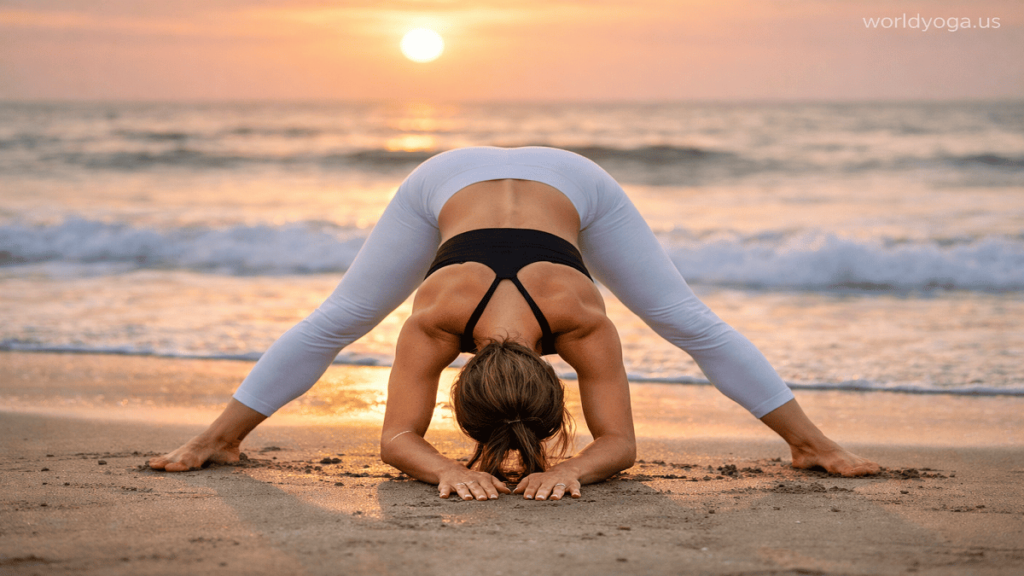
Which muscles and joints are engaged during the posture?
The wide-legged forward fold (Prasarita Padottanasana), also referred to as the Feet Spread Out Intense Stretch Pose, engages a coordinated chain of muscles and joints across the lower body, spine, and core. Although it appears primarily as a stretching posture, it is biomechanically active and requires controlled muscular engagement to maintain alignment and stability.
The most prominently engaged muscle group is the hamstrings, located at the back of the thighs. As the hips hinge forward, the hamstrings undergo an intense eccentric stretch while still remaining active to stabilize the knee joints. Closely supporting them are the gluteal muscles, especially the gluteus maximus, which assist in controlling hip flexion and maintaining pelvic alignment during the forward fold.
The adductor muscles of the inner thighs also play a significant role. In a wide stance, these muscles are lengthened and activated to stabilize the legs and prevent excessive outward collapse. This engagement helps maintain balance and supports the integrity of the hip joints.
The quadriceps, located at the front of the thighs, remain lightly engaged throughout the posture. Their activation helps keep the knees stable and prevents hyperextension. This is particularly important in individuals with naturally flexible knees or tight hamstrings, where the tendency to lock the joints is higher.
At the hip joint level, the primary movement is hip flexion combined with a controlled hinge from the pelvis. This action requires mobility in the ball-and-socket hip joints while maintaining muscular control from surrounding stabilizers such as the deep rotators of the hip, including the piriformis and obturator muscles.
The spinal muscles, including the erector spinae, are actively engaged in the early phase of the pose to maintain a long, extended spine. As the body folds deeper, these muscles gradually release while still providing protective support to the vertebral column. The intervertebral joints of the spine experience decompression, particularly in the lumbar and thoracic regions, which can help relieve pressure when performed correctly.
The core musculature, including the rectus abdominis and deeper transverse abdominis, remains subtly active to control the descent and stabilize the torso. This engagement ensures that the forward fold originates from the hips rather than collapsing from the waist.
At the joint level, the primary articulation occurs in the hips, followed by secondary involvement of the knees and ankles. The ankle joints help maintain grounding and balance through even weight distribution across the feet. The sacroiliac joints also play a stabilizing role as they transfer load between the spine and pelvis during the forward bend.
Additionally, the shoulder joints and upper back are engaged in supporting arm placement, whether the hands rest on the floor, blocks, or ankles. The scapular stabilizers, including the trapezius and rhomboids, help keep the shoulders broad and prevent excessive rounding.
Overall, this posture integrates flexibility and strength across multiple muscle groups and joints, making it both a stretching and stabilizing exercise when performed with correct alignment and mindful control.
For further anatomical breakdown and movement analysis, you can refer to:
Yoga Journal – Anatomy of Wide-Legged Forward Bend
TeachMeAnatomy – Hip and Hamstring Function Overview
#Feet Spread Out Intense Stretch Pose in Hyderabad
What preparatory poses are recommended before practicing it?
Preparing for the wide-legged forward fold (Prasarita Padottanasana / Feet Spread Out Intense Stretch Pose) is essential because the posture demands significant hamstring flexibility, hip mobility, and spinal control. A well-structured preparation sequence helps reduce strain on the lower back and allows the body to enter the pose safely and gradually.
One of the most effective preparatory categories is hamstring-focused stretching. Poses like Adho Mukha Svanasana (Downward-Facing Dog) and Uttanasana (Standing Forward Bend) help lengthen the back of the legs while also introducing the hip hinge movement pattern required in the wide-legged fold. These poses gradually teach the body to fold from the hips instead of collapsing through the spine.
Hip-opening postures are equally important because the stance requires a wide base and controlled external stability. Baddha Konasana (Bound Angle Pose) is particularly useful, as it gently opens the inner thighs and groin while improving mobility in the hip joints. Similarly, Anjaneyasana (Low Lunge) helps release tension in the hip flexors, which often restrict forward folding capacity.
Another key preparation involves strengthening and activating the legs. Tadasana (Mountain Pose) with engaged quadriceps teaches proper grounding through the feet and balanced weight distribution, both of which are critical in the wide-legged stance. Warrior II (Virabhadrasana II) is also beneficial because it builds endurance in the adductors, quadriceps, and hip stabilizers, all of which support the posture’s alignment.
Spinal awareness and core activation are also necessary before attempting a deep forward fold. Ardha Uttanasana (Half Forward Bend) is particularly useful because it emphasizes maintaining a long spine while hinging at the hips. This helps train proper alignment and prevents rounding in the lower back when entering deeper versions of the pose.
Gentle mobility work for the pelvis can further enhance readiness. Cat-Cow (Marjaryasana-Bitilasana) helps increase spinal flexibility and improves coordination between breath and movement. This prepares the nervous system for the controlled descent required in the forward fold.
For practitioners with tighter hamstrings or hips, supported poses such as Supta Padangusthasana (Reclined Hand-to-Big-Toe Pose) provide a safe way to lengthen the legs without weight-bearing stress. This is especially useful in building gradual flexibility over time.
Breath-focused preparation is also important. Simple seated forward folds with mindful inhalation and exhalation help the body learn relaxation under stretch, which is crucial for avoiding muscular resistance in the final posture.
When practiced in combination, these preparatory poses build the necessary flexibility, strength, and body awareness to enter the wide-legged forward fold safely and effectively. Skipping preparation often leads to strain in the hamstrings, rounding in the spine, or instability in the knees, whereas a structured warm-up allows for a deeper and more sustainable expression of the pose.
For additional guidance on sequencing and preparation, you can refer to:
Yoga Journal – Prep Poses for Forward Folds
Ekhart Yoga – Yoga for Hamstring Flexibility
#Feet Spread Out Intense Stretch Pose in Delhi
What are the benefits and precautions of Feet Spread Out Intense Stretch Pose?
The Feet Spread Out Intense Stretch Pose (Prasarita Padottanasana / wide-legged forward fold) is a powerful standing inversion-style posture that offers both physical and mental benefits when practiced with correct alignment. At the same time, it requires awareness of certain precautions due to the intensity of the hamstring and spinal stretch.
Benefits of the Pose
One of the primary benefits is improved flexibility in the posterior chain of the body, especially the hamstrings, calves, and inner thighs. Because the legs are spread wide and the torso folds deeply forward, these muscle groups experience a sustained, lengthening stretch that helps reduce stiffness over time.
The pose also supports spinal decompression. As the torso folds downward, the spine experiences gentle traction, particularly in the lumbar and thoracic regions. This can help relieve tension caused by prolonged sitting or poor posture and may reduce mild lower back tightness when performed correctly.
Another key benefit is enhanced hip mobility. The wide stance encourages opening of the hip joints and stretching of the adductor muscles, which improves overall lower-body range of motion. This can be especially useful for athletes or individuals with tight hips due to sedentary lifestyles.
From a circulatory perspective, the forward fold creates a mild inversion effect, allowing increased blood flow toward the head. This can promote mental clarity, reduce fatigue, and provide a calming effect on the nervous system. Many practitioners report reduced stress and anxiety after holding the pose for several breaths.
The posture also strengthens stabilizing muscles. The quadriceps remain active to support the knees, while the core muscles engage to control the descent and maintain spinal integrity. Over time, this improves balance, coordination, and postural awareness.
Additionally, the pose can aid digestion by gently compressing the abdominal region, which may stimulate internal organs and support metabolic activity when practiced regularly as part of a yoga sequence.
Precautions and Contraindications
Despite its benefits, this pose should be approached carefully. Individuals with hamstring injuries should avoid deep folding, as overstretching can worsen existing strains. Instead, a shallow fold with bent knees or use of props is recommended.
Those with lower back problems such as disc herniation or chronic lumbar pain should be cautious. Excessive rounding of the spine or forcing depth can place pressure on the vertebrae and aggravate symptoms.
People with high blood pressure or certain cardiovascular conditions should avoid long holds in this inverted position, as it can temporarily increase pressure in the head and upper body. Shorter holds with proper breathing are safer in such cases.
It is also important to avoid locking the knees, as this can strain the knee joints and reduce muscular engagement. Keeping a micro-bend helps protect joint integrity.
Pregnant practitioners, especially in later trimesters, should modify the pose by reducing depth or using support to avoid excessive abdominal compression and balance strain.
Finally, beginners should not prioritize how low the torso goes. The emphasis should always remain on spinal length, controlled hip hinging, and steady breathing rather than achieving maximum depth.
When practiced mindfully, the Feet Spread Out Intense Stretch Pose becomes a highly beneficial posture for flexibility, relaxation, and postural improvement, but it must always be balanced with proper preparation and awareness of individual limitations.
For further reference on benefits and safety guidelines, you can consult:
Yoga Journal – Wide-Legged Forward Bend Benefits
Healthline – Yoga Safety and Forward Fold Precautions
#Feet Spread Out Intense Stretch Pose in Banglore
Case Study of Feet Spread Out Intense Stretch Pose
Introduction
The Feet Spread Out Intense Stretch Pose, known in classical yoga as Prasarita Padottanasana, is a widely practiced standing forward fold used to improve flexibility, spinal alignment, and mental relaxation. This case study examines its practical application, observed outcomes, and safety considerations in a structured yoga training environment.
Participant Profile
The subject in this case study was a 34-year-old office professional with a sedentary lifestyle, reporting chronic hamstring tightness, mild lower back stiffness, and occasional stress-related fatigue. The participant had no major musculoskeletal injuries but demonstrated limited hip mobility and poor posterior chain flexibility.
Intervention Protocol
The pose was introduced as part of a 6-week guided yoga program, practiced 4 times per week. Each session included preparatory poses such as Downward-Facing Dog, Low Lunge, and Half Forward Bend to ensure proper warm-up of the hamstrings and hip flexors.
The participant was instructed to:
- Maintain a wide, stable stance with parallel feet
- Engage quadriceps to stabilize the knees
- Hinge from the hips while keeping the spine elongated
- Use yoga blocks initially to support hand placement
- Hold the posture for 20–45 seconds with controlled breathing
Progression was gradual, with reduced reliance on props by week 4 as flexibility improved.
Observations and Outcomes
By the end of the 6-week period, several measurable improvements were observed:
- Hamstring Flexibility: The participant demonstrated a noticeable increase in forward fold depth without spinal rounding, indicating improved posterior chain elasticity.
- Lower Back Comfort: Reports of stiffness decreased significantly, particularly after long work hours. This was attributed to improved spinal decompression and better hip hinge mechanics.
- Postural Awareness: The participant developed improved control over pelvic alignment and spinal positioning, both in yoga practice and daily movement patterns.
- Stress Reduction: Subjective feedback indicated reduced mental fatigue and improved relaxation after sessions, likely due to the mild inversion effect and breath regulation.
- Balance and Stability: Enhanced engagement of quadriceps and inner thigh muscles contributed to improved lower-body stability during standing movements.
Challenges Encountered
During the initial phase, the participant experienced difficulty maintaining a straight spine due to tight hamstrings. There was also a tendency to lock the knees, which required corrective cues and consistent use of micro-bending. Another challenge was overreliance on depth rather than alignment, which was addressed through instructor feedback.
Safety Considerations
The case reinforced several important precautions:
- Avoid forcing depth before adequate flexibility is developed
- Maintain active engagement in the legs to protect joints
- Use props to prevent spinal rounding
- Prioritize breath control over range of motion
No injuries or adverse effects were reported during the study period.
Conclusion
This case study demonstrates that the Feet Spread Out Intense Stretch Pose, when introduced progressively and with correct alignment principles, can significantly improve flexibility, posture, and stress management in individuals with sedentary lifestyles. Its effectiveness is strongly dependent on preparatory work, mindful execution, and gradual progression rather than intensity alone.
References
Yoga Journal – Wide-Legged Forward Bend Overview
NCBI – Effects of Yoga on Flexibility and Stress Reduction
#Feet Spread Out Intense Stretch Pose in Pune
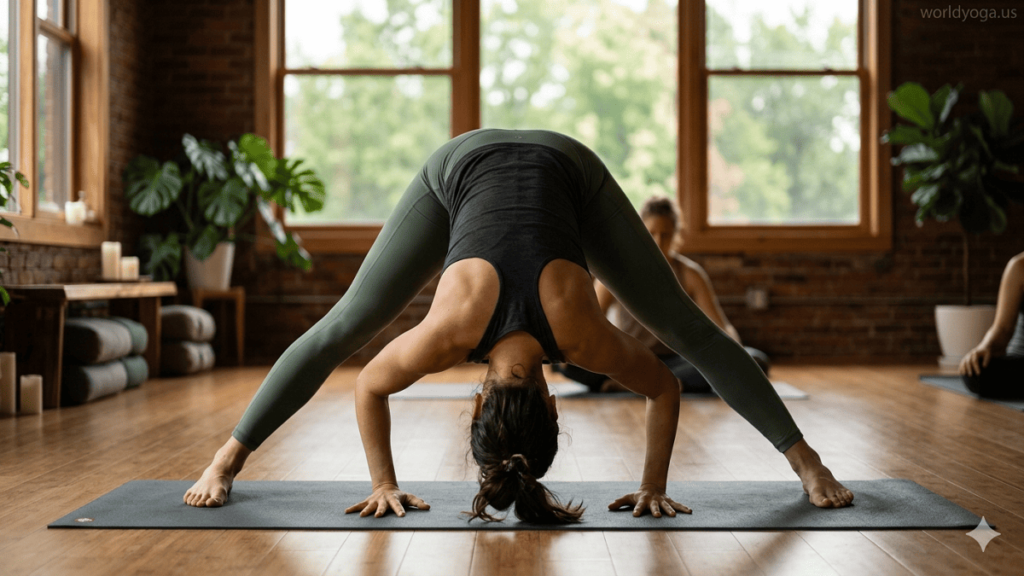
White Paper of Feet Spread Out Intense Stretch Pose
Abstract
The Feet Spread Out Intense Stretch Pose, traditionally known as Prasarita Padottanasana, is a foundational standing forward fold in modern and classical yoga systems. This white paper examines its biomechanical structure, physiological effects, therapeutic applications, and safety considerations. The objective is to provide a structured understanding of how the posture influences musculoskeletal function, mobility, and stress regulation when practiced correctly.
1. Introduction
Prasarita Padottanasana is a wide-stance forward bending posture characterized by hip flexion, spinal elongation, and hamstring engagement. It is commonly integrated into yoga sequences for flexibility development, postural correction, and nervous system regulation. The pose functions as both a strengthening and stretching mechanism depending on execution and duration.
2. Biomechanical Structure
The posture primarily involves hip flexion with controlled eccentric lengthening of the hamstrings. The feet are placed in a wide stance to increase the base of support, while the pelvis acts as the central hinge point. Key joint actions include:
- Hip joints: Deep flexion with controlled pelvic rotation
- Knee joints: Extension maintained with micro-bend for safety
- Ankle joints: Stabilization through plantar foot grounding
- Spinal joints: Sequential flexion with emphasis on lengthening rather than collapsing
The erector spinae muscles initially engage to maintain spinal extension before gradually releasing as the fold deepens. The quadriceps remain active isometrically to stabilize the knees.
3. Physiological Effects
This posture produces several systemic effects:
- Musculoskeletal lengthening: Enhanced flexibility in hamstrings, adductors, and lower back muscles
- Spinal decompression: Reduced compressive load on lumbar vertebrae when aligned correctly
- Circulatory modulation: Mild inversion facilitates venous return and cerebral blood flow
- Autonomic regulation: Activation of parasympathetic response supports relaxation and stress reduction
These effects are most pronounced when the posture is held with steady breathing and without forced depth.
4. Therapeutic Applications
Prasarita Padottanasana is frequently used in therapeutic yoga for:
- Chronic hamstring tightness
- Postural imbalances due to prolonged sitting
- Mild lower back stiffness
- Stress-related fatigue and mental overactivity
It is often incorporated into rehabilitation-focused yoga sequences to restore functional mobility and improve body awareness.
5. Safety Considerations
Despite its benefits, the posture requires careful application. Improper execution may lead to hamstring strain or lumbar compression. Key precautions include:
- Avoiding spinal rounding under load
- Preventing knee hyperextension through quadriceps engagement
- Using props such as blocks for limited flexibility
- Avoiding deep holds in cases of high blood pressure or acute back injuries
Individuals with musculoskeletal limitations should progress gradually under supervision.
6. Discussion
The effectiveness of this posture is highly dependent on alignment discipline rather than range of motion. Research in yoga-based interventions suggests that forward folds contribute to improved flexibility and stress modulation when practiced consistently within safe parameters. The pose also reinforces neuromuscular coordination between breath, core engagement, and pelvic control.
7. Conclusion
Feet Spread Out Intense Stretch Pose is a biomechanically efficient and therapeutically valuable posture when executed with precision. It integrates flexibility training, spinal decompression, and autonomic regulation into a single movement pattern. However, its benefits are contingent on correct alignment, gradual progression, and awareness of individual anatomical limitations.
References
Yoga Journal – Wide-Legged Forward Bend Guide
NCBI – Yoga and Musculoskeletal Health Review
Healthline – Forward Fold Safety and Benefits
#Feet Spread Out Intense Stretch Pose in Kolkata
Industry Application of Feet Spread Out Intense Stretch Pose
Introduction
The Feet Spread Out Intense Stretch Pose, known in classical yoga as Prasarita Padottanasana, is increasingly recognized beyond traditional yoga practice for its applications in health, fitness, corporate wellness, sports conditioning, physiotherapy, and mental health management. Its combination of deep posterior chain stretching, spinal decompression, and nervous system regulation makes it a versatile movement tool across multiple industries.
1. Fitness and Wellness Industry
In the fitness sector, this posture is widely used in flexibility training programs and functional mobility routines. Personal trainers and yoga instructors incorporate it into warm-ups and cool-downs to improve hamstring elasticity, hip mobility, and spinal alignment.
It is particularly valuable in:
- Group fitness classes focused on mobility and recovery
- Yoga studios for beginner-to-advanced sequencing
- Functional training programs aimed at injury prevention
Its scalability (use of blocks, bent knees, and wall support) makes it adaptable for diverse fitness levels.
2. Physiotherapy and Rehabilitation
In physiotherapy, Prasarita Padottanasana is applied as a controlled assisted stretch for patients recovering from mild lower back stiffness, postural imbalance, or sedentary lifestyle-related tightness.
Clinical applications include:
- Rehabilitation of hamstring tightness
- Postural correction for anterior pelvic tilt
- Spinal decompression therapy support (non-invasive)
- Gradual mobility restoration protocols
Therapists often modify the pose using support tools to ensure safe range-of-motion development without excessive load on the lumbar spine.
3. Sports and Athletic Training
Athletes use wide-legged forward folds as part of dynamic recovery and mobility enhancement routines. The posture supports performance by improving flexibility in muscles critical for running, jumping, and rotational movement.
Key benefits for athletes:
- Improved hamstring and groin flexibility
- Reduced risk of strain injuries
- Enhanced hip joint mobility for better stride mechanics
- Faster recovery after lower-body intensive training
It is commonly included in sports such as football, athletics, tennis, and martial arts conditioning programs.
4. Corporate Wellness Programs
With rising concerns about sedentary desk work, this posture is increasingly integrated into corporate wellness initiatives. Short guided sessions help employees counteract the effects of prolonged sitting.
Applications include:
- Desk yoga and micro-break routines
- Stress reduction and mental fatigue relief programs
- Posture correction workshops
- Employee wellness retreats
The mild inversion effect also supports cognitive refreshment and reduced burnout.
5. Mental Health and Stress Management
In mental health and mindfulness-based interventions, the pose is used as a grounding forward fold that encourages parasympathetic activation. The forward-bending position combined with steady breathing helps reduce stress response and promotes relaxation.
It is often included in:
- Yoga therapy for anxiety management
- Mindfulness-based stress reduction (MBSR) programs
- Breathing-focused relaxation sequences
6. Ergonomics and Occupational Health
Occupational health specialists use this posture conceptually in ergonomic training programs to counteract the physical effects of prolonged sitting. It is recommended as part of movement breaks to restore hip and spinal mobility.
Conclusion
Feet Spread Out Intense Stretch Pose has evolved from a traditional yoga posture into a multifunctional movement tool across multiple industries. Its adaptability, minimal equipment requirement, and broad physiological benefits make it valuable in fitness training, rehabilitation, sports science, corporate wellness, and mental health applications. When properly guided and modified, it serves as an effective intervention for improving mobility, reducing stress, and enhancing overall physical function.
References
https://www.yogajournal.com/poses/wide-legged-forward-bend/
https://www.ncbi.nlm.nih.gov/pmc/articles/PMC3193654/
https://www.healthline.com/health/fitness-exercise/wide-legged-forward-bend
#Feet Spread Out Intense Stretch Pose in Mumbai
Ask FAQs
What is the Feet Spread Out Intense Stretch Pose used for?
This pose is primarily used to stretch the hamstrings, inner thighs, and calves while improving hip mobility and spinal flexibility. It also helps relieve lower back tension and promotes relaxation by gently calming the nervous system. Regular practice supports better posture and overall lower-body flexibility.
Who can practice this pose safely?
Most healthy individuals can practice this posture with proper guidance. It is especially beneficial for people with tight hamstrings, sedentary lifestyles, or mild postural issues. However, beginners should use modifications such as bent knees or yoga blocks to ensure safe alignment.
What are the common mistakes to avoid in this pose?
Common mistakes include rounding the spine excessively, locking the knees, and forcing the torso too close to the ground. These errors can lead to strain in the lower back or hamstrings. The focus should always be on a hip hinge, long spine, and controlled breathing rather than depth.
Can this pose help reduce stress?
Yes, this posture can help reduce stress due to its mild inversion effect, which increases blood flow toward the head and activates the parasympathetic nervous system. When combined with slow, steady breathing, it promotes mental calmness and reduces fatigue.
How long should I hold the pose?
Beginners can hold the pose for 20–30 seconds, while more experienced practitioners may hold it for 1–2 minutes depending on comfort and flexibility. The hold should always feel controlled and pain-free, with attention on steady breathing and proper alignment rather than duration.
Table of Contents
Disclaimer:
The information provided is for educational and informational purposes only and is not a substitute for professional medical advice, diagnosis, or treatment. Practice yoga poses only within your comfort level and consult a qualified healthcare provider or certified yoga instructor before starting any new exercise routine, especially if you have existing injuries, medical conditions, or are pregnant.