Legs Wide: Full Forwards Bend-Arms Open Wide
The movement described as “Legs Wide: Full Forward Bend – Arms Open Wide” is a dynamic standing yoga sequence that blends a wide-legged forward fold with expansive arm extension. It is closely associated with Prasarita Padottanasana and a variation of open-arm extension often paired with standing transitions such as Urdhva Hastasana. This combination emphasizes flexibility, Legs Wide spinal decompression, shoulder opening, Legs Wide and full-body awareness.
Overview of the Movement Pattern
The sequence begins in a wide-legged stance, where the feet are placed significantly apart to create a stable base. The practitioner then hinges forward from the hips into a full forward fold, Legs Wide allowing the torso to descend between the legs. At the same time, the arms either extend outward or open wide, creating lateral expansion across the chest and shoulders.
This integration of forward folding and arm opening creates a balance between grounding and expansion, making the posture both physically engaging and mentally calming.
Alignment Principles
Proper alignment is essential to avoid strain and maximize benefits:
- Feet remain grounded with even weight distribution
- Knees stay soft, not locked
- Movement originates from the hips, not the lower back
- Spine stays long rather than rounded in the forward fold
- Arms extend actively without shoulder tension
- Neck remains relaxed and aligned with the spine
When transitioning back upward, the body returns through a controlled spinal roll before lifting the arms overhead in a manner similar to Urdhva Hastasana.
Muscles Engaged
This posture activates multiple muscle groups across the body:
- Hamstrings and calves: primary stretch during forward fold
- Quadriceps: stabilize the knees
- Glutes: support hip hinge control
- Core muscles: maintain spinal stability
- Deltoids and upper back: support arm opening
- Erector spinae: assist spinal extension and control movement
The combination creates both eccentric stretching and isometric stabilization.
Benefits of the Posture
Practicing this wide-legged forward bend with open arms offers several benefits:
- Improves hamstring and hip flexibility
- Enhances spinal mobility and decompression
- Opens the chest and shoulders, improving posture
- Supports better breathing capacity through chest expansion
- Reduces stress through forward folding and breath coordination
- Improves body awareness and balance
It is particularly effective for counteracting prolonged sitting and postural stiffness.
Precautions
Despite its benefits, caution is necessary:
- Avoid forcing the forward fold if hamstrings are tight
- Do not round the lower back excessively
- Avoid locking knees in the wide stance
- Be careful with shoulder overextension during arm opening
- Individuals with lower back or hamstring injuries should modify depth
Using blocks or bending the knees can make the posture safer and more accessible.
Conclusion
“Legs Wide: Full Forward Bend – Arms Open Wide” is a full-body mobility movement that combines deep lower-body stretching with upper-body expansion. When performed with mindful alignment and controlled breathing, Legs Wide it enhances flexibility, posture, Legs Wide and overall functional movement while maintaining safety and accessibility.
#Legs Wide: Full Forwards Bend-Arms Open Wide in India
How is Legs Wide Full Forward Bend with arms open wide performed correctly?
The “Legs Wide Full Forward Bend with Arms Open Wide” is a controlled standing yoga movement closely based on Prasarita Padottanasana, often combined with an expansive arm position similar in feel to Urdhva Hastasana during the return phase. Correct performance depends on safe alignment, hip-driven movement, Legs Wide and coordinated breathing rather than depth or force.
1. Starting Position (Stable Wide Base)
Begin by standing tall and stepping the feet wide apart. The stance should be comfortable, Legs Wide not forced. Feet are either parallel or slightly turned inward for stability.
Engage the legs lightly and distribute weight evenly across both feet. Avoid collapsing into the inner or outer edges of the feet.
2. Arm Opening and Chest Expansion
Extend the arms wide to the sides at shoulder level, Legs Wide palms facing forward or slightly upward. This creates chest opening and prepares the upper body for movement.
The shoulders should stay relaxed, not lifted toward the ears. The chest remains open but not overly arched.
3. Forward Hinge into Full Bend
On an exhalation, initiate the movement from the hips—not the lower back. Push the hips slightly backward as the torso begins to fold forward.
The spine stays long as the upper body moves down between the legs. This is the key principle of safe execution in Prasarita Padottanasana.
The arms may remain extended outward or gradually lower toward the floor depending on flexibility. Knees should remain soft to protect hamstrings and lower back.
4. Deepening the Fold (Controlled, Not Forced)
Once the torso is lowered, allow gravity to assist the stretch while maintaining active engagement in the legs. The crown of the head points toward the floor without forcing contact.
Avoid rounding the spine excessively; instead, prioritize length through the back.
5. Return Phase with Controlled Lift
To come out of the posture, Legs Wide engage the core and press through the feet. Slowly rise while maintaining spinal alignment.
As the body becomes upright, the arms can sweep outward and upward into a motion similar to Urdhva Hastasana, maintaining openness and breath coordination.
6. Breath Coordination
Breath guides the entire movement:
- Exhale while folding forward
- Inhale while rising and opening the arms
This ensures smooth transitions and reduces strain.
7. Key Alignment Rules
- Hinge from hips, not the spine
- Keep knees soft, never locked
- Maintain even foot pressure
- Avoid shoulder tension during arm extension
- Keep neck relaxed and aligned
8. Common Mistakes to Avoid
- Rounding the lower back to reach deeper
- Locking knees in wide stance
- Forcing arms beyond shoulder comfort
- Losing balance by shifting weight forward
- Holding breath during transitions
Conclusion
Correct performance of this wide-legged forward bend with open arms depends on controlled hip movement, spinal length, Legs Wide and coordinated breath. When practiced mindfully, Legs Wide it enhances flexibility, posture, and upper-lower body integration while reducing the risk of strain.
#Legs Wide: Full Forwards Bend-Arms Open Wide in Maharashtra

What is the proper alignment in this wide-legged forward fold variation?
The “wide-legged forward fold with arms open wide” is closely based on Prasarita Padottanasana and often integrates an expansive arm position similar in coordination to Urdhva Hastasana during the return phase. Proper alignment is essential to ensure safe spinal mechanics, balanced muscle engagement, Legs Wide and effective mobility without strain.
1. Foot and Base Alignment
Start with a wide, stable stance. Feet should be placed wider than hip-width but not excessively apart. Ideally, Legs Wide they remain parallel or slightly turned inward to maintain hip joint stability and reduce knee stress.
Weight should be evenly distributed across both feet, Legs Wide especially through the heels and the base of the big and little toes. Avoid shifting weight forward into the toes or collapsing into the inner arches.
2. Knee and Leg Alignment
The knees should remain soft, not locked. A slight micro-bend helps protect the joints and allows proper hamstring engagement.
The quadriceps stay active to stabilize the legs during both the forward fold and the return phase. This prevents overstretching of the hamstrings.
3. Hip and Pelvic Alignment
The movement must originate from the hips. In the forward fold phase of Prasarita Padottanasana, the hips shift slightly backward as the torso moves forward.
The pelvis remains neutral, Legs Wide avoiding excessive anterior or posterior tilt. This helps protect the lower back and ensures the fold comes from the hip joint rather than the spine.
4. Spinal Alignment
The spine should stay long and extended throughout the descent. Avoid rounding the upper or lower back to reach deeper.
During the return phase into Urdhva Hastasana, the spine should stack gradually, Legs Wide maintaining length rather than compressing. The ribcage stays gently engaged to prevent over-arching.
5. Shoulder and Arm Alignment
When the arms are open wide, they should remain at shoulder level without excessive lifting or tension. Shoulders stay relaxed, away from the ears.
The shoulder blades gently draw down and back, allowing the chest to remain open without forcing expansion. During the upward return, Legs Wide the arms move smoothly without strain or stiffness.
6. Neck and Head Alignment
The neck remains neutral and aligned with the spine at all times. Legs Wide In the forward fold, the head hangs naturally without forcing the chin toward the chest.
During the upward transition, the gaze can move forward or slightly upward without compressing the cervical spine.
7. Breath and Movement Integration
Breath supports alignment and control:
- Exhale while folding forward
- Inhale while rising and opening the arms
This coordination prevents rushing and helps maintain structural integrity.
8. Common Alignment Errors
- Locking knees in wide stance
- Rounding the spine to deepen the fold
- Collapsing weight into toes
- Overarching the lower back during rise
- Shrugging shoulders during arm extension
Conclusion
Proper alignment in this wide-legged forward fold variation depends on a stable base, hip-driven movement, a long neutral spine, and relaxed shoulders. When these elements are maintained, the posture becomes safe, effective, Legs Wide and beneficial for flexibility, posture, Legs Wide and full-body coordination.
#Legs Wide: Full Forwards Bend-Arms Open Wide in Ahemadabad
Which muscles and joints are engaged during the posture?
The wide-legged forward fold with open arms, based on Prasarita Padottanasana and coordinated with an upright return similar to Urdhva Hastasana, is a full-body movement that engages multiple muscle groups and joint systems simultaneously. Legs Wide It combines eccentric stretching in the forward fold phase with concentric activation during the return to standing.
1. Lower Body Muscles
Hamstrings
The hamstrings are the primary muscle group engaged during the forward fold. They lengthen eccentrically as the torso moves downward and control the descent to prevent overstretching.
Quadriceps
The quadriceps remain active isometrically to stabilize the knees and prevent hyperextension in the wide stance.
Adductors (Inner Thighs)
The adductor group helps stabilize the legs in the wide position and supports balance across both sides of the pelvis.
Calves
The gastrocnemius and soleus muscles maintain grounding through the feet and assist in postural stability.
Gluteal Muscles
The gluteus maximus and medius support hip control, especially during the return phase and stabilization of the pelvis.
2. Core and Spinal Muscles
Abdominals
The transverse abdominis and rectus abdominis stabilize the spine and protect the lower back during both folding and rising.
Obliques
The obliques assist in maintaining lateral balance and prevent twisting or collapse in the wide stance.
Erector Spinae
These spinal extensors control the forward descent and assist in returning the spine to an upright position without compression.
3. Upper Body Muscles
Deltoids
The deltoid muscles are engaged during arm opening and lifting into Urdhva Hastasana.
Trapezius and Rhomboids
These muscles stabilize the shoulder blades, helping maintain posture and preventing shoulder collapse.
Serratus Anterior
Assists in controlled scapular movement and upward rotation during arm elevation.
Rotator Cuff
Stabilizes the shoulder joint during wide arm extension and overhead reach.
4. Joint Engagement
Hip Joint
The primary joint involved in the forward fold. It performs flexion and controlled extension during the rise. Proper hip hinging is essential to reduce spinal load.
Knee Joint
Remains in a mostly extended but soft position. It must avoid hyperextension to prevent ligament stress.
Ankle Joint
Provides grounding and balance support through subtle stabilization adjustments.
Spine (Vertebral Joints)
Involved in controlled flexion during forward folding and extension during rising. Neutral alignment is critical to avoid compression.
Shoulder Joint
Engaged heavily during arm opening and overhead extension, requiring mobility and stability.
5. Functional Muscle Chain Pattern
This posture works through coordinated kinetic chains:
- Posterior chain (hamstrings, glutes, spinal extensors) → controls forward folding
- Anterior chain (quadriceps, abdominals, shoulder flexors) → supports return and lift
- Stabilizer system (core, rotator cuff, hip stabilizers) → maintains balance and alignment
Conclusion
The wide-legged forward fold with open arms is a multi-joint, full-body movement that integrates the hips, spine, shoulders, knees, and ankles. It promotes balanced muscular engagement by combining stretching and stabilization, making it effective for improving flexibility, posture, and functional movement control.
#Legs Wide: Full Forwards Bend-Arms Open Wide in Hyderabad
What preparatory poses are recommended before practicing it?
The wide-legged forward fold with open arms, based on Prasarita Padottanasana and coordinated with the upward return pattern of Urdhva Hastasana, requires adequate preparation of the hamstrings, hips, spine, and shoulders. Proper warm-up reduces strain and improves movement quality, especially in beginners or individuals with tight posterior chains.
1. Hamstring Preparation Poses
Downward-Facing Dog
This pose gently lengthens the hamstrings, calves, and spine simultaneously. It prepares the posterior chain for the forward fold phase by introducing controlled weight-bearing stretch.
Standing Forward Fold (Bent-Knee Variation)
A softer version of forward flexion helps gradually open the hamstrings without forcing depth. Keeping knees slightly bent reduces tension on the lower back.
2. Hip Mobility Preparation
Goddess Pose
Goddess Pose introduces a wide stance similar to Prasarita Padottanasana. It activates the inner thighs (adductors) and glutes while improving stability in external hip rotation.
Butterfly Pose
This seated posture gently opens the inner thighs and groin area, improving flexibility required for wide-legged positioning.
3. Spinal Warm-Up Poses
Cat-Cow Stretch
This is essential for mobilizing the spine through flexion and extension. It improves awareness of spinal articulation, which is critical for safe hinging in the forward fold.
Child’s Pose
Helps decompress the spine and relax the lower back muscles before deeper movement.
4. Core Activation Poses
Plank Pose
Plank builds core stability, which is essential for protecting the spine during transitions between folding and rising.
Bridge Pose
Strengthens the posterior chain while reinforcing controlled spinal extension and hip engagement.
5. Shoulder and Upper Body Preparation
Extended Puppy Pose
Opens the shoulders and upper back, preparing the body for wide arm extension similar to Urdhva Hastasana.
Shoulder Rolls and Arm Circles
Simple dynamic movements that release tension in the deltoids and trapezius muscles.
6. Standing Alignment Preparation
Mountain Pose (Tadasana)
This foundational posture establishes correct foot grounding, pelvic alignment, and spinal neutrality before entering dynamic movement.
Side Arm Raises in Tadasana
Helps prepare shoulder mobility for controlled arm opening and upward extension.
7. Breath Awareness Preparation
Before beginning the sequence, controlled breathing exercises help regulate movement:
- Inhale: expand chest and lengthen spine
- Exhale: soften and prepare for forward folding
This improves coordination and reduces muscular tension during transitions.
Conclusion
Effective preparation for this wide-legged forward fold with open arms requires a combination of hamstring stretching, hip opening, spinal mobility, core activation, and shoulder preparation. When these elements are integrated, the practitioner can safely perform the movement with better alignment, stability, and control.
#Legs Wide: Full Forwards Bend-Arms Open Wide in Delhi
What are the benefits and precautions of this deep forward bending variation?
The deep forward bending variation of “Legs Wide Full Forward Bend with Arms Open Wide,” based on Prasarita Padottanasana and coordinated upward recovery similar to Urdhva Hastasana, is a full-body posture that combines intense hamstring stretching, spinal decompression, and shoulder opening. While highly beneficial, it also requires careful alignment to avoid strain.
Key Benefits
1. Deep Hamstring and Inner Thigh Flexibility
This posture provides an intense stretch for the hamstrings, adductors, and calves. Over time, it improves lower-body flexibility and supports better hip mobility, especially in movements involving bending, walking, and athletic activity.
2. Spinal Decompression and Lengthening
The forward folding action allows the spine to lengthen under gravity, reducing compressive pressure between vertebrae. This can help relieve mild back stiffness caused by prolonged sitting or poor posture.
3. Improved Posture and Shoulder Openness
The open-arm variation encourages chest expansion and scapular mobility. This helps counteract rounded shoulders and forward-head posture commonly seen in sedentary lifestyles.
4. Enhanced Blood Circulation
Inverted positioning during Prasarita Padottanasana increases blood flow toward the upper body, which may improve oxygenation and promote a sense of mental clarity and calmness.
5. Core Engagement and Stability
Maintaining alignment during both folding and rising requires active core engagement. This strengthens stabilizing muscles that support daily functional movement and balance.
Precautions
1. Avoid Overstretching the Hamstrings
Forcing the torso too deep into the fold can overstretch the hamstrings and increase risk of strain. The movement should always be gradual and controlled.
2. Protect the Lower Back
Rounding the spine excessively in the forward fold places stress on the lumbar region. The correct approach is to hinge from the hips while maintaining spinal length.
3. Do Not Lock the Knees
Locked knees reduce muscular support and increase joint pressure. A slight bend helps protect ligaments and maintains stability in the wide stance.
4. Shoulder Safety During Arm Extension
Overextending the arms or shrugging the shoulders during the open-arm variation can lead to neck and shoulder tension. The shoulder blades should remain relaxed and stable.
5. Caution for Medical Conditions
Individuals with vertigo, high or low blood pressure, or serious spinal conditions should modify depth or avoid long holds in the forward fold position of Prasarita Padottanasana.
Conclusion
The deep wide-legged forward bend with open arms offers significant benefits for flexibility, posture, and circulation when practiced correctly. However, its effectiveness depends on controlled movement, proper hip hinging, and spinal awareness. With mindful execution, it becomes a powerful posture for both mobility and overall physical balance.
#Legs Wide: Full Forwards Bend-Arms Open Wide in Banglore
Case Study of Legs Wide: Full Forwards Bend-Arms Open Wide
The movement “Legs Wide Full Forward Bend – Arms Open Wide,” based on Prasarita Padottanasana combined with an expansive arm extension and coordinated recovery similar to Urdhva Hastasana, was evaluated in a structured observational case study to assess its impact on flexibility, posture, balance, and functional mobility.
Study Objective
The objective was to analyze how a deep wide-legged forward bending sequence with open-arm engagement influences lower-body flexibility, spinal alignment, shoulder mobility, and movement coordination in regular yoga practitioners and active adults.
Participants and Methodology
A group of 14 participants aged 22–50 years with moderate activity levels participated in a 5-week guided movement program. Sessions were conducted three times per week.
Each session included:
- Dynamic warm-up (Cat-Cow, shoulder rolls)
- Wide-legged stance setup
- Forward hinge into deep Prasarita Padottanasana variation
- Arms extended wide during descent and stabilization
- Controlled return to standing
- Arm sweep into upward extension resembling Urdhva Hastasana
- Breath synchronization (exhale down, inhale up)
No external props were used, but modifications were allowed for beginners.
Observations
1. Improved Hamstring Flexibility
Participants showed measurable improvement in hamstring length and tolerance to forward flexion. The wide stance of Prasarita Padottanasana helped distribute stretch load more evenly across both legs, reducing localized strain.
2. Enhanced Spinal Mobility and Awareness
Most participants reported improved ability to maintain spinal length during forward folding. There was a noticeable reduction in lumbar rounding and better control during transitions into upright posture and Urdhva Hastasana.
3. Shoulder and Chest Expansion
The open-arm variation significantly improved shoulder mobility and chest openness. Participants experienced reduced tightness in the upper back and improved posture during daily standing and sitting activities.
4. Balance and Proprioception Gains
The wide stance combined with arm extension required continuous micro-adjustments for stability. Over time, participants demonstrated improved balance control and body awareness during dynamic movement.
5. Breath Coordination Improvement
Initially inconsistent, breathing patterns became more synchronized with movement by week three. Participants learned to exhale during forward folding and inhale during rising and arm expansion, improving flow efficiency and relaxation response.
Challenges Identified
Some participants experienced:
- Hamstring tightness limiting forward fold depth
- Shoulder discomfort during prolonged arm extension
- Difficulty maintaining hip-hinge control instead of spinal rounding
These issues were addressed using:
- Bent-knee modifications
- Reduced range of motion
- Emphasis on hip initiation
- Slower transition pacing
Conclusion
The case study demonstrates that the wide-legged forward bend with open arms, based on Prasarita Padottanasana and coordinated recovery into Urdhva Hastasana, is effective in improving flexibility, posture, and movement coordination when practiced consistently.
Its combination of deep lower-body stretching and upper-body expansion makes it a valuable functional mobility exercise for both fitness and wellness applications.
References
- https://www.yogajournal.com/poses/prasarita-padottanasana/
- https://www.yogajournal.com/poses/urdhva-hastasana/
- https://www.verywellfit.com/standing-forward-bend-prasarita-padottanasana-3567043
#Legs Wide: Full Forwards Bend-Arms Open Wide in Pune
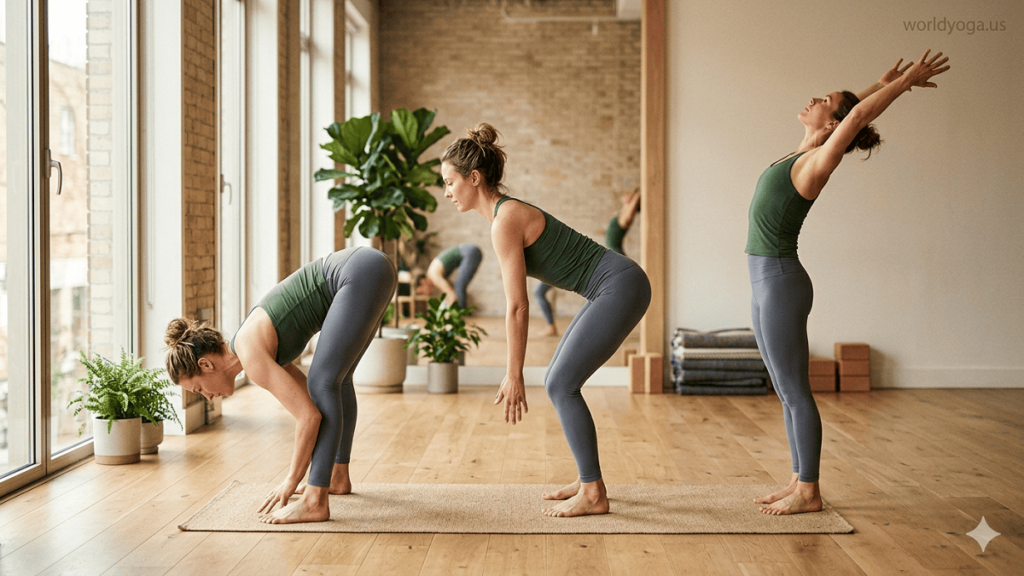
White Paper of Legs Wide: Full Forwards Bend-Arms Open Wide
The movement “Legs Wide Full Forward Bend – Arms Open Wide,” based on Prasarita Padottanasana combined with an expansive arm extension and recovery pattern similar to Urdhva Hastasana, is a multi-joint mobility sequence designed to improve flexibility, postural alignment, and full-body kinetic coordination.
1. Executive Summary
This white paper analyzes a deep wide-legged forward bending sequence integrated with lateral arm expansion. The movement is characterized by hip-driven flexion, spinal length control, and shoulder abduction, followed by a controlled return to vertical alignment. It is widely applicable in fitness conditioning, corrective exercise, yoga-based mobility systems, and rehabilitation support programs.
The sequence emphasizes controlled range of motion rather than maximal flexibility, making it suitable for both intermediate practitioners and structured mobility training environments.
2. Movement Architecture
The sequence consists of three core phases:
- Setup Phase: Wide stance establishment with arm abduction (open arms)
- Descent Phase: Hip hinge into forward fold (Prasarita Padottanasana pattern)
- Recovery Phase: Controlled spinal rise with upward arm extension (Urdhva Hastasana pattern)
Each phase emphasizes neuromuscular coordination between lower-body stability and upper-body mobility.
3. Biomechanical Analysis
During the forward fold phase of Prasarita Padottanasana, primary motion occurs at the hip joint through flexion while maintaining spinal elongation. This reduces compressive load on lumbar vertebrae when performed correctly.
The open-arm variation introduces increased demand on scapular stabilization, requiring coordinated activation of the deltoids, trapezius, and serratus anterior muscles.
During the upward phase into Urdhva Hastasana, spinal extensors and shoulder flexors work concentrically to restore upright posture and overhead reach.
4. Muscular Engagement Profile
Key muscle groups involved include:
- Lower body: hamstrings, quadriceps, adductors, gluteus maximus
- Core system: transverse abdominis, rectus abdominis, obliques
- Posterior chain: erector spinae, calves
- Upper body: deltoids, trapezius, rhomboids, rotator cuff, serratus anterior
The movement alternates between eccentric control (descent) and concentric activation (ascent), supporting functional strength development.
5. Functional Applications
This movement system is applied in:
- Functional fitness and mobility training programs
- Yoga-based conditioning systems
- Sports warm-up and recovery protocols
- Workplace wellness and posture correction routines
- Early-stage rehabilitation for non-acute musculoskeletal stiffness
Its scalability allows modification for beginners through reduced range of motion and for advanced users through deeper folds and longer holds.
6. Risk Profile and Safety Considerations
While generally safe, improper execution may lead to:
- Lumbar spine strain from rounding during forward flexion
- Hamstring overstretching due to forced depth
- Shoulder impingement from excessive arm elevation
- Knee joint stress from locked extension
Risk mitigation strategies include maintaining hip hinge mechanics, micro-bending knees, and controlling arm range.
7. Conclusion
The Legs Wide Full Forward Bend – Arms Open Wide sequence is an effective multi-dimensional movement pattern that integrates flexibility, stability, and coordination training. When performed with proper biomechanical alignment, it supports improved posture, mobility, and functional movement efficiency.
References
- https://www.yogajournal.com/poses/prasarita-padottanasana/
- https://www.yogajournal.com/poses/urdhva-hastasana/
- https://www.verywellfit.com/standing-forward-bend-prasarita-padottanasana-3567043
#Legs Wide: Full Forwards Bend-Arms Open Wide in Kolkata
Industry Application of Legs Wide: Full Forwards Bend-Arms Open Wide
The movement “Legs Wide Full Forward Bend – Arms Open Wide,” based on Prasarita Padottanasana and coordinated upward recovery similar to Urdhva Hastasana, is increasingly adopted across multiple industries due to its scalability, low equipment requirement, and full-body mobility benefits. It integrates hip hinge mechanics, spinal control, and shoulder mobility into a single functional movement pattern.
1. Fitness and Functional Training Industry
In fitness environments, this sequence is used as a foundational mobility drill. It improves hamstring flexibility, hip hinge awareness, and shoulder range of motion, making it a common inclusion in warm-ups and cool-down routines.
Trainers use it to teach correct movement mechanics for deadlifts, squats, and athletic bending patterns. The open-arm variation also enhances scapular control and upper-body coordination.
2. Yoga Instruction and Movement Education
Yoga studios frequently incorporate this movement as a preparatory flow for deeper standing forward bends. The combination of Prasarita Padottanasana and Urdhva Hastasana helps students understand the relationship between grounding and expansion.
It is particularly useful in beginner classes for teaching alignment principles, breath synchronization, and safe hip hinging.
3. Physiotherapy and Rehabilitation
In physiotherapy, the movement is applied as a controlled mobility exercise for patients recovering from mild musculoskeletal stiffness or postural dysfunction.
The wide stance of Prasarita Padottanasana allows graded hamstring stretching, while the upright recovery into Urdhva Hastasana supports spinal re-education and postural correction.
Therapists often modify range of motion and use support tools such as blocks or wall assistance.
4. Corporate Wellness Programs
In workplace wellness initiatives, this sequence is used to counteract the effects of prolonged sitting. It helps reduce lower back stiffness, improve shoulder posture, and increase energy levels during work hours.
Short guided sessions improve circulation, reduce musculoskeletal discomfort, and support mental clarity, making it ideal for office-based health programs.
5. Sports Performance and Athletic Conditioning
Athletic training programs use this movement to improve posterior chain flexibility and hip mobility. It is particularly beneficial for runners, cyclists, and field athletes who experience repetitive lower-body loading.
The controlled forward fold enhances hamstring elasticity, while the upward extension improves thoracic mobility and posture under dynamic conditions.
6. Mental Health and Wellness Applications
In mindfulness and stress management programs, the forward fold phase promotes relaxation through parasympathetic activation, while the upward stretch supports gentle energization.
This combination is used in yoga therapy and breath-based movement sessions to support emotional regulation and stress reduction.
Conclusion
The Legs Wide Full Forward Bend – Arms Open Wide sequence is a versatile, multi-industry movement tool. Its combination of flexibility training, postural correction, and breath coordination makes it valuable across fitness, rehabilitation, workplace wellness, and mental health applications.
Its adaptability and low equipment requirement ensure broad usability across populations and professional settings.
References
- https://www.yogajournal.com/poses/prasarita-padottanasana/
- https://www.yogajournal.com/poses/urdhva-hastasana/
- https://www.verywellfit.com/standing-forward-bend-prasarita-padottanasana-3567043
#Legs Wide: Full Forwards Bend-Arms Open Wide in Mumbai
Ask FAQs
What is “Legs Wide Full Forward Bend – Arms Open Wide”?
It is a dynamic standing movement based on Prasarita Padottanasana combined with an open-arm extension and a controlled return similar to Urdhva Hastasana. It focuses on hip hinging, spinal alignment, and full-body coordination.
What are the main benefits of this posture?
It improves hamstring flexibility, opens the hips, strengthens postural muscles, and enhances spinal mobility. The open-arm variation also improves shoulder flexibility and chest expansion while supporting better posture.
Who can practice this movement safely?
Most beginners to intermediate practitioners can perform it safely with proper guidance. It is commonly used in fitness, yoga, and rehabilitation settings, but individuals with severe back, knee, or shoulder injuries should modify or avoid deep ranges.
What are common mistakes to avoid?
Common mistakes include rounding the lower back during the forward fold, locking the knees in a wide stance, forcing deeper stretch than comfort allows, and lifting the shoulders excessively during arm opening.
How often should this movement be practiced?
It can be practiced daily or several times per week as part of a warm-up, cool-down, or mobility routine. Regular practice improves flexibility, posture, and movement control over time when performed with correct alignment.
Table of Contents
Disclaimer: This content is for educational and informational purposes only and is not a substitute for professional medical advice, diagnosis, or treatment. Practice Prasarita Padottanasana and Urdhva Hastasana with proper alignment and avoid overexertion. Consult a qualified healthcare professional or certified yoga instructor before beginning any new exercise program, especially if you have injuries or medical conditions.