Arm Balance: One Leg Over The Shoulder
The arm balance commonly referred to as “One Leg Over the Shoulder” is most closely associated with advanced yoga postures such as Eka Pada Koundinyasana I and II, as well as variations of Astavakrasana (Eight-Angle Pose). These postures combine strength, flexibility, balance, and deep body awareness, making them a hallmark of advanced yoga practice.
At its core, this arm balance involves threading one leg over the upper arm or shoulder while the body is lifted off the ground using arm strength and core engagement. The movement requires not only physical conditioning but also precise alignment and mindful control of breath.
Key Benefits
Practicing this arm balance offers multiple physical and mental benefits:
- Upper body strength: Engages shoulders, triceps, wrists, and chest muscles.
- Core stability: Deep activation of abdominal muscles improves balance and control.
- Hip flexibility: The “leg over shoulder” position opens the hips and hamstrings.
- Mental focus: Demands concentration, patience, and confidence under pressure.
- Body coordination: Enhances neuromuscular awareness and movement efficiency.
How It Is Practiced (Overview)
Although variations exist, the general structure includes:
- Starting from a low lunge or seated twist.
- Placing both hands firmly on the mat, shoulder-width apart.
- Threading one leg high onto the upper arm or shoulder.
- Engaging the core and leaning forward to shift weight into the hands.
- Lifting the back leg and extending it outward while balancing on the arms.
The pose is typically entered after preparing the body with hip openers (like pigeon pose) and core-strengthening sequences (like plank variations and chaturanga practice).
Safety and Preparation
This is an advanced arm balance and should not be rushed. Common risks include wrist strain, shoulder compression, or loss of balance leading to falls. Proper warm-up and progressive training are essential.
Recommended preparatory poses include:
- Low lunge (Anjaneyasana)
- Pigeon Pose (Eka Pada Rajakapotasana)
- Crow Pose (Bakasana)
- Side plank variations
Beginners should practice under supervision or use props such as blocks to build confidence safely.
Progression Tips
- Focus on core engagement before lift-off rather than arm strength alone.
- Shift weight forward gradually instead of jumping into balance.
- Keep gaze steady (drishti) to improve stability.
- Practice regularly but in short, controlled sessions.
Conclusion
“One Leg Over the Shoulder” arm balances represent the intersection of strength and flexibility in yoga. While physically demanding, they also cultivate mental resilience and mindfulness, making them a rewarding milestone for dedicated practitioners.
Further Reading
- https://www.yogajournal.com/poses/eka-pada-koundinyasana-i/
- https://www.yogajournal.com/poses/eka-pada-koundinyasana-ii/
- https://www.yogabasics.com/asana/astavakrasana/
- https://www.verywellfit.com/yoga-arm-balances-3566875
#Arm Balance: One Leg Over The Shoulder in India
What is the One Leg Over The Shoulder arm balance?
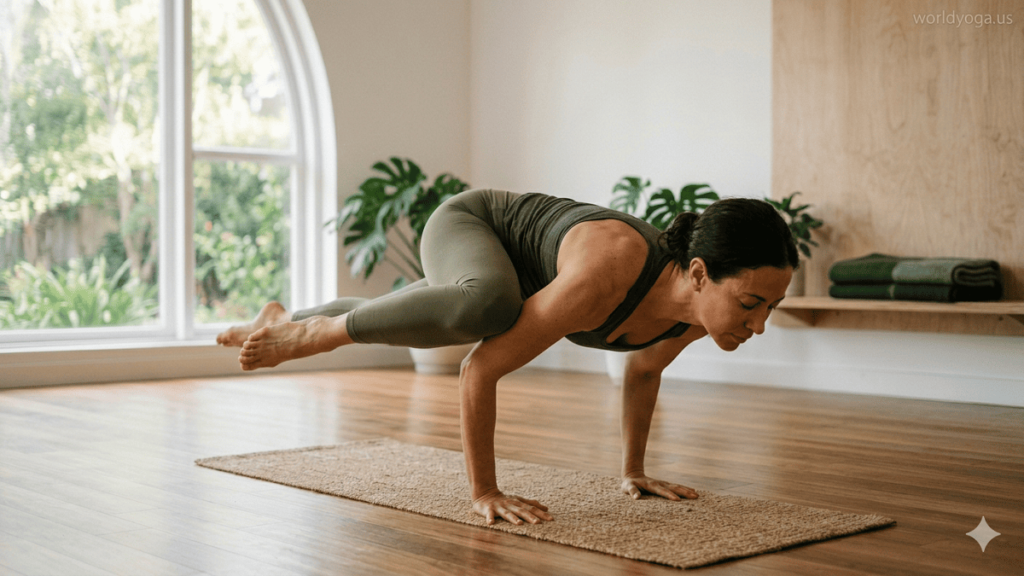
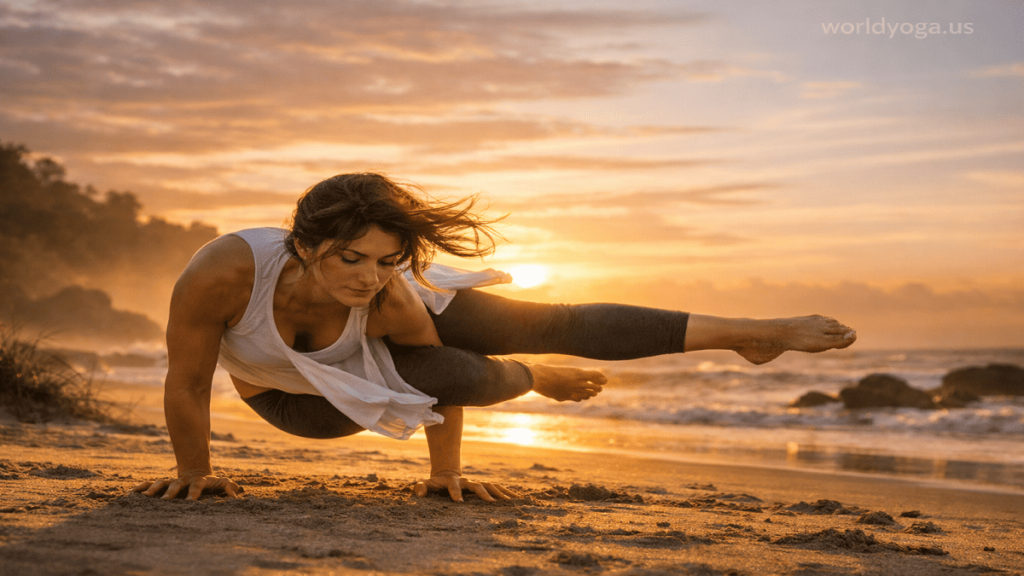
The “One Leg Over the Shoulder” arm balance is a category of advanced yoga poses where one leg is actively hooked or placed high over the upper arm or shoulder while the practitioner balances the body off the ground using arm strength, core engagement, and controlled alignment. It is not a single fixed pose but rather a family of arm balances, most commonly seen in variations of Eka Pada Koundinyasana I & II and related transitions from hip-opening and twisting sequences.
In these poses, the practitioner typically begins from a grounded position such as a low lunge or a twisting posture. One leg is then threaded over the corresponding upper arm or shoulder, creating a strong “shelf” with the arm. The hands press firmly into the floor, and the body weight shifts forward until the feet lift off the ground. The lifted position is sustained by a combination of core strength, shoulder stability, and precise balance control.
What makes this arm balance distinctive is the integration of deep hip flexibility and upper-body power. The leg-over-shoulder action requires open hips and hamstrings, while the lifting phase demands strong wrists, triceps, and scapular stability. The core plays a central role in preventing collapse and maintaining a lifted, horizontal body line.
This posture is considered advanced because it requires coordination of multiple physical systems at once. Unlike simpler arm balances such as Crow Pose, the One Leg Over The Shoulder variation introduces asymmetry and twisting, which increases both the challenge and the need for body awareness.
Key characteristics:
- One leg is placed high on the upper arm/shoulder
- Body weight is supported entirely by the hands
- Core and arm strength are essential for lift
- Requires hip openness and spinal rotation
Benefits include:
- Improved upper-body and wrist strength
- Increased core stability and control
- Enhanced hip mobility and flexibility
- Better focus, balance, and mental discipline
Preparation is essential, often including poses like Pigeon Pose, Lizard Pose, and basic arm balances such as Crow Pose. Without proper preparation, the posture can strain the wrists or shoulders.
In summary, the One Leg Over The Shoulder arm balance is a dynamic, strength-and-flexibility-based yoga posture that challenges both physical control and mental focus, making it a milestone for experienced yoga practitioners.
For more details, you can explore:
- https://www.yogajournal.com/poses/eka-pada-koundinyasana-i/
- https://www.yogabasics.com/asana/astavakrasana/
#Arm Balance: One Leg Over The Shoulder in Maharashtra
How is this pose performed step by step?
1. Warm-Up and Preparation
Before attempting this pose, properly prepare the body. Focus on opening the hips, hamstrings, and shoulders. Effective preparatory poses include:
- Low Lunge (Anjaneyasana)
- Lizard Pose (Utthan Pristhasana)
- Pigeon Pose (Eka Pada Rajakapotasana)
- Plank and Chaturanga variations for arm strength
Warming up is essential to prevent strain in the wrists, shoulders, and hip flexors.
2. Start in a Low Lunge or Squat
Begin in a low lunge position with one foot forward and the back leg extended. Place both hands firmly on the ground inside the front foot. Spread the fingers wide to create a stable base.
3. Create the Shoulder Shelf
Shift your torso slightly forward and bend your elbows to form a stable “shelf” with your upper arms. This is where the back of the thigh will eventually rest. Engage the core strongly to prepare for lifting.
4. Hook the Leg Over the Shoulder
Carefully lift the front leg and guide it up and over the corresponding upper arm or shoulder. The knee may rest high on the triceps while the thigh presses firmly into the arm. This step requires hip flexibility and patience.
5. Shift Weight Forward
Gradually lean the body forward, transferring weight from the feet into the hands. Keep the elbows bent but strong, hugging inward to support stability. This is the most critical transition point.
6. Lift the Back Leg
Once enough weight is supported by the arms, engage the core deeply and lift the back leg off the ground. Extend it straight behind you. The body begins to float parallel to the floor.
7. Balance and Stabilize
Hold the posture by:
- Keeping gaze slightly forward (drishti)
- Engaging abdominal muscles
- Pressing firmly through the fingertips
- Maintaining even shoulder engagement
Breathing should remain steady and controlled.
8. Exit Safely
To exit, slowly lower the back leg first, then release the hooked leg from the shoulder. Return to a seated or low lunge position with control rather than dropping abruptly.
Key Tips
- Do not rush the leg hook; forcing it can strain the hips.
- The lift comes from core engagement, not just arm strength.
- Practice short holds before attempting full extension.
Conclusion
The One Leg Over The Shoulder arm balance is a progressive skill that develops over time. Mastery depends on consistent preparation, patience, and awareness of alignment rather than force.
Further Reading
- https://www.yogajournal.com/poses/eka-pada-koundinyasana-i/
- https://www.yogajournal.com/poses/eka-pada-koundinyasana-ii/
- https://www.yogabasics.com/asana/arm-balances/
#Arm Balance: One Leg Over The Shoulder in Kolkata
What strength and flexibility are required?
1. Upper-Body Strength Requirements
This pose heavily relies on the ability to support and lift body weight using the arms.
Key areas:
- Wrists: Must tolerate significant weight-bearing in extended positions.
- Shoulders (deltoids & rotator cuff): Provide stability and prevent collapse.
- Triceps: Assist in supporting and slightly bending the elbows to act as a “shelf.”
- Chest muscles (pectorals): Help maintain forward lean and balance.
Without sufficient upper-body strength, the practitioner may struggle to lift off the ground or may place excessive strain on the wrists.
2. Core Strength Requirements
Core engagement is the most critical element for successfully lifting into the balance.
Key areas:
- Rectus abdominis (front core): Controls lifting and holding the body horizontal.
- Obliques (side core): Stabilize twisting and asymmetrical positioning.
- Lower back muscles: Support spinal alignment during forward lean.
A strong core allows the practitioner to shift weight smoothly from feet to hands and maintain a floating position without collapsing.
3. Hip and Lower-Body Flexibility
The “one leg over the shoulder” action requires significant mobility in the hips and hamstrings.
Key areas:
- Hip flexors: Must open enough to lift the leg high onto the shoulder.
- Hamstrings: Need length to allow extension of the lifted leg.
- Outer hips (glute medius and rotators): Allow safe external rotation.
- Groin/adductors: Must be flexible for deep leg threading.
Tight hips are one of the main limitations for beginners attempting this pose.
4. Spinal and Twisting Mobility
Most variations involve a twist, so spinal mobility is important:
- Thoracic spine (upper back) must rotate freely
- Obliques assist in controlled twisting without strain
- Prevents compression in the lower back during entry and hold
5. Balance, Coordination, and Control
Beyond physical strength and flexibility, the pose requires:
- Precise weight shifting skills
- Strong proprioception (body awareness)
- Calm breath control under effort
- Ability to maintain focus during instability
Summary
To perform the One Leg Over The Shoulder arm balance safely and effectively, a practitioner needs:
- Strong wrists, shoulders, triceps, and core
- Open hips, hamstrings, and groins
- Mobile spine with controlled twisting ability
- Good balance and body awareness
It is considered an advanced posture because it demands simultaneous strength and flexibility in multiple regions of the body, rather than relying on a single physical quality.
Further Reading
- https://www.yogajournal.com/practice/yoga-sequences/arm-balances/
- https://www.yogabasics.com/asana/arm-balances/
- https://www.verywellfit.com/yoga-arm-balances-3566875
#Arm Balance: One Leg Over The Shoulder in Hyderabad
What are the benefits of this arm balance?
1. Builds Upper-Body Strength
This arm balance places significant load on the upper body, helping to develop:
- Wrists: Improved load-bearing capacity and resilience
- Shoulders: Stronger stabilizing muscles and joint control
- Triceps and chest: Enhanced pushing strength and endurance
Over time, this strengthens the body for other arm balances and improves functional upper-body power.
2. Strengthens the Core Deeply
One of the most important benefits is intense core activation:
- Engages rectus abdominis for lifting and holding
- Strengthens obliques for twisting stability
- Activates deep core stabilizers for balance control
A strong core developed through this pose supports better posture and spinal health in daily life.
3. Improves Hip Flexibility and Mobility
The “leg over shoulder” position opens deep areas of the hips:
- Stretches hip flexors and groin muscles
- Improves external rotation of the hip joint
- Increases overall lower-body mobility
This is especially beneficial for people who sit for long hours.
4. Enhances Balance and Body Awareness
This posture requires precise control of body weight distribution:
- Improves proprioception (body awareness in space)
- Develops fine motor control and coordination
- Trains the nervous system to manage instability calmly
It helps practitioners become more mindful of subtle alignment shifts.
5. Builds Mental Focus and Confidence
Because the pose is challenging, it strengthens mental qualities such as:
- Concentration (single-point focus)
- Patience and persistence
- Confidence in physical ability
Successfully holding the pose often gives a strong sense of accomplishment.
6. Improves Shoulder Stability and Injury Resistance
Controlled practice strengthens the stabilizing muscles around the shoulder joint, which can:
- Improve joint alignment
- Support healthier movement patterns
- Reduce risk of injury in other weight-bearing activities
7. Supports Advanced Yoga Progression
This arm balance acts as a gateway pose for:
- More advanced arm balances
- Inversions like handstand variations
- Complex transitions in vinyasa flow
It builds the foundational strength required for higher-level yoga practice.
Conclusion
The One Leg Over The Shoulder arm balance is a powerful full-body posture that develops strength, flexibility, balance, and mental focus simultaneously. Beyond physical conditioning, it also builds confidence and body awareness, making it a significant milestone in advanced yoga practice.
Further Reading
- https://www.yogajournal.com/poses/eka-pada-koundinyasana-i/
- https://www.yogabasics.com/asana/arm-balances/
- https://www.verywellfit.com/yoga-arm-balances-3566875
#Arm Balance: One Leg Over The Shoulder in Ahmedabad
What common mistakes should be avoided?
1. Forcing the Leg Over the Shoulder
One of the most common mistakes is trying to aggressively place the leg over the shoulder before the hips are ready.
Why it’s a problem:
- Can strain the hip flexors and groin
- Leads to unstable positioning in the arms
- Reduces control during lift-off
Better approach:
Work on hip-opening poses like Pigeon Pose and Lizard Pose first, allowing gradual mobility development.
2. Relying Only on Arm Strength
Many beginners assume the pose is an arm-only balance.
Why it’s a problem:
- Causes wrist and shoulder fatigue
- Leads to early collapse
- Prevents proper lift from the core
Better approach:
Engage the core deeply to initiate lift. Think of the arms as support, not the sole source of strength.
3. Poor Weight Shift (Not Leaning Forward Enough)
A frequent mistake is staying too upright and not shifting enough weight forward.
Why it’s a problem:
- Feet cannot lift off the ground
- Excess pressure remains in the legs
- Balance never fully engages
Better approach:
Gradually lean forward until the center of gravity moves over the wrists before attempting to lift.
4. Collapsing the Elbows or Shoulders
Letting elbows splay outward or shoulders sink is another common error.
Why it’s a problem:
- Reduces stability in the pose
- Increases risk of wrist and shoulder injury
- Makes balancing nearly impossible
Better approach:
Keep elbows hugging inward (as if squeezing a block) and shoulders actively engaged away from the floor.
5. Neglecting Core Engagement
Without active core engagement, the body cannot stay lifted.
Why it’s a problem:
- Legs drop quickly after lift-off
- Lower back compensates, leading to strain
- Balance becomes unstable
Better approach:
Engage the abdomen before lifting—imagine pulling the belly toward the spine.
6. Rushing the Transition
Attempting to jump directly into the pose without controlled movement is risky.
Why it’s a problem:
- Loss of balance and potential falls
- Poor alignment development
- Inconsistent progress
Better approach:
Move slowly through each stage: setup → leg hook → forward shift → lift.
7. Ignoring Wrist Preparation
Skipping wrist warm-ups is a major oversight.
Why it’s a problem:
- Wrist compression and strain
- Reduced stability in hand support
Better approach:
Include wrist circles, gentle weight shifts, and plank holds before practice.
Conclusion
Avoiding these common mistakes ensures safer, more efficient progress in the One Leg Over The Shoulder arm balance. The key is not force, but progressive preparation, proper alignment, and coordinated strength between core, hips, and arms.
Further Reading
- https://www.yogajournal.com/practice/arm-balance-tips/
- https://www.yogabasics.com/asana/arm-balances/
- https://www.verywellfit.com/yoga-arm-balances-3566875
#Arm Balance: One Leg Over The Shoulder in Banglore
Case Study of Arm Balance: One Leg Over The Shoulder
1. Background of the Practitioner
The subject is a 28-year-old recreational yoga practitioner with:
- 2 years of consistent yoga practice (4–5 sessions per week)
- Moderate upper-body strength (from vinyasa flows)
- Limited hip flexibility due to prolonged sitting lifestyle
- No prior experience with advanced arm balances
Primary goal: Achieve controlled lift-off into One Leg Over The Shoulder balance within 3–4 months.
2. Initial Assessment
At the beginning:
- Strength level: Adequate plank and chaturanga control, but weak wrist endurance
- Flexibility: Tight hip flexors and limited external hip rotation
- Core stability: Moderate, but insufficient for sustained floating holds
- Balance awareness: Basic (comfortable in crow pose only briefly)
Key limitation identified: hip opening + core integration gap
3. Training Approach
The training program was structured into three phases:
Phase 1: Foundation Building (Weeks 1–4)
Focus:
- Hip openers (Pigeon Pose, Lizard Pose)
- Core strengthening (planks, boat pose)
- Wrist conditioning drills
Outcome:
- Improved hip range of motion
- Increased wrist tolerance in weight-bearing positions
Phase 2: Strength + Entry Mechanics (Weeks 5–8)
Focus:
- Crow Pose progression
- Side plank variations
- Slow leg threading drills onto upper arm
Outcome:
- Better weight shift awareness
- First controlled attempts at leg-over-shoulder placement
- Improved core engagement during forward lean
Phase 3: Integration and Lift-Off (Weeks 9–12)
Focus:
- Full pose transitions from low lunge
- Micro-lifts (brief foot lifts off ground)
- Breath control under load
Outcome:
- Successful short holds (1–3 seconds initially)
- Improved balance stability and reduced fear response
- Increased confidence in shifting full body weight into hands
4. Key Challenges Observed
1. Over-reliance on arm strength
Early attempts failed due to lack of core activation.
2. Hip restriction
Difficulty placing the leg high enough without collapsing forward.
3. Fear of falling forward
Psychological barrier slowed forward weight shift.
5. Corrective Adjustments
- Increased emphasis on slow forward lean drills
- Added longer passive hip-opening sessions
- Introduced wall-assisted balance practice
- Focused on exhale-led lift initiation
6. Final Outcome
After 12 weeks:
- Achieved controlled entry into Eka Pada Koundinyasana variation
- Maintained balance for up to 5–7 seconds
- Demonstrated improved coordination between hips, core, and shoulders
- Significant increase in confidence in arm balances
7. Key Insights
- Flexibility is as important as strength in this posture
- Core activation is the true “lifting engine,” not the arms
- Progress is non-linear—small improvements in alignment produce big stability gains
- Mental confidence directly affects physical execution
8. Conclusion
The One Leg Over The Shoulder arm balance is best understood as a progressive integration skill, not a single strength-based pose. This case study shows that structured preparation, gradual exposure, and mindful alignment practice can transform an initially inaccessible posture into a controlled and stable balance over time.
Further Reading
- https://www.yogajournal.com/poses/eka-pada-koundinyasana-i/
- https://www.yogabasics.com/asana/arm-balances/
- https://www.verywellfit.com/yoga-arm-balances-3566875
#Arm Balance: One Leg Over The Shoulder in Chennai
White Paper of Arm Balance: One Leg Over The Shoulder
1. Executive Summary
The “One Leg Over The Shoulder” arm balance refers to advanced yoga arm-balancing postures most commonly represented by Eka Pada Koundinyasana I and II. These asanas integrate upper-body strength, core stabilization, hip mobility, and neuromuscular coordination into a single weight-bearing movement pattern. This white paper examines the biomechanics, training principles, benefits, risks, and progression methodology of the pose from a movement science and applied yoga perspective.
2. Introduction
Arm balances in yoga are classified as closed-chain kinetic movements where the hands act as the primary base of support. In One Leg Over The Shoulder variations, asymmetrical leg positioning introduces rotational torque and load imbalance, increasing the complexity of stabilization demands.
These postures are widely used in modern yoga systems as benchmarks of advanced physical control and intermuscular coordination.
3. Biomechanical Analysis
The pose can be broken down into three primary mechanical systems:
3.1 Upper-Body Load Bearing
- Primary joints: wrists, elbows, shoulders
- Muscles: deltoids, triceps, serratus anterior, pectorals
- Function: absorb compressive force and maintain scapular stability
3.2 Core Stabilization System
τ=rFsin(θ)\tau = rF\sin(\theta)τ=rFsin(θ)
This torque relationship reflects the rotational stress created when one leg extends asymmetrically from the body, increasing leverage forces that the core must counteract.
Core muscles (rectus abdominis, obliques, transverse abdominis) function to:
- Prevent spinal collapse
- Control forward weight shift
- Maintain horizontal body alignment
3.3 Hip and Lower Limb Mobility
- Hip flexion and external rotation are critical for leg placement
- Hamstrings and adductors must allow deep extension and threading
- Asymmetry creates differential loading across pelvis
4. Physiological and Performance Benefits
- Increased upper-body isometric strength
- Enhanced core endurance and anti-rotational stability
- Improved hip joint mobility and functional range of motion
- Development of proprioception and balance control systems
- Neural adaptation for complex motor sequencing
These adaptations translate into improved performance in calisthenics, gymnastics, and functional movement systems.
5. Training Methodology
A structured progression model is recommended:
Phase 1: Foundational Conditioning
- Wrist loading adaptation
- Plank and chaturanga mechanics
- Basic hip-opening sequences
Phase 2: Motor Pattern Development
- Crow pose and side plank variations
- Controlled weight shifting drills
- Assisted leg threading mechanics
Phase 3: Integration Phase
- Partial lift-offs
- Static holds (1–5 seconds)
- Breath-coordinated stabilization
6. Risk Analysis
Primary risks include:
- Wrist compression injuries
- Shoulder impingement from poor scapular control
- Hip strain due to forced external rotation
- Falls due to improper weight shift timing
Risk mitigation requires gradual loading, mobility preparation, and technical supervision.
7. Discussion
The pose is not purely strength-based; rather, it is a systems integration task involving strength, flexibility, timing, and neural coordination. Performance improvements are typically nonlinear, with small mobility gains producing large stability improvements.
8. Conclusion
The One Leg Over The Shoulder arm balance represents a high-complexity movement pattern in modern yoga practice. It serves as both a diagnostic and developmental tool for assessing integrated physical capacity across strength, mobility, and motor control domains.
References
- https://www.yogajournal.com/poses/eka-pada-koundinyasana-i/
- https://www.yogabasics.com/asana/arm-balances/
- https://www.verywellfit.com/yoga-arm-balances-3566875
- https://www.ncbi.nlm.nih.gov/ (general research on balance and proprioception in movement science)
#Arm Balance: One Leg Over The Shoulder in Delhi
Industry Application of Arm Balance: One Leg Over The Shoulder
1. Overview
The “One Leg Over The Shoulder” arm balance, commonly associated with Eka Pada Koundinyasana I and II, is an advanced yoga-based movement that combines upper-body strength, core stabilization, hip mobility, and neuromuscular coordination. While it originates in yoga practice, its underlying movement principles have significant applications across multiple industries including fitness, sports performance, rehabilitation, biomechanics research, and occupational training systems.
2. Fitness and Strength & Conditioning Industry
In modern fitness programming, this arm balance is used as an advanced bodyweight strength benchmark.
Applications:
- Calisthenics progression training for elite body control
- Functional strength development programs
- Core stability conditioning for advanced athletes
- Mobility-strength integration routines in yoga-fitness hybrid systems
The pose is often used to assess:
- Relative upper-body strength (strength-to-body-weight ratio)
- Core control under instability
- Movement efficiency under asymmetrical load
3. Sports Performance and Athletic Training
Athletes in gymnastics, martial arts, climbing, and acrobatics benefit from the same movement mechanics.
Key performance transfers:
- Gymnastics: Improves hand-balancing control and aerial awareness
- Martial arts: Enhances core rotation control and balance recovery
- Rock climbing: Strengthens scapular stability and grip endurance
- Dance & acrobatics: Develops fluid transitions and body coordination
The asymmetrical nature of the pose trains athletes to manage rotational torque under load, a critical skill in dynamic sports environments.
4. Rehabilitation and Physiotherapy Applications
In controlled clinical environments, modified versions of this movement pattern are used for rehabilitation purposes.
Applications:
- Shoulder stabilization after injury (progressive loading drills)
- Wrist strengthening protocols for repetitive strain recovery
- Core re-education after spinal or postural dysfunction
- Hip mobility restoration in sedentary populations
Physiotherapists often break the pose into components (plank, weight shift, hip opening) rather than teaching the full balance directly.
5. Biomechanics and Movement Science Research
This arm balance provides a useful model for studying:
- Closed-chain kinetic loading
- Asymmetrical force distribution
- Center of mass displacement control
τ=rFsin(θ)\tau = rF\sin(\theta)τ=rFsin(θ)
This torque relationship is relevant in analyzing how the extended leg creates rotational force that must be counterbalanced by core and shoulder engagement.
Researchers use such poses to study:
- Human balance strategies under unstable support
- Neural coordination between upper and lower body segments
- Injury prevention mechanisms in weight-bearing flexion tasks
6. Ergonomics and Occupational Health
Although not directly performed in workplaces, the training principles translate into ergonomic improvements.
Applications:
- Prevention of repetitive wrist and shoulder strain in desk workers
- Core strengthening protocols for manual labor safety
- Postural correction programs for sedentary workers
- Functional movement training in corporate wellness programs
7. Fitness Technology and Digital Coaching
With the rise of AI-driven fitness platforms and wearable devices, this pose is used as a:
- Movement quality benchmark in advanced yoga apps
- Stability metric in motion tracking systems
- Skill progression milestone in gamified fitness programs
8. Conclusion
The One Leg Over The Shoulder arm balance extends far beyond yoga practice. Its biomechanics and training principles are widely applicable across sports science, rehabilitation, fitness programming, and human movement research. It serves as a high-level model for understanding integrated strength, mobility, and neuromuscular control in complex physical systems.
References
- https://www.yogajournal.com/poses/eka-pada-koundinyasana-i/
- https://www.yogabasics.com/asana/arm-balances/
- https://www.ncbi.nlm.nih.gov/ (movement science & biomechanics research database)
- https://www.verywellfit.com/yoga-arm-balances-3566875
#Arm Balance: One Leg Over The Shoulder in Mumbai
Ask FAQs
What is the “One Leg Over The Shoulder” arm balance?
It is an advanced yoga arm balance commonly seen in variations of Eka Pada Koundinyasana I and II, where one leg is placed over the upper arm or shoulder while the body is lifted off the ground using arm strength, core control, and balance. It combines flexibility, strength, and coordination in a single movement.
Is this arm balance suitable for beginners?
No, it is generally not suitable for beginners. It requires a solid foundation in:
Basic arm strength (plank, chaturanga)
Core stability (boat pose, plank variations)
Hip flexibility (pigeon pose, lizard pose)
Beginners should first master simpler arm balances like Crow Pose before attempting this posture.
What muscles are most used in this pose?
This arm balance engages multiple muscle groups, including:
Shoulders and triceps for support and lifting
Core muscles (abdominals and obliques) for stability
Hip flexors and hamstrings for leg positioning
Forearms and wrists for weight-bearing control
It is a full-body integration posture rather than an isolated strength movement.
What are the main risks or injuries to be careful about?
Common risks include:
Wrist strain due to heavy load bearing
Shoulder compression if alignment is incorrect
Hip or groin strain from forced flexibility
Loss of balance leading to falls
Proper warm-up, gradual progression, and correct alignment are essential to reduce injury risk.
How long does it take to learn this pose?
The time varies depending on fitness level, but typically:
3–6 months for practitioners with strong yoga foundations
6–12+ months for beginners building strength and flexibility
Progress depends more on consistent practice and preparation than speed. Developing hip mobility, core strength, and arm balance control step-by-step is key.
Table of Contents
Disclaimer: This information is for general educational purposes only and is not a substitute for professional yoga instruction, medical advice, or physiotherapy guidance. Arm balances like “One Leg Over The Shoulder” are advanced movements and may carry a risk of injury if performed incorrectly. Practice under the supervision of a qualified instructor and stop immediately if you experience pain or discomfort.