Supine: Both Legs Straight “Scissors”
The Supine Both Legs Straight “Scissors” exercise is a foundational core-strengthening movement widely used in fitness, rehabilitation, and athletic conditioning programs. Despite its simple appearance, it engages multiple muscle groups simultaneously and demands controlled coordination, making it an effective tool for improving core stability, hip flexibility, and lower abdominal strength.
This exercise is performed while lying in a supine position, meaning the body is flat on the back with the face upward. The legs are extended straight and lifted slightly off the ground, while the arms typically rest alongside the body or under the hips for lower back support. From this position, the legs alternate in a vertical scissoring motion—one leg lifts upward while the other lowers toward the floor, without touching it. The movement is continuous and controlled, emphasizing precision rather than speed.
One of the key benefits of the Supine Scissors exercise is its direct activation of the lower abdominal muscles, particularly the rectus abdominis and the deep core stabilizers. It also engages the hip flexors, quadriceps, and obliques, making it a comprehensive lower-body and core coordination exercise. When performed correctly, it helps improve pelvic stability, which is essential for posture, balance, and injury prevention.
A key variation of this movement is commonly referred to in training systems as Scissor kicks. This variation places greater emphasis on maintaining a consistent core contraction throughout the movement, ensuring that the lower back remains stable and supported. This is particularly important for individuals who experience lower back discomfort, as improper form can place strain on the lumbar region.
Breathing control is another essential aspect of this exercise. Exhaling during the switching phase of the legs and inhaling while maintaining the hold helps regulate intra-abdominal pressure and enhances muscular endurance. Beginners are often advised to start with smaller leg ranges and gradually increase the amplitude as core strength improves.
From a programming perspective, the Supine Scissors exercise can be incorporated into warm-up routines, abdominal circuits, Pilates sessions, or rehabilitation programs. It is especially useful for athletes who require strong core stability for running, kicking, or rotational sports movements. Additionally, it complements other core exercises by targeting the lower abdominal region, which is often undertrained in traditional crunch-based workouts.
Common mistakes include arching the lower back, using momentum instead of controlled movement, and holding the breath. These errors can reduce effectiveness and increase the risk of strain. Maintaining a neutral spine, engaging the core throughout, and performing slow, deliberate repetitions are essential for maximizing benefits.
In summary, the Supine Both Legs Straight “Scissors” exercise is a highly efficient core movement that combines simplicity with functional strength development. When performed with proper technique and consistency, it contributes significantly to improved core endurance, posture alignment, and overall body control.
#Supine: Both Legs Straight “Scissors” in India
How is Supine Scissors Pose performed correctly?
The Supine Scissors Pose, commonly referred to in fitness and movement training as Scissor kicks, is a controlled core exercise designed to strengthen the abdominal muscles, improve hip mobility, and enhance overall core stability. Performing it correctly is essential, as proper technique ensures maximum benefit while minimizing strain on the lower back and hip flexors.
To begin, lie flat on your back in a supine position on a comfortable but firm surface such as a yoga mat. Extend your legs fully and place your arms alongside your body with palms facing down. For additional support, beginners may place their hands slightly under the hips to help maintain a neutral spine. Engage the core by gently drawing the navel toward the spine. This activation is critical before any leg movement begins.
Next, lift both legs slightly off the ground while keeping them straight. The height should be manageable—typically around 30 to 45 degrees from the floor, depending on your core strength. Avoid lifting too high, as this can reduce abdominal engagement and place unnecessary pressure on the lower back.
Once stable, begin the scissoring motion. Slowly lower one leg toward the floor while simultaneously raising the other leg upward. The movement should be smooth and controlled, ensuring that neither heel touches the ground at any point. After reaching the switching point, reverse the motion and continue alternating in a steady rhythm. The key is maintaining constant tension in the core throughout the exercise.
Breathing plays an important role in proper execution. Inhale as you prepare for the movement and exhale during the switching phase when the legs pass each other. This helps maintain intra-abdominal pressure and supports spinal stability. Avoid holding your breath, as this can lead to unnecessary tension and reduce endurance.
Proper alignment is critical. The lower back should remain pressed gently into the floor throughout the exercise. If the back begins to arch, it indicates that the legs are lowered too far or the core is not fully engaged. Reducing the range of motion is recommended in such cases until strength improves.
Common mistakes include moving too quickly, bending the knees, or allowing the hips to rock side to side. These errors reduce effectiveness and increase the risk of strain. The exercise should always prioritize control over speed.
For beginners, starting with shorter sets of 10–15 repetitions per leg or 20–30 seconds of controlled movement is ideal. As strength improves, duration and intensity can be gradually increased.
In conclusion, the Supine Scissors Pose is a highly effective core stabilization exercise when performed with proper form. Focused breathing, controlled movement, and consistent core engagement are the foundations of correct technique, ensuring both safety and optimal training results.
#Supine: Both Legs Straight “Scissors” in Maharashtra
What is the proper alignment in this supine scissor-leg variation?
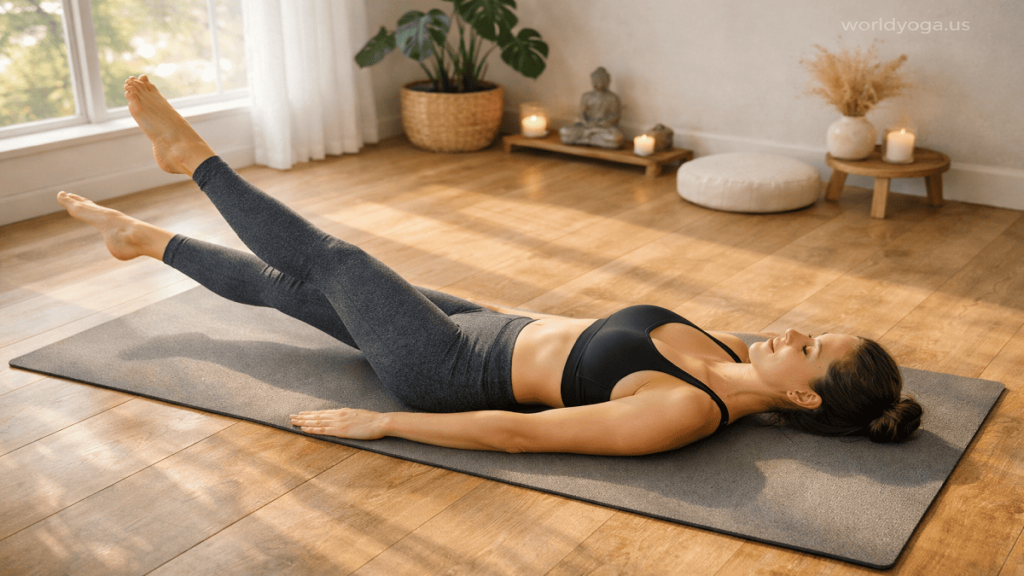
Proper alignment in the supine scissor-leg variation is the foundation that determines whether the exercise strengthens the core effectively or places unnecessary strain on the lower back and hip flexors. Although the movement appears simple, maintaining correct body positioning throughout is what ensures stability, control, and safety.
The starting alignment begins in a supine position, where the body lies flat on the floor. The head, shoulders, and pelvis should rest evenly on the mat without any twisting or lifting. The spine should remain in a neutral position, meaning it is neither excessively arched nor overly pressed into the floor. A slight natural curve in the lumbar spine is acceptable, but it should not increase during movement.
The arms are typically placed alongside the body with palms facing down. This positioning provides light support and helps stabilize the upper body. For beginners or individuals with weaker core control, placing the hands under the hips can assist in maintaining pelvic stability and reducing strain on the lower back.
The pelvis plays a crucial role in proper alignment. It should remain level and stable throughout the entire exercise. Any tilting or rocking of the hips indicates loss of core engagement. To maintain correct positioning, the abdominal muscles must remain gently activated, drawing the navel inward toward the spine without holding the breath.
Leg alignment is equally important. Both legs should remain fully extended with a slight micro-bend in the knees if hamstring tightness is present, but ideally kept straight for maximum effectiveness. The feet should be relaxed or slightly pointed, depending on comfort and training emphasis. The legs must move in a controlled vertical plane, without drifting sideways or crossing the midline excessively.
One of the most critical alignment principles is lower back contact with the floor. As the legs lower during the scissor motion, the lower back should remain in gentle contact with the mat. If the back begins to arch, it indicates that the legs are descending too far or that core engagement is insufficient. In such cases, reducing the range of motion is essential to restore proper alignment.
The shoulder position should remain relaxed and grounded. Tension in the neck or shoulders often indicates improper bracing or overexertion. Keeping the chest open and the neck neutral helps maintain full-body relaxation while the core does the majority of the work.
This exercise, commonly known as Scissor kicks, relies heavily on precision rather than speed. Proper alignment ensures that the abdominal muscles, particularly the lower rectus abdominis and deep stabilizers, are doing the primary work, rather than momentum or hip flexors dominating the movement.
In summary, correct alignment in the supine scissor-leg variation involves a neutral spine, stable pelvis, engaged core, relaxed upper body, and controlled leg movement within a safe range of motion. When these alignment principles are consistently maintained, the exercise becomes highly effective for building core strength, improving posture, and enhancing overall movement control.
#Supine: Both Legs Straight “Scissors” in Ahemadabad
Which muscles are engaged during the movement?
The supine scissor-leg movement, commonly known in training systems as Scissor kicks, is a multi-muscle core exercise that targets the abdominal region while also engaging several supporting muscle groups in the hips, thighs, and stabilizing structures of the spine. Its effectiveness comes from the combination of controlled lower-body movement and continuous core activation, which requires both strength and stability.
The primary muscles engaged are the abdominal muscles, especially the rectus abdominis. This muscle is responsible for flexing the trunk and maintaining tension throughout the movement. In the scissor variation, the lower portion of the rectus abdominis is particularly activated because the legs are held extended away from the body, increasing the demand on the core to stabilize the pelvis and prevent the lower back from arching.
Another key muscle group involved is the transverse abdominis, which acts as a deep stabilizer. It functions like a natural corset, tightening around the midsection to support spinal alignment and control intra-abdominal pressure. This muscle is crucial for maintaining form and preventing excessive movement in the lower back during the exercise.
The oblique muscles, both internal and external, are also engaged. These muscles help stabilize the torso and control rotational forces that may occur as the legs alternate. Even though the movement is primarily vertical, slight shifts in balance require the obliques to maintain symmetry and prevent the hips from tilting.
In the lower body, the hip flexors—including the iliopsoas and rectus femoris—are significantly involved. These muscles control leg lifting and lowering, working in coordination with the abdominal muscles. While they assist in movement, excessive dominance of the hip flexors often indicates weak core engagement, which is why proper technique is essential.
The quadriceps also contribute, particularly during the upward phase of each leg. They help maintain knee extension and support the controlled motion of the legs. Meanwhile, the adductor muscles inside the thighs assist in stabilizing leg alignment and preventing unnecessary lateral movement.
Additionally, smaller stabilizing muscles around the pelvis and lower back, including the erector spinae (in an isometric role), help maintain spinal position. These muscles ensure that the back remains supported without excessive arching or rounding.
This exercise is highly effective because it trains coordination between the core and lower body simultaneously. When performed correctly, it strengthens not only the visible abdominal muscles but also the deeper stabilizing structures that support posture, balance, and functional movement.
In summary, supine scissor-leg movements engage the rectus abdominis, transverse abdominis, obliques, hip flexors, quadriceps, and supporting stabilizers of the spine and pelvis. The coordinated activation of these muscles makes the exercise valuable for developing core endurance, improving control, and enhancing overall lower-body stability.
#Supine: Both Legs Straight “Scissors” in Hyderabad
What preparatory exercises are recommended before practicing it?
Before practicing the supine scissor-leg movement, it is important to prepare the body with foundational core activation and mobility drills. This ensures proper technique, reduces strain on the lower back, and helps the core muscles take over the workload instead of the hip flexors. The exercise, commonly known in fitness training as Scissor kicks, requires both stability and control, so preparation should focus on core engagement, hip flexibility, and spinal awareness.
One of the most effective preparatory exercises is the pelvic tilt. In this movement, you lie on your back with knees bent and gently flatten the lower back into the floor by engaging the abdominal muscles. This teaches proper core activation and helps establish the neutral spine control needed for scissor movements. It also improves awareness of how the pelvis should remain stable during leg motion.
Another useful preparation is the dead bug exercise. In this drill, you lie supine with arms and legs raised, then slowly lower opposite arm and leg while keeping the core engaged and the lower back pressed into the floor. This builds coordination and teaches the body how to maintain spinal stability while the limbs move independently, which is directly relevant to scissor kicks.
Leg raises in a controlled range are also highly recommended. Starting with bent-knee variations and progressing to straight-leg raises helps build strength in the lower abdominals and hip flexors. The key focus is slow lowering rather than lifting, as eccentric control is essential for maintaining form during the scissor motion.
Glute bridges are another valuable preparatory exercise. While they primarily target the glutes and posterior chain, they help stabilize the pelvis and reduce excessive reliance on hip flexors during supine movements. Strong glutes contribute to better pelvic alignment, which is crucial for preventing lower back strain during scissor kicks.
Core bracing drills, such as drawing-in maneuvers or isometric hollow holds, are also effective. These exercises train the transverse abdominis, the deep core muscle responsible for spinal stability. Strengthening this muscle ensures that the lower back remains supported when the legs are extended and moving.
Hip mobility exercises, including gentle hamstring stretches and hip flexor stretches, are also important. Tight hip flexors can restrict movement and cause compensations in the lower back. Improving flexibility allows for smoother leg motion and better alignment during the exercise.
Finally, practicing slow marching movements in a supine position helps integrate coordination. Alternating leg lifts with controlled breathing prepares the nervous system for the rhythm and control required in scissor kicks.
In summary, effective preparation for supine scissor-leg exercises includes pelvic tilts, dead bugs, controlled leg raises, glute bridges, core bracing drills, and hip mobility work. These foundational exercises build strength, stability, and awareness, ensuring safer and more efficient performance of the movement while maximizing core engagement and reducing injury risk.
#Supine: Both Legs Straight “Scissors” in Delhi
What are the benefits and precautions of Supine Scissors Pose?
The Supine Scissors Pose, commonly known in fitness training as Scissor kicks, is a highly effective core conditioning exercise that offers a combination of strength, stability, and mobility benefits. However, like any core-intensive movement, it also requires proper technique and awareness to avoid strain, particularly in the lower back and hip flexors.
One of the primary benefits of this exercise is improved core strength, especially in the lower abdominal region. The continuous alternating leg motion forces the rectus abdominis and deeper stabilizing muscles, such as the transverse abdominis, to remain engaged throughout the movement. This leads to enhanced abdominal endurance and better overall trunk control.
Another key benefit is improved pelvic stability. Because the legs move independently while the torso remains stable, the body learns to resist unwanted movement in the hips and lower spine. This contributes to better posture and more efficient movement patterns in daily activities and sports performance.
The exercise also enhances hip flexor strength and coordination. The iliopsoas and rectus femoris are actively involved in controlling leg movement, which improves lower-body control and functional mobility. Additionally, the oblique muscles assist in stabilizing the torso, contributing to better rotational control and balance.
From a performance perspective, supine scissor movements improve muscular endurance and neuromuscular coordination. This makes it particularly useful for athletes who require strong core stability for running, kicking, or repetitive lower-body actions. It also supports better body awareness, helping individuals develop precise control over limb movement without compromising spinal alignment.
Despite these benefits, certain precautions are essential. The most important consideration is lower back safety. If the core is not properly engaged, the lower back may arch excessively during leg lowering, which can lead to discomfort or strain. Individuals should always maintain gentle contact between the lower back and the floor, reducing the range of motion if necessary.
People with existing lumbar spine issues, such as herniated discs or chronic lower back pain, should approach this exercise cautiously or consult a healthcare professional before performing it. In such cases, modified versions with bent knees or reduced leg height are often safer alternatives.
Another precaution involves avoiding excessive speed. Performing the movement too quickly reduces control and shifts the workload from the abdominal muscles to momentum and hip flexors, decreasing effectiveness and increasing injury risk. Controlled, deliberate motion is essential.
Breathing should also be regulated. Holding the breath can create unnecessary intra-abdominal pressure and reduce stability. Instead, steady breathing patterns help maintain core engagement and support spinal alignment throughout the movement.
Finally, overtraining should be avoided. While the exercise is effective, it should be balanced with other core and mobility exercises to ensure overall muscular development and prevent fatigue-related form breakdown.
In summary, supine scissor-leg movements provide significant benefits in core strength, pelvic stability, coordination, and endurance. However, they require proper alignment, controlled execution, and mindful progression to ensure safety and effectiveness. When performed correctly, they become a powerful addition to any core training or rehabilitation program.
#Supine: Both Legs Straight “Scissors” in Pune
Case Study of Supine: Both Legs Straight “Scissors”
A case study on the Supine Both Legs Straight “Scissors” exercise, commonly referred to in exercise science as Scissor kicks, highlights its application in improving core stability, rehabilitation outcomes, and athletic conditioning. This movement is frequently used in physiotherapy clinics, Pilates programs, and sports training environments due to its ability to isolate and strengthen the deep abdominal and hip stabilizing muscles.
In this case study, a 29-year-old recreational athlete presented with complaints of poor core endurance and recurring lower back fatigue during running and bodyweight training. The individual had no structural spinal injury but demonstrated weak lower abdominal activation and overreliance on hip flexors during dynamic leg movements. The goal of the intervention was to improve core stability, reduce lumbar strain, and enhance movement efficiency.
The training program incorporated supine scissor-leg exercises as a primary core conditioning tool. The initial phase focused on teaching proper alignment, including neutral spine positioning and controlled pelvic stability. The participant began with modified scissor movements, keeping the legs higher (approximately 45–60 degrees from the floor) to reduce strain on the lower back while ensuring abdominal engagement.
Over a period of six weeks, the progression included gradual reduction in leg height, increased duration of holds, and slower transition speed between leg switches. Complementary exercises such as dead bugs, pelvic tilts, and glute bridges were included to reinforce core activation patterns and improve pelvic control. This integrated approach ensured balanced muscle development rather than isolated strengthening.
Midway through the program, measurable improvements were observed. The participant reported reduced lower back fatigue during running sessions and improved control during bodyweight exercises. Objective assessments showed increased endurance in static core holds and better ability to maintain spinal neutrality during dynamic movement tasks.
One of the key outcomes was improved neuromuscular coordination between the abdominal muscles and hip flexors. Initially, the participant relied heavily on hip flexors, which caused early fatigue and poor form. With consistent practice of scissor kicks, the rectus abdominis and transverse abdominis became more actively engaged, reducing compensatory strain on the lower back.
By the end of the six-week period, the participant was able to perform controlled supine scissor movements with a lower leg angle and minimal pelvic movement. This indicated improved core stability and better motor control. Additionally, functional performance improved in running efficiency and general athletic endurance.
This case study demonstrates that the supine scissor exercise can be an effective intervention for improving core strength, especially when combined with foundational stabilization exercises. However, its success depends on correct progression, proper alignment, and consistent practice.
In conclusion, the Supine Both Legs Straight “Scissors” exercise serves as a valuable tool in both rehabilitation and performance training contexts. When applied systematically, it enhances core endurance, improves pelvic stability, and reduces the risk of lower back strain, making it a practical and effective component of structured exercise programs.
#Supine: Both Legs Straight “Scissors” in banglore
White Paper of Supine: Both Legs Straight “Scissors”
Abstract
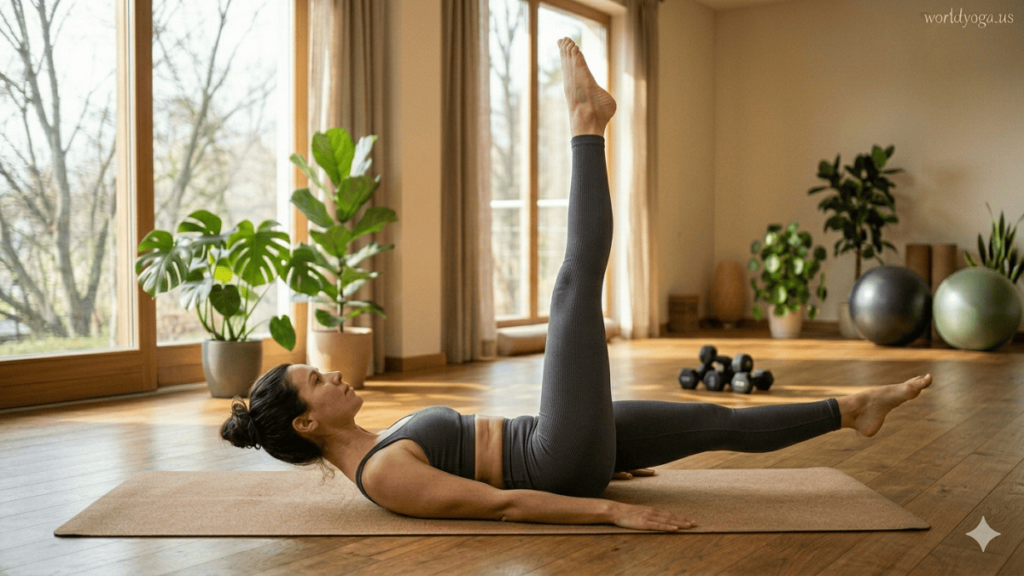
The Supine Both Legs Straight “Scissors” exercise, commonly known in exercise science as Scissor kicks, is a widely used core stabilization movement applied in fitness training, rehabilitation, and athletic conditioning. This white paper examines its biomechanical principles, muscular activation patterns, functional benefits, clinical applications, and safety considerations. The exercise is characterized by alternating vertical leg movements performed in a supine position while maintaining core engagement and spinal stability.
1. Introduction
Core stability training plays a fundamental role in injury prevention, posture control, and athletic performance. The scissor movement is a low-equipment, bodyweight-based exercise designed to improve neuromuscular coordination between the abdominal region and lower limbs. It is frequently integrated into Pilates-based programs, physiotherapy protocols, and general fitness conditioning routines.
2. Biomechanical Overview
The exercise is performed in a supine position with both legs extended and elevated above the floor. Alternating leg motion creates a controlled lever system that increases demand on the anterior core musculature. The longer the lever arm (straighter and lower the legs), the greater the torque applied to the lumbar spine, requiring higher stabilization from the abdominal wall.
Key biomechanical principles include:
- Isometric stabilization of the trunk
- Alternating concentric and eccentric control of hip flexors
- Anti-extension demand on the lumbar spine
- Controlled pelvic positioning to prevent anterior tilt
Proper execution requires maintaining a neutral spine and minimizing compensatory lumbar arching.
3. Muscular Activation
Primary muscles involved include:
- Rectus abdominis (primary stabilizer and flexor control)
- Transverse abdominis (deep core stabilization)
- Internal and external obliques (anti-rotational control)
- Iliopsoas and rectus femoris (hip flexion control)
- Quadriceps (knee extension maintenance)
- Erector spinae (isometric spinal support)
This coordinated activation improves both local muscular endurance and systemic motor control.
4. Functional Benefits
Regular inclusion of the scissor movement provides:
- Enhanced lower abdominal endurance
- Improved pelvic stability and postural control
- Better coordination between upper and lower kinetic chains
- Increased hip mobility and flexor control
- Reduced risk of lower back dysfunction when performed correctly
It is particularly beneficial for athletes requiring repetitive lower-limb motion such as runners, football players, and dancers.
5. Clinical and Performance Applications
In rehabilitation settings, the exercise is used to retrain core activation patterns following lumbar strain or postural dysfunction. In performance training, it serves as a foundational anti-extension drill that supports more advanced core movements.
It is often progressed alongside other stabilization exercises such as dead bug variations and hollow body holds to improve functional carryover.
6. Safety Considerations
Despite its benefits, improper execution may lead to lumbar strain or hip flexor dominance. Key precautions include:
- Avoid excessive lumbar arching
- Limit range of motion if core strength is insufficient
- Maintain slow, controlled tempo
- Ensure continuous abdominal engagement
- Modify leg height for individuals with lower back sensitivity
Individuals with pre-existing spinal conditions should seek professional guidance before implementation.
7. Conclusion
The supine scissor exercise is a highly effective, evidence-aligned core stabilization movement with broad applications in fitness and rehabilitation. Its effectiveness lies in controlled execution, progressive overload, and proper alignment. When integrated into structured training programs, it enhances core endurance, improves functional movement efficiency, and supports spinal health.
#Supine: Both Legs Straight “Scissors” in Kolkata
Industry Application of Supine: Both Legs Straight “Scissors”
The Supine Both Legs Straight “Scissors” exercise, commonly known in professional training environments as Scissor kicks, is a versatile movement used across multiple industries, including fitness, rehabilitation, sports performance, dance training, and occupational health. Its value lies in its simplicity, scalability, and strong emphasis on core stabilization without requiring equipment.
1. Fitness and Gym Training Industry
In commercial fitness settings, scissor kicks are a staple in core conditioning programs. Personal trainers incorporate them into abdominal circuits, HIIT routines, and bodyweight training sessions to develop lower abdominal endurance and improve trunk control. The exercise is particularly useful in beginner-to-intermediate programming due to its adaptability through range reduction, tempo control, and progression intensity.
Fitness professionals often use it as a bridge exercise between basic core activation (such as crunches) and advanced stability drills (such as hollow holds or hanging leg raises). It helps clients build foundational strength before progressing to higher-load movements.
2. Physiotherapy and Rehabilitation Industry
In rehabilitation settings, scissor movements are widely used for retraining neuromuscular control of the core and pelvis. Physiotherapists prescribe them for patients recovering from lower back strain, postural imbalance, or core weakness.
The exercise is particularly valuable because it promotes anti-extension control of the lumbar spine while encouraging gentle activation of deep stabilizing muscles such as the transverse abdominis. It is often introduced in early-to-mid rehabilitation phases due to its low impact and controllable intensity.
3. Sports Performance and Athletic Training
In athletic conditioning programs, scissor kicks are used to enhance core endurance and improve kinetic chain efficiency. Sports such as football, running, gymnastics, and martial arts benefit significantly from improved pelvic stability and lower abdominal strength.
Athletic trainers integrate the exercise into warm-ups, core circuits, and injury-prevention programs. It helps athletes maintain spinal stability during high-speed or repetitive lower-limb actions, reducing the risk of fatigue-related injury.
4. Dance, Pilates, and Movement Education
In dance and Pilates studios, scissor movements are used to improve body control, alignment, and flexibility. The exercise enhances awareness of pelvic positioning and strengthens the deep core, which is essential for balance, posture, and fluid movement.
Pilates instructors often modify the movement to emphasize precision, breath control, and slow tempo, making it a key component of mat-based conditioning sequences.
5. Occupational Health and Corporate Wellness
In workplace wellness programs, scissor kicks are included in short exercise routines aimed at reducing sedentary posture effects. Office workers use modified versions to activate core muscles and improve spinal alignment during breaks.
These programs focus on reducing lower back discomfort caused by prolonged sitting and improving overall postural endurance.
6. Military and Tactical Training
In military conditioning systems, scissor movements are used in bodyweight fitness protocols to build core endurance under fatigue conditions. The exercise supports load-bearing stability and improves resilience during prolonged physical activity.
Conclusion
The Supine Both Legs Straight “Scissors” exercise serves as a multi-industry training tool due to its adaptability, low equipment requirement, and strong core engagement benefits. Whether applied in rehabilitation clinics, sports training centers, fitness studios, or workplace wellness programs, it consistently contributes to improved core stability, posture control, and functional movement efficiency.
#Supine: Both Legs Straight “Scissors” in Mumbai
Ask FAQs
What is the Supine Scissors exercise used for?
The Supine Scissors exercise, commonly known as Scissor kicks, is primarily used to strengthen the core muscles, especially the lower abdominals. It also improves hip flexibility, pelvic stability, and overall body coordination. It is widely used in fitness training, rehabilitation, and sports conditioning programs.
Is the Supine Scissors exercise suitable for beginners?
Yes, it is suitable for beginners when performed in a modified form. Beginners are usually advised to keep the legs higher off the ground and reduce the range of motion. This helps maintain lower back safety while gradually building core strength and endurance.
Which muscles are targeted during the exercise?
The exercise mainly targets the rectus abdominis and transverse abdominis, which are essential for core stability. It also engages the obliques, hip flexors (iliopsoas), quadriceps, and stabilizing muscles of the lower back and pelvis. This makes it a full-core and lower-body coordination movement.
What are the common mistakes to avoid?
Common mistakes include arching the lower back, moving the legs too quickly, bending the knees excessively, and holding the breath. These errors reduce effectiveness and may increase the risk of lower back strain. Maintaining a controlled tempo and proper core engagement is essential for safe execution.
Can Supine Scissors help reduce lower back pain?
It can help improve core strength, which supports better spinal alignment and may reduce discomfort caused by weak abdominal muscles. However, it should be performed carefully. If lower back pain already exists, the exercise should be modified or done under professional supervision to avoid aggravation.
Table of Contents
Disclaimer: This content is for educational and informational purposes only and is not a substitute for professional medical, fitness, or physiotherapy advice. Consult a qualified healthcare or fitness professional before beginning any new exercise program, especially if you have existing injuries or medical conditions.