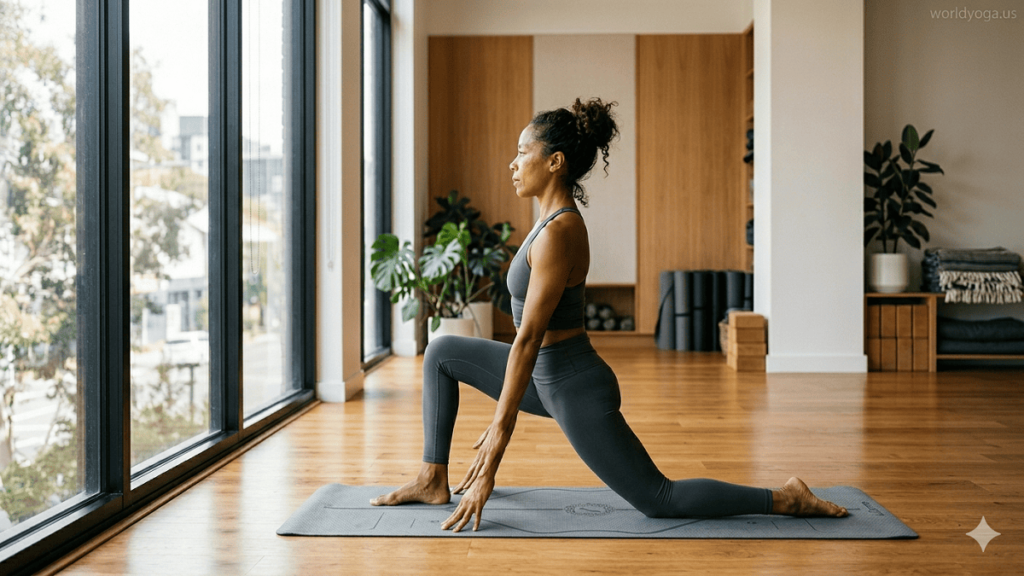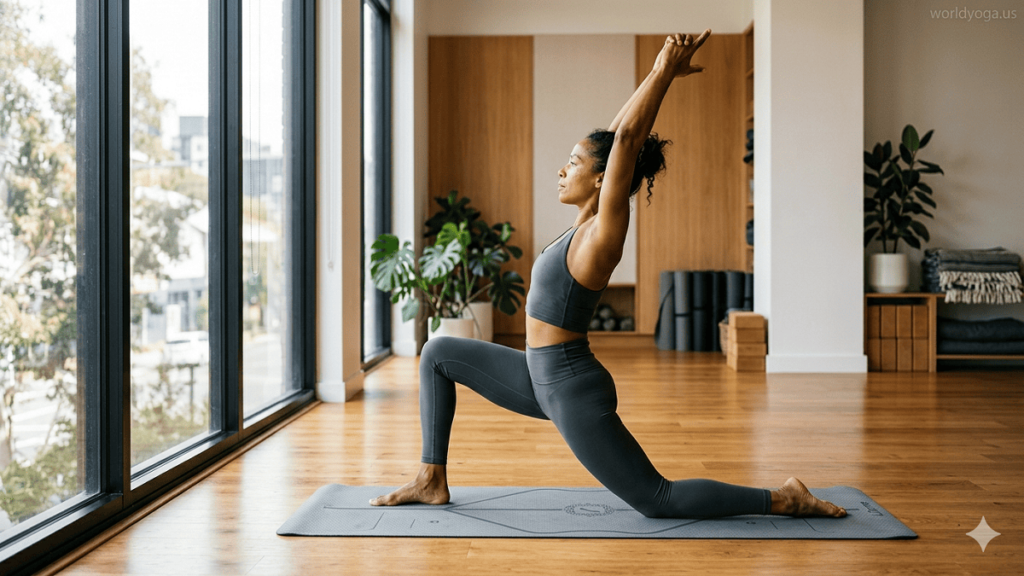
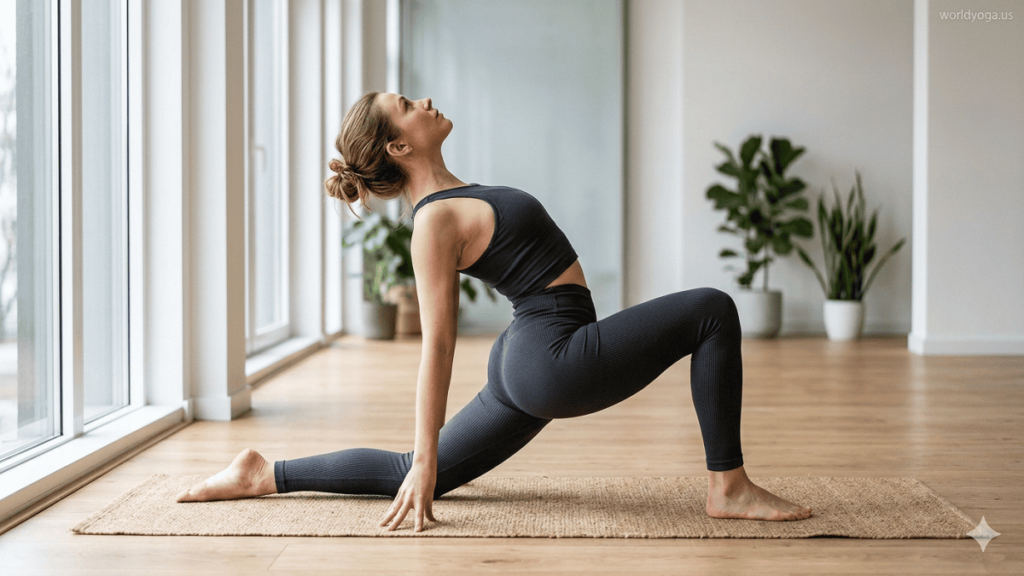
LUNGE: BACK KNEE ON THE FLOOR UNDER THE HIP SOCKET—BACKBEND
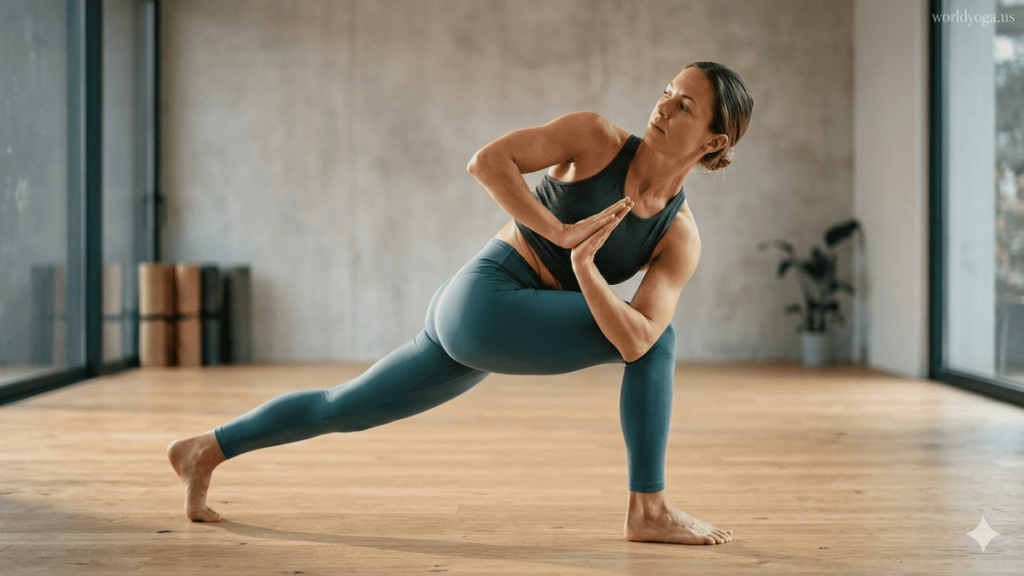
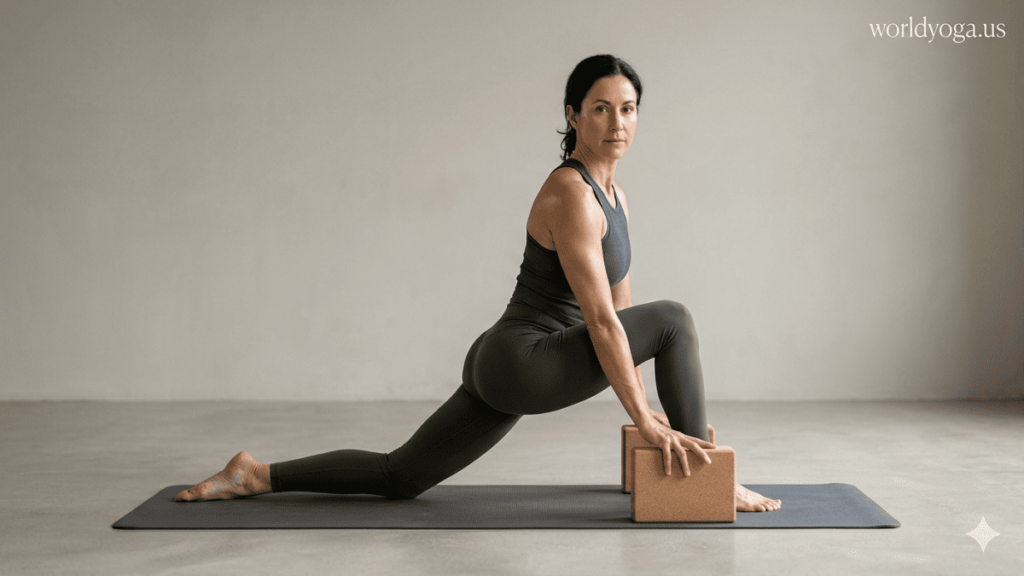
Lunge: Back Knee on the Floor Under the Hip Socket-Backbend The “Lunge: Back Knee on the Floor Under the Hip Socket with Backbend” is a foundational yoga alignment variation of the low lunge that emphasizes structural precision, hip opening, and spinal extension. In traditional yoga practice, this position closely relates to Anjaneyasana (Low Lunge Yoga Pose), often used to stretch the hip flexors while building stability in the lower body. In this variation, the back knee is placed directly under the hip socket rather than extending far behind the body. This alignment is significant because it creates a stacked joint relationship—hip over knee—allowing the practitioner to maintain balance and reduce unnecessary strain on the lumbar spine or front knee. The front leg remains bent at approximately a right angle, ensuring stability and engagement of the quadriceps and glute muscles. Once the lower body is stabilized, the upper body transitions into a controlled backbend. The chest lifts upward and forward, and the sternum gently opens toward the ceiling. This backbend is not about compressing the lower back but about creating length through the front body, especially the hip flexors, abdomen, and chest. The action encourages thoracic extension rather than lumbar overextension, making it safer and more effective for long-term spinal health. This posture is widely used in yoga sequences to counteract prolonged sitting and forward-leaning postures. It helps release tight hip flexors such as the iliopsoas, which often become shortened due to sedentary lifestyles. When practiced correctly, it also improves posture, enhances breathing capacity, and increases awareness of pelvic alignment. Common mistakes include letting the front knee collapse inward, over-arching the lower back, or allowing the back hip to drift behind the knee, which reduces stability. To refine the pose, practitioners are encouraged to engage the core lightly, press the front foot firmly into the ground, and visualize lifting the rib cage away from the pelvis before deepening the backbend. Modifications can make this posture more accessible. Placing a folded blanket under the back knee reduces pressure, while keeping the hands on the front thigh instead of lifting the arms can help beginners maintain balance. For deeper intensity, practitioners may lift the arms overhead or add a gentle neck extension, always ensuring the movement originates from the upper spine. Regular practice of this alignment-focused lunge supports both mobility and strength, making it valuable for yoga practitioners of all levels. It is commonly integrated into vinyasa flows and mobility routines for athletes and office workers alike. For further reference on alignment principles and hip-opening sequences, you may explore:Yoga Journal Pose LibraryVerywell Fit Yoga Guides #Lunge: Back Knee on the Floor Under the Hip Socket-Backbend in India How is Lunge with back knee under the hip socket and backbend performed correctly? The “Lunge with back knee under the hip socket and backbend” is a precise alignment-based variation of a low lunge that combines lower-body stability with controlled spinal extension. It is closely associated with Anjaneyasana (Low Lunge Yoga Pose) and is commonly used in yoga mobility sequences to open the hips while improving posture and balance. To perform this variation correctly, begin in a kneeling position on a yoga mat. Step one foot forward into a lunge so that the front knee is stacked approximately over the ankle. The key adjustment in this variation is the position of the back knee: instead of placing it far behind the hips, bring it directly under the hip socket. This creates a vertical alignment between the hip and knee, which stabilizes the pelvis and reduces strain on the lower back. Once the base is set, ensure the pelvis is neutral. Avoid tilting the hips excessively forward or backward. Engage the core lightly to support the spine. The front foot should be firmly grounded, with weight distributed evenly through the heel and the ball of the foot. From this stable foundation, begin the upper-body movement into a backbend. Lift the chest upward rather than collapsing into the lower back. The movement should originate from the thoracic spine (mid and upper back), not the lumbar region. Imagine lengthening through the crown of the head while simultaneously lifting the sternum toward the ceiling. This creates space across the front body, particularly the hip flexors and abdominal region. If appropriate, the arms can be raised overhead with palms facing each other or slightly apart. The shoulders should stay relaxed, avoiding tension near the neck. The gaze can be neutral or gently lifted, depending on comfort and neck mobility. Breathing plays an important role in maintaining control. Inhale deeply to expand the chest and support the lift into the backbend. Exhale slowly to maintain stability and prevent over-arching. The breath should feel smooth and steady throughout the posture. Common errors include letting the back hip drift behind the knee, collapsing into the lower back, or losing engagement in the front leg. To correct these, focus on stacking joints (hip over knee), activating the abdominal muscles, and lifting through the sternum instead of pushing the pelvis forward. For beginners, placing a folded blanket under the back knee can reduce pressure and improve comfort. Advanced practitioners may deepen the stretch by slightly increasing thoracic extension while maintaining pelvic stability. This posture improves hip flexibility, strengthens lower-body stability, and supports better spinal alignment. It is often included in yoga flows designed for posture correction, athletic recovery, and functional mobility training. For additional alignment guidance and safe progression techniques, you can refer to:Yoga Journal – Lunge Pose GuideVerywell Fit – Low Lunge Instructions #Lunge: Back Knee on the Floor Under the Hip Socket-Backbend in Maharashtra What is the proper alignment in this supported backbending lunge variation? The supported backbending lunge variation—often practiced as a structured form of Anjaneyasana (Low Lunge Yoga Pose)—focuses on precise joint stacking, pelvic stability, and controlled spinal extension. Proper alignment is essential because the pose combines a deep hip flexor stretch with a mild backbend, and incorrect positioning can easily shift pressure into the lower back or knees. The foundation